
How Much Down Payment Do You Need to Buy a Car?
Put down enough cash to keep the loan at or below 80% loan-to-value after taxes and fees. Many buyers land around 10% to 20% on a new car, and more on a used one. Too little down can leave you upside down fast and raise your monthly payment. This guide shows how to size cash down, trade-in equity, and zero-down financing for a safer loan.
This guide is part of our Car Dealer Money Guide: Negotiating, Financing, Leasing, Trading In and Selling series.
How a down payment affects loan size and payment
A down payment is cash paid upfront that cuts the amount financed. It can be zero on some auto loans, but the amount you put down still matters because it changes the loan balance, the monthly payment, and how much depreciation you have to absorb in the first year or two.
How it changes the amount financed
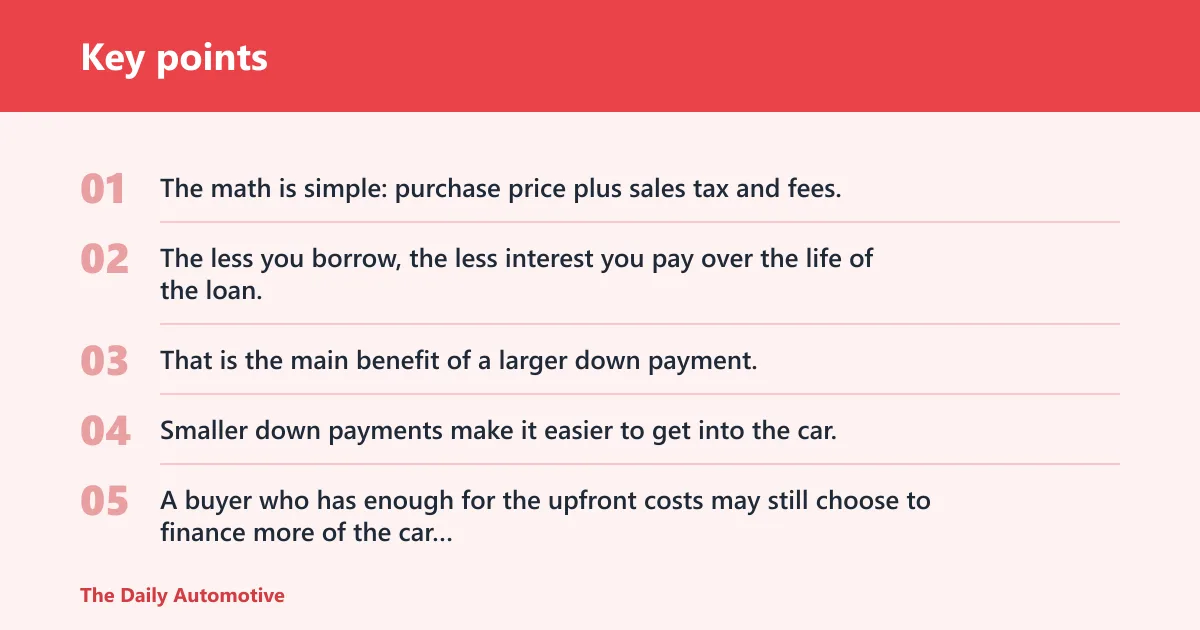
The math is simple: purchase price plus sales tax and fees, minus any cash down and positive trade-in equity, equals the amount financed. The less you borrow, the less interest you pay over the life of the loan. That is the main benefit of a larger down payment.
Smaller down payments make it easier to get into the car. A buyer who has enough for the upfront costs may still choose to finance more of the car to keep cash on hand, but that choice usually means a higher balance and a longer stretch before the loan gets ahead of depreciation.
What it can do to monthly payment
Monthly payment falls as the down payment rises, but the size of that drop depends on APR and term length. A shorter term with the same down payment produces a higher payment than a longer term, even if the borrowed amount is the same. Rate matters too.
Suppose a buyer is choosing between a 60-month loan and a 72-month loan on the same vehicle. The longer term can make the payment feel manageable, but it also keeps the balance higher for longer. That matters if the car loses value quickly.
Why approval can change with credit score
Credit score can affect approval, APR, and sometimes the down payment a lender expects. Strong credit may open up zero-down offers or lower rates. Weak credit can lead to a higher APR, a higher required down payment, or both, especially on a used car.
Some lenders allow zero down on auto loans. Others set minimums, especially when the vehicle is older, the term is long, or the borrower’s credit profile is thin. Ask the lender directly. Do not assume the dealer quote is the floor.
How much down payment do you need?
There is no universal car down payment rule. Many buyers think they need 16% to 20% down, but the average can be much lower. Some auto loans can start at 0% down.
Zero-down financing and when it appears
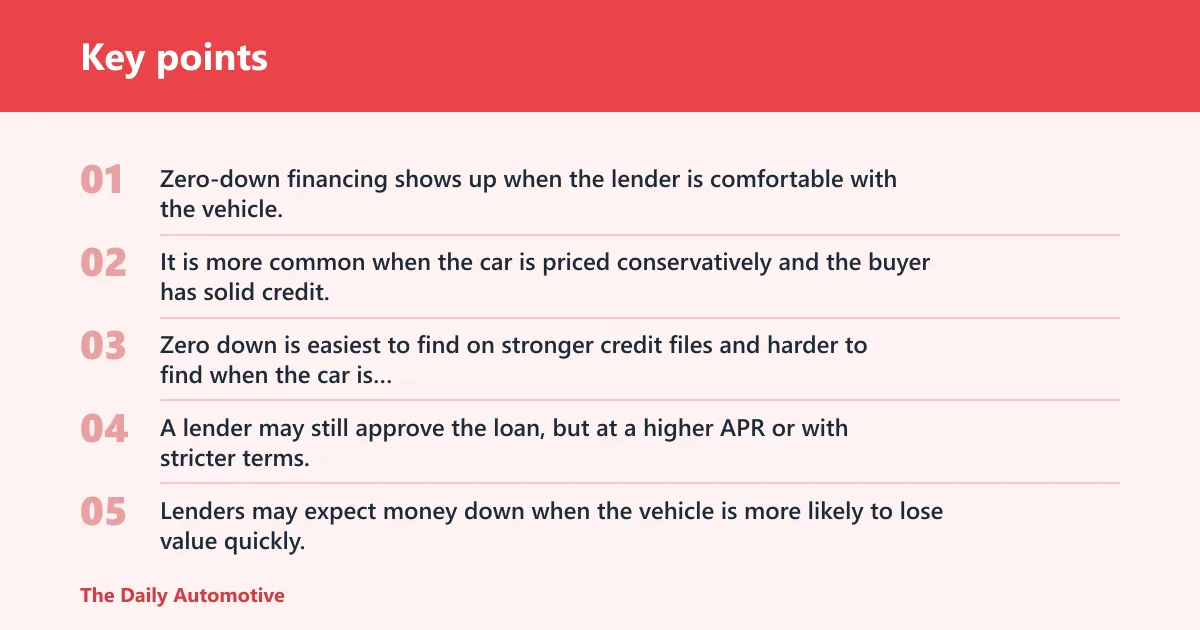
Can you buy a car with no money down? Yes, sometimes. Zero-down financing shows up when the lender is comfortable with the vehicle, the borrower’s credit, and the loan-to-value ratio. It is more common when the car is priced conservatively and the buyer has solid credit.
Zero down is easiest to find on stronger credit files and harder to find when the car is older, the loan term is long, or the deal already stretches the buyer’s budget. A lender may still approve the loan, but at a higher APR or with stricter terms.
When lenders may expect money down
Lenders may expect money down when the vehicle is more likely to lose value quickly, when the borrower’s score is lower, or when the requested loan amount leaves little room between value and balance. In plain terms, the riskier the deal, the more cash the lender may want up front.
A common first-timer mistake is assuming the down payment covers every upfront cost. It usually does not. Taxes, title work, registration, and dealer documentation fees can still show up at signing, so the cash due at purchase may be higher than the down payment alone.
Why new and used car loans differ
How much down payment do you need to buy a new car? Often less than people expect, but lenders can still be more cautious on a new-car loan if the buyer wants a long term and a high loan-to-value ratio. New cars also depreciate quickly in the first years.
Used-car financing can bring different minimums. Because used cars are already further into their depreciation curve, the lender may judge the risk differently. Some used-car loans still allow zero down, but many buyers find that a modest down payment helps approval and keeps the balance safer.
How loan-to-value affects approval
Loan-to-value ratio, or LTV, is the loan amount divided by the vehicle’s value. A higher down payment lowers LTV, which lowers lender risk. That is why cash down, or positive trade-in equity, can improve approval odds and sometimes improve the rate offer.
How lenders calculate LTV
Lenders compare the amount financed against the car’s value, not just the sticker price. If a buyer finances nearly all of the vehicle, the LTV is high. If the buyer puts more down, the LTV falls. Many lenders use that number to decide how much risk they are taking.
That matters because the car can lose value faster than the loan balance falls. If the loan starts with a high LTV, the borrower may owe more than the car is worth for a long stretch. That is the negative-equity problem in auto lending.
Why a higher LTV raises risk
Higher LTV means the lender has less cushion if the car is totaled, stolen, or sold after a sudden value drop. It can also leave the buyer upside down longer. A loan that begins near the full value of the car can stay underwater for much of the early repayment period.
Picture a buyer who finances almost the entire price of a new sedan with minimal cash down. If the car drops in value faster than the principal falls, the owner may owe more than the car can bring in a sale. That is exactly the situation gap insurance is designed to address.
Down payment decision table
This table uses a simple assumption: taxes and fees add to the amount financed unless the buyer pays them in cash at signing. The payment pressure column assumes a standard auto loan with typical APR and term choices; it is a guide, not a quote.
| Vehicle price band | Down payment level | Estimated amount financed | Monthly payment pressure | Negative-equity risk |
|---|---|---|---|---|
| $20,000 car | 0% | High, about the full car cost plus tax and fees | High | High |
| $20,000 car | 5% | Slightly lower; some cushion only | High | High |
| $20,000 car | 10% | Meaningfully lower; still tight if the term is long | Medium | Moderate |
| $20,000 car | 20% | Lowest balance in this group | Low to medium | Lower |
| $35,000 car | 0% | Very high; tax and fees push the loan up fast | High | High |
| $35,000 car | 5% | Still high; room to spare is limited | High | High |
| $35,000 car | 10% | More manageable, especially with good credit | Medium | Moderate |
| $35,000 car | 20% | Substantially lower balance | Medium | Lower |
| $50,000 car | 0% | Very high; the loan starts far above the safe zone | High | Very high |
| $50,000 car | 5% | Still large; little buffer against depreciation | High | High |
| $50,000 car | 10% | Better, but the payment can still feel heavy | Medium to high | Moderate |
| $50,000 car | 20% | Lowest balance here; strongest cushion | Medium | Lower |
Use the table as a decision aid, not a rule book. A small car with a long term can still be a poor loan if the payment strains the budget. A higher-priced car with a larger down payment can be safer if the payment stays within reach and the LTV remains reasonable.
Can you use a trade-in as the down payment?
Positive trade-in equity can count toward the down payment and reduce the amount financed. Negative equity does the opposite. It gets added into the new loan balance unless the buyer pays it off separately, which raises the loan size and the risk of owing more than the car is worth.
Positive equity versus negative equity
Should you use a trade-in as your down payment? If the trade has positive equity, it can be a strong substitute for cash. If the trade is upside down, it is not a down payment at all. It is extra debt that moves into the new auto loan.
Say your trade-in is worth $12,000 and the payoff is $9,500. That $2,500 difference can reduce the amount financed. If the payoff were $13,000 instead, the buyer would need to cover the $1,000 gap before the new loan math makes sense.
How a trade-in changes the financed balance
Trade-in equity works the same way as cash down in the loan math. It lowers the balance, trims the interest burden, and can bring the LTV down. That is useful when the buyer wants to keep monthly costs in check without draining savings.
Still, only positive equity helps. A trade with negative equity does not reduce the financed amount. It raises it. That is why buyers should ask for the payoff quote and the trade value before agreeing to the final numbers.
When cash still matters at signing
Even with a trade-in, the buyer may still need cash at signing for taxes, title, registration, doc fees, and any difference between the trade payoff and trade value. A strong trade can cover part of the down payment, but it may not cover every upfront cost on the contract.
What fees are outside the down payment?
Sales tax and fees are often separate from the down payment. They can be paid upfront, rolled into the loan, or split between the two. Either way, they matter because they change the amount financed and can move a deal from comfortable to stretched.
Sales tax
Sales tax depends on the state and sometimes the county or city. It is not the same as the down payment. If the buyer rolls tax into the loan, the balance rises. If the buyer pays it in cash, the upfront amount due rises instead.
Title and registration
Title and registration costs are usually required to put the car on the road legally. They are often due at purchase or very soon after. They are not part of the down payment unless the buyer chooses to include them in the cash brought to the deal.
Dealer documentation and add-on charges
Dealer documentation fees and add-on charges can also sit outside the down payment. Some are fixed, some are optional, and some vary by dealer. A buyer should ask which fees are mandatory before deciding how much cash to bring.
When does gap insurance matter?
Gap insurance is often more relevant with a small or zero down payment, a longer loan term, or a vehicle that depreciates quickly. That is more likely with a small or zero down payment, a long loan term, or a fast-depreciating vehicle. It is often discussed on new-car financing for that reason.
Small down payments and fast depreciation
If a buyer puts little money down on a car that loses value quickly, the loan can fall behind the market value early on. If the car is totaled or stolen, standard auto insurance may pay only the value of the vehicle, not the full loan balance. Gap coverage can help close that difference.
A common new-car pattern can be a 72-month loan with little cash down, followed by a vehicle that starts depreciating immediately. The loan balance drops slowly, but the value can drop fast. That is the gap insurance trigger.
New-car loans versus used-car loans
Gap insurance is usually more relevant on new cars than on used ones because new cars often depreciate faster in the early months. Used cars may already have absorbed some of that drop, so the risk can be lower. Still, a used-car loan with a tiny down payment can also be vulnerable.
Putting more money down does not erase the need to think about insurance, but it can reduce the chance that gap coverage will be useful. The safer the LTV at signing, the less likely the loan is to end up underwater after a loss event.
Frequently asked questions
How much down payment do you need to buy a car?
There is no fixed number. A lot depends on credit score, vehicle price, term length, APR, and lender policy. Some loans allow zero down, while many buyers choose 10% to 20% to lower the balance and keep the payment manageable after taxes and fees.
How much down payment do you need to buy a new car?
New-car financing can sometimes start with no cash down, but many lenders still prefer a down payment if the loan is long or the borrower’s credit is weak. A larger down payment lowers the amount financed and can reduce the chance of negative equity early in the loan.
Is 20% down a good rule for a car loan?
It is a useful benchmark, not a universal rule. Twenty percent gives the buyer more cushion, but many car buyers do not put that much down. The right number is the one that keeps the payment affordable and the loan-to-value ratio from staying too high.
Can I buy a car with no money down?
Yes, some auto loans allow it. Zero-down financing is more likely with stronger credit and a lender that is comfortable with the car and the loan structure. The tradeoff is a higher balance, a higher payment, and more exposure to negative equity if the car depreciates quickly.
Should I use a trade-in as my down payment?
Use it if the trade has positive equity. That equity can reduce the amount financed and lower your payment. If the trade is upside down, it adds debt to the new loan unless you pay off the shortfall separately, which works against the goal of keeping LTV low.
What fees are not included in a car down payment?
Sales tax, title, registration, and dealer documentation fees are often separate from the down payment. Some buyers pay those costs in cash at signing, while others finance them. Ask for the out-the-door figure so you know the total cash needed before you agree to the deal.
Products related to this article
Sponsored / affiliate links. As an Amazon Associate I earn from qualifying purchases. I may earn additional commission from eligible campaigns.