
What Is a Capitalized Cost Reduction on a Lease?
A capitalized cost reduction is money paid at signing on a lease to lower the vehicle’s adjusted capitalized cost, which usually cuts the monthly payment. It is separate from the total due at signing, which can also include fees, taxes, and other upfront charges. Used badly, it can trap cash you may not recover if the car is stolen or totaled early in the lease. This guide explains how cap cost reduction changes payments, how it differs from fees and down payments, and when paying upfront makes sense.
This guide is part of our Car Loans, Leasing and Dealer Tactics: What to Know Before You Sign series.
Capitalized cost reduction overview
What it changes in the lease
The capitalized cost is the negotiated lease price before reductions and additions. In practice, it is the price base for the lease, and it can include items such as fees or add-ons. Anything that lowers the amount being financed is known as a cap cost reduction.
That reduction can come from cash, a trade-in credit, or rebates. A dealer offer may also label a preferred customer discount as a cap cost reduction. The net capitalized cost is the actual amount being financed after those additions and reductions.
What counts toward it
Common sources include a down payment, trade-in value, and manufacturer rebates. Multiple security deposits are different: they usually reduce the money factor and are typically refundable deposits, not a cap cost reduction. That distinction matters because some items lower the lease balance while others are better treated as deposits or incentives instead of cash at risk.
How lease payment math works

A lease payment has two parts, depreciation and rent charge. Depreciation covers the vehicle’s loss in value over the lease term, and rent charge is the finance cost. Lease payments depend heavily on the money factor and residual value.
Capitalized cost versus net capitalized cost
The capitalized cost is effectively the selling price of the vehicle for the lease. Once reductions and additions are applied, the result is the net capitalized cost, which is the actual amount being financed. If you lower that figure, the depreciation portion of the payment usually drops.
Residual value and money factor
Residual value is the projected end-of-lease value, usually stated as a percentage of MSRP. A higher residual lowers the payment because you are financing less depreciation. The money factor is the lease finance charge, and you can convert it to APR by multiplying by 2400. (Caranddriver)
Dealers can legally mark up the money factor and keep the extra profit. That means two leases with the same sticker price can produce different payments even before any cap cost reduction is applied.
Where fees fit in the formula
Acquisition fee is the bank or captive fee charged at lease start. It is often rolled into the cap cost. A disposition fee is typically due at lease-end if the vehicle is returned instead of being bought out or re-leased. Both can be hard to avoid.
A simple payment view looks like this:
- Depreciation charge = net capitalized cost minus residual value, spread across the lease term
- Rent charge = net capitalized cost plus residual value, multiplied by the money factor
- Total payment = depreciation charge plus rent charge, plus tax where applicable
A larger cap cost reduction can lower the monthly payment, but the exact savings depend on the lease terms, including taxes and the rent charge.
Is a down payment the same as a capitalized cost reduction?
No. A down payment is one common form of cap cost reduction, but cap cost reduction can also come from trade equity, rebates, or other credits. Those items can affect tax and risk differently depending on the state and on whether the incentive is taxed as a discount or treated as taxable assistance.
Down payment, trade equity, and rebates
A down payment is cash you hand over at signing. Trade equity is the value left after any loan payoff on the trade-in. Manufacturer rebates may reduce the lease cost, but the tax treatment can vary by state and by incentive type.
Do not lump those together. A rebate may lower the price on paper without creating the same cash risk as a larger check from your account.
Why dealers roll fees into the lease instead
Many shoppers prefer to roll acquisition fees or similar charges into the net capitalized cost rather than pay them out of pocket. That keeps cash in hand, but it also increases the amount being financed. The monthly payment rises a bit, yet the upfront cash burden stays lower.
That choice matters if you plan to return the car and do not want your own cash trapped in the deal. It also matters if the lease is likely to end early, because prepaid cash is harder to recover than a fee that was simply financed.
When upfront cash helps less
Cap cost reduction is less attractive when the lease is likely to end in a way that makes upfront cash hard to recover. High-mileage drivers, lessees with negative-equity rollover, and shoppers who may end the lease early all face more risk from prepaying to lower the payment.
High-mileage drivers
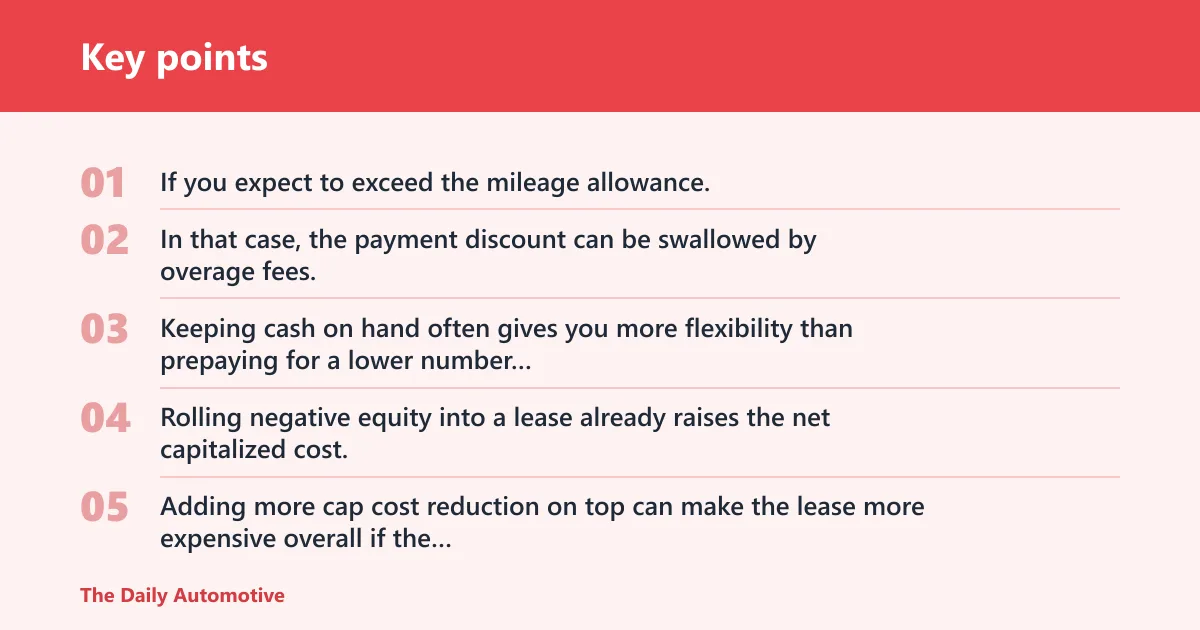
If you expect to exceed the mileage allowance, the monthly savings from cap cost reduction may not offset end-of-lease charges. In that case, the payment discount can be swallowed by overage fees. Keeping cash on hand often gives you more flexibility than prepaying for a lower number on the first page of the contract.
Negative-equity rollover
Rolling negative equity into a lease already raises the net capitalized cost. Adding more cap cost reduction on top can make the lease more expensive overall if the old debt is simply being hidden inside a lower monthly payment. You may lower the visible payment while increasing the amount at risk if the vehicle is totaled or the lease ends early.
Short ownership plans
If you think you may buy out the lease early, a large cap cost reduction can be a poor fit. You may not capture the full benefit of the upfront cash because the payment savings are spread over months you might not keep. The shorter the likely holding period, the weaker the case for prepaying.
Picture a driver who rolls $4,000 of old loan balance into a new lease and then adds another $2,000 down. The payment looks better, but the deal now depends on more cash being sunk into an asset that is still losing value every month.
Lease payment decision table
The right answer depends on how long you will keep the lease, whether you may buy it out, and how much cash you want exposed if the vehicle is stolen, totaled, or turned in early. The table below compares cap cost reduction, multiple security deposits, and keeping cash in hand across five common scenarios.
| Scenario | Cap cost reduction | MSDs | Keep cash in hand |
|---|---|---|---|
| Low-risk lessee | Moderate monthly drop; requires upfront cash; not refundable if paid as down payment; avoid if cash reserves are thin | Smaller monthly drop than a big down payment; upfront cash required; usually refundable at lease-end if rules are met; avoid if the contract does not allow them | No monthly drop from upfront cash; $0 beyond normal drive-off costs; fully flexible; avoid only if you want the lowest possible monthly payment |
| High-mileage driver | Monthly savings can be erased by overage fees; upfront cash required; not refundable; avoid if mileage will run high | Useful only if the lender allows them and the lease is otherwise a good fit; refundable; avoid if you expect mileage penalties to be the main cost | Higher payment, but more flexibility to cover mileage charges; $0 extra beyond standard drive-off; safest choice for most high-mileage drivers |
| Likely buyout | May be wasted if you buy out early; upfront cash required; not refundable; avoid if you expect to own the car soon | Limited value for a likely buyout because the deposit may never do enough work; upfront cash required; usually refundable; avoid if you plan a quick purchase | Best if you want cash available for the buyout price; no refund issue because nothing extra is prepaid; preferred for near-term ownership plans |
| Likely return | Can lower the monthly payment, but your cash is exposed for the full term; not refundable; avoid if the car could be totaled or the lease may change | Good fit when allowed, because the deposit may return at lease-end; upfront cash required; refundable; avoid if you need the money tied up elsewhere | Most flexible; higher monthly payment, but no extra cash is trapped; ideal for drivers who want to keep options open |
| Negative-equity rollover | Usually the worst fit because you are funding old debt and adding more cash at risk; upfront cash required; not refundable; avoid in most cases | Can help lower payment only if the lender allows it and the structure still makes sense; refundable; avoid if the rolled-in balance is already heavy | Usually safest because it avoids adding more prepaid cash to an already expensive structure; no refund issue; preferred when debt rollover is present |
How to read the table
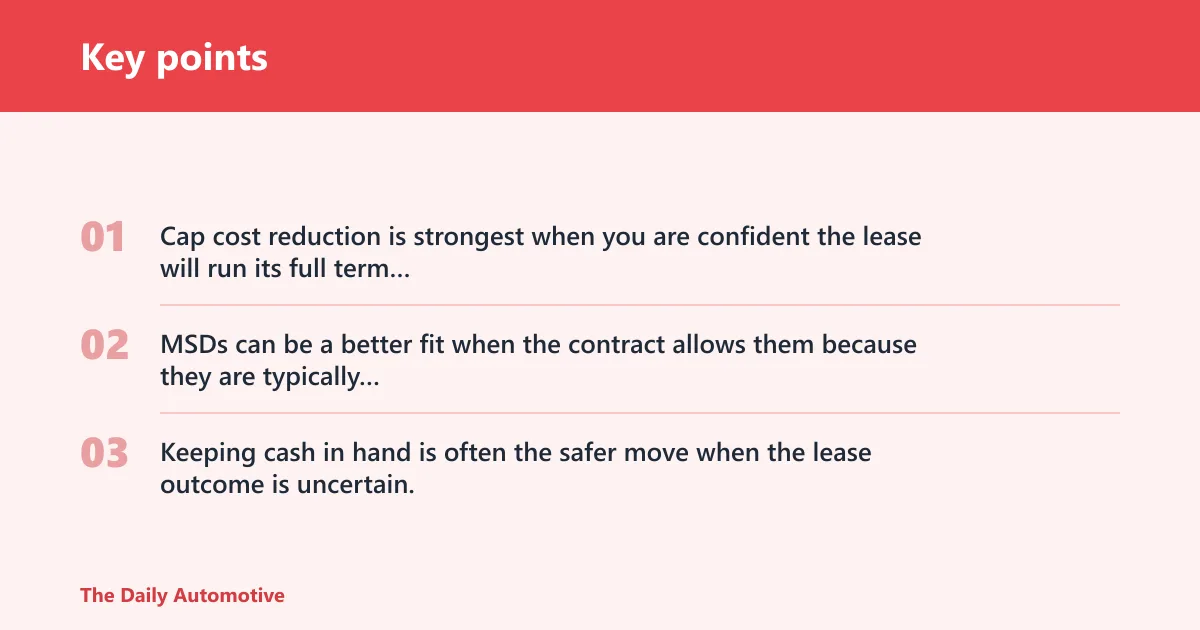
Cap cost reduction is strongest when you are confident the lease will run its full term and you do not need the cash elsewhere. MSDs can be a better fit when the contract allows them because they are typically refundable. Keeping cash in hand is often the safer move when the lease outcome is uncertain.
Can cap cost reduction be rolled into the lease?
Fees and other capitalized amounts can often be rolled into the net capitalized cost instead of being paid at signing. Cap cost reduction itself is an upfront reduction, not something that gets rolled in. Acquisition fees are often financed this way. The point is not to avoid every charge upfront, but to decide which charges should be paid now and which should simply increase the amount being financed.
What should stay separate?
Money you want protected from loss should stay separate from the payment structure whenever possible. That includes emergency cash and, often, funds you may need if the car is totaled early or the lease changes. A true no-money-down lease means cap cost reduction is $0, though lessees usually still pay drive-off costs.
Why this matters at signing
The signing table can blur the difference between fees, deposits, and real prepayment. Ask which charges are being rolled in, which are refundable, and which are simply gone once paid. That makes the cost of the lease easier to compare across offers.
Does a bigger reduction lower payment?
Yes. A larger cap cost reduction usually lowers the monthly payment because it reduces the amount being financed. The savings are real, but they are not free: the more you prepay, the more cash you expose if the lease ends early or the vehicle is lost.
Monthly impact at common terms
A larger cap cost reduction can lower the monthly payment. That gives you a rough benchmark for the size of the tradeoff. If the payment drop does not matter enough to justify the risk, keeping the cash may be the better choice.
Refundability and cash at risk
A capitalized cost reduction is generally not refundable the way a security deposit can be. That is the main reason it deserves cash-allocation thinking rather than “lower monthly at any cost” thinking. If the vehicle is stolen, totaled, or returned early, the prepaid money may not come back to you.
A common first-timer mistake is treating all upfront money the same. A $2,500 down payment, a trade credit, and a manufacturer rebate can each lower the lease in different ways, and only one of them may be a true cash outlay from your bank account.
How money factor changes the tradeoff
The money factor changes how valuable any upfront payment strategy becomes. If the dealer marks up the money factor, a bigger cap cost reduction may look less attractive because the finance charge is still being loaded into the payment. Always ask for the buy rate and compare it to the quoted factor.
Frequently asked questions
What is a capitalized cost reduction on a lease?
It is money or value applied upfront to reduce the lease’s net capitalized cost. That lowers the amount being financed and usually lowers the monthly payment. The tradeoff is that prepaid cash may not be recoverable if the lease ends early or the vehicle is lost.
What is cap cost reduction on a car lease?
It is the same idea on a vehicle lease: anything that lowers the financed amount, including cash down, trade credit, rebates, or other qualifying credits. The less you finance, the lower the depreciation portion of the payment usually becomes.
What is capitalized cost in a lease?
It is the negotiated lease price before reductions and additions. In practical terms, it is the price base for the lease calculation. Fees or add-ons may be included, and the final financed amount becomes the net capitalized cost after adjustments.
What is cap cost reduction tax on a lease?
Tax handling varies by state and by incentive type. Some places tax the full lease payment, some tax portions of the upfront structure differently, and manufacturer rebates may be treated differently from cash down. A dealer or state tax chart should confirm the treatment before you sign.
How do you calculate cap cost reduction on a lease?
Start with the capitalized cost, then subtract any qualifying reductions such as cash down, trade credit, or rebates, and add any rolled-in fees or other additions. The result is the net capitalized cost, which is the actual amount being financed in the lease payment formula.
Products related to this article
Sponsored / affiliate links. As an Amazon Associate I earn from qualifying purchases. I may earn additional commission from eligible campaigns.