Can You Negotiate the Buyout Price on a Leased Car?
Yes, sometimes, but often not the residual value itself. That number is usually fixed in the lease contract, and the real room to move is in fees, taxes, dealer markup, and whether you buy through the lessor, a dealer, or a third party. If you miss those items, you can pay hundreds or even thousands more than needed at lease end. This guide explains where buyout prices are fixed, where they move, and which purchase path can lower the total cost.
This guide is part of our Car Loans, Leasing and Dealer Tactics: What to Know Before You Sign series.
Which parts of a lease buyout can actually be negotiated?
What is usually fixed in the contract?
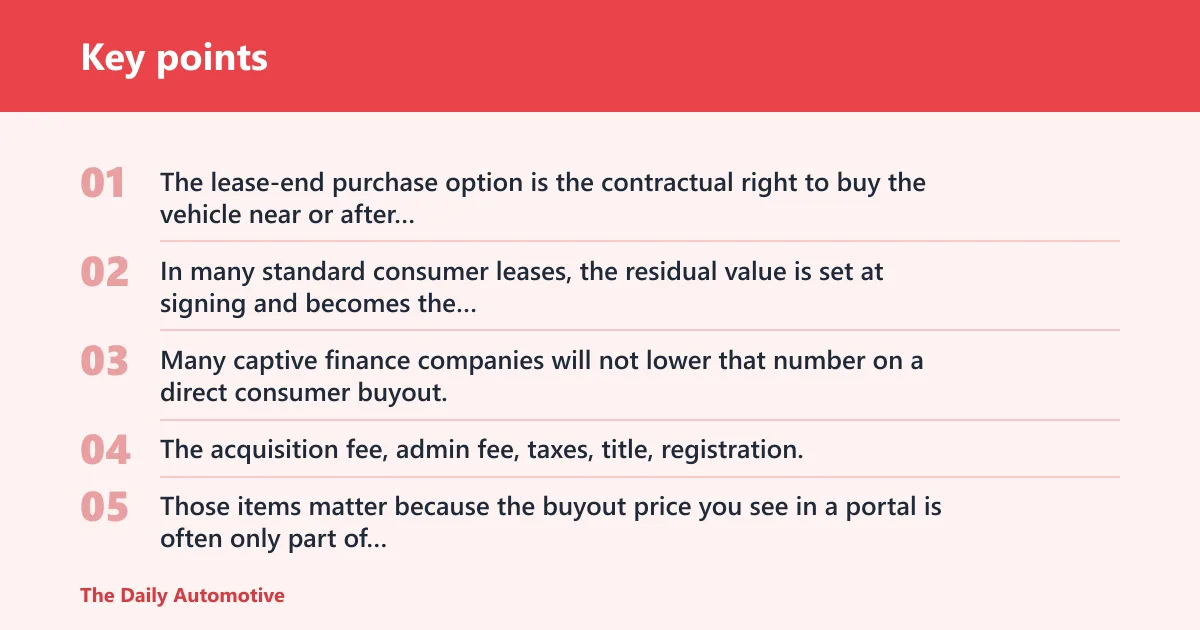
The lease-end purchase option is the contractual right to buy the vehicle near or after maturity. In many standard consumer leases, the residual value is set at signing and becomes the starting point for the buyout quote. Many captive finance companies will not lower that number on a direct consumer buyout.
That does not mean every dollar is fixed. The acquisition fee, admin fee, taxes, title, registration, and the purchase path can change the out-the-door amount. Those items matter because the buyout price you see in a portal is often only part of the final cost.
What may still be negotiable?
In practice, the negotiable pieces are usually the transaction details rather than the residual itself. A lender may waive or reduce a fee, a dealer may or may not add markup, and a third-party buyer may use a different process that changes the total. The contract, not the sales pitch, decides what can move.
Why the answer changes by lender type
A captive finance company is the automaker-linked lender that often owns the lease. Those lenders commonly use fixed procedures for direct purchase, including online or phone quotes, and many do not negotiate the residual value. Banks and credit unions that hold leases may have different policies, so check the actual leaseholder, not assume the rules are the same.
Lease buyout worksheet
Use this worksheet to compare the total buyout cost with the car’s market value. Keep return-related charges, such as mileage overages and wear charges, out of the buyout total because those usually apply only if you turn the vehicle in.
| Residual value | Acquisition/admin fee | Taxes | Title/registration | Dealer third-party fee | Estimated market value |
|---|---|---|---|---|---|
| $18,000 | $350 | $1,260 | $250 | $0 | $19,500 |
| Out-the-door buyout cost: $19,860 | |||||
| Equity versus market value: -$360 | |||||
| Simple result: Return, unless you want the car for non-price reasons | |||||
This example shows the math, not a universal quote. The buyout cost is the residual value plus fees, taxes, and title or registration charges. If a dealer or third party handles the transaction, add any extra fee they charge. Compare that total with the current market value, not just the residual.
- Get the lease-end purchase quote from the lender.
- Add acquisition or admin fees, taxes, and title or registration costs.
- Add any dealer or third-party fee if the purchase path requires one.
- Get a current market estimate from an appraisal tool or dealer offer.
- Compare the total buyout cost with the market value and decide whether the car is worth keeping.
What the residual value means
The residual value is the contract figure that sets the starting point for many lease-end purchases. It is usually based on the car’s projected value when the lease ends, not the price you might hope to negotiate later. For many captive lenders, that number is the firmest part of the deal.
How the lease sets the residual
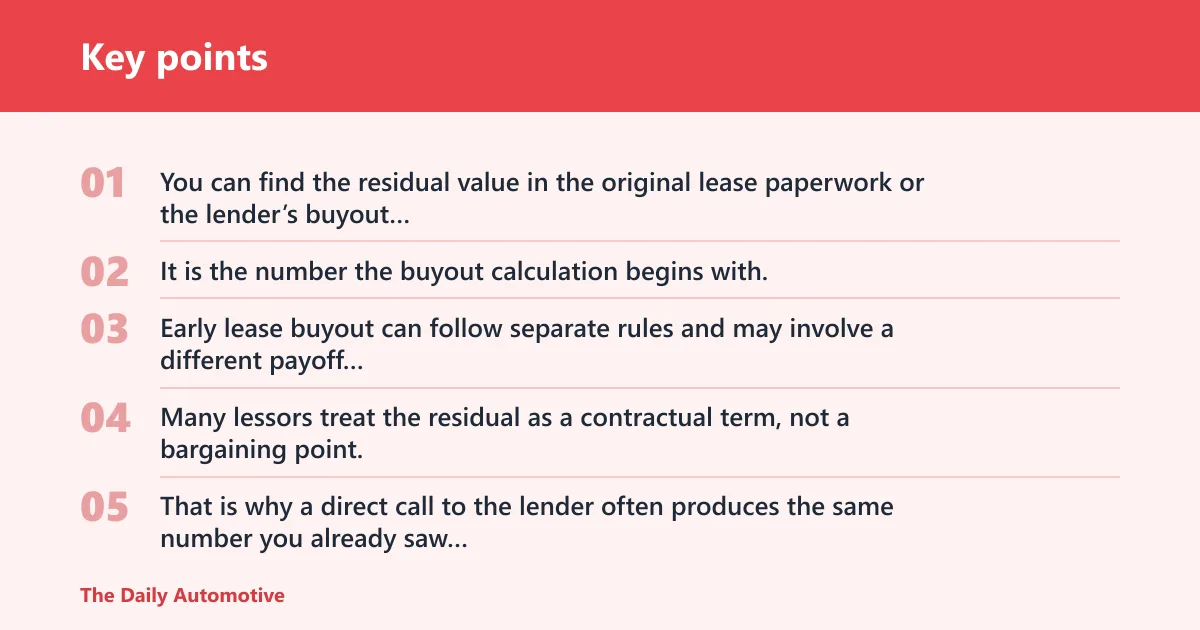
You can find the residual value in the original lease paperwork or the lender’s buyout quote. It is the number the buyout calculation begins with, and it may differ from the payoff if you are buying early. Early lease buyout can follow separate rules and may involve a different payoff structure than a purchase at maturity.
Why many lessors will not lower it
Many lessors treat the residual as a contractual term, not a bargaining point. That is why a direct call to the lender often produces the same number you already saw in the contract. If the vehicle’s market value is lower than the residual, the lender may still stand on the contract price.
Suppose your SUV’s market value has softened, but the residual is unchanged. That does not automatically create a discount. You may still be able to reduce fees or choose a different purchase path, but the residual itself often stays put.
How it compares with current market value
Market value is the actual used-car value at decision time. It matters because a buyout makes the most financial sense when the car is worth at least as much as the total out-the-door cost. If market value is below the buyout total, you are paying a premium to keep the car.
That premium can still be worth paying if you want the exact vehicle, its equipment, or known maintenance history. But the lower the market value sits below the buyout total, the harder the purchase is to justify on price alone.
Can the fees move?
Yes, some fees can move even when the residual does not. Acquisition or admin charges may be set by the lessor, but they are sometimes reduced, waived, or handled differently depending on the lender and the buyout path. Taxes and title charges are usually not negotiable in the same way, though they can vary by state and transaction structure.
Acquisition or admin fees
These fees are often disclosed in the lease documents or the final quote. Ask the lender whether the fee applies to a direct consumer buyout, an early buyout, or only a transaction routed through a dealer. If the lender says the fee is fixed, do not assume a dealer can remove it.
Dealer or third-party charges
A third-party lease buyout means a dealer or outside lender purchases the car, then sells or finances it to you. That path may create room for a better deal, but it can also add dealer fees or markups. Some lessors block third-party buyouts entirely, so availability depends on the leaseholder and state rules.
Taxes and title costs
Sales tax and registration costs commonly get added to the final amount, and those charges vary by state. The final cost can also differ if the buyout is processed directly with the lessor versus through a dealer. Check the lease contract and your state’s rules before you assume a quote is final.
Direct buyout vs third-party buyout
A direct buyout is the simplest route: you pay the lessor and take title through its process. A third-party buyout uses a dealer or outside lender as the middle step. The first is usually cleaner. The second may create pricing flexibility, but it also adds risk, paperwork, and extra fees.
When a dealer may help
A dealer may help if the vehicle’s market value is above the lease-end buyout total and the lender allows a dealer-assisted transaction. That setup can sometimes lower the all-in cost by shifting the process or reducing a fee. It can also be useful if the dealer wants the car for its used inventory.
When a lender may block the path
Some captive finance companies restrict third-party buyouts or require the lessee to buy directly before any resale. That restriction matters because it can eliminate the dealer’s ability to buy the vehicle first. If the lender says no, the dealer cannot override the lease terms.
How the final cost can change
The path itself can change tax treatment, title handling, and the presence of a dealer fee. That is why two quotes for the same car can differ even when the residual value is identical. The number that matters is the out-the-door total, not the headline residual.
Can you negotiate the buyout price if the market value is lower than the residual value?
Sometimes you can negotiate around the edges, but many standard direct buyouts still do not allow the residual value to fall just because the market price is lower. If the car is underwater, focus on whether the lender will adjust fees, whether a dealer-assisted route is allowed, and whether buying the car still fits your needs.
The lower market value matters because it tells you the vehicle may not be a bargain at the contract price. That does not automatically make the buyout wrong. It just means the financial case is weaker and you should be honest about the premium you are paying to keep the car.
What happens if the lease buyout price is higher than the car’s market value?
If the buyout price is higher than market value, you are starting from a negative-equity position. That does not force a return, but it does make a purchase less attractive on pure dollars. You need to add financing cost if you are borrowing to buy it, plus the cost of replacing it if you turn it in.
In that situation, a buyout may still make sense if the vehicle is in excellent condition, has features you want, or would be costly to replace. But the decision should be based on the total picture, not just the residual versus market value.
Should you buy or return it?
Buy if the total out-the-door cost is close to or below the car’s market value, or if the car has value to you that the market does not capture. Return if the buyout total is clearly above market value and you do not have a strong reason to keep the vehicle. Financing cost and replacement-vehicle cost also matter.
When the car is worth more than the payoff
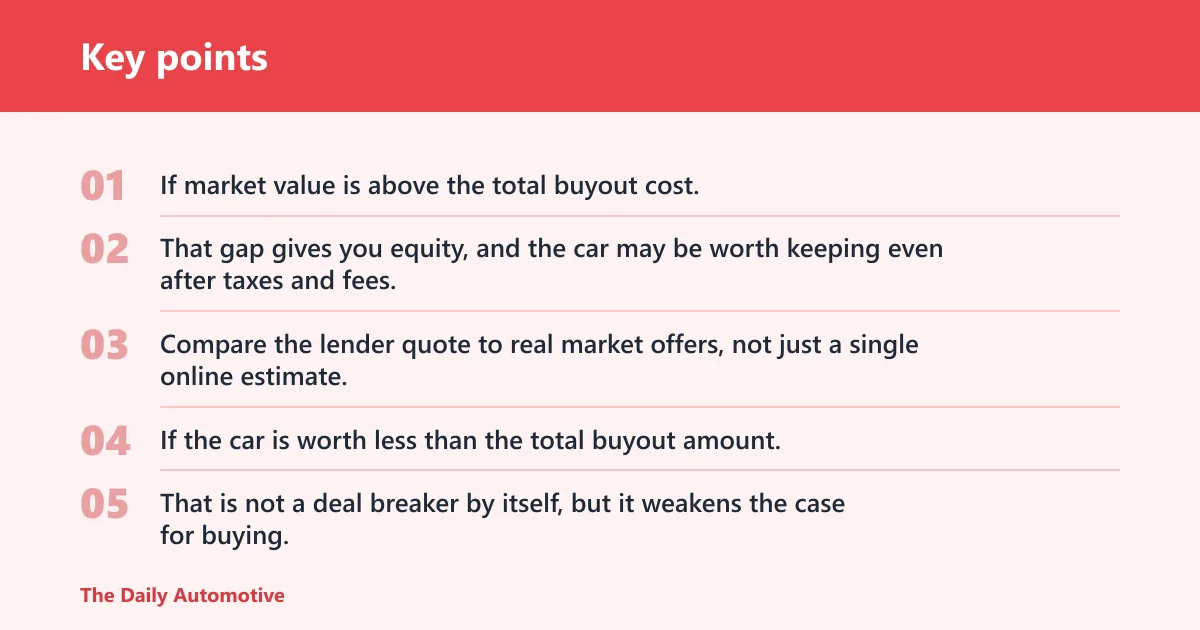
If market value is above the total buyout cost, the lease-end purchase can make sense financially. That gap gives you equity, and the car may be worth keeping even after taxes and fees. Compare the lender quote to real market offers, not just a single online estimate.
When negative equity makes buying harder to justify
If the car is worth less than the total buyout amount, you are paying more than the market would support. That is not a deal breaker by itself, but it weakens the case for buying. Worn condition can matter here, but mileage overages and lease-return wear charges usually belong to the return decision, not the buyout total.
Why financing and replacement costs matter
A financed buyout adds interest, and a return may force you to shop for another vehicle in a higher-priced market. Those costs can offset or even outweigh a small market-value gap. A lease-end decision should include the car’s condition, the financing terms available to you, and the cost of finding a replacement.
Picture a sedan with a $18,000 residual, a $19,200 market value, and a lender quote that becomes $19,860 after fees, tax, and title. The raw equity is not huge, but the car may still be worth buying if you want to avoid another used-car search. That is a judgment call, not a math trick.
Can you negotiate a car lease buyout after the lease ends?
After the lease ends, the contract usually still controls the purchase option if that option remains open. You may be able to negotiate fees, dealer handling, or the purchase path, but many captive lenders do not reopen the residual just because the car is still with you. Timing can matter, so do not wait until the lender changes the process.
Frequently asked questions
Can you negotiate the buyout price of a leased car?
Sometimes, but often only the fees or transaction path, not the residual value itself. Many captive finance companies hold the residual firm under the contract. Check the lease paperwork and ask for the exact lease-end purchase quote before you assume there is room to bargain.
Can you negotiate the purchase price at the end of a car lease?
Usually you can negotiate only if the lessor allows it, and that is more common with dealer-assisted or third-party transactions than with a direct consumer buyout. The contract often fixes the residual value. Compare the quote with market value before you push for a lower number.
Can you negotiate a lease buyout if the market value is lower than the residual value?
You can try, but many lenders will not lower the residual just because the market moved down. In that case, focus on fees, taxes, and whether a dealer or outside lender can legally handle the purchase. If not, the buyout may simply be a poor value.
Can you negotiate a lower lease buyout with the leasing company?
Sometimes the leasing company may reduce an admin fee or clarify a charge, but many will not reduce the residual on a standard direct buyout. Captive finance company policy matters here. Ask for the full out-the-door quote and the exact rules for your leaseholder.
Can you negotiate end of lease buyout fees or only the residual value?
In many cases, the fees are more flexible than the residual. Acquisition, admin, dealer, and processing charges may differ by lender and transaction path. Taxes and title or registration costs usually are not negotiable in the same way, though they vary by state.
Products related to this article
Sponsored / affiliate links. As an Amazon Associate I earn from qualifying purchases. I may earn additional commission from eligible campaigns.