Should You Negotiate Your Trade-In Separately?
Yes, negotiate the new-car out-the-door price first, then verify trade value, payoff, and tax credit separately before you let the dealer fold them into one monthly payment. Skip that order, and a weak trade allowance can hide inside a good-looking price or payment. This guide shows how to compare each number, calculate net equity, and spot when bundling costs you more.
This guide is part of our Car Loans, Leasing and Dealer Tactics: What to Know Before You Sign series.
Trade-in worksheet
Use this worksheet to keep the numbers apart. The goal is simple: compare the new-car out-the-door price, the trade allowance, the loan payoff, and the tax savings as separate lines before you decide whether the deal is fair.
| Deal A | New-car OTD | Trade-in allowance | Loan payoff | Tax savings |
|---|---|---|---|---|
| Example 1 | $31,000 | $11,000 | $8,000 | $660 |
| Example 2 | $32,200 | $13,000 | $8,000 | $780 |
Here is the same-payment trap in plain math. In Deal A, the net vehicle cost before loan math works out to about $19,340. In Deal B, the net vehicle cost before loan math works out to about $18,420. If the monthly payment is identical, Deal B still appears to cost about $920 less on the deal itself.
A quick net-equity check looks like this: new-car out-the-door price minus trade allowance, plus any negative equity from the loan payoff if the payoff is higher than the allowance, then minus any trade-related tax savings your state allows. If you owe less than the allowance, the difference is positive equity. If you owe more, the gap becomes negative equity that must be handled somewhere in the contract.
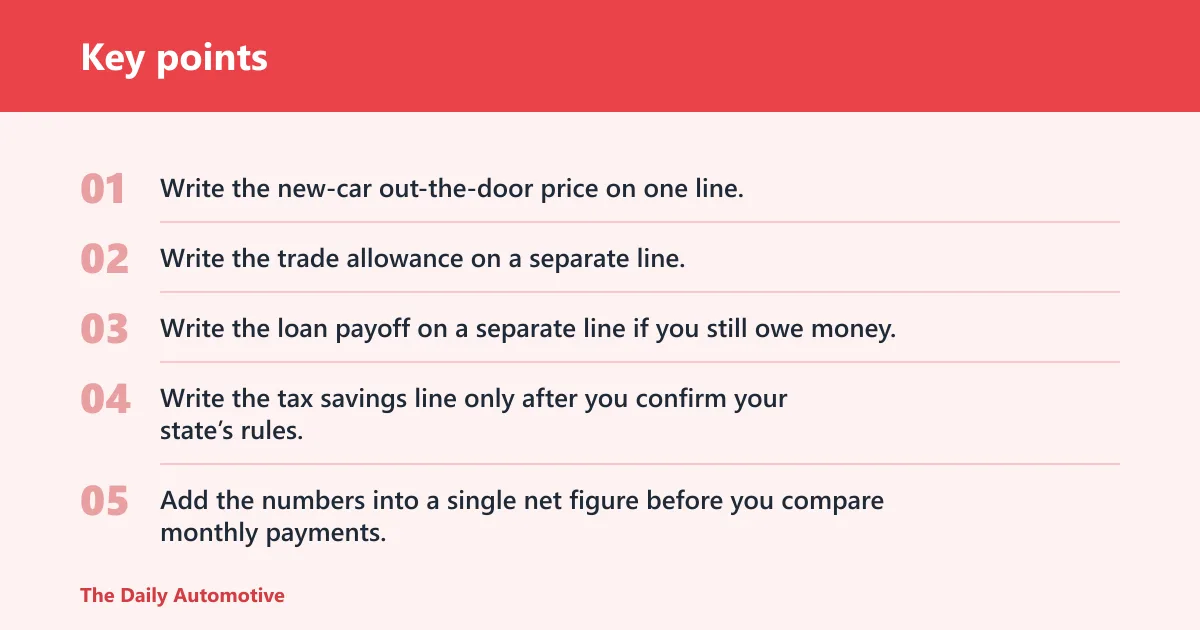
- Write the new-car out-the-door price on one line.
- Write the trade allowance on a separate line.
- Write the loan payoff on a separate line if you still owe money.
- Write the tax savings line only after you confirm your state’s rules.
- Add the numbers into a single net figure before you compare monthly payments.
Say your trade allowance is $12,000 and your payoff is $14,500. That $2,500 gap does not disappear because the payment looks lower. It still has to be paid, rolled into the new loan, or covered another way.
Should you split the negotiations?
Yes, splitting the talks makes the math easier to verify. You can judge the new-car price on its own, then judge the trade on its own, which makes it harder for the dealer to blur a weak allowance into a payment that looks acceptable on paper.
Why separate quotes help
Comparing the new-car selling price before the trade enters the conversation, and another says dealers often blend trade-in value into the new-car price. That is why separate quotes matter. They let you see whether the dealer improved the car price, the trade allowance, or only the payment math.
The cleanest order is usually: price the car, then price the trade, then compare the total. U.S. News says to focus on the total out-the-door price, not the monthly payment, and to treat your trade-in as a separate transaction.
When bundling can hide a weak trade
A bundled offer can look strong because the payment lands where you want it while the trade allowance quietly drops. That is the appraisal haircut problem. The dealer may shift value between the car price, the trade line, fees, and the payoff line until the monthly number works.
That does not mean bundling is always worse. It means the final math matters more than the order only after you can see each line clearly. If the dealer will not itemize the deal, you cannot tell whether you are getting a better new-car price or a cheaper trade allowance.
What should you know before you visit?
Know your car’s likely trade range before you go in. Use market guides, comparable listings, and written offers from online buying services to set a realistic floor and ceiling. Then check mileage, condition, service history, and any title or damage history so you understand what may change the offer.
What affects trade-in value
Dealer allowance usually tracks wholesale logic, not retail asking prices. A dealer has to resell the car, inspect it, recondition it, and leave room for profit. That is why condition adjustments, mileage impact, and history report impact all matter. A clean history report usually helps. Unreported damage or a branded title usually hurts.
Bring payoff details if you still owe on the loan. If the dealer has to call your lender later for a payoff amount, delays and mistakes can creep in. A current payoff quote keeps the trade calculation cleaner.
Competing offers matter here too. A written appraisal from CarMax, Carvana, or another buyer gives you a comparison point, but only if it lists the expiration date and any conditions. A number that expires tomorrow or excludes certain trim, damage, or mileage limits is not the same as cash in hand.
How do you price the new car first?
Ask for the out-the-door price, not a monthly payment. That means the written quote should separate MSRP, invoice context, destination fee, dealer fees, taxes, and any accessories or documentation charges. The point is to pin down the full purchase price before the trade enters the conversation.
What belongs on the quote
MSRP is the window sticker reference. Invoice price gives you a rough reference point for dealer cost context. Dealer holdback is a bonus paid after the car is sold, and destination fee is part of the vehicle’s base cost structure. None of those should be buried inside a vague payment quote.
To request an itemized price including destination charges, accessories, documentation fees, and taxes. That is the right move because it lets you compare one dealer’s quote with another dealer’s quote line by line.
Use the written quote before the trade is added. That keeps the car price test separate from the trade test. If the dealer changes the car price after the trade discussion starts, the first number you should question is the new-car line, not the payment.
How does the trade change the math?

The trade changes the math through tax treatment, equity, and payoff. In some states, the trade allowance reduces the taxable amount of the purchase. In others, the rule is different. That is why you need to confirm your state’s tax treatment instead of assuming the credit works the same everywhere.
How trade tax savings work
If your state allows a tax credit on the trade-in amount, the allowance can lower the taxable base of the new car. That can create real savings. But the tax line may not change in the same way in every state, and some states apply the credit only to part of the deal.
Suppose the dealer offers $12,000 for your trade and your state taxes the purchase after subtracting trade value. If the tax rate is 6 percent, the trade can reduce tax by $720. If your state taxes the full purchase price instead, that savings may not exist. The deal still has value, but the tax math changes the final result.
What happens with negative equity
If your payoff is higher than the trade allowance, the gap is negative equity. Dealers may roll that amount into the new loan, which can make the monthly payment look manageable while increasing the total amount financed. That is why payoff confusion is such a common trap.
Picture a buyer with a $9,000 trade allowance and a $10,800 payoff. The $1,800 gap is not a mystery number. It has to be paid by cash, covered by equity from the deal, or folded into the new loan. If the dealer skips that line, ask for it in writing.
Keep the dealer from bundling the numbers
When the talk shifts to payment only, move it back to the line items. Ask for the new-car out-the-door price in writing, then ask for the trade allowance, payoff, and tax credit on separate lines. If the dealer keeps blending the figures, the buyer’s order may hide a worse trade or a changed fee.
What to say
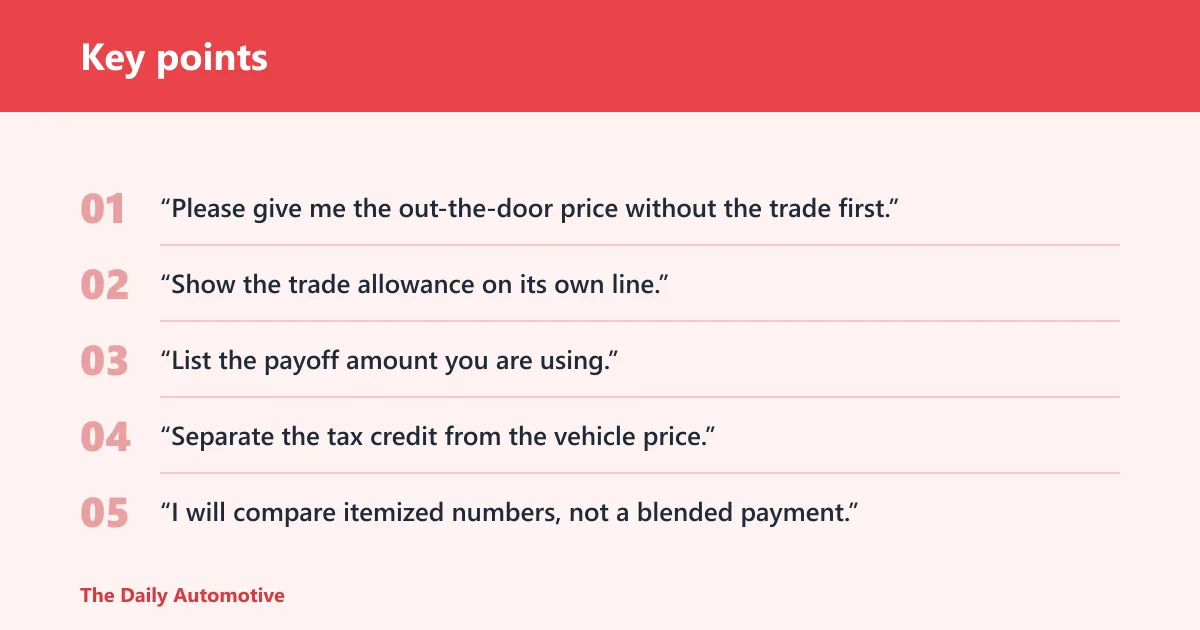
- “Please give me the out-the-door price without the trade first.”
- “Show the trade allowance on its own line.”
- “List the payoff amount you are using.”
- “Separate the tax credit from the vehicle price.”
- “I will compare itemized numbers, not a blended payment.”
A common first-timer mistake is accepting a payment that looks fine while the dealer quietly moved a fee upward and the trade downward. The payment stays the same, but the net deal changes. That is why the buyer’s order matters more than the salesperson’s verbal summary.
What the buyer’s order should show
Before you sign, the buyer’s order or purchase agreement should list the main price components, including the vehicle price, destination fee, dealer fees, taxes, trade allowance, any payoff amount, and the final amount due. If any of those are missing, ask for a corrected copy. A written, itemized document is the only version worth comparing.
Watch for a moved fee, a moved allowance, or a changed payoff line. A dealer can make the payment look stable by moving value between lines. The question is not whether the payment moved. The question is whether the net cost did.
Competing offers and dealer appraisals
Written offers from CarMax, Carvana, or another buyer create comparison power because they set an outside number the dealer has to answer. The single biggest advantage is a real outside offer in hand. That gives you a floor to compare against the dealership appraisal.
How to use outside offers
Bring the written appraisal, note the expiration date, and read the conditions carefully. Some offers require a clean title, no major damage, or a short time window. If the dealer wants to beat the offer, make sure the comparison is real and current.
That offer can also expose a low appraisal. If the dealer claims the car is worth less, ask what factor changed the number. Mileage, condition, missing equipment, and history report issues are valid reasons. A vague “we just need more room” answer is not useful.
When a fair offer is not the best outcome
A fair dealer offer is often based on wholesale logic and resale risk. That does not automatically make it your best consumer outcome. If the new-car price is worse, the trade allowance may be offset by the higher car price. That is why the net deal matters more than one line by itself.
Frequently asked questions
Should you negotiate your trade-in separately from the new car price?
Usually, yes. Separating the two makes it easier to see the real out-the-door price, the trade allowance, and the tax treatment before the dealer folds them into one payment. The cleanest comparison is the one where each line stands on its own.
What order should you negotiate the new car price and trade-in?
A common approach is to start with the new-car out-the-door price, then move to the trade allowance, payoff, and tax credit. That order makes the purchase price easier to verify and reduces the chance that a weaker trade gets hidden inside a payment that still looks acceptable.
How do you keep a dealer from bundling the numbers?
Ask for a written quote with separate lines for vehicle price, fees, taxes, trade allowance, and payoff. If the dealer shifts back to payment talk, restate that you need itemized numbers. Do not compare offers until the buyer’s order shows each figure clearly.
What is a fair trade-in offer based on?
A fair dealer offer usually reflects wholesale logic, reconditioning costs, mileage, condition, title status, and history report issues. It is a dealer’s resale number, not a retail listing price. That is why a fair offer can still be less than the best outcome for you.
Can a dealer change the trade-in value after the appraisal?
Yes, if the vehicle’s condition, mileage, or payoff information changes, or if the written offer has expired. That is why you should keep the appraisal in writing, check the expiration date, and make sure the dealer is using the same assumptions you were given.
How do trade-in tax savings affect the final deal?
Trade-in tax savings can lower the taxable amount of the purchase in some states, which changes the real net cost. In other states, the rule works differently or may be limited. Always compare the full net deal after tax, not just the allowance or the monthly payment.
What numbers should be on the buyer’s order before you sign?
You should see the vehicle price, destination fee, dealer fees, taxes, trade allowance, payoff amount if any, and final amount due. If the dealer is using a trade tax credit, that should be visible too. Never sign a form that leaves those numbers vague or blended.
Products related to this article
Sponsored / affiliate links. As an Amazon Associate I earn from qualifying purchases. I may earn additional commission from eligible campaigns.