Music Horns for Cars: Tested & Reviewed (2 Picks)
The best music horns for cars are two-horn 12V kits that trade some output for more tone choices, simpler wiring, and less install risk; pick the louder option if you want more attention, and the easier one if you need a better fit across more vehicles. Choose poorly, and you can end up with a horn that sounds weak, breaks local noise rules, or turns into a headache to fit. This guide compares two picks by sound variety, install burden, loudness claims, and legal-risk fit for cars, trucks, motorcycles, and boats.
Music horns for cars: Vixen Horns vs 10-tone kits


The Vixen Horns VXS6200 is the stronger choice for sound variety and day-to-day flexibility. The 10-tone controller kit is the simpler novelty option if you want a fixed set of tones, a claimed 130 dB output, and a more straightforward setup for occasional use.
What this comparison settles
These are both 12V musical horn kits, so they can work with cars, trucks, motorcycles, and boats if the electrical system and mounting space fit the kit. The split is practical: Vixen gives you more sound choices, while the 10-tone kit is the cleaner pick if you want a louder, smaller novelty horn without moving into compressor-driven hardware.
Side-by-side at a glance
| Pick | Loudness | Tone variety | Install complexity | Weather resistance | Relay need | Best-use scenario | Who should not buy this |
|---|---|---|---|---|---|---|---|
| Vixen Horns VXS6200 | 15W speaker; not a verified road loudness number | 46 total sounds, including 16 musical tunes, 12 sirens, and 14 animal noises | Moderate; needs space for the unit, speaker placement, and compatible wiring | Depends on mounting and exposure; corrosion and grounding still matter | Recommended when the kit draw or vehicle wiring calls for cleaner power routing | Drivers who want novelty sounds plus a PA microphone for occasional use | Anyone wanting a simple one-sound horn or a guaranteed road-legal setup everywhere |
| 10-tone controller horn kit | 130 dB claimed output | 10 distinct tones | Lower than air systems; usually simpler than compressor-based kits | Better if the housing has a metal protective grille and weather-resistant shell | Often smart on higher-draw installs, even if the kit includes basic wiring | Buyers who want a louder novelty horn with fewer moving parts | Anyone expecting deep sound libraries or a quiet, apartment-friendly horn |
Vixen Horns VXS6200 review
The Vixen Horns VXS6200 is the more versatile pick. It offers 46 total sounds across five categories, including 16 musical tunes, 12 sirens, and 14 animal noises, and it uses a 15W speaker with an integrated PA system and microphone.
Sound options and speaker setup
This kit is built for variety, not single-note brute force. Its five sound categories give you more than a parade horn or a basic tune horn, and the included PA microphone pushes it toward show use, parking-lot announcements, and private-property events.
That flexibility matters if you want one kit to do more than one job. A horn with 46 sounds can feel playful without being locked into one melody, but that same flexibility can also make it harder to justify for public-road use where local rules are strict.
Install burden, relay need, and fitment
As a 12V kit, it still needs mounting space, solid grounding, and wiring that matches the vehicle. Cars and trucks usually have more room for the speaker and controller; motorcycles and smaller boats can be tighter fits and may need more careful placement to keep the unit dry and secure.
A relay is worth planning for on higher-draw setups or when the factory horn circuit is not meant to carry the load directly. That helps protect stock wiring and gives the horn a cleaner power path. Corrosion control matters too, especially anywhere spray, road salt, or vibration can loosen grounds.
Say your compact SUV already has limited front-end space and a small battery tray nearby. A kit like this can still work, but only if the speaker, controller, and wiring route all fit without pinching wires or leaving the microphone and controls in a bad spot.
Who should not buy this?
Skip the Vixen kit if you want one horn that behaves like a normal daily driver horn. Skip it if you do not want to explain a microphone-equipped novelty system to local law enforcement or inspection staff. Skip it if your install space is very tight and you do not want to plan around a controller box plus speaker.
10-tone controller horn kit review
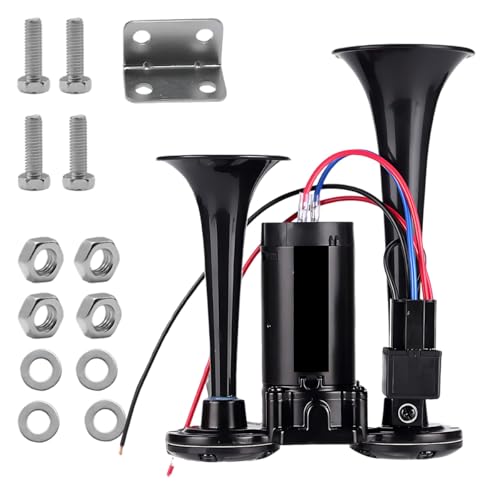
The 10-tone controller horn kit is the simpler novelty pick. It offers 10 distinct tones and a claimed 130 dB output, which puts it in the louder novelty range without the plumbing and package bulk of a compressor system.
Tone switching and claimed output
A switchable tone controller is the main draw here. You get fewer options than the Vixen kit, but the appeal is direct: turn it on, pick a tone, and move on. The 130 dB figure is a marketing claim, not a guarantee of what you will hear in traffic, where mounting location and vehicle bodywork change the result.
That number also needs context. Horn output is often advertised in a very wide range, but such claims can be inflated. A horn mounted behind a grille, inside a tight bumper cavity, or on a bracket that vibrates can sound less forceful than its spec sheet suggests.
Weather resistance and mounting needs
The protective metal grille and weather-resistant housing are the parts that matter most here. They help, but they do not erase the usual problems: water intrusion, corrosion at the terminals, and poor grounding. If the horn sits low in the nose of the vehicle, splash protection matters more than the headline dB number.
Compared with musical air horn kits, this style is lighter on space and much simpler to package. It still needs a clean mounting spot and a wiring route that does not rub through on sheet metal or suspension travel.
Picture a hatchback owner trying to fit the horn behind the front bumper cover with little clearance to spare. The install can still work, but the mounting bracket, wire routing, and grille exposure become the deciding factors, not the tone selector.
Music horn comparison matrix
The main trade-off is simple: Vixen gives you more sound variety and more utility, while the 10-tone kit gives you a louder-sounding novelty horn with less complexity. Neither is a substitute for reading local rules before road use.
| Criterion | Vixen Horns VXS6200 | 10-tone controller horn kit |
|---|---|---|
| Loudness | 15W speaker; loudness depends on mounting and enclosure | 130 dB claimed output |
| Tone variety | 46 total sounds across five categories | 10 distinct tones |
| Install complexity | Moderate | Lower than compressor systems |
| Weather resistance | Depends on exposure, grounding, and corrosion control | Metal protective grille and weather-resistant housing help |
| Relay need | Smart on higher-draw or cleaner installs | Often smart on higher-draw installs |
| Best use | Novelty use with the widest sound palette | Louder novelty use with simpler switching |
Loudness and tone variety
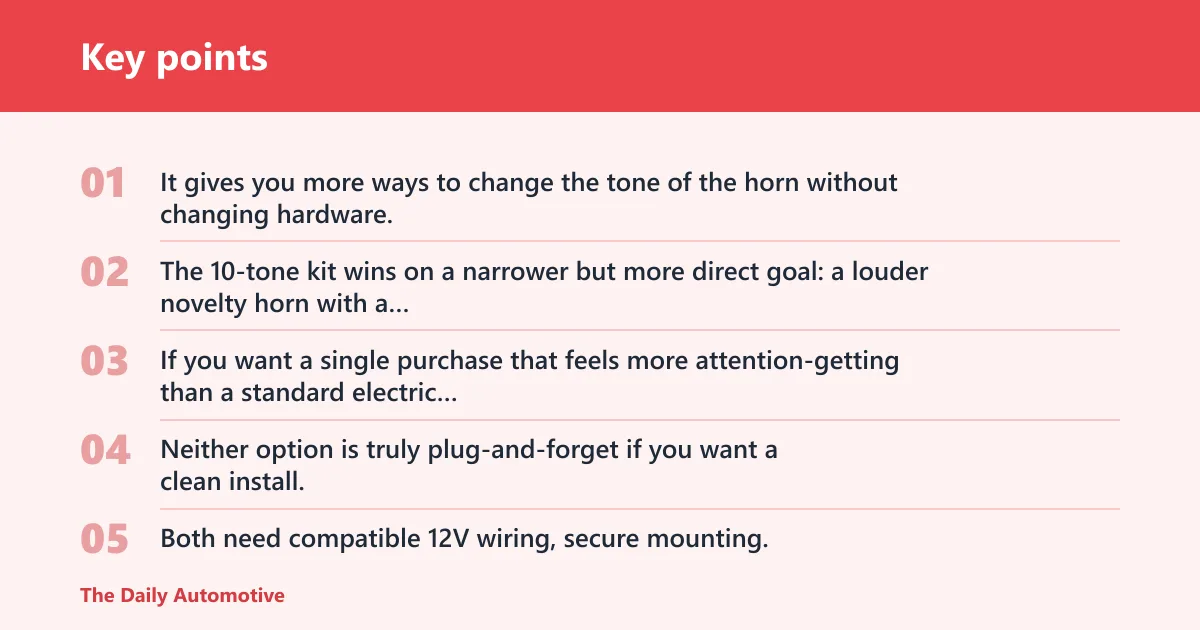
The Vixen kit wins on variety. It gives you more ways to change the tone of the horn without changing hardware, and the PA microphone expands what the unit can do in show or private-property settings.
The 10-tone kit wins on a narrower but more direct goal: a louder novelty horn with a simple controller. If you want a single purchase that feels more attention-getting than a standard electric horn, that is the better fit.
Install complexity and wiring
Neither option is truly plug-and-forget if you want a clean install. Both need compatible 12V wiring, secure mounting, and enough room for the controller and horn body. A relay and wire set, if included, usually make the job cleaner and help protect stock wiring when current demand rises.
Musical air horn kits are the harder version of this problem. They add a compressor, air lines, more parts, and more install space. Electric kits avoid that complexity, which is why they make more sense for people who want novelty sound without building a compressed-air system.
Weather resistance, relay need, and best use
Weather resistance is never just a buzzword here. Exposed terminals, loose grounds, and bracket corrosion can turn a novelty horn into a flaky one. If the vehicle lives outside, the safer choice is the kit that can be mounted high, dry, and away from direct spray.
Relay support becomes more valuable as draw rises. It is not only about loudness. It is about keeping the original horn circuit from carrying more than it should. That matters on older vehicles, motorcycles, and anything with thin factory wiring.
Are music horns legal on public roads?
They can be legal in some places, but not everywhere, and legality changes with use case. A musical horn may be acceptable on private property, at shows, or for off-road use, while public-road use can trigger restrictions on horn type, sound level, or unnecessary noise.
Road use versus private-property use
Public-road use is the risky zone. Even a horn that fits 12V systems and installs cleanly may still violate local rules if it plays melody sounds instead of an ordinary warning tone. Private-property use usually gives you more freedom, but that does not carry over to streets, parking lots open to traffic, or highway driving.
Why local noise rules matter
Local regulations matter because a 130 dB claim is not the same thing as verified safe road use. A louder horn may get attention, but attention is not the same as permission. If your area limits horn use to warning only, novelty tunes can become a citation risk very fast.
A common first-timer mistake is buying a horn for the sound list and checking the rulebook last. That leads to a good-looking install that never gets used where the owner wanted it most.
What to check before you buy
- Check whether your area allows musical or multi-tone horns on public roads.
- Confirm whether the horn is for road use, show use, or off-road use only.
- Look for mounting space, grounding points, and weather exposure before ordering.
- Review whether the kit includes a relay and wire set.
- Decide whether you want a melody horn, a tone controller, or an air system.
How difficult is it to install a musical horn kit?
Install difficulty can range from straightforward to annoying, depending on whether there is space for the horn body, a solid ground, and a wiring path that avoids heat and abrasion. Electric kits are usually simpler than air horn systems, but none are truly easy if the vehicle is cramped.
Mounting space and grounding
Mounting space is the first check. Cars and trucks often have more room than motorcycles, and boats raise their own issues with moisture and corrosion. A strong ground is just as important as the positive feed, because a weak ground can make the horn intermittent or quiet.
Relay and harness basics
If the kit includes a relay and wire set, that is a useful plus. The wire set can tidy the run and reduce splicing, while the relay helps switch power safely on higher-draw horns. That is especially useful when the horn current should not pass through factory controls directly.
Motorcycle fitment and space limits
Can you install a musical car horn on a motorcycle? Often yes, but only if the horn body, controller, and wiring can fit without interfering with steering, suspension travel, or weather exposure. Compact motorcycles leave little room, so smaller electric kits are usually easier than compressor-based layouts.
Use the motorcycle’s existing electrical capacity with care. A horn that seems modest on paper can still overtax a weak circuit if the wiring is thin or the battery is small. That is where a relay and solid mounting points matter most.
Choose Vixen Horns VXS6200 if… / Choose 10-tone controller horn kit if…
Pick the Vixen Horns VXS6200 if you want the broadest sound library, a built-in PA microphone, and a kit that feels more like a show tool than a one-note horn. Pick the 10-tone controller kit if you want the simpler path to a louder novelty horn and do not need all the extra sound categories.
Best match by buyer profile
Choose Vixen if you want variety first and loudness second. That makes sense for drivers who want a novelty horn with multiple personalities, or for buyers who may use the PA mic in controlled settings.
Choose the 10-tone kit if you want an easy-to-grasp novelty horn and you care more about a claimed 130 dB figure than about a long sound list. It is the tighter fit for buyers who want a louder impression without moving into compressor plumbing.
Best match by vehicle type
Choose Vixen for cars and trucks with enough front-end space for the unit and a sensible wiring route. It can also work on motorcycles and boats, but only when the mount is protected and the vehicle has room for the controller and speaker.
Choose the 10-tone kit for smaller vehicles that still have room for a protected grille and a clean wire path. It is the better fit when install simplicity matters more than sound count.
When to skip both
Skip both if you need a horn that is clearly road-legal everywhere you drive. Skip both if you live in a tight apartment area where loud novelty use will create complaints. Skip both if your vehicle has poor grounding, exposed wiring, or no safe place to mount the horn without water damage.
Frequently asked questions
What should I look for in a 12V musical horn kit?
Look for 12V compatibility, mounting space, a solid ground, and whether the kit includes a relay and wire set. Also check the sound count, housing protection, and whether the seller labels it for road, show, or off-road use. If the kit hides those details, treat that as a warning sign.
Is a 130 dB car horn loud enough for safety?
On paper, 130 dB is very loud, but safety is not just about the number. The real question is whether other drivers can hear it in the right direction and whether local rules allow that sound on public roads. Mounting, vehicle shape, and road noise all change the result.
What is the difference between an air horn and an electric horn?
An electric horn uses electrical power directly to make sound. A musical air horn adds a compressor, air lines, and often a multi-trumpet layout. Air horns are usually louder and more complex to install, while electric horns are simpler and usually easier to fit into smaller vehicles.
Do I need a relay to wire a new musical horn?
Often, yes. A relay is wise on higher-draw horns because it helps keep the stock horn circuit from carrying too much load. Even when a kit includes basic wiring, a relay and wire set can make the install cleaner and reduce stress on factory switches and wiring.
Can I install a musical car horn on a motorcycle?
Yes, if the kit fits the bike’s electrical capacity and mounting space. The challenge is usually not the 12V system itself; it is space, weather exposure, and routing wires without interfering with steering or suspension. Smaller electric kits are usually easier than compressor systems.
Which musical car horn has the most sound options?
Among these two, the Vixen Horns VXS6200 has the most sound options. It offers 46 total sounds across five categories, including 16 musical tunes, 12 sirens, and 14 animal noises. That makes it the better fit when variety matters more than a single loudness claim.
Products related to this article
Sponsored / affiliate links. As an Amazon Associate I earn from qualifying purchases. I may earn additional commission from eligible campaigns.