
Can My Wife Refinance My Car? Spouse Loan and DMV Rules
A spouse may be able to refinance a car loan if the lender approves that spouse alone or both spouses together and the title can be retitled to match the new loan. Skip one step and you can end up with a denied application, a lien mismatch, or DMV paperwork that leaves the old borrower stuck on record. This guide separates lender approval, title ownership, and state DMV requirements so you know when a spouse can refinance versus only apply jointly.
Can my wife refinance my car?

The short answer
A spouse can refinance a car in three common ways. One spouse can refinance alone if that person qualifies on income and credit. Both spouses can refinance together if the lender wants joint income or a stronger file. Or the refinance can fail if the title, lien, and lender rules do not line up.
Marriage does not automatically change who owns the loan, who is on the title, or who the lender will treat as the borrower.
What refinancing actually changes
An auto loan refinance replaces the existing car loan with a new one. The new lender pays off the old loan and then sets new terms such as APR, monthly payment, and loan length. The old lienholder must be paid before the new loan is fully closed.
Why the borrower and title holder are not always the same
The borrower is the person legally responsible for repayment. The title holder is the legal owner listed on the vehicle title. A lienholder is the lender with a security interest in the car. Those roles can overlap, but they are not the same thing.
Say your husband is the borrower on a $19,000 loan, while both spouses are on the title. A lender may still approve only the wife on a new refinance if her income, credit score, and debt-to-income ratio are strong enough. The title still has to be handled correctly after payoff.
When a spouse can apply alone versus jointly
One spouse can apply alone if the new lender allows a sole borrower and that person can qualify on credit and income. Joint refinance is common when both incomes are needed or when one spouse’s credit file is too thin on its own. Some lenders will insist on both spouses, even if the title only shows one owner.
Who has to qualify: borrower, title holder, or both?
The borrower must usually qualify, even if that person is not the only title holder. Lenders underwrite the person or people on the new note, not the marriage itself. Title rules and DMV rules matter too, but lender approval is the first gate.
Credit score and income checks
Refinance approval usually depends on credit score, income, payment history, and the vehicle’s value versus the payoff amount. A higher credit score can improve APR eligibility, while stronger income can offset weaker credit in some files. The spouse asking to refinance must usually document pay stubs, tax returns, or bank statements, depending on lender policy.
How debt-to-income ratio affects approval
Debt-to-income ratio compares monthly debt obligations with gross monthly income. If the ratio is too high, a solo spouse refinance may be denied even when the car payment would be affordable in practice. Joint refinance can help if the combined income lowers the ratio enough for approval.
Why lender policy can be stricter than state title rules
State DMV rules control title paperwork, but the lender controls credit risk. A state may allow a title transfer, yet the lender may still refuse a spouse-only refinance because of policy, equity concerns, or income limits. Approval from one side does not guarantee approval from the other.

Can my wife refinance my car if she is not on the title?
Sometimes, yes — depending on the lender and title situation. A lender may allow a spouse who is not on the current title to refinance the loan alone, but only if that spouse qualifies and the title can be updated when the refinance closes. If the title structure blocks the transaction, the lender may require a title change first or a joint refinance instead.
When a lender may allow it
Some lenders care most about borrower credit, income, and lien payoff. If the spouse who is applying has strong underwriting numbers, the lender may permit a refinance even if the existing title shows only the other spouse. That does not remove the need for DMV paperwork after payoff.
When the title must be updated first
If the lender requires the title holder and borrower to match, a title transfer may need to happen before or alongside the refinance. That is more common when the current title has one owner but the new loan will have a different sole borrower. State law and lender policy both matter here.
What happens if the current loan has a co-signer
A co-signer is a secondary credit backstop, not the primary owner by default. A co-signer may not be able to refinance alone unless the lender permits it and the person qualifies on their own. Even then, the old loan usually keeps the co-signer liable until payoff and release are complete.
Joint refinance may be the simplest path for spouses

Joint refinance is often the cleanest option when one spouse does not qualify alone or when the lender wants more income on the application. It lets the lender review both credit profiles and both incomes, which can help approval odds. It also aligns liability more clearly with ownership in many cases.
How joint income and credit are used
In a joint refinance, the lender can look at combined income, combined monthly obligations, and both credit reports. That can help if one spouse has a stronger score and the other has stronger income. It can also help if the car loan balance is high relative to the vehicle’s value.
How liability changes on a joint loan
In a joint refinance, both spouses are typically legally responsible for repayment on the new loan. That means the lender can collect from either borrower if payments stop. If one spouse expected to be removed from the debt, a joint refinance does not accomplish that goal.
Suppose the car still has $14,500 outstanding and the lender wants a lower risk file than either spouse can provide alone. A joint application may be approved where a solo application would fail, but both names will stay on the new note unless the lender structures it differently.
When joint refinancing is better than a solo application
Joint refinancing is usually better when one spouse has a weak credit score, inconsistent income, or a high debt-to-income ratio. It can also be the better path when the lender wants both incomes to support the payment. If the goal is to keep both spouses involved, it is often simpler than trying to transfer ownership and debt separately.
What paperwork and approvals do you need?
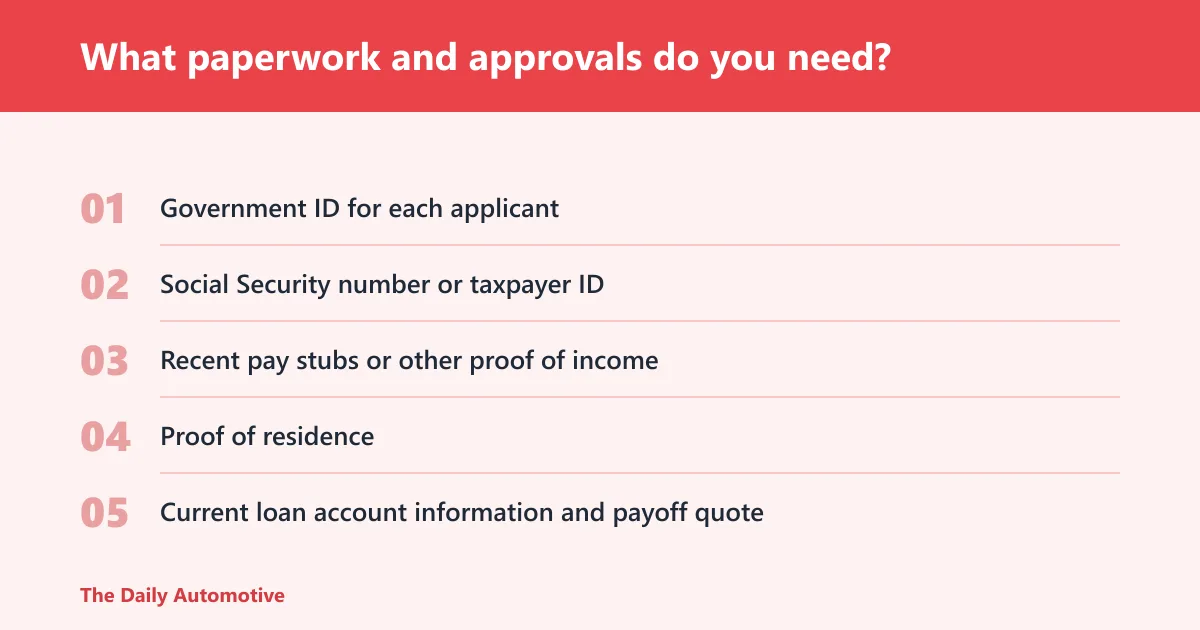
Most lenders ask for identity, income, vehicle, and loan documents before they approve a spouse refinance. After approval, the old lender is paid off, the lien is released, and then the DMV or title office handles any state-specific title and registration steps. The sequence matters.
Common documents lenders ask for
- Government ID for each applicant
- Social Security number or taxpayer ID
- Recent pay stubs or other proof of income
- Proof of residence
- Current loan account information and payoff quote
- Vehicle identification number, mileage, and insurance details
- Existing title information, if available
Lien payoff and release timing
The current lender, or lienholder, usually needs to be paid off before the new loan is fully complete. After payoff, the old lender sends lien release documentation or title release paperwork. That timing can take days or longer, depending on the lender and state process.
State DMV title transfer and registration steps
DMV rules vary by state. Some states require a new title application and registration update after the refinance. Others mainly want proof that the lien was released and the new lender was recorded. If a spouse is being removed from title or added to it, that may trigger separate transfer paperwork and fees.
- Submit the refinance application and supporting documents.
- Wait for credit and income review from the new lender.
- If approved, the new lender funds the payoff of the old loan.
- The old lienholder sends a lien release or title release.
- File any required DMV title or registration updates.
- Keep copies of the payoff and release records.
What can stop a spouse refinance?
Several things can block approval: a low credit score, a thin credit file, high debt-to-income ratio, negative equity, title problems, or lender policy limits. A spouse can be married to the current borrower and still be denied if the file does not meet underwriting rules.
Low credit score or thin credit file
Credit score is a key underwriting factor for refinance approval. If the spouse applying alone has little credit history or recent late payments, the lender may deny the loan or offer worse terms. Thin credit can be a problem even when income is steady.
High debt-to-income ratio
If monthly debt payments already take too much of the applicant’s income, the lender may consider the new car loan too risky. That is true even if the payment would technically fit the household budget. Joint refinance can sometimes fix this by using both incomes.
Negative equity, lender limits, or title problems
If the car is worth less than the payoff amount, the lender may limit the refinance or require extra conditions. Some lenders also restrict spouse-only applications, title transfers, or co-signer changes. A title mismatch can stop the process until the ownership record is corrected.
Can my husband refinance my car?
Yes, your husband can refinance your car if the lender approves him alone or approves you both together and the title paperwork can be handled correctly. The marriage itself does not create automatic authority. The lender still checks credit, income, debt load, and the vehicle’s lien status.
Can I refinance my car in my wife’s name?
Yes, if your wife qualifies as the new borrower and the lender allows a refinance in her name only. The current title and existing loan still have to be handled correctly. If the lender will not accept her as the sole borrower, a joint refinance may be the next-best option.
Can I refinance my husband’s car in my name?
Yes, but only if the new lender approves you alone and the title can be changed to match the loan structure. A spouse cannot simply assume the car loan by marriage. If the lender wants both spouses on the note, joint refinance may be required instead.
Can a cosigner refinance my car?
A co-signer can sometimes refinance, but not automatically. The lender must allow that person to become the primary borrower or joint borrower, and the co-signer must qualify on their own or with a spouse. Many co-signers remain liable until the old loan is paid off and released.
Can my bank refinance my car loan?
Yes, your bank may refinance your car loan if it offers auto refinance and the file meets its underwriting rules. Some banks and credit unions are more flexible on member relationships, while others are strict about title and borrower structure. Ask whether spouse-only, joint, or title-change refinances are allowed.
What do we need to qualify for a spouse refinance?
To qualify, you usually need enough credit strength, enough verifiable income, an acceptable debt-to-income ratio, and a vehicle value that supports the loan amount. You also need the title and lien records to be workable under lender and state rules. A strong application can still fail if the title paperwork is not aligned.
Spouse refinance decision checklist
| Checkpoint | Current borrower/title holder | Spouse as sole borrower | Joint refinance |
|---|---|---|---|
| Who applies | Current borrower applies again or stays on record | Only the spouse applies | Both spouses apply together |
| Documents needed | Current loan payoff, ID, title, income docs | Spouse’s ID, income proof, credit review, title details | Both spouses’ IDs and income documents, plus title details |
| Likely approval blockers | Negative equity, late payments, title mismatch | Weak credit, high debt-to-income ratio, lender refusal to allow sole spouse borrowing | Combined debt too high, title issues, lender policy limits |
| Who stays liable | Current borrower stays liable if unchanged | Only the spouse is liable on the new loan if approved | Both spouses are liable on the new loan |
| Title outcome | May stay the same unless the DMV requires an update | May need retitling to match the new borrower and lien | Often easier to align ownership and liability, but DMV steps may still apply |
Will refinancing remove me from the loan?
Refinancing can remove you from the loan, but only if the new loan is written in the other spouse’s name alone or if the old loan is replaced with a different structure. If your name stays on the new note, you remain liable. A joint refinance does not remove anyone.
Does the title have to change when my wife refinances my car?
Not always, but it often needs to be reviewed. The title lists the legal owner or owners, while the loan shows who owes the money. If the refinance changes who is responsible for the debt or who owns the car, the DMV may require a title update and registration paperwork after the old lien is released.
Frequently asked questions
Can my wife refinance my car loan?
Yes, if the lender approves her as the sole borrower or approves both spouses together. The answer depends on her credit, income, debt-to-income ratio, and whether the title and lien paperwork can be updated correctly after payoff.
Can my husband refinance my car?
Yes, your husband can refinance your car if he qualifies and the lender allows the structure. Marriage alone does not transfer the loan. The lender, title record, and DMV paperwork still have to line up before the refinance is complete.
Can my wife refinance my car if she’s not on the title?
Sometimes. Some lenders will allow a spouse to refinance even if that spouse is not currently on title, but others will require a title update first. State DMV rules and lender policy both matter, so the title should be checked before applying.
Can a cosigner refinance my car?
Sometimes, but not automatically. A co-signer may be able to refinance only if the new lender permits it and the person qualifies as a borrower. Until the old loan is paid off and released, the co-signer can still remain liable.
Can my bank refinance my car loan?
Yes, many banks and credit unions offer auto refinance, but their rules differ. Some allow spouse-only applications, some prefer joint applications, and some are strict about title documentation. Ask the bank how it handles borrower changes, title changes, and payoff timing.
Will refinancing remove me from the loan?
It can, but only if the new loan is written without your name. If you sign the refinance as a joint borrower, you stay liable. If the lender will not approve your spouse alone, the old borrower may remain on the new loan.
Products related to this article
Sponsored / affiliate links. As an Amazon Associate I earn from qualifying purchases. I may earn additional commission from eligible campaigns.
 Portable Car Heater Car Heater, Portable Electronic Auto Heater Fan Fast Heating Defrost 12V 120W Car Defrost Defogger, 2 in 1 Heating/Cooling Function 3-Outlet, Plug Adjustable
 winvin Car Dashboard Mount Holder Stand Clamp Cradle Clip GPS Navigation Non-Slip Durable Car Phone Holder Mount Fit for Mobile Phones