Can You Rent Manual Cars? Essential Guide
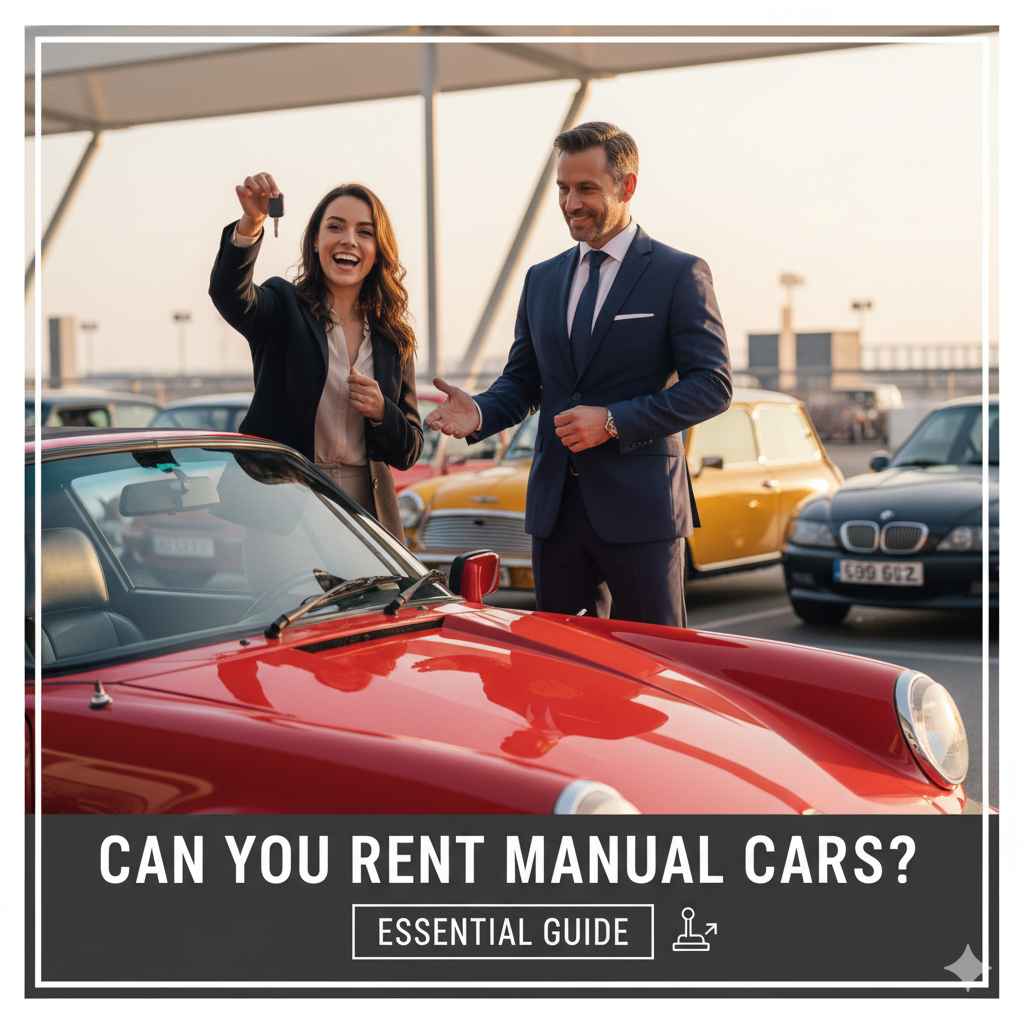
Yes, you absolutely can rent manual cars, but they are becoming harder to find. While automatic transmission vehicles are more common, many rental companies still offer manuals, especially in certain regions or for specific car classes. This guide will help you navigate the process and ensure you get the stick shift you want!
Learning to drive a manual car might feel like a lost art, especially when most new vehicles sold today come with automatic transmissions. If you’re used to driving a stick shift or are curious to try one, you might be wondering if you can even rent a manual car. It’s a common question, and the answer isn’t always a straightforward “yes” or “no.” Finding one can sometimes feel like searching for a needle in a haystack! But don’t worry, with a little planning and knowing where to look, you can definitely get behind the wheel of a manual transmission rental. Let’s break down everything you need to know to make your manual car rental smooth sailing.
Why Are Manual Cars Harder to Rent?
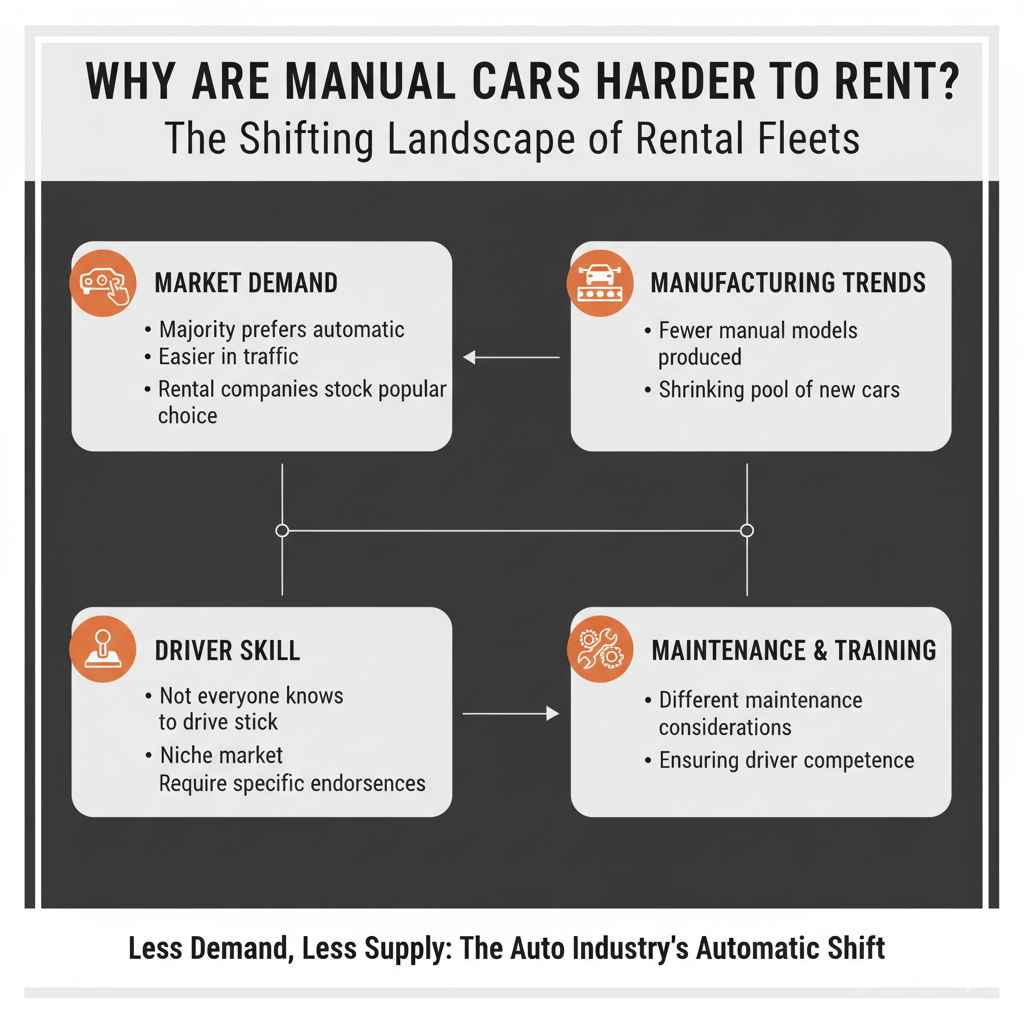
The shift towards automatic transmissions in new car sales has a direct impact on rental fleets. Here’s why you’ll find fewer manual cars available:
- Market Demand: The majority of drivers today prefer automatic cars because they are generally easier to drive, especially in stop-and-go traffic. Rental companies often stock what sells and what customers ask for most.
- Manufacturing Trends: Car manufacturers are producing fewer manual transmission models. This means the pool of new manual cars available for rental companies to purchase is shrinking.
- Driver Skill: Not everyone knows how to drive a manual. Rental companies might see offering manuals as catering to a smaller niche, and sometimes, they require specific assurances or endorsements from renters.
- Maintenance and Training: While not significantly more complex, there can be slightly different considerations for maintenance and ensuring drivers are competent.
Can You Rent Manual Cars? The Simple Answer
Yes, but with caveats. While automatic transmissions dominate rental fleets, manual cars are still available. Your success in finding one often depends on:
- Location: Manuals are more common in regions where stick shifts are still popular, like parts of Europe (especially the UK and Ireland) or in more rural areas globally.
- Rental Company: Some companies specialize more than others, or have specific car classes that are more likely to be manual.
- Timing and Booking: Booking in advance is crucial. Manuals are often reserved quickly.
- Car Class: You’re more likely to find manual transmissions in economy, compact, or smaller vehicle classes. Luxury or specialty vehicles are almost always automatic.
Where and How to Find a Manual Rental Car
Finding a manual transmission car for rent requires a proactive approach. Here’s your step-by-step strategy from Md Meraj:
1. Start with Major Rental Companies
You’d be surprised, but the big names often still have a few manuals in their fleet. Don’t just rely on the website’s initial search; sometimes you need to dig deeper or call.
- Hertz, Avis, Enterprise, Budget, Sixt, Europcar: These companies operate globally and maintain diverse fleets. They are your best bet.
2. Be Specific in Your Search
When searching on a rental company’s website, look for terms like “Manual,” “Stick Shift,” or “Standard Transmission.” Sometimes, they might list the car type (e.g., “Economy” or “Compact”) which is historically more likely to be manual. If the transmission type isn’t clearly listed, proceed to the next steps.
3. Filter by Car Class
For the best chance of finding a manual, focus on these car classes:
- Economy: Small, fuel-efficient cars are frequently manual.
- Compact: Similar to economy, these smaller cars often come with a stick shift option.
- Intermediate: A slightly larger option that might still offer manuals.
Avoid classes like “Full-Size,” “Luxury,” “SUV,” “Minivan,” or “Sports Car,” as these are almost exclusively automatic.
4. Read the Fine Print and Car Details
Once you find a car that seems promising, click on the details. Look for specific information about the transmission. If it doesn’t explicitly say “Automatic,” there’s a good chance it might be manual, but it’s best to confirm.
5. Call the Rental Location Directly
This is perhaps the most effective method. Websites can be clunky, and inventory displayed online might not always be 100% up-to-date for specific transmission types. Calling the actual rental branch you plan to pick up from can confirm availability directly. Be ready to state your request clearly: “I need to reserve a car with a manual transmission.”
6. Consider Local or Smaller Rental Companies
In areas where manual cars are more popular, smaller, local rental agencies might be more likely to cater to that demand. Do some research specific to your destination.
7. Book in Advance!
Manual cars are rare, and when available, they are often booked up quickly because they appeal to a specific group of renters. The earlier you book, the better your odds. Aim to book at least a few weeks, if not months, ahead of your travel date.
Rental Agreement Considerations for Manual Cars
Once you’ve secured a manual car, there are a few extra things to be aware of in your rental agreement:
- Driver’s License: Ensure your driver’s license doesn’t have any restrictions related to automatic or manual transmissions. In some countries, there might be separate endorsements. For example, in the United States, most licenses cover both, but it’s always good to be aware. If you obtained your license in an automatic car, be confident in your ability to operate a manual before renting.
- Insurance: Standard rental insurance usually covers all car types. However, always review the policy to understand what’s included.
- Damage Waivers: Be aware of any extra charges or clauses related to potential damage, especially clutch wear if not handled properly.
- Mileage Limits: If you’re planning a road trip, check mileage limits and pay close attention to whether they are sufficient for your plans.
Pros and Cons of Renting a Manual Car
Renting a manual car can be a fun experience, but it also comes with its own set of advantages and disadvantages. Let’s look at them:
| Pros | Cons |
|---|---|
| More Engaging Drive: You have more control over the vehicle, leading to a more connected and enjoyable driving experience, especially on scenic routes. | Steeper Learning Curve: If you’re not accustomed to driving a manual, it can be challenging to learn, especially in stressful situations like hill starts or heavy traffic. |
| Potentially Cheaper: Sometimes, manual transmission cars can be slightly cheaper to rent than their automatic counterparts, though this isn’t always the case. | Harder to Find: As discussed, availability is limited, requiring advance booking and potentially more effort to secure. |
| Better Fuel Efficiency (Historically): While modern automatics are very efficient, a skilled manual driver can often achieve better fuel economy – though this gap has narrowed considerably. | Difficult in Traffic: Constant clutch work in heavy, stop-and-go traffic can be exhausting and tedious. |
| Sense of Accomplishment: Successfully navigating with a manual transmission can be rewarding, especially if you’re practicing or have a specific reason to drive one. | Risk of Damage: Improper clutch use (e.g., “riding” the clutch, stalling, poor gear changes) can potentially lead to unintended damage, which could have rental implications. However, rental companies expect normal wear and tear. |
| More Control on Slopes: Manuals offer precise control on steep hills, which can be advantageous in certain terrains. | Less Ideal for Novices: If you’re a new driver or someone who hasn’t driven a manual in years, it might be best to opt for an automatic for rental ease. |
Tips for Driving a Manual Rental Car
If you’ve booked a manual and want to ensure a smooth journey, here are some practical tips:
- Practice Before You Go: If possible, get some practice in a manual car before your trip. This will build your confidence for picking up the rental.
- Understand the Clutch: The clutch pedal is usually on the far left, just like the accelerator and brake. It’s used to disengage the engine from the transmission, allowing you to change gears smoothly.
-
The Gear Stick Operation:
- Neutral: Wiggle the gear stick freely side-to-side.
- First Gear: Usually up and to the left.
- Reverse: Often marked with an ‘R’, sometimes requires lifting a collar or pushing down on the gear stick. Check the diagram on the stick or console.
- Other Gears: Typically arranged in a pattern (e.g., 2nd below 1st, 3rd and 4th in the middle symmetrically, 5th and 6th to the right).
-
Starting the Car:
- Put the car in Neutral.
- Press the clutch pedal all the way down.
- Turn the ignition key or press the start button.
- Once the engine is running, you can gently release the clutch.
-
Moving Off:
- Press the clutch pedal down.
- Shift into first gear.
- Gently release the clutch pedal while simultaneously and gradually pressing the accelerator. You’ll feel the “bite point” where the clutch starts to engage and the engine RPMs might dip slightly. Find this point, hold it briefly, then slowly release the clutch fully as you apply more gas.
-
Changing Gears:
- As you accelerate, the engine will rev higher. When it reaches a suitable RPM for the next gear (listen to the engine sound!), ease off the accelerator, press the clutch pedal fully down, shift to the next gear, and then smoothly release the clutch while gently pressing the accelerator again.
- For downshifting (slowing down), do the same process: ease off accelerator, clutch down, shift to a lower gear, clutch up, then reapply accelerator as needed for engine braking or maintaining speed.
-
Hill Starts: This is where practice is key!
- Engage the handbrake firmly.
- Put the car in first gear, clutch down.
- Find the clutch’s bite point.
- As you begin to feed in enough gas to hold the car still (or start moving forward slightly), slowly release the handbrake.
- As soon as the car feels like it’s pulling forward, release the clutch fully.
If you stall, don’t panic! Just re-engage the handbrake, put the car in neutral, restart the engine, and try again. Most rental cars have hill-start assist features nowadays, but it’s good to know the manual way.
- Parking: Always put the car in gear (first on a hill facing up, reverse on a hill facing down) and engage the handbrake.
- Don’t Ride the Clutch: Avoid resting your foot on the clutch pedal once you’ve engaged the gear. This causes unnecessary wear.
- Be Patient: If you’re learning, take your time. Avoid stressful driving situations until you’re comfortable.
For more detailed guidance on driving a manual, you can refer to resources like the DMV.org’s guide on driving a manual transmission, prepared for new drivers looking to master the skill.
Can You Rent a Manual Car in Different Countries?
The availability and prevalence of manual cars can vary significantly by country:
Europe
Manual transmission cars are much more common throughout Europe, especially in:
- United Kingdom and Ireland: Driving is on the left, and manual cars are the norm. You’ll find many options.
- Continental Europe (France, Germany, Italy, Spain, etc.): While automatics are gaining ground, manual cars are still widely available and often the default option in the economy and compact classes.
If you’re renting in Europe, your chances of finding a manual are generally high, especially if you book an economy or compact car and book in advance.
North America (USA & Canada)
This is where manual rentals become significantly more challenging. Automatic transmissions dominate the market, and thus, rental fleets. You might find a rare manual in:
- Budget or Economy Classes: Sometimes offered by major companies, but very limited.
- Specific Locations: Very rural areas might have a slightly higher chance, but it’s uncommon.
- Specialty Rentals: Some classic car rental companies or performance car rentals might offer manuals, but these come at a premium.
If you need a manual in North America, pre-booking and direct calls to the rental location are absolutely essential.
Asia, Australia, and New Zealand
The availability varies by country and region. In Australia and New Zealand, automatics are prevalent, but you might still find some manual options in smaller car classes. In many Asian countries, manual transmission vehicles are still common workhorses, so finding one for rent might be easier, especially in smaller vehicle categories or through local rental outfits.
When to Choose a Manual Rental
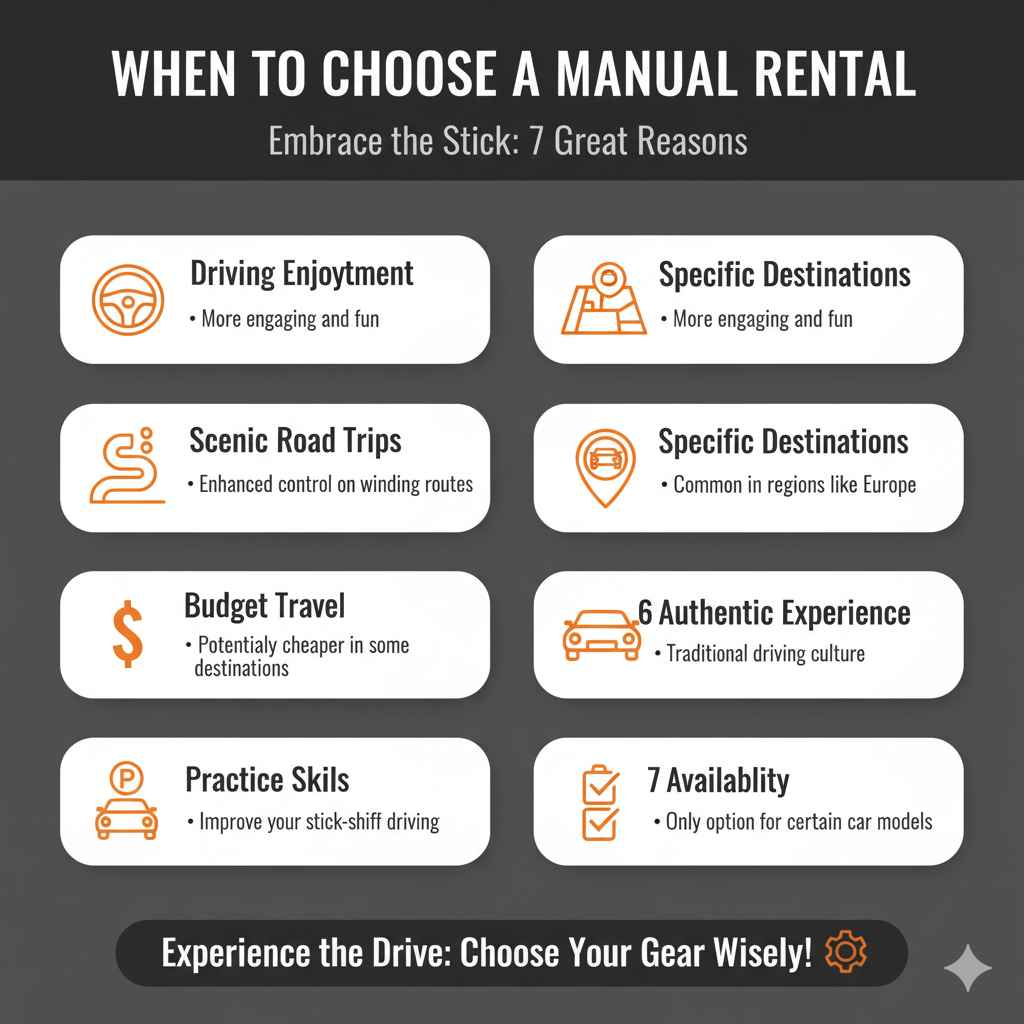
Here are some excellent reasons you might actively seek out a manual rental:
- You Love Driving: If you find driving a manual more engaging and fun.
- Scenic Road Trips: More control can enhance the experience on winding, scenic routes.
- Budget Travel: If you find manuals are typically cheaper to rent in your chosen destination.
- Practicing Your Skills: If you are learning to drive stick and want to get more practice.
- Specific Destinations: If you’re traveling to a region like Europe where manuals are common and a part of the driving culture.
- Authentic Experience: For a more “traditional” driving experience in certain countries.
When to Stick with an Automatic Rental
Conversely, an automatic is often the better choice if:
- You’re Unfamiliar with Manuals: Don’t rent a manual if you don’t know how to drive one or are very rusty.
- Heavy City Traffic: Constant clutch work in urban jams is tiring.
- Limited Time: If you’re in a hurry and just need to get from A to B without fuss.
- Comfort is Key: If you simply prefer the ease and comfort of an automatic.
- No Manual Options Available: If you can’t find one despite your best efforts, it’s better to accept an automatic than be without a car.
Frequently Asked Questions (FAQ)
Q1: How can I be sure the car I book is a manual and not an automatic?
While websites might not always be perfectly clear, the best ways are to filter by car class (economy/compact are more likely manual), read the detailed car description very carefully, and most importantly, call the specific rental location directly to confirm availability before booking or upon booking.
Q2: Are manual cars cheaper to rent than automatic cars?
Historically, yes, manual cars were often cheaper. While this is still sometimes the case, especially in regions where manuals are common (like Europe), the price difference is narrowing. Automatics are so dominant now that the “cheaper” aspect isn’t as guaranteed as it once was. Always compare prices for the specific car you’re interested in.
Q3: What if I book a manual but can’t drive it well enough?
If you realize you’re struggling soon after picking up the car, contact the rental company immediately. They might be able to switch you to an automatic, but this is subject to availability and potential re-metering (you might incur extra charges or need to pay for a different car class). It’s best to be confident in your manual driving skills before renting one.