Parking Sensors vs 360 Camera: Which Fits Your Parking?
For tight city parking and parallel spots, a 360 camera is the better tool; for simple front-and-rear distance warnings, parking sensors are enough. Pick the system that matches your blind spots, or you may scrape wheels, tap bumpers, or still guess in tight spaces. This guide compares both by parking scenario, weather, vehicle size, and what each system actually solves.
Parking sensors vs 360 camera: what each one does


Parking sensors use ultrasonic proximity sensor hardware to measure distance to nearby objects and warn you with beeps or tones. A 360 camera system uses four cameras around the vehicle to build a stitched bird’s-eye composite image, which helps you place the car visually in tight spaces.
How parking sensors detect distance with ultrasound
Ultrasonic parking sensors send out sound waves and measure the echo’s return time. They are often mounted in the front and rear bumpers, and the alert pattern usually speeds up as distance closes, then may turn into a solid tone near the stop point.
They are most useful at parking speed, not at normal driving speeds. Many OEM systems are limited to low-speed maneuvering and may shut off above a set threshold, which is why they are generally a parking aid rather than a traffic safety system.
How a 360 camera builds a bird’s-eye view
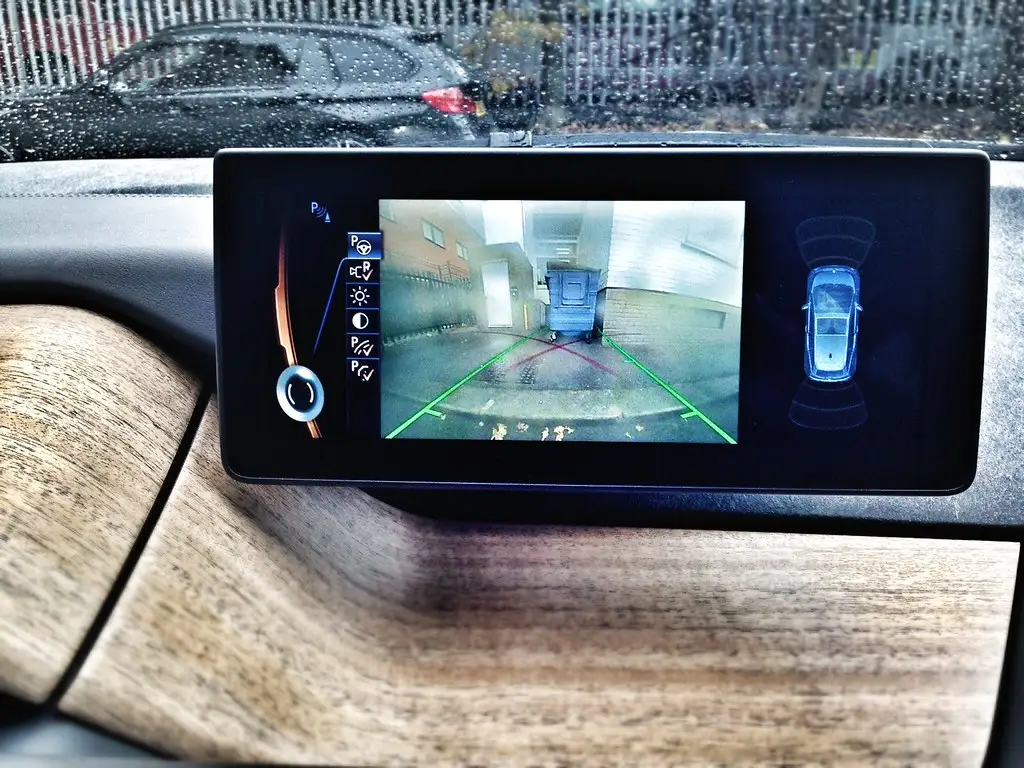
A surround-view system generally uses multiple cameras around the vehicle, then software stitches the feeds into a top-down view. That composite view helps you see curb edges, posts, painted lines, and wheel position around the vehicle.
The trade-off is setup complexity. The system depends on precise camera angle and height alignment, so calibration matters after body repairs, bumper work, or changes that alter ride height or camera position.
Where the two systems overlap, and where they do not
Both help at low speed, and both can reduce guesswork. But sensors tell you how close something is, while a 360 camera shows where the car is relative to it.
That difference matters in angled spots, narrow garages, and curb parking. A beeping sensor can say “stop soon”; a surround-view image can show that your front wheel is already drifting toward the curb.
| Decision factor | Parking Sensors | 360 Camera | Winner |
|---|---|---|---|
| Close-range distance warning | Very good for front and rear proximity alerts | Good, but depends on driver reading the image | Parking Sensors |
| Seeing wheel position and curb edge | Limited | Strong, especially with bird’s-eye view | 360 Camera |
| Low-light and dirty-weather tolerance | Better when sensors stay clear | Weaker when lenses are dirty, wet, or glazed | Parking Sensors |
| Calibration and retrofit complexity | Usually simpler, especially aftermarket | More complex; true surround-view retrofits are harder | Parking Sensors |
| Confidence in tight maneuvering | Good for warning-only guidance | Stronger for visual placement | 360 Camera |
Close-range distance warning
Parking sensors are a good fit when the main question is, “How close am I?” They are designed to measure proximity, and the audio cue lets you keep your eyes on mirrors, pillars, and pedestrians instead of a screen.
A 360 camera can still help, but it asks more of the driver. You have to interpret the image, which is easy for some drivers and distracting for others.
Seeing wheel position and curb edge
The 360 camera is better when the problem is placement, not just distance. If you need to keep a rear wheel off a high curb, or center the car in a narrow garage, the stitched overhead image gives far more context than beeps alone.
Parking sensors cannot show whether the obstacle is beside the wheel, behind the corner of the bumper, or offset to one side. That is the main reason they lose this category.
Low-light and dirty-weather tolerance
Sensors usually tolerate darkness better because ultrasound does not depend on visible light. Cameras can still work at night, but image quality drops with glare, weak lighting, and lens contamination from spray, road salt, mud, or rain droplets.
This is where a clean sensor may outperform a dirty camera. Still, sensors have their own weak point: snow, ice, and packed dirt can distort or block readings entirely.
Calibration and retrofit complexity
Parking sensors are often easier to retrofit than a real surround-view system. Many aftermarket kits use separate front or rear ultrasonic units, while a true 360 setup needs four cameras, wiring, display integration, and calibration that matches the vehicle trim.
That makes OEM availability important. Some vehicles offer a factory 360 system only on higher trims, and a retrofit may not fully replicate the original integration.
Confidence in tight maneuvering
The 360 camera is the stronger confidence tool for new drivers, seniors, and anyone parking a larger vehicle in a tight space. It reduces the mental load of estimating corner clearance, especially when the car is long, tall, or hard to see from the driver’s seat.
Parking sensors still help, but they leave more room for uncertainty. They warn; they do not show the full scene.
Which works better in real parking scenarios?
For curb parking, parallel parking, and cramped lots, a 360 camera usually solves the harder problem because it shows position, not just proximity. Parking sensors are better when you mainly need distance alerts in straightforward backing or pulling into a space. The combined setup is strongest when the vehicle offers both.
Curb parking and parallel parking
Parallel parking favors the 360 camera because wheel position, curb height, and adjacent cars all matter at once. A sensor can tell you the rear bumper is close; the camera shows whether the tire is about to kiss the curb or whether the nose is too far into traffic.
Say your sedan is sliding into a city curb space between two SUVs. The rear sensor may beep hard long before the wheels are aligned, but the bird’s-eye view can reveal that the front end still needs a small pull-up and angle correction.
Tight garages and short driveways
Tight garages often favor sensors if the main hazard is a wall, shelf, or closed door at one end. A front sensor is especially useful for creeping forward in small steps without staring at a screen the entire time.
If the garage is narrow or the car is long, the 360 camera becomes more valuable because it shows mirror clearance and side clearance together. That matters when you are trying to center a larger vehicle without scraping trim or folding mirrors repeatedly.
Apartment lots and angled spaces
Angled apartment spaces are where a 360 camera usually pulls ahead. The overhead image makes it easier to judge if the car is centered between lines when the parking angle hides part of the bumper or the wheel.
Sensors help if another bumper is too close, but they do not explain the shape of the stall. In lots with sharp angles, painted lines and curbs can be the real issue, not the object directly behind you.
Large vehicles, city streets, and low-speed turns
Large SUVs and trucks benefit more from a 360 camera because sight lines are worse and front corners are harder to judge. Sensors help, but they do not show the vehicle’s full footprint, which is the main challenge in tight city parking.
For low-speed turns into parking spots, the camera reduces guesswork. That is especially useful for new drivers who have not yet built a feel for overhang, wheelbase, and turning radius.

Scenario-by-scenario decision table
The right answer changes by maneuver. Use this table to match the system to the parking problem, not to the spec sheet.
| Scenario | Parking Sensors | 360 Camera | Combined setup | Recommendation |
|---|---|---|---|---|
| Curb parking | Helps with rear distance, less useful for wheel placement | Best for curb and wheel positioning | Best overall | 360 Camera |
| Garage parking | Strong for wall or door clearance | Useful if space is narrow or offset | Best if available | Parking Sensors |
| Parallel parking | Useful but limited for angle control | Best for positioning and curb awareness | Best overall | 360 Camera |
| Tight apartment lots | Good for bumper-to-bumper gaps | Best for line, curb, and corner visibility | Best overall | 360 Camera |
| Bad weather | Better if sensors stay clean; snow can confuse them | Weaker when lenses are wet, muddy, or salted | Better than either alone when clean | Parking Sensors |
| Large vehicles | Helpful for front and rear proximity only | Best for full-size placement control | Best overall | 360 Camera |
Where parking sensors fail and where they help most
Parking sensors help most when you want simple, low-workload distance warnings. They fail when the object is small, oddly shaped, or outside the bumper’s sensing zone, and they can false-alert if the bumper repair is off or a tow hitch sits in the way.
Front and rear placement
Front and rear placement matters because a sensor only covers the area near its bumper. That means the system is best at detecting obstacles directly ahead or behind, not off to the side of the wheel or beyond the sensor’s field.
Aftermarket systems can add coverage, but fitment quality varies. OEM placement is usually cleaner because the vehicle was designed for those sensor locations from the start.
Audible alert patterns and driver workload
The usual pattern is simple: slow beeps when far, rapid beeps when near, solid tone at very close range. That works well for drivers who want audio-first guidance or who would rather keep their eyes outside the car.
The downside is workload during complex maneuvers. In a cramped lot, beeps alone may not tell you which side is the problem.
Blind spots, small objects, and tow hitch false alerts
Ultrasonic sensors have blind spots at very low angles and may miss small posts, thin poles, or edges below the sensing beam. A tow hitch can also trigger false alerts because it sits where the sensor expects an obstacle.
Rain, snow, mud, and dirt can change the return signal. If the sensor face is blocked, the reading can become noisy or useless.
Speed thresholds and parking assist tie-ins
Many parking assist systems combine sensors and cameras, and some automatic steering systems use both to guide the vehicle into a space. Those systems usually activate only below a low speed threshold, because they are intended for parking and very slow maneuvering.
Warning-only systems tell you what is nearby. Automatic steering systems actually turn the wheel, but they still rely on low-speed sensor input and driver oversight.
Where a 360 camera helps, and where it can fall short

A 360 camera helps most when you need visual control of the car’s position, not just a warning. It falls short when the lenses are dirty, the light is poor, or the system is not calibrated correctly after repair or retrofit work.
Four-camera surround view and the stitched top-down image
The four-camera setup is the core advantage. By combining front, rear, and side views, the system creates a composite that helps you understand the vehicle’s footprint in one frame.
That makes angled spaces, curb lines, and tight offsets much easier to judge. It is not the same as a rear camera alone; the extra side views are what make the system useful in close quarters.
Low-light use, glare, and lens contamination
Rearview cameras are now a common regulatory baseline on new vehicles, and they are helpful for backing up. But low-light performance can drop quickly when the lens has water spots, salt film, mud, or a splash of slush on it.
Glare from headlights or sun can also wash out part of the image. A camera can still work at night, but the image is only as good as the lens and the lighting conditions allow.
Calibration needs after repair or tire changes
Sensor calibration matters because angle and height alignment affect what the system sees. After bumper repair, body work, or changes that alter ride height, a surround-view system may need recalibration to keep the composite image accurate.
Tow hitches can also interfere with sensor behavior. If the system was calibrated around a clean bumper and then a hitch is added, readings can become less reliable.
OEM systems versus retrofit kits
OEM surround-view systems are usually more complete than retrofit kits because they are integrated into the vehicle’s display, wiring, and trim. A true aftermarket 360 retrofit is possible on some vehicles, but it is more complicated than adding a basic rear camera or a few parking sensors.
That complexity matters for fitment, calibration, and reliability. If a shopper wants the factory-like result, OEM availability is the safer bet.
Choose Parking Sensors if… / Choose 360 Camera if…
Choose parking sensors if you want audio-first warnings, mostly back into simple spaces, and do not need to see the car’s footprint. Choose a 360 camera if you park in tight city spaces, care about curb and wheel placement, or want more confidence in narrow garages and angled lots. If the car offers both, the combined setup is the best answer for most buyers.
Choose parking sensors if you want audio-first guidance
- You mainly need front and rear distance warnings.
- You drive in simple garages or open spaces where exact wheel placement is less important.
- You want easier retrofit options than a full surround-view system.
- You prefer not to watch a screen while parking.
Choose a 360 camera if you want visual position control
- You park in parallel spots, curb spaces, or tight apartment lots.
- You drive a larger SUV, crossover, or truck with harder-to-see corners.
- You want to see wheel position, lane lines, and surrounding objects at once.
- You are shopping for the factory system rather than an aftermarket workaround.
Choose both if the car offers the combined setup
Combined systems give you a screen for placement and beeps for closing distance. That matters in bad weather, at night, and in mixed parking tasks where one tool fills the other’s blind spots.
Frequently asked questions
parking sensors vs camera
Parking sensors are better for distance warnings, while a camera is better for seeing position and nearby obstacles. If your main problem is not knowing how close the bumper is, sensors help. If your main problem is lining up the car in a tight space, a camera wins.
which is better parking sensors or camera
Neither wins every time. A camera is usually better for parallel parking, curb parking, and narrow garages because it shows the scene. Parking sensors are better when you want simple alerts without checking a display, especially for straight backing and creeping forward.
parking sensor vs parking camera
A parking sensor measures proximity with ultrasound and warns by tone. A parking camera shows the rear or surround view and helps you place the vehicle visually. The camera gives more context, but the sensor is often easier to use in poor light or when the screen is hard to read.
front parking sensor vs 360 camera
A front parking sensor is strongest when you only need help approaching a wall, garage door, or curb at low speed. A 360 camera is better when front clearance is only part of the problem and you also need to watch sides, wheel position, and the vehicle’s overall footprint.
how does 360 parking camera work
A 360 parking camera uses four cameras placed around the vehicle. Software stitches their feeds into a bird’s-eye composite image so you can see the car’s surroundings from above. That image depends on calibration, so repairs or hardware changes can affect accuracy.
are parking sensors worth it
Yes, if you want low-cost, low-effort guidance for close maneuvers. They are especially useful for drivers who do not want to rely on a screen and for cars that only need front and rear distance warnings. They are less helpful when exact placement matters more than distance.
do parking sensors work better than a rear camera
They work better in some conditions, such as darkness, because they do not rely on image quality. A rear camera works better for seeing obstacles, curb lines, and parking marks. For most drivers, the camera is more informative, but sensors can be easier to trust when visibility is poor.
is a 360 camera worth it for parking
It is worth it if you regularly park in tight city spaces, parallel spots, or narrow garages, or if you drive a large vehicle. It is less valuable if you mostly park in open lots and only need basic distance alerts. The value rises with vehicle size and parking difficulty.
Products related to this article
Sponsored / affiliate links. As an Amazon Associate I earn from qualifying purchases. I may earn additional commission from eligible campaigns.