Backup Camera vs Rear Parking Sensors
Choose a backup camera if you want to see obstacles directly behind you. Choose rear parking sensors if you mainly want an audible warning while you watch mirrors or look over your shoulder. Missing either system can mean clipped bumpers, scraped wheels, or a much costlier repair. This comparison explains how each works, where each fails, and which upgrade fits your parking habits.
| Decision factor | Backup Camera | Rear Parking Sensors | Winner |
|---|---|---|---|
| What it tells you | Shows the area behind the vehicle on a screen. | Gives audio warning or display output as an obstacle gets closer. | Backup Camera |
| Best fit for | Drivers who want visual confirmation of curbs, posts, children, pets, or cargo. | Drivers who want a warning while checking mirrors or turning their head forward. | Tie |
| Low-speed use | Strong for judging what is behind the bumper and how much space remains. | Strong for alerting you when an unseen object is close. | Tie |
| Failure mode | Can be hurt by glare, mud, snow, or a blocked lens. | Can miss silent or oddly shaped objects, and effects vary by automaker and driver age. | Tie |
| Install path | Can be OEM or aftermarket; many older cars may need a screen, wiring, and camera mounting for a backup camera retrofit. | Rear parking sensor installation usually needs sensor placement, wiring, and a control module tied into the reverse circuit. | Tie |
| Older-car retrofit | Often easier if you already have a screen or want a wireless kit. | Often more work because the bumper needs sensor holes and proper aiming. | Backup Camera |
| Night use | Helps if the camera has usable low-light image quality and the lens stays clean. | Works by distance sensing, so darkness matters less than dirt, ice, or blockage. | Rear Parking Sensors |
Backup camera vs rear parking sensors: which is better?
The better choice depends on what you miss while reversing. A backup camera works best when you need to see the obstacle itself. Rear parking sensors work best when your eyes are elsewhere and you want a close-range warning. For many drivers, the strongest setup is both together.
Rearview cameras reduced backing crash involvement rates by 17% in one study, and for drivers 70 and older the reduction was 36%. Rear parking sensors also showed benefit in one Buick Lucerne system, with a 34% reduction in backing crashes, though the study found sensor effects were less straightforward than camera effects.
What the table means in real parking
Back-up damage often starts with a bad guess about space, a low curb, or a child-sized obstacle that is hard to judge in mirrors. A camera helps you confirm what is actually behind the bumper. Sensors help when you are looking over a shoulder or at mirrors and still want an alert if the gap closes too far.
Picture a compact SUV backing toward a concrete post in a crowded lot. A camera shows the post early if the lens is clean and the image is clear. Sensors may warn later, but they can still catch the final few feet when your eyes are busy elsewhere.


What are rear parking sensors?
Rear parking sensors are commonly described as an ultrasonic proximity system mounted around the rear bumper. They measure distance to obstacles and give audible warnings or display output as the vehicle gets closer. The point is not to show the scene; it is to tell you that something is near the bumper.
These systems are often called parking radar. Some are rear-only, while others are front-and-rear configurations. Effectiveness varies by automaker and driver age, and the rear sensors can be combined with a rearview camera for a fuller picture.
How do rear parking sensors work?
Ultrasonic sensors send sound waves and read the return signal to estimate how far away an object is. The car then turns that distance into beeps, faster warnings, or a visual bar on a display. The closer the object, the more urgent the alert.
That makes sensors useful when your attention is split between mirrors, the steering wheel, and traffic around you. They are less useful for seeing exactly what the object is, and they can be confused by odd shapes, soft material, or objects that sit outside the sensor’s detection pattern.
What parking radar alerts sound like
Parking radar usually starts with spaced beeps and becomes more rapid as distance closes. Some systems add a screen cue, but the core signal is the audio alert. That is why sensors work well for drivers who want a warning they can hear without taking their eyes off the surroundings.
How do backup cameras help while reversing?
A backup camera shows what is behind the car on a screen, which is useful when a mirror view is limited or when you need direct visual confirmation. Many OEM and aftermarket units offer wide-angle or bird’s-eye style coverage, and some include guide lines on the screen. Some also integrate with a dash cam.
New passenger vehicles were expected to have rear visibility systems required starting in 2018, and CNET notes that new cars are required to have backup cameras installed before leaving the factory. That makes the camera the baseline rear-view tool on many newer vehicles, while older cars often need a retrofit.
Guide lines, dash cam links, and OEM vs aftermarket
Guide lines help you judge angle and path, but they do not measure distance with the same certainty as a sensor. A factory system may be tied into the infotainment display, while an aftermarket kit can use its own screen or connect to an existing one. Some backup cameras can also be integrated with a dash cam.
CNET also notes that some backup cameras use a wide angle or even a series of cameras, which is why the same category can look very different from one vehicle to another. The key question is whether your setup gives you the rear view you lack today.
Where each system fails
Neither system is perfect. Cameras can lose clarity when the lens is covered or the image is washed out. Sensors can miss very low objects, oddly shaped obstacles, or anything that falls outside their effective sensing pattern. The right choice depends on which failure matters more in your parking routine.
Low curbs, tow hitches, and silent objects
Low curbs are a common blind spot for both systems, but especially for sensors if the curb sits below the sensor’s best detection zone. A tow hitch can also interfere with sensor readings and create false alerts. Silent objects are a different problem: sensors may warn, but they will not tell you what you are about to hit.
A common first-timer mistake is assuming a beep means the obstacle is centered. It may mean only that something is close enough to trigger one sensor. A camera can show whether that thing is a shopping cart, a post, or the nose of another car.
Snow, mud, glare, and bad weather
Snow and mud can block both systems, but they hurt cameras in a more visible way because the lens image turns useless fast. Glare can also flatten detail on a screen, especially in bright sun or strong reflections. Sensors do not depend on light, but heavy grime, ice, or a blocked bumper can still weaken them.
At night, the trade-off changes. Sensors keep working as a distance aid in darkness, while cameras depend on image quality, lighting, and a clean lens. That is why night parking often favors sensors for warning and cameras for confirmation.
Rear safety decision matrix
This matrix turns the trade-off into practical choices. Use the vehicle type, your habits, and the most common blind spot to decide which system solves the problem you actually have. If your biggest miss is visual, camera first. If your biggest miss is attention, sensor first.
| Vehicle type | Driver type | Common blind spot | Weather or failure risk | Install complexity | Recommendation |
|---|---|---|---|---|---|
| Compact car | Daily city parker | Low curb, short post, tight parallel space | Glare and dirty lens in stop-and-go traffic | Low to moderate for either, depending on screen access | Backup Camera |
| Midsize sedan | Older driver | Parking space edge, shopping cart, child-height object | Night glare and reduced mirror confidence | Moderate for camera; moderate for sensors | Backup Camera |
| SUV | Frequent mall or school-lot parker | Rear bumper edge and objects just below mirror line | Snow, mud, and a higher rear body that hides small objects | Moderate for both | Both |
| Van | Family or work driver | Long rear overhang and wide blind zone | Glare, rain, and busy loading-zone backing | Moderate to high for camera; moderate for sensors | Both |
| Older car with no screen | Budget retrofit buyer | Rear bumper corners and lane position while backing | Wiring limits, hidden dash-space issues | Higher for camera if no display exists; moderate for sensors | Rear Parking Sensors |
| Bulky vehicle with premium trim | Driver who wants all-around awareness | Wide rear corners and diagonal backing paths | Snow, mud, and blind spots around the rear corners | Higher, especially for multi-camera systems | Both |
| Where each fails | Any driver | Low curbs, tow hitch interference, silent obstacles | Snow, mud, glare, or a blocked lens/sensor face | Varies by system and vehicle | Tie |
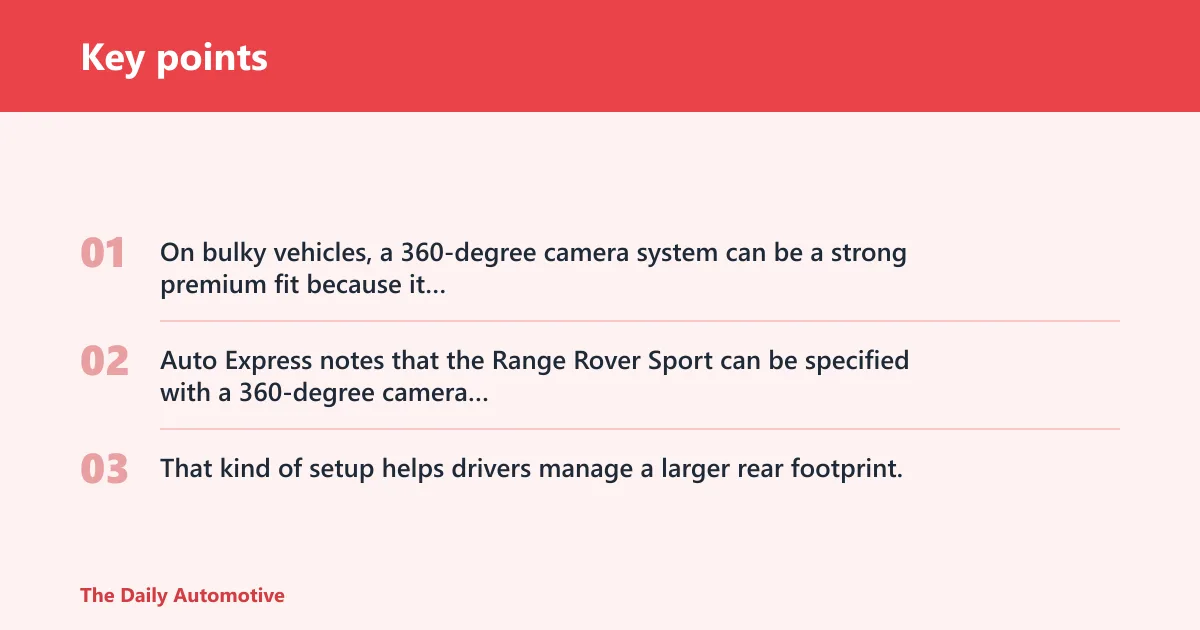
On bulky vehicles, a 360-degree camera system can be a strong premium fit because it gives wraparound parking visibility. Auto Express notes that the Range Rover Sport can be specified with a 360-degree camera system, and that the vehicle also has blind spot monitoring and lane-keeping assist as standard. That kind of setup helps drivers manage a larger rear footprint, especially in tight spaces.
Choose Backup Camera if… / Choose Rear Parking Sensors if…
Choose Backup Camera if you need to see what is behind the car, if you park in tight lots where curbs and posts are common, or if you want clear visual confirmation before you stop. It is also the stronger choice for older drivers who benefit from a direct image and for older cars that can take a simple aftermarket screen-based retrofit.
Choose Rear Parking Sensors if you keep your eyes on mirrors and traffic and mainly want a close-range warning you can hear. They make sense for drivers who want an alert without relying on a screen, and they can be the better retrofit when a car has no easy display path. If you want the most complete rear awareness, use both.
Can you add a backup camera to an older car?
Yes. An aftermarket backup camera kit can be installed on older cars, and it may be wired or wireless. Review roundups list budget kits starting around $26, while CNET notes that some backup cameras can be integrated with a dash cam. The main question is whether your car already has a screen or needs one added.
Wired vs wireless retrofit options
Wired kits usually need a camera mounted at the rear, a path for the video signal, and a display or head unit connection. Wireless kits can cut down on cable runs, but they still need power and a good signal path. Either way, check the kit’s listing for your model before buying.
Hidden costs often come from the display, trim removal tools, mounting hardware, or the labor needed to route cables cleanly. If the car has no screen at all, the price of the camera is only part of the bill. That is why some older-car owners find sensors easier to budget, even if the camera offers more visual detail.
How do you install rear parking sensors?
Rear parking sensors are usually installed as a sensor-based parking add-on, often called a rear parking assist kit. The bumper typically needs sensor placement, wiring to a control module, and a connection to the reverse light circuit so the system knows when the car is backing up. A retail listing price for some kits can be around $150 to $160.
- Check the bumper material and the kit’s fitment notes for your vehicle.
- Mark sensor locations so spacing stays even across the rear bumper.
- Run the wiring to the control module and reverse trigger.
- Mount the alert unit or display where the driver can hear or see it.
- Confirm the system triggers only in reverse and stays quiet otherwise.
The hard part is often not the sensor itself. It is the routing, drilling, and finishing work that keeps the system tidy and reliable. A poor install can lead to false alerts, weak output, or ugly fitment around the bumper.
How do you test rear parking sensors?
Test rear parking sensors by backing toward a known obstacle at walking pace and confirming that the alert starts at a sensible range and becomes more urgent as the gap closes. The goal is to verify that each sensor reports and that the beeps or display match what the car is actually doing.
Use a safe, open area and a helper if possible. Check for uneven warning patterns, dead zones, or one sensor that stays silent while the others react. If the warning changes only when the obstacle is directly behind the center of the car, the system may need adjustment or service.
Which is better for older drivers, camera or sensors?
A rearview camera is often the better first pick for older drivers because it reduced backing crash rates by 36% for drivers 70 and older in one study. It gives direct visual confirmation, which helps when mirrors alone do not feel clear enough. Sensors can still help, especially when hearing an urgent warning is easier than watching a screen.
If the driver has trouble turning to check blind zones, a camera usually gives the clearest benefit. If the driver prefers to keep eyes forward and react to a tone, sensors can be easier to use. For many older drivers, both together remove more uncertainty than either system alone.
Do backup cameras or parking sensors work better at night?
Rear parking sensors usually keep their distance-reading function at night because they do not depend on light. Backup cameras can still work well at night, but they rely on the lens staying clean and on enough image quality to show detail. In darkness, sensors are often the steadier warning tool, while cameras remain the better visual check.
If glare, rain, or a dirty lens is part of the equation, the camera’s image can fall apart faster than the sensor alert. But if the issue is a silent, low object that you want to see, the camera still has the edge when the screen remains usable. Night parking is one of the clearest cases for a combined system.
Should I get both a backup camera and rear parking sensors?
Get both if you want visual confirmation and close-range audio warning from the same reverse maneuver. That combination helps on SUVs, vans, and any car with a long rear overhang or a blind zone you cannot judge from mirrors alone. It also gives you a second cue if one system is obscured or hard to read.
Say your SUV is backing out of a driveway after a snowfall. The camera may be blurred by slush, but the sensors can still warn as the bumper nears a mailbox post. If the sensors are blocked by ice, the camera may still show the post once the lens is cleared. That backup layer matters.
What is the difference between a rearview camera and a backup camera?
In common use, the terms are often interchangeable. A rearview camera and a backup camera both mean a camera that shows what is behind the vehicle while reversing. Some drivers use “rearview” for the factory-style system and “backup” for the general category, but the function is the same.
The more useful distinction is between a camera and a sensor, not between those two camera labels. If a listing says backup camera, rearview camera, or rear camera, read the details for screen type, guide lines, and whether it is OEM or aftermarket. CNET notes that some backup cameras can show wide-angle coverage and may integrate with a dash cam.
Frequently asked questions
What are rear parking sensors: rear parking sensors are ultrasonic?
Rear parking sensors are ultrasonic parking aids mounted at the back of the vehicle. They measure how close an object is and warn the driver with beeps or a display cue. They are meant to alert you, not to show the obstacle on a screen.
How do you fit rear parking sensors?
To fit rear parking sensors, you usually mark the bumper, mount the sensors evenly, route the wires, and connect the control box to power and the reverse trigger. The exact process depends on the kit and the vehicle. Check the manufacturer’s listing for your model before cutting or drilling.
How do you install rear parking sensors: installation usually means bumper work?
Installation usually means bumper work, wiring, and a driver alert unit or display. The hardest part is getting the sensor spacing and cable routing right. If you want a cleaner result, professional fitment may be worth the extra cost.
Products related to this article
Sponsored / affiliate links. As an Amazon Associate I earn from qualifying purchases. I may earn additional commission from eligible campaigns.