Car Audio Upgrade Cost: Real Installed Prices
Installed car audio upgrade cost usually runs $300 to $800 for speakers and a simple amp, $800 to $2,500 for a full head unit plus amp-and-sub setup, and $2,500+ for OEM-integration jobs. Weak quotes hide the real bill in labor, adapters, and tuning. This guide breaks down upgrade paths, installed price ranges, and the hidden charges that change the final total.
Installed-cost ladder
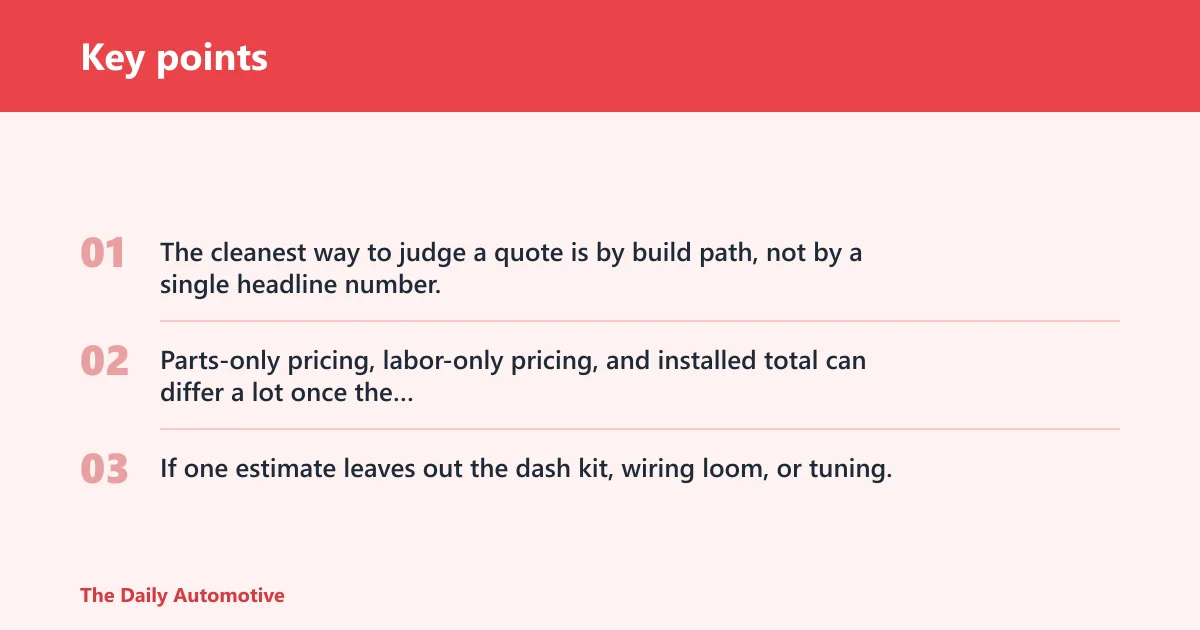


The cleanest way to judge a quote is by build path, not by a single headline number. Parts-only pricing, labor-only pricing, and installed total can differ a lot once the car needs adapters, dash parts, or factory-system integration.
| Build path | Parts range | Labor range | Hidden add-ons | Questions to ask the installer |
|---|---|---|---|---|
| Speaker swap | $50 to $200 per pair | Often modest, but varies with door access and bracket fitment | Speaker brackets, wiring adapters, sound deadening, trimming, reassembly time | Are brackets and adapters included? Do the doors need extra labor? Is any damping recommended? |
| Head unit swap | Basic Bluetooth radios about $60 to $100; touchscreen units about $250 to $700, with some premium units exceeding $800 | Professional labor for a straightforward installation is around $295 | Dash kit, wiring loom, antenna adapter, steering-wheel-control adapter, data interface, backup camera parts | Does the quote include the dash kit and wiring loom? Will steering-wheel controls still work? Is the camera integrated? |
| Head unit + speakers | About $110 to $900+ depending on screen type and speaker pair | Usually higher than a simple radio swap because the car is opened up twice or more | Extra wiring, mounting hardware, possible tuning, door damping | Are both jobs bundled? Is tuning included? What happens if the factory amp limits the new speakers? |
| Amp + sub package | Varies widely by amp, subwoofer, and enclosure; parts can push the project well above basic upgrade pricing | Amplifier and subwoofer install is about $150 to $250 in labor | Dedicated power wiring, fuse holders, enclosure cost, signal interface, gain setting, electrical checks | Does the quote include power wire, fuse, and enclosure? Is tuning part of the job? Any extra charge for running cable through the firewall? |
| Full system | Can exceed $2,000 when head unit, speakers, amp, sub, and accessories are combined | Can run from the low hundreds to $500 or more depending on integration complexity | Backup camera, data interface, steering-wheel-control module, sound deadening, rework on factory systems | What is included, and what is excluded? Are integration modules separate? Will the shop tune the system after install? |
Use the table to filter quotes. If one estimate leaves out the dash kit, wiring loom, or tuning, it is not the same job as the higher one next to it.
What changes the price most?
Vehicle age, factory integration, parts quality, and labor time explain most of the spread. Older cars often need fewer interface modules. Newer vehicles can need a data interface, steering-wheel-control retention, and more time around factory electronics.
Vehicle age and dash integration
An older car with a standard double-DIN opening is usually simpler than a late-model vehicle with a sculpted dash and screen-based controls. If the dash needs a kit, a trim panel, or custom mounting, the labor line moves fast.
Factory amp and data-bus complexity
Many modern cars send audio through a factory amplifier or a data network. That means the installer may need an interface module, extra programming, or more time to keep warning chimes and controls working. Those parts and the added labor can turn a cheap head unit into a much higher installed total.
Parts quality and brand tier
Parts range matters because cheap hardware can force a second labor bill later. A basic Bluetooth radio is not the same job as a touchscreen unit with camera input, app support, and vehicle-specific integration. The same is true for speakers: a bargain pair may fit, but it may not match the factory amplifier’s output.
Labor time and shop rates
Professional labor ranges from about $100 to $500, and original estimates use approximately $70 to $150 per hour as an illustrative labor range. A straightforward installation may be around $295, but complex wiring, disassembly, or programming can push the bill higher.
How much does a speaker swap cost?
A speaker swap is often the cheapest meaningful upgrade, with speakers about $50 to $200 per pair in the example. Labor depends on door access, brackets, and whether the shop has to remove panels, seal the door, or adapt the new speaker to the factory opening.
Parts range for door speakers
For a budget-minded build, a pair of replacement speakers can be the first step. That price does not include the rest of the job, though. If your car needs mounting brackets, foam rings, or wiring adapters, the final invoice rises.
Labor factors: door access and brackets
Some doors are quick. Others need careful panel removal, clips, water barriers, and bracket work. If the shop has to fabricate or modify mounting hardware, that labor can exceed the value of the speaker pair itself.
Picture a compact sedan with front speakers that are easy to reach. The install may stay close to the lower end of the labor range. Now picture a newer crossover with deep door panels, a factory amplifier, and odd-shaped mounts. The quote changes because the job changes.
When a speaker swap is the best first step
This path makes sense when the factory radio still sounds clean and the speakers are worn, harsh, or weak. It is less effective when the real problem is factory EQ, a weak amplifier, or aggressive bass roll-off. In those cars, new speakers alone may sound different, not better.
How much does a head unit swap cost?
A head unit swap usually starts with parts, then adds vehicle-specific accessories and labor. Basic Bluetooth radios are about $60 to $100, while touchscreen units run about $250 to $700, with some premium units exceeding $800. The installed total depends on dash parts, wiring, and integration.
Basic Bluetooth radios
A low-cost radio can be enough for drivers who want hands-free calling and streaming without chasing a larger screen. The catch is accessory cost. Even a modest radio may still need a dash kit, wiring loom, and antenna adapter to fit and work correctly.
Touchscreen units
Touchscreen head units add features, but they also add complexity. Many vehicles need a dash kit, wiring loom, antenna adapter, data interface, and sometimes a steering-wheel-control adapter. If the unit includes camera support or smartphone integration, installation time can climb further.
Required adapters and interfaces
Installation accessories range from about $15 to $150 depending on the part. A wiring loom adapter is required for vehicle compatibility, and the steering-wheel-control adapter keeps factory controls alive. In modern cars, the data interface can be the difference between a working install and a dashboard full of warning lights.
Backup camera integration
That extra charge reflects cable routing, power hookup, and integration with the screen, which can be straightforward or time-consuming depending on the vehicle.
Amp and subwoofer install costs
An amplifier and subwoofer package is where many quotes jump sharply. The subwoofer labor alone is about $150 to $250, but the real total also includes dedicated power wiring, signal wiring, an enclosure, and tuning. That is why bass-focused upgrades rarely stay cheap for long.
Amplifier labor and power wiring
An amplifier needs a clean power feed from the battery, grounding, and signal routing. That takes more labor than a simple radio swap. If the car has tight firewall access or a hard-to-reach battery, the installer may charge more for the time involved.
Subwoofer enclosure choices
The enclosure changes the bill as much as the speaker itself. A prefab box is simpler than a custom enclosure, but fitment still matters. Trunk space, hatch depth, and seat clearance all affect the final install cost.
Tuning and electrical add-ons
Many systems need gain setting or more detailed tuning after install. That step matters because a loud system with bad settings can clip, distort, or sound thin. If the vehicle has a weak charging system, the installer may recommend electrical add-ons that add cost beyond the amp and sub.
Suppose a driver wants a single 12-inch sub in a sedan trunk and adds a modest amplifier. The parts may look affordable on paper, but the labor, power wire, enclosure, and tuning push the total much closer to a full-system budget than a simple speaker job.
What hidden costs surprise buyers?
The biggest surprises are usually the parts that never appear in a casual quote. Wiring loom and antenna adapters, steering-wheel-control adapters, sound deadening, tuning, and rework on factory-amplified systems can all add cost after the first estimate.
Wiring loom and antenna adapters
A wiring loom adapter is required for vehicle compatibility, and an antenna adapter is common when replacing the factory radio. These are small parts, but they are not optional in many cars. If they are not in the quote, they may show up later.
Steering-wheel-control adapters
Steering-wheel-control adapters retain factory controls and often matter in newer vehicles. They can add parts and labor, especially when the head unit needs programming or the car uses a more complex data system. A quote that skips this item is incomplete if the customer wants those buttons to keep working.
Sound deadening and tuning
Sound deadening can improve perceived sound quality, especially in door panels that rattle or flex. It adds cost beyond speakers and the head unit, and it is often needed in premium builds. Tuning also matters, because a system that is installed but not adjusted may underperform.
Rework on factory-amplified systems
Factory-amplified systems can be the most expensive trap. A cheap speaker swap may sound worse if the new speakers are inefficient, the factory amp is already clipping, or the factory EQ is fighting the replacement parts. In those cases, the real fix may require more than a speaker change.
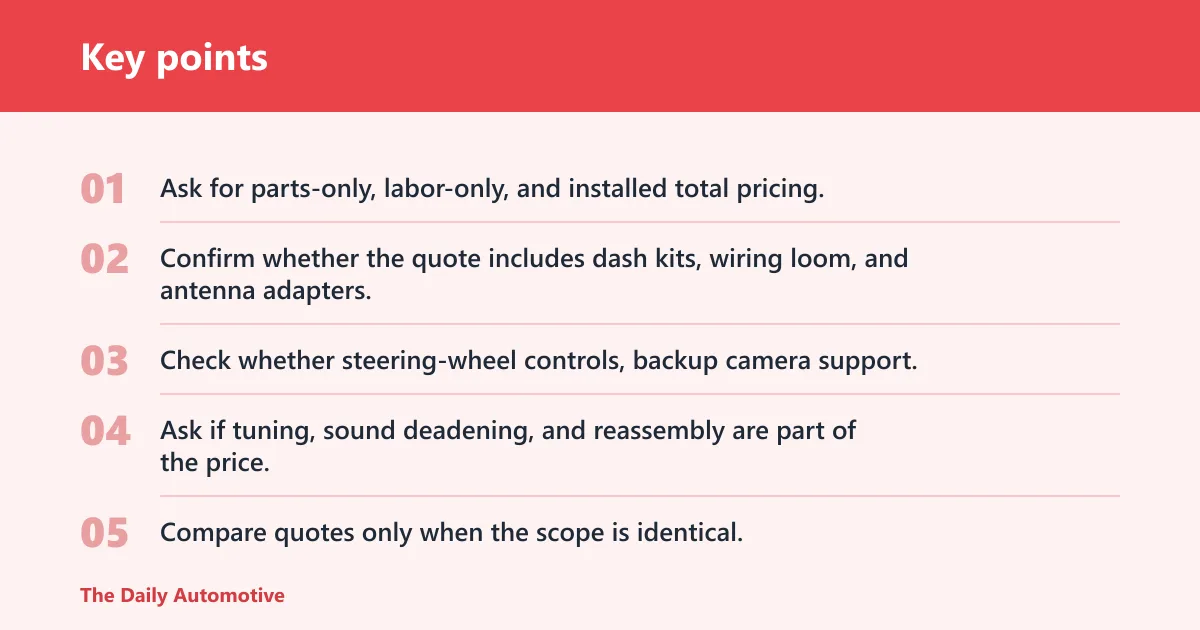
- Ask for parts-only, labor-only, and installed total pricing.
- Confirm whether the quote includes dash kits, wiring loom, and antenna adapters.
- Check whether steering-wheel controls, backup camera support, and factory amp integration are included.
- Ask if tuning, sound deadening, and reassembly are part of the price.
- Compare quotes only when the scope is identical.
When is the upgrade worth it?
It is usually worth it when the current system is the bottleneck and the next step matches the budget. Older cars with weak factory audio often benefit most from speakers or a basic head unit. Modern infotainment cars can be more expensive to improve, and bass-focused builds need a clear ceiling before costs climb too far.
Older cars with weak factory audio
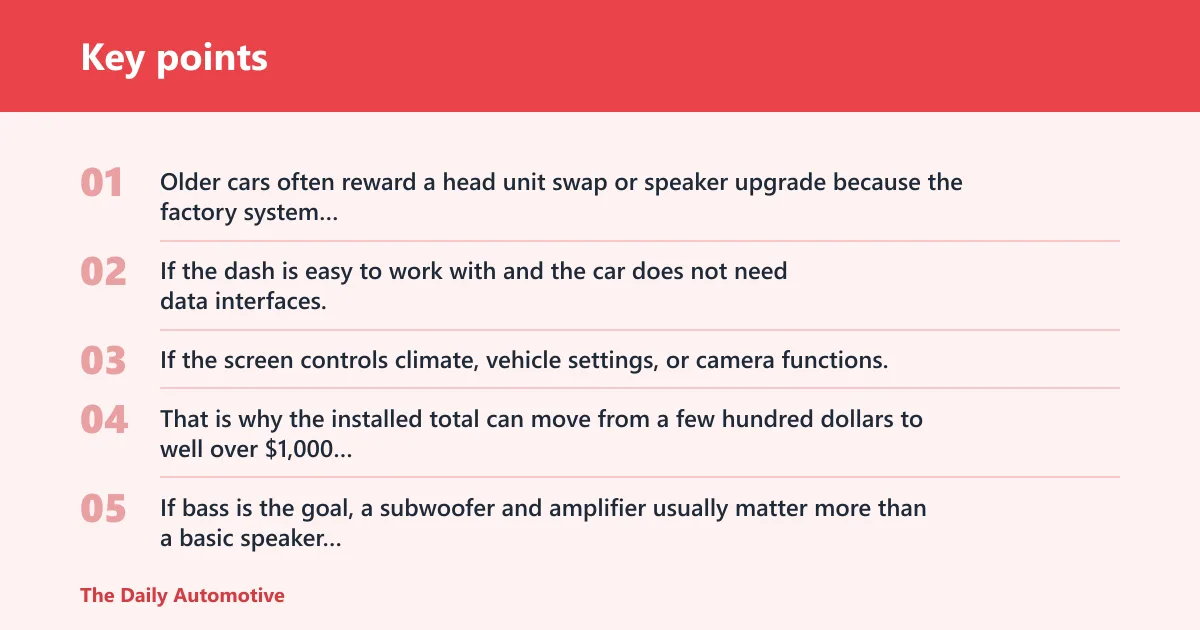
Older cars often reward a head unit swap or speaker upgrade because the factory system is simpler. If the dash is easy to work with and the car does not need data interfaces, the sound gain per dollar can be strong.
Modern infotainment cars
Modern cars may need more than a radio. If the screen controls climate, vehicle settings, or camera functions, the upgrade can become a full integration job. That is why the installed total can move from a few hundred dollars to well over $1,000 faster than most buyers expect.
Bass-focused budgets
If bass is the goal, a subwoofer and amplifier usually matter more than a basic speaker swap. The average buyer should expect that path to cost more than a simple radio change, because the package includes power wiring, enclosure work, and tuning.
When to stop upgrading
Stop when the next dollar buys less sound improvement than a different path would. That is the practical rule. If the factory amp, cabin noise, or weak integration is still the limit, a second speaker purchase may not be the best use of money. A complete audio upgrade can cost well over $2,000, so the ceiling matters.
Frequently asked questions
How much does it cost to upgrade a car sound system?
The final number depends on whether the job is speakers only, a head unit swap, or a larger system with amplifier, subwoofer, and integration parts.
Is upgrading car audio worth it?
It is worth it when the factory system is the weak point and the upgrade path fits the car. Older cars often gain the most from simple parts. Modern cars can cost more to improve, so the value depends on how much integration work is required.
How much does it cost to install a car stereo?
Professional labor for a straightforward installation is around $295. That number can rise if the car needs a dash kit, wiring loom, antenna adapter, steering-wheel-control adapter, or backup camera integration. Parts are separate unless the quote clearly says otherwise.
How much does it cost to install a subwoofer and amplifier?
Amplifier and subwoofer install is about $150 to $250 in labor, before parts. The total rises with the enclosure, power wiring, signal routing, and tuning. If the car needs extra electrical work, the bill can move higher again.
What affects car audio upgrade cost
Vehicle age, factory amp complexity, parts quality, and labor time have the biggest effect. Modern cars often need data interfaces and control adapters. Older cars may be simpler, but bracket fitment, door access, and tuning still change the final total.
How much should you spend on a car audio system?
Spend enough to match the car and the goal, then stop when the next upgrade no longer delivers clear value. A basic build can average around $400 with a new head unit and speakers, while an amp-and-sub setup pushes the total much higher. Better to buy the right path once than redo it later.
Products related to this article
Sponsored / affiliate links. As an Amazon Associate I earn from qualifying purchases. I may earn additional commission from eligible campaigns.