Car Audio System Cost
A basic car audio system replacement usually costs about $300 to $1,000 installed; a mid-tier upgrade runs about $1,000 to $2,500; complex factory-integration builds can exceed about $3,000. Underbudgeting often means surprise labor, missing adapters, or a system that loses factory features. This guide breaks down parts, labor, and hidden integration costs by upgrade level so you can estimate your total before you buy.
Car audio cost table
This worksheet splits parts, labor, and integration pieces so you can budget by build level instead of guessing from one headline number. The ranges below are planning numbers, not promises, because vehicle layout, factory electronics, and tuning demands change the bill.
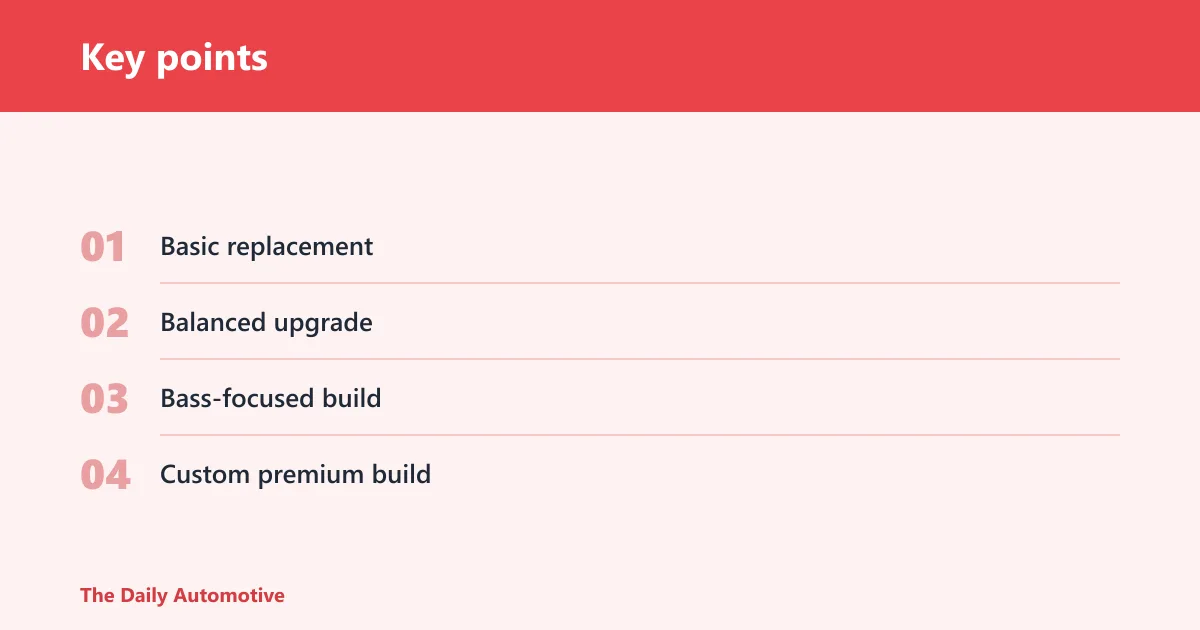
| Build tier | Parts cost | Labor cost | Hidden integration parts | Realistic total range | What to skip |
|---|---|---|---|---|---|
| Basic replacement | $150 to $450 | $295 to $400 | $50 to $150 | $300 to $1,000 | Skip the amp, subwoofer, and custom dash work. |
| Balanced upgrade | $500 to $900 | $400 to $700 | $100 to $250 | $1,000 to $2,500 | Skip rear-speaker replacements if the front stage matters more. |
| Bass-focused build | $700 to $1,500 | $500 to $900 | $150 to $350 | $1,100 to $2,500 | Skip premium displays and spend on clean power, wiring, and enclosure fit. |
| Custom premium build | $1,500 to $4,000+ | $900 to $2,000+ | $300 to $800+ | Well over $3,000 | Skip cosmetic extras until tuning, sound deadening, and integration are sorted. |
The hidden integration column matters because modern cars often need more than a head unit and speakers. You may also need a vehicle-specific wiring adapter, dash kit, mounting kit, fuse holder, power wire, RCA cables, and a steering wheel control interface.
Basic replacement build
A basic replacement is for drivers who want a working radio, smartphone connectivity, and factory features kept intact. That usually means a new head unit plus the adapters needed to make it fit and communicate with the vehicle.
If the factory system already sounds acceptable, this is often the smartest spend. A new head unit can be the main cost driver because smartphone integration, larger displays, and factory compatibility modules can push the price up quickly.
Balanced upgrade build
A balanced upgrade usually centers on a head unit, front component speakers, and modest amplification. Component speakers improve sound quality more than a same-price rear-speaker swap because the front stage carries most of the detail the driver hears.
Labor rises here because installers must run power, speaker, and signal wiring, then set gains and verify the system works with the vehicle’s electronics. A reasonable target for this level is around $1,000 to $1,100 for a well-balanced system with speakers, head unit, amplifier, and subwoofer.
Bass-focused build
A bass-focused build adds a subwoofer and the support hardware needed to feed it clean power. A powered sub is simpler and usually cheaper to install; a separate amplifier and passive subwoofer give more control, but they add wiring, setup time, and enclosure decisions.
Sound can still disappoint if the enclosure is wrong, the amp is underpowered, or the sub is phased badly. Bigger equipment does not fix poor setup.
Custom premium build
A custom premium build is where digital signal processing, sound deadening, and custom mounting push the cost up. A DSP helps tune speaker timing, equalization, and crossover points, but it also adds setup time and installation complexity.
This is the tier where labor can climb faster than parts. Premium systems may include custom fabrication, vehicle-specific modules, and more time spent tuning than bolting in hardware.
What to skip at each tier
- Basic replacement: skip amplifier upgrades unless the factory radio cannot drive the new speakers well.
- Balanced upgrade: skip rear speakers if you sit in the front row and want better detail up front.
- Bass-focused build: skip oversized cosmetics and put money into the enclosure, power wire, and fuse protection.
- Custom premium build: skip luxury add-ons until the tuning, wiring, and integration parts are complete.
How much does a car audio system cost?
How much a car audio system costs depends on replacing one worn-out piece or building a full system around factory electronics. Parts-only budgets can stay near a few hundred dollars, but installed projects often move into four figures once labor and compatibility pieces are included.
Typical parts-only range
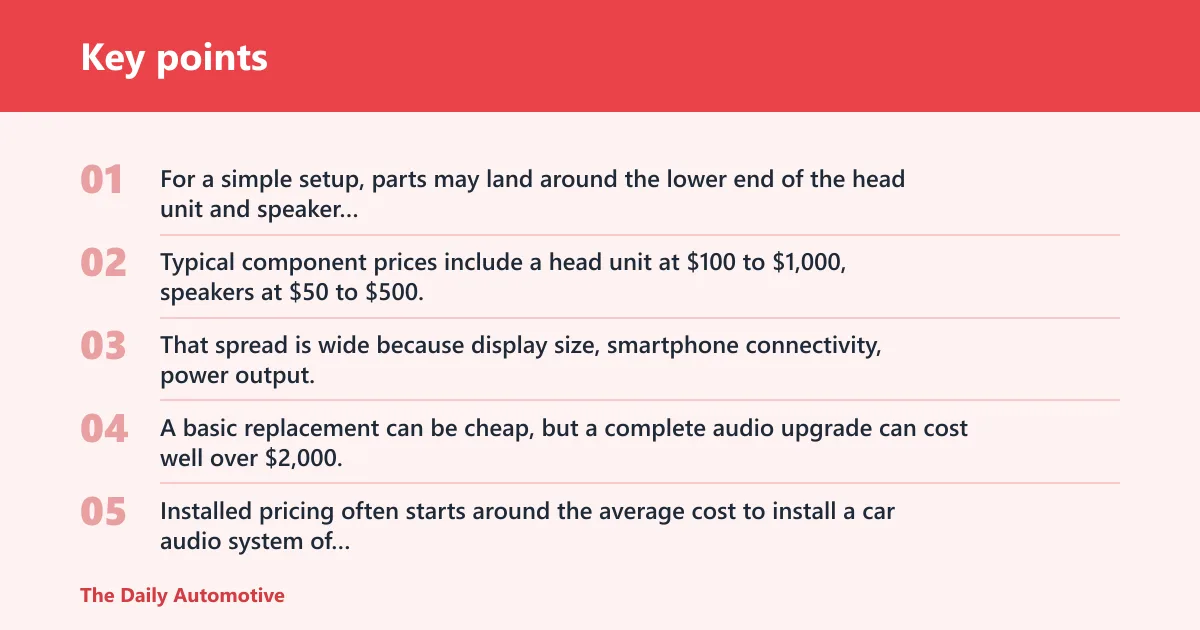
For a simple setup, parts may land around the lower end of the head unit and speaker ranges. Typical component prices include a head unit at $100 to $1,000, speakers at $50 to $500, an amplifier at $100 to $1,000, and a subwoofer at $50 to $800.
That spread is wide because display size, smartphone connectivity, power output, and vehicle compatibility all change the bill. A basic replacement can be cheap, but a complete audio upgrade can cost well over $2,000.
Typical installed range
Installed pricing often starts around the average cost to install a car audio system of around $400 for a basic upgrade. Adding an amplifier and subwoofer can bring total cost closer to $1,100 with professional installation.
A well-balanced system can sit near $1,000 to $1,100, while more involved factory-integration work pushes the price much higher. Complex builds often need extra modules, more labor, and tuning time.
Why the total changes by vehicle
Vehicle design changes both parts and labor. Some cars accept a new head unit with a simple adapter, while others need an interface module to keep steering wheel controls, factory audio warnings, or amplifier communication working.
Suppose a 2018 SUV needs a dash kit, steering wheel control interface, and a vehicle-specific adapter just to keep the backup camera and factory buttons alive. The equipment list may look modest until those parts are added.
What drives the price up?
The biggest cost drivers are the head unit, factory integration, speakers, amplifiers, subwoofers, and the vehicle-specific parts needed to connect them. Cars with newer electronics usually cost more to update because they need more adapters and more labor.
Head unit and factory integration
A head unit is often the biggest single upgrade cost because it may control smartphone connectivity, display size, navigation features, and factory integration. If the vehicle uses a data network instead of simple wiring, you may need extra modules to retain stock functions.
That is why a cheap head unit can still produce an expensive job once the dash kit, adapter, and interface are counted. The radio itself is only part of the invoice.
Speakers, amps, and subwoofers
Component speakers usually go in the front doors or kick panels and improve imaging and clarity. Rear speakers matter less for sound quality in many daily-driver builds, so paying for them first is often a weaker value move.
An amplifier adds power, but it also needs dedicated wiring and more labor. Typical amplifier installation runs about $120-$130, while subwoofer installation is around $100 in labor; installing a subwoofer and amplifier typically costs around $220 to $250 in labor.
Vehicle-specific modules and wiring
Modern cars often need a wiring adapter, steering wheel control interface, and other integration parts before anything will function correctly. Those add-ons may look small on paper, but they can change the job from a simple swap to a multi-hour install.
Hidden parts also include mounting kits, fuse holders, power wire, and RCA cables. Those items do not create sound on their own, but they are often required for a safe and reliable install.
How much does installation add?
Professional installation can add a lot, and the bill should be treated as a scope-based charge rather than a flat fee. A straightforward car audio installation labor baseline is around $295, but the price rises as the job adds amplifiers, subwoofers, interfaces, and tuning.
Baseline labor estimate
For a plain radio replacement, labor may begin near the $295 baseline. That number can still move up if the dash is difficult, the factory wiring is complex, or the installer has to retain steering wheel controls and camera functions.
In practice, labor tends to follow the time spent on removal, wiring, testing, and setup. A simple swap is faster than a system that needs multiple modules and custom signal routing.
Scope-based labor pricing
Labor rises with each added layer. A head unit swap is one thing; adding component speakers, an amplifier, a subwoofer, and a DSP is another job entirely.
Premium builds can also require sound deadening and custom installation, which adds time and material. That is one reason a complete audio upgrade can cost well over $2,000 even before top-shelf parts are chosen.
Regional rate differences
Regional labor rates vary by city, shop type, and demand. A shop in a high-cost market may charge more than a smaller-market installer for the same basic work.
Ask for written estimates that separate parts, labor, and integration parts. That makes it easier to compare quotes and see whether one shop is simply quoting more complete work.
What do the parts cost?
Parts pricing is easiest to read in categories. The head unit drives the feature set, speakers change clarity, amps add power, subs add low end, and DSPs handle tuning when the system becomes more complex.
Head unit pricing
Head units typically run from $100 to $1,000. Lower-cost units may cover basic Bluetooth and smartphone connectivity, while higher-end units can add bigger screens, more outputs, and better factory-system compatibility.
If the vehicle depends on the original radio for climate or vehicle settings, the head unit change may require extra integration hardware. That cost belongs in the budget from the start.
Speaker and amplifier pricing
Typical speaker cost ranges from $50 to $500. Component speakers cost more than simple coaxial replacements because they use separate tweeters, crossovers, and midrange drivers for better front-stage performance.
Typical amplifier cost ranges from $100 to $1,000. More power means more wiring, more setup, and more room for error if gains are not set correctly.
Subwoofer and DSP pricing
Typical subwoofer cost ranges from $50 to $800. Powered subwoofers simplify the build, while passive subs paired with a separate amplifier usually need more install time and more enclosure planning.
A DSP is often a premium-build item because it lets the installer tune output, timing, and crossover behavior. It also multiplies setup complexity, which is why premium systems often cost more even when the parts list looks manageable.
Adapters, kits, and wiring
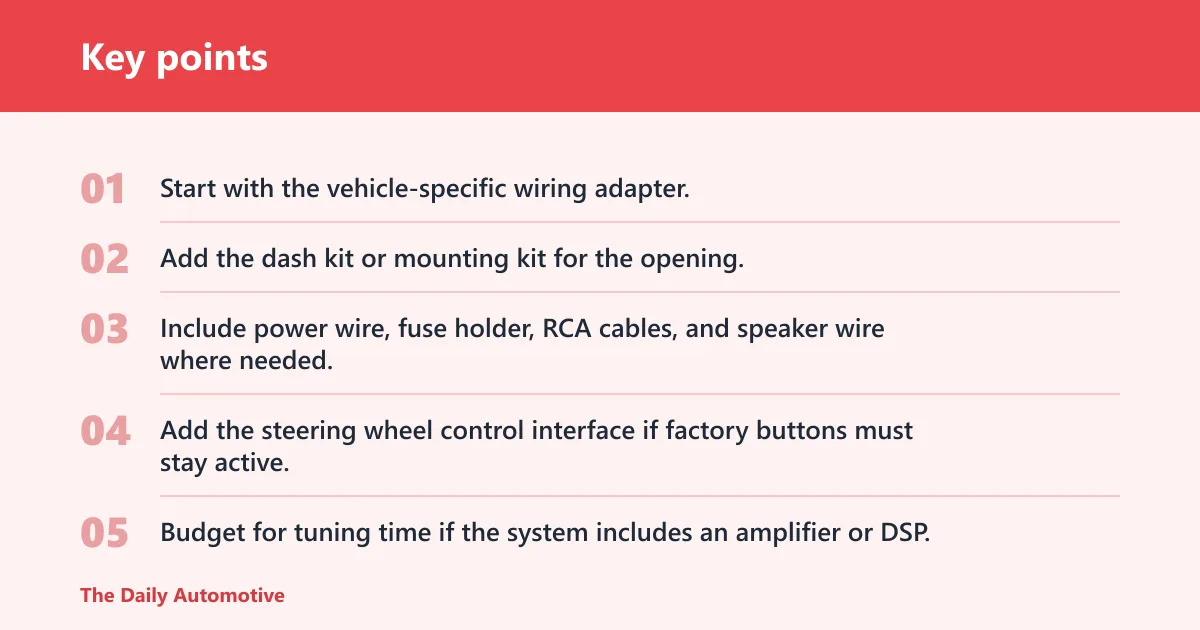
- Start with the vehicle-specific wiring adapter.
- Add the dash kit or mounting kit for the opening.
- Include power wire, fuse holder, RCA cables, and speaker wire where needed.
- Add the steering wheel control interface if factory buttons must stay active.
- Budget for tuning time if the system includes an amplifier or DSP.
These parts are easy to overlook because none of them are the “main” product. They are still part of the real invoice.
When is a full upgrade worth it?
A full upgrade is worth it when the factory system is limited, the speakers are failing, or the car needs new hardware anyway to preserve factory features. If the current system already sounds decent, a partial upgrade is often the smarter spend.
Signs a partial upgrade is enough
If the radio works, the speakers are only mildly thin, and you mainly want Bluetooth or CarPlay/Android Auto, a head unit or front-speaker swap may be enough. That avoids paying for bass gear and custom work you may not notice every day.
A common first-timer mistake is buying a subwoofer before fixing the front stage. Deep bass will not hide muddy mids or a poor head unit signal.
Cases where full replacement makes sense
If the factory radio is locked into the dash, the speakers distort at normal volume, and the vehicle has lost control or amplifier functions, a full system can make sense. Modern cars sometimes need enough interface parts that replacing only one piece solves too little.
That is also the point where a complete audio upgrade can cost well over $2,000. The expense is not only hardware; it is the work needed to make the pieces communicate.
When tuning matters more than new gear
Expensive gear can still sound poor if gain, phase, crossover settings, or wiring are wrong. A bad install can make a premium system sound worse than a modest one with careful setup.
Picture a bass build with a strong amp and a high-end sub that still sounds slow and lumpy because the enclosure is wrong and the phase is off. New parts would not fix that by themselves.
Frequently asked questions
How much does a good car audio system cost?
A good car audio system usually lands in the $600 to $1,100 range if you want a balanced mix of head unit, speakers, amplifier, and subwoofer. That range is a practical target because it covers useful upgrades without forcing you into custom fabrication.
How much does a full car audio system cost?
A full car audio system can run from around $1,000 to well over $3,000 once you include parts, labor, and the integration pieces needed for modern vehicles. The total climbs fast when the car needs steering wheel control modules, dash kits, or DSP tuning.
How much does it cost to install a full car audio system?
Installation cost depends on the scope, but a straightforward labor baseline is around $295. A system with an amplifier and subwoofer typically adds around $220 to $250 in labor, and more complex builds cost more because of wiring, tuning, and vehicle-specific modules.
How much does it cost to put a sound system in your car?
Putting a sound system in your car can cost around $300 to $1,000 for a basic replacement and move into the low thousands for bigger upgrades. The final number depends on replacing one unit, adding power, or keeping factory controls and displays intact.
Why is car audio so expensive?
Car audio gets expensive because the radio is only one part of the job. Speakers, amplifiers, subwoofers, wiring, adapters, and labor all stack up, and newer vehicles often need extra modules just to retain factory functions and keep the install clean.
Products related to this article
Sponsored / affiliate links. As an Amazon Associate I earn from qualifying purchases. I may earn additional commission from eligible campaigns.
 NuIth Universal Car Amplifier RCA Level Controller, Car Audio Bass Control Knob, High Quality Sub Amp Volume Control Cable for Car, Motorcycle, Speakers, Home Theater
 Pyle 3.0 Farad Digital Power Capacitor, High-Performance Car Audio Accessory with Blue Digital Display Voltage Readout and LED Flash, Over Voltage Protection, Mounting Hardware, DC 12-24V