Car Loan Refinance Cost: Fees and Break-Even
Car loan refinance cost is the total of lender fees, DMV/title charges, and any interest timing loss, and refinancing only makes sense when your monthly savings repay those costs before you sell the car or finish the loan. Ignore the math, and a lower APR can still leave you paying more overall. This guide breaks down each fee, shows how payoff timing changes the bill, and gives you a simple break-even check.
Refinance worksheet
Use this worksheet to compare offers without mixing lender-controlled fees with state or title charges. The key question is not whether the new APR is lower. It is whether the savings beat every upfront cost before the loan ends or the car leaves your driveway.
| Cost item | Who sets it | Example amount | Why it matters |
|---|---|---|---|
| Lender application or processing fee | New lender | $0 to $150 | Raises your upfront refinance cost even if the APR is lower. |
| Title transfer or lien recording fee | State, county, or title office | $25 to $250 | Needed to show the new lienholder on the title or registration record. |
| DMV or registration fee | State DMV | $0 to $200 | Can apply when paperwork, plates, or registration must be updated. |
| Prepayment penalty | Old lender | $0 to several hundred dollars | Some loans charge for paying off early. |
| Payoff interest overlap | Timing lag | $10 to $150 | Interest can keep running while the new lender and old lender exchange payoff funds. |
| Optional third-party charges | Outside service provider | $0 to $100+ | May include document delivery, notary, or similar add-ons. |
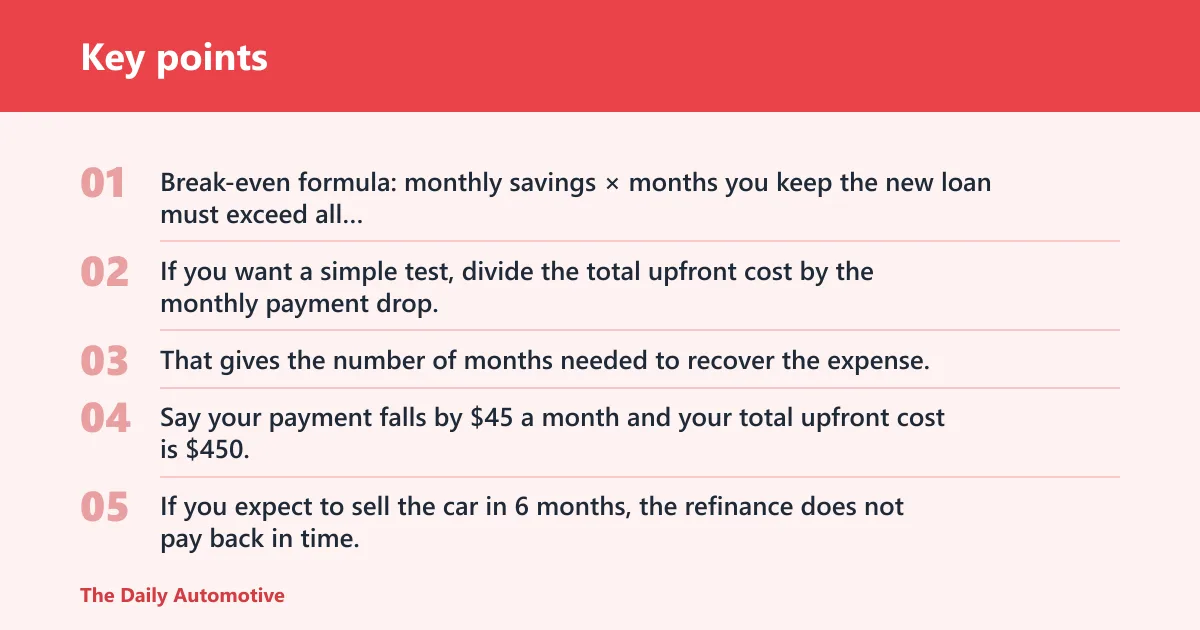
Break-even formula: monthly savings × months you keep the new loan must exceed all upfront refinance costs. If you want a simple test, divide the total upfront cost by the monthly payment drop. That gives the number of months needed to recover the expense.
Say your payment falls by $45 a month and your total upfront cost is $450. Your break-even point is 10 months. If you expect to sell the car in 6 months, the refinance does not pay back in time.
Suppose your rate drops, but the new term adds two extra years. The monthly payment may still fall, yet the added months can create more total interest than the old loan would have charged. Lower payment. Higher lifetime cost.
Worked example 1: savings — Current loan balance: $16,000. Current APR: 11.5%. New APR: 8.0%. Term stays close to the original schedule. Upfront costs: $275 lender fee, $75 title transfer, $50 DMV charge, and $25 payoff overlap. Total upfront cost: $425. If the payment drops by $62 a month, break-even arrives in about 7 months. Keeping the loan longer than that can produce net savings.
Worked example 2: break even — Current loan balance: $9,500. Current APR: 9.0%. New APR: 7.5%. Upfront costs total $360. The monthly payment drops by $30. Break-even takes 12 months. If the borrower plans to keep the car for another 12 months or longer, the refinance is roughly neutral. If the car will be sold sooner, the fee stack eats the gain.
Worked example 3: higher total cost, Current loan balance: $7,200. Current APR: 10.0%. New APR: 8.5%. Upfront costs total $500. The payment drops by $18. Break-even takes nearly 28 months, which may exceed the remaining time in the car. In this case, the refinance can lower the payment and still cost more overall.
How much does it cost to refinance a car loan?

The total usually comes from three buckets: lender fees, state or title fees, and payoff timing costs. Some borrowers pay very little beyond title work. Others face a bigger bill because the old loan has a penalty, the state adds registration charges, or the payoff takes long enough to create extra interest.
Typical lender fees
Lender fees are the easiest part to compare because they belong to the new offer. They may appear as an application fee, processing fee, or document fee. A lower APR does not cancel them. Add them to every quote before you compare monthly payment changes.
State and DMV charges
DMV and title charges vary by state, and that variability matters. Title transfer, lien recording, registration updates, taxes, or plate fees can be small in one state and meaningful in another. Do not assume every refinance costs the same outside the lender side of the deal.
Payoff timing costs
Payoff timing can change the result by a surprising amount. The new lender sends a payoff check, the old lender posts it, and interest may continue until the balance clears. If the process drags, you may owe a little more interest than the quote assumed.
A common first-timer mistake is counting the new monthly payment and forgetting the old loan keeps accruing interest until the payoff clears. That gap is usually small, but on a tight break-even calculation it can decide the answer.
What fees should you expect?
Expect a mix of lender charges and outside charges. Application or processing fees belong to the lender. Title transfer and lien recording fees usually belong to the state or title process. Optional third-party services can sit on top of both. Keep those lines separate so you can compare offers cleanly.
Application or processing fees
These are the fees a lender may charge to open and process the new loan. One lender may waive them, another may not. If one offer has a lower APR but a larger lender fee, the lower rate may still lose on total cost.
Title transfer and lien recording
The title has to show the new lender’s interest in the car. That usually means a title transfer, lien recording, or similar filing step. These charges are not controlled by the lender in the same way as an application fee, so compare them separately.
Optional third-party charges
Some borrowers see notary, courier, document handling, or other outside charges. These are optional only if the lender truly lets you skip them. If the fee is required for closing, include it in the total cost calculation.
Does a lower APR always save money?
No. A lower APR can reduce interest, but it does not guarantee a lower total cost. If the refinance extends the term, adds fees, or resets the payoff timeline enough to create more interest, the loan can cost more even while the payment falls.
New APR versus current APR
Compare the new APR with the current APR, but do not stop there. APR is only one piece of the cost picture. The remaining balance, how many payments are left, and the refinance fees all affect the real result.
Monthly payment versus total interest
Monthly payment relief can help cash flow. Total interest tells you what the loan costs over time. A lower payment from a longer term may feel better today and still create a bigger overall bill. That trade-off deserves a direct look before you sign.
When a small rate drop is not enough
A small rate drop may be too small to justify the paperwork and fees. If the payment only falls a little and the upfront cost is several hundred dollars, the break-even point can stretch too far. For a short remaining loan, that usually weakens the case for refinancing.
How loan term changes the math
The term choice matters as much as the APR. A shorter term usually lowers total interest but raises the monthly payment. A longer term can cut the payment but raise the total cost. The right answer depends on whether you care more about cash flow or lifetime expense.
36- and 48-month comparisons
On a 36-month refinance, the payment can be higher because the balance is repaid faster. The benefit is less interest over time. A 48-month term is a middle ground for borrowers who want some payment relief without stretching the loan too far.
60- and 72-month comparisons
On a 60- or 72-month term, the monthly payment often drops further. That can help if your budget is tight. The downside is simple: a longer schedule gives interest more time to add up, so total cost can rise even when the APR is lower.
What can block refinance approval?

Eligibility can stop a refinance before fees even matter. Lenders check the vehicle, the remaining balance, payment history, and your credit profile. A loan that looks affordable on paper can still fail if the car or borrower falls outside the lender’s limits.
Vehicle age and mileage limits
Some lenders cap how old the vehicle can be and how many miles it can have. Upgrade says eligible vehicles must be 10 years old or newer, under 130,000 miles, and trucks can be under 150,000 miles. Older or high-mileage vehicles may be rejected or offered worse terms.
Minimum balance and payment history
The same source says borrowers must have made at least 3 monthly payments and the outstanding balance must be greater than $5,000. Very small balances can be hard to refinance because the savings are too thin to cover closing costs. Recent payment history also matters.
Negative equity and credit profile
Negative equity can block approval or make the offer poor enough to skip. Credit can help or hurt the rate. Improvement since the original loan may open better terms, while debt-to-income problems can still hold the offer back. Prior credit trouble does not automatically end the process, but it can narrow options.
Checking a rate should not itself be the problem. The same source says checking your rate is free and won’t impact your credit score, and Freeway says prequalifying won’t impact your credit score. That said, prequalification is not the final offer. The lender can still change terms after a full application.
How the payoff process affects your cost
The payoff process matters because interest and title work do not finish the same day. The new lender pays off the old loan after approval, the old lender clears the balance, and the title or lien is updated afterward. That timing gap can add cost if you ignore it.
Payoff check and clearing timeline
The new lender usually sends a payoff check or electronic payment to the old lender. Until that payment clears, interest can keep running. If the payoff quote expires or the old lender needs a fresh figure, you may face a small additional charge.
Title transfer and overpayment refund
After payoff, the title or lien record moves to the new lender. If you overpay the old loan by a little, the lender should refund the extra amount after processing. Keep an eye on that refund so it does not get lost in the paperwork.
When to keep making payments
Keep making payments until the old lender confirms the loan is paid off unless the payoff instructions say otherwise. Missing a payment during the transfer can create late fees or credit damage, which adds cost on top of the refinance.
Frequently asked questions
How much does it usually cost to refinance a car loan?
There is no single standard number because the fee stack changes by lender and state. A common refinance includes lender charges, title or lien filing fees, and sometimes DMV charges. The only reliable way to judge “usual” cost is to total every fee and compare it with the monthly savings.
Are there fees to refinance a car loan?
Yes. You may see lender application or processing fees, title transfer or lien recording fees, registration or DMV fees, and sometimes prepayment penalties from the old lender. Timing can add a small amount of interest too. A lower APR does not erase those charges automatically.
Can refinancing a car loan increase my total cost?
Yes. It can happen when the fee stack is large, the term gets longer, or the payment savings are too small to recover the upfront cost. The monthly payment may drop while the lifetime interest rises. That is why break-even months matter more than the new rate alone.
How do I know if refinance closing costs are worth it?
Divide your total upfront cost by your monthly payment savings. That gives the break-even point in months. If you expect to keep the loan longer than that, the refinance may be worth it. If not, the lower APR may still leave you worse off overall.
Does it cost money to refinance auto loan?
Usually yes, even when the lender advertises a low rate or no application fee. State title work, DMV charges, payoff interest overlap, and possible old-loan penalties can still create an out-of-pocket cost. The safe move is to compare total cost, not just the advertised APR or payment.
Products related to this article
Sponsored / affiliate links. As an Amazon Associate I earn from qualifying purchases. I may earn additional commission from eligible campaigns.