Endurance Car Repair Insurance Review: Is It Worth It?
Endurance can be worth buying for older, higher-mileage cars only if one covered repair is likely to cost more than the contract’s total cost plus deductible; otherwise, self-funding or a repair fund is usually cheaper. Skip the math, and you can pay premiums for months, then still face a denied claim or a bill for wear items. This review breaks down Endurance plans, deductibles, waiting periods, exclusions, and how its coverage stacks up against other repair-protection options.
This guide is part of our Car care and upkeep guide series.
Verdict
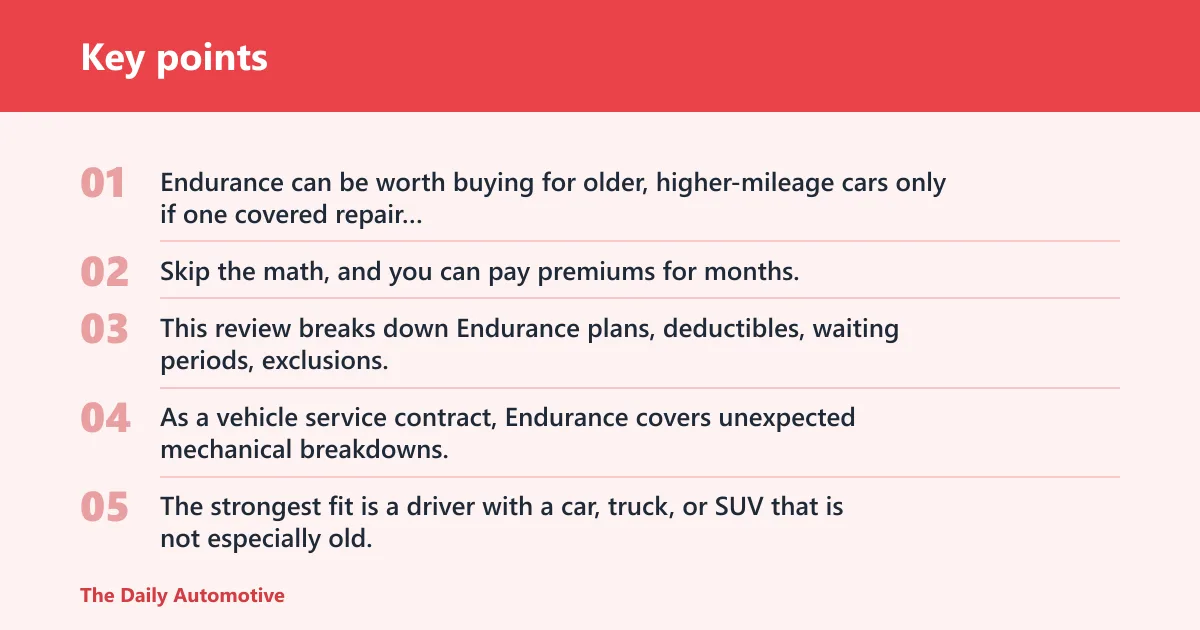


As a vehicle service contract, Endurance covers unexpected mechanical breakdowns, not routine maintenance or factory-style bumper-to-bumper coverage. The strongest fit is a driver with a car, truck, or SUV that is not especially old, with no stated mileage limit, and a real chance of drivetrain, cooling, A/C, or electrical failure that would cost more than the annual plan price.
📊 ConsumerAffairs lists Endurance’s rating at 4.5 from 19,756 reviews. Source: Endurance Warranty Reviews from Real Customers.
Specs at a glance
| Spec | Endurance |
|---|---|
| Coverage type | Vehicle service contract for unexpected breakdowns |
| Vehicle eligibility | Cars, trucks, and SUVs up to 20 years old; no mileage cap |
| Waiting period | 30 days and 1,000 miles |
| Deductibles | $0, $100, $200; $500 deductible available on Supreme only |
| Repair-shop access | Certified mechanics chosen by the driver; RepairPal network with over 4,000 shops and dealerships |
| Included benefits | 24/7 roadside assistance, rental car reimbursement, trip interruption reimbursement, Elite Benefits |
| Typical price range | About $1,200-$1,920 per year; roughly $90-$160 per month |
| Money-back guarantee | 30 days |
Who is Endurance for?
Endurance is for owners who want repair risk moved away from them, especially when a vehicle is old enough that one major repair can wipe out a year of savings. It fits best if the car still runs well but has enough age and mileage that the next failure is hard to predict.
Older vehicles and high-mileage drivers
ConsumerAffairs says Endurance covers vehicles up to 20 years old, and there is no mileage cap. That matters for high-mileage commuters because the real question is not whether a car is “old enough” on paper; it is whether wear-driven failures are likely enough to justify the premium and deductible.
Owners worried about drivetrain, cooling, or electronics failures
Endurance makes the most sense when you are worried about a repair class that can get expensive quickly: transmission trouble, engine issues, cooling-system faults, A/C failure, or aging electronics. Those losses can overwhelm a repair fund if they hit before you have enough cash set aside.
When repair insurance adds real value versus a repair fund
If you already keep a dedicated emergency fund and can absorb a $1,500 to $3,500 repair without stress, Endurance may be redundant. If that bill would force a credit-card balance or delay needed repairs, the contract is acting as a risk transfer tool, not a budget optimizer.
What does Endurance cover by plan?
Endurance’s plan ladder is easiest to read as three levels of repair risk protection. Secure is the leanest fit for older cars. Superior adds more component coverage. Supreme is the broadest exclusionary-style option and is the closest match to the “what can go wrong on an aging car” buyer.
Secure: powertrain-style protection for older vehicles
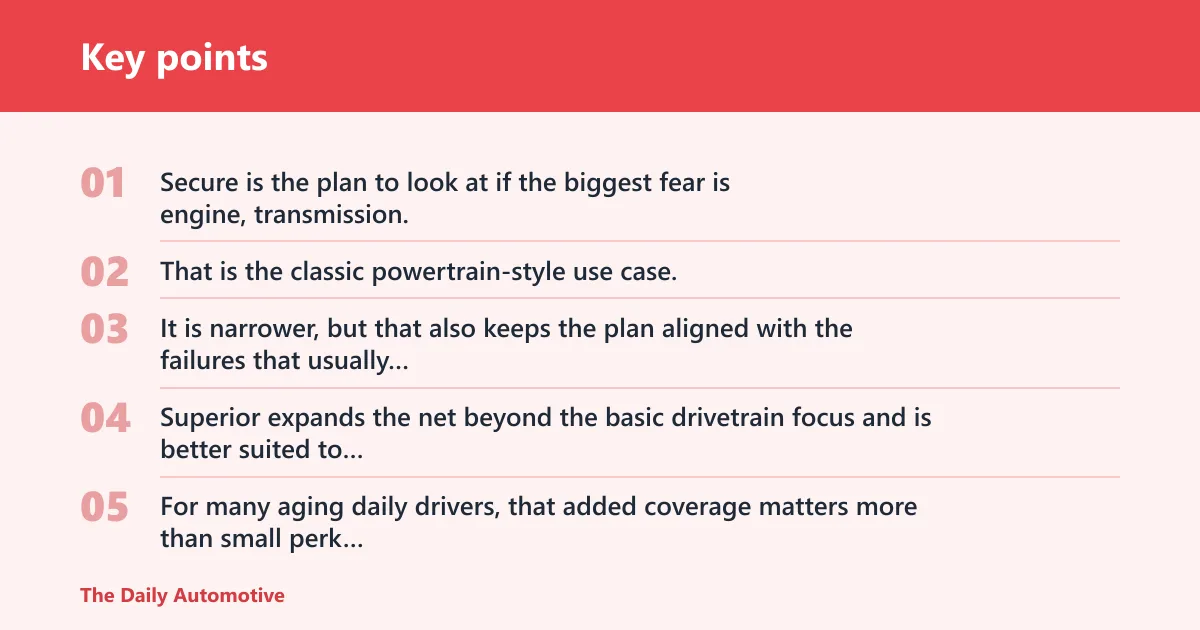
Secure is the plan to look at if the biggest fear is engine, transmission, or A/C trouble on an older vehicle. That is the classic powertrain-style use case. It is narrower, but that also keeps the plan aligned with the failures that usually create the biggest bills.
Superior: broader component protection for added failure points
Superior expands the net beyond the basic drivetrain focus and is better suited to vehicles where fuel-system problems, electrical issues, and some high-tech components are part of the risk profile. For many aging daily drivers, that added coverage matters more than small perk differences.
Supreme: exclusionary-style coverage and seals and gaskets
Supreme is the broadest plan Endurance sells and is meant to act more like a manufacturer-style warranty, though it is still a service contract. It is the strongest option for buyers who want coverage that reaches engine, transmission, A/C, fuel system, electrical components, seals, and gaskets where applicable.
What works
Endurance’s strengths are easy to verify. It covers unexpected breakdowns rather than routine maintenance. It lets the driver choose from certified mechanics, and Endurance says it partners with RepairPal and has over 4,000 repair shops and dealerships in the network. The included benefits package also has real trip-disruption value.
Benefits that actually matter
24/7 roadside assistance matters most if you drive long distances, park in dense city neighborhoods, or keep an older car on the road daily. Rental car reimbursement and trip interruption reimbursement are more useful to commuters and road-trippers than they sound on a sales page because they soften the secondary cost of a breakdown.
Elite Benefits can matter, but only for the right driver
Endurance says Elite Benefits are free for one year and can include tire repair or replacement limits, key fob replacement, windshield repair up to $500, and collision discounts up to $500 per incident. That package is useful if you park on the street, drive in bad weather, or rack up miles quickly. It is less convincing if you already carry separate coverage for those items.
What does not
The biggest drawback is simple: this is not a guaranteed savings product. Endurance has a waiting period of 30 days and 1,000 miles, and pre-existing conditions are outside the value equation from the start. If the car already has symptoms, the contract is unlikely to work the way a buyer hopes.
Common exclusions and denial risks
Complaint pages often blur together different kinds of denials. A legitimate denial for a pre-existing problem is not the same as a denial for missed maintenance, and both are different from excluded wear items. Buyers should read the contract for what is explicitly covered, what is wear-related, and what must be maintained to keep the claim valid.
A common first-timer mistake is buying the plan after a warning light appears. Suppose a 12-year-old sedan starts slipping in second gear, then the owner shops for coverage the same week. That repair risk was already on the vehicle before coverage started, so the claim is exactly where pre-existing-condition language becomes decisive.
How complaints should be interpreted
Endurance has strong review volume on ConsumerAffairs, which lists a 4.5 rating from 19,756 reviews, and Car Talk says it scored 4.8 out of 5 stars. Those figures do not remove complaint risk. They do suggest the brand is worth evaluating carefully rather than dismissing, especially if the buyer can explain the contract terms to themselves before signing.
Buyer-fit table: which plan matches which repair risk?
Endurance works best when the plan tier matches the failure pattern on the vehicle, not the buyer’s fear in the abstract. The key question is which repair class is most likely to hit first, and whether the plan’s deductible still leaves enough upside after premiums.
| Repair-risk scenario | Most likely fit | Why that tier fits | Simple value example |
|---|---|---|---|
| Aging electronics and sensor problems | Superior | Broader component coverage is a better match for electrical items and some high-tech options than a powertrain-only plan. | If the repair is $1,100 and the deductible is $100, the contract may save about $1,000 before premiums. |
| Cooling-system and A/C failures | Secure or Superior | Secure is the basic fit if the main worry is engine, transmission, and A/C; Superior makes more sense if other non-drivetrain failures are also likely. | If the bill is $1,400 and the deductible is $200, the gross protection is about $1,200 before premiums. |
| Drivetrain wear and major engine repairs | Secure | Older cars most often justify service contracts when the risk is a large mechanical failure, not a minor trim or accessory issue. | If the bill is $2,600 and the deductible is $0, the plan could cover the full approved amount before premiums. |
| Maximum coverage for a later-model, aging vehicle | Supreme | Exclusionary-style coverage is the broadest option and can better match owners who want fewer uncovered gaps. | If the repair is $2,200 and the deductible is $500, net before premiums is roughly $1,700. |
Net value example using the published deductible options
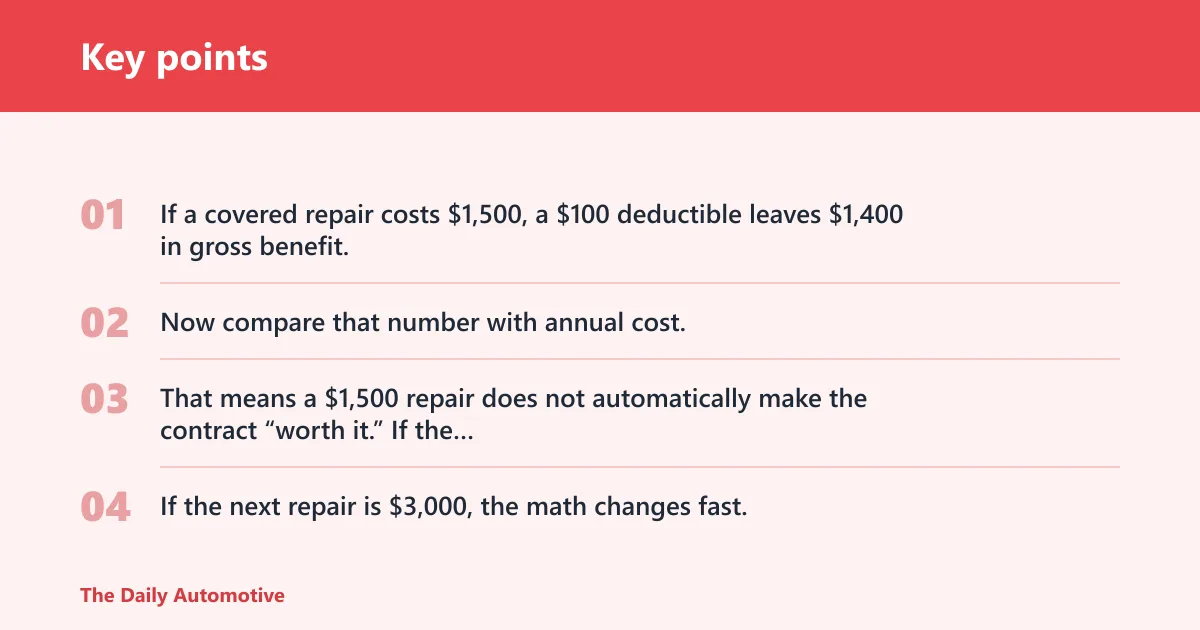
Use a simple break-even check. If a covered repair costs $1,500, a $100 deductible leaves $1,400 in gross benefit; a $200 deductible leaves $1,300; a $0 deductible leaves $1,500. On Supreme, a $500 deductible leaves $1,000. Now compare that number with annual cost, which ConsumerAffairs estimates at $1,200-$1,920 per year.
That means a $1,500 repair does not automatically make the contract “worth it.” If the plan costs $1,440 for the year and the deductible is $200, the buyer is effectively paying $1,640 to avoid a $1,500 bill. If the next repair is $3,000, the math changes fast.
Can you use any mechanic with Endurance?
Endurance says plans use certified mechanics chosen by the driver, and it partners with RepairPal, which it says gives access to over 4,000 repair shops and dealerships nationwide. In practice, that gives you broad shop choice, but the shop still has to fit the contract rules and certification requirements.
When shop choice matters most
Shop choice matters most for commuters, family vehicles, and drivers in smaller cities where a trusted local ASE-certified mechanic may be easier to reach than a dealership. It also matters if you want to avoid towing long distances just to open a claim.
Endurance vs other car repair insurance options
The real comparison with companies like CarShield is not “who sounds better.” It is coverage structure, exclusions, and value after the deductible. Endurance is strong when you want broad mechanic access, clear age eligibility, and a plan ladder that maps to aging-car failure risk. Other providers may look cheaper upfront, but the contract details decide the outcome.
| Comparison point | Endurance | What to compare in rivals like CarShield |
|---|---|---|
| Coverage structure | Secure, Superior, Supreme | Whether tiers are truly exclusionary or more limited than they first appear |
| Mechanic access | Certified mechanics, RepairPal network, over 4,000 shops and dealerships | Whether you can choose your own shop or must work through a narrow network |
| Waiting period | 30 days and 1,000 miles | Any longer waiting period or extra claim conditions |
| Price | Estimated $1,200-$1,920 per year, or about $90-$160 per month | Whether the quote is actually lower after comparable deductible and coverage terms |
| Value driver | Best when one major covered repair is likely | Whether the rival’s exclusions erase the price advantage |
What to compare before you request a quote
Ask about the deductible, the waiting period, the covered components, transfer rules, cancellation rules, and whether wear items are excluded. If two quotes are close in price, the cleaner contract is usually worth more than the one with slicker marketing.
Should you buy it
Buy Endurance if your vehicle is old enough that a covered failure would be painful, but not so worn that the plan is likely to deny the problem as pre-existing or maintenance-related. That is the core filter. If the next major bill would stress your budget, a service contract can be a rational hedge.
Skip it if you already self-fund repairs comfortably, drive a vehicle with low repair risk, or only want coverage for a symptom that is already present. The best use case is not panic buying. It is buying before the risk becomes visible in the driveway.
Frequently asked questions
which is better carshield or endurance
Neither is automatically better. Endurance is easier to judge by its plan ladder, shop access, and age limits. CarShield may quote differently, but you should compare covered parts, waiting periods, claim rules, and deductibles before deciding. The cheaper quote is not the better value if it excludes the repair you fear most.
is endurance car warranty worth it
It can be worth it if a covered repair is likely to cost more than the contract’s annual price plus deductible. That usually means an older, higher-mileage car where engine, transmission, cooling, or electrical failure would create a large bill. If you can pay that bill yourself, the plan is less convincing.
how much does endurance cost per month
ConsumerAffairs says the basic plan cost is estimated between $1,200 and $1,920 per year, and Car Talk says typical pricing is about $90 to $160 monthly. Your actual quote will vary with vehicle age, mileage, deductible, and financing. More coverage and lower deductibles generally push the monthly number higher.
is there a waiting period for endurance coverage
Yes. ConsumerAffairs says Endurance has a 30-day and 1,000-mile waiting period. That means coverage does not begin the moment you buy. It also means a repair that is already developing before the start date can run into pre-existing-condition issues, which is why timing matters so much.
is endurance good for high-mileage cars
Yes, if the car is still structurally and mechanically sound enough to qualify and the likely repair is expensive enough to beat the premium-plus-deductible math. Endurance covers vehicles up to 20 years old with no mileage cap, so high mileage alone does not rule it out. The real question is repair probability.
what are the biggest complaints about endurance warranty
The biggest complaint themes are denied claims, but those need context. Denials tied to pre-existing conditions, missed maintenance, or excluded wear items are not the same as a wrongful denial. Read the contract carefully so you can tell whether a rejection came from the terms or from a legitimate claim limitation.
Products related to this article
Sponsored / affiliate links. As an Amazon Associate I earn from qualifying purchases. I may earn additional commission from eligible campaigns.