Car Maintenance vs Repair: Where One Ends and Begins
Car maintenance is routine service done on schedule or at wear limits; repair starts when a part has failed, warning lights stay on, or a symptom changes how the car drives, stops, or starts. Miss that line and you waste money on work that was not needed, or you keep driving until a small fault turns expensive. This guide shows symptom-by-symptom decisions, borderline cases, and the home checks that separate maintenance from repair.
This guide is part of our Car care and upkeep guide series.
Car maintenance vs repair: the core trade-off
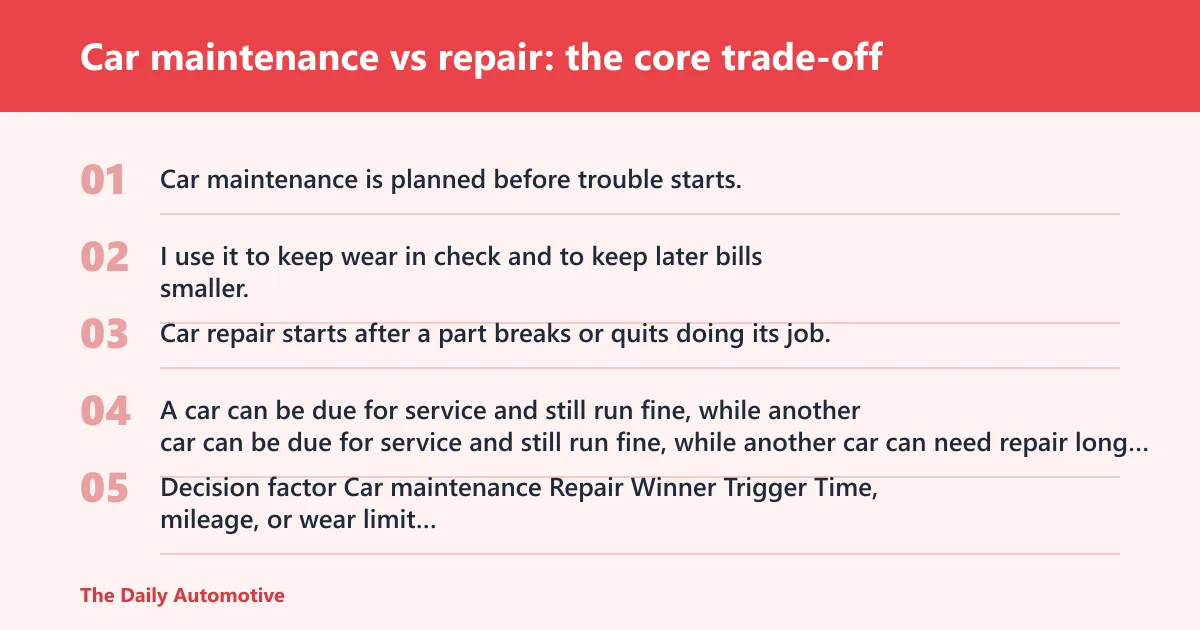



Car maintenance is planned before trouble starts. I use it to keep wear in check and to keep later bills smaller. Car repair starts after a part breaks or quits doing its job. A car can be due for service and still run fine, while another car can need repair long before the next service date arrives.
| Decision factor | Car maintenance | Repair | Winner |
|---|---|---|---|
| Trigger | Time, mileage, or wear limit | Failure, warning light, or active symptom | Tie |
| Goal | Extend vehicle life and prevent problems | Restore a broken system to working order | Tie |
| Typical urgency | Book soon | Often drive now, book soon, or stop driving depending on symptom | Repair |
| Cost pattern | Usually lower and more predictable | Often higher because parts are already failing | Maintenance |
| Examples | Oil changes, tire rotations, fluid checks | Belts, radiator leaks, transmission faults, brake failures | Tie |
Trigger: schedule versus symptom
Maintenance begins with a calendar, mileage, or wear interval. Repair begins with a symptom: the engine will not start, the brakes grind, the cooling system leaks, or a warning light stays on. Once you name the trigger, the split is clear.
Goal: prevention versus restoration
Maintenance keeps the car on track. Repair puts a system back to work after it stops doing its job. Pearson’s maintenance checklist includes oil changes, tire rotations, filter changes, alignments, and winterization, while Wright’s maintenance examples include oil changes, tire rotations, brake checks, air filters, and fluid levels.
Cost and downtime
Maintenance usually costs less because it happens before damage spreads. Repair often shows up after the failure has already touched another part. A worn belt left too long can damage charging or cooling systems; a neglected brake issue can turn pads, rotors, and calipers into a larger bill.
What counts as maintenance, repair, or inspection?
Maintenance is scheduled upkeep such as oil changes, tire rotations, fluid checks, and air filter replacement. Inspection is the look-before-you-leap step: checking brakes, belts, hoses, tires, and leaks before parts fail. Repair is the next step after a fault appears, when a broken component or diagnostic trouble code needs diagnosis and correction.
Maintenance
Oil changes, tire rotations, fluid checks, and air filter replacement belong here. Tire rotations are often paired with tire pressure checks, and a tire pressure gauge is a useful DIY tool for periodic checks. These tasks do not mean something is broken.
Inspection
Brake inspection, belt inspection, hose inspection, and under-car leak checks sit in the middle. They are prevention steps. Brake squeaks, squealing, vibration, or a change in pedal feel push the issue from inspection into repair territory.
Repair
Repair begins when a system is not doing its job. Wright lists a car that won’t start, squeaky brakes, and an A/C that doesn’t blow cold air as repair examples. Check engine lights also belong in this column because they point to a fault that needs diagnosis.
Is an oil change maintenance or repair?
An oil change is maintenance, not repair. It is routine service done on a schedule to keep engine lubrication where it should be. The fact that a shop performs it does not turn it into repair.
Why it stays in the maintenance column
Oil changes are planned ahead of time and done whether the engine is failing or not. They sit with basic upkeep, alongside tire rotations and fluid checks. Many drivers do them at home; others let a shop handle the service.
When oil becomes a repair issue
If the engine has sludge, low oil pressure, or a persistent oil leak, the job changes. At that point, the question is no longer “when is the next oil change?” It is “what failed, what got damaged, and why?”
When an oil leak is more than upkeep
A small seep can be watched if it is not affecting the car. A drip that lowers the oil level, leaves spots quickly, or causes the low-oil light to come on needs diagnosis. That is repair work because a seal, gasket, pan, or line has already failed.
When does maintenance turn into repair?
Maintenance turns into repair when a wear item stops staying within normal limits or when a symptom begins changing how the car drives, stops, or starts. Noise, vibration, warning lights, and fluid loss are the common cutoff points. Once the car is no longer functioning normally, it is repair territory.
Noise and vibration
Brake squeal may mean a pad is getting thin, which is still an inspection or scheduled service issue. Grinding, pulling, or steering shake means the wear has crossed into repair. The same logic applies to belts and hoses once cracks, fraying, bulging, or separation appear.
Warning lights
A warning light is not routine maintenance. It is a symptom. A check engine light is a repair trigger because it points to a fault, not a scheduled task.
Fluid loss
Top-offs can be maintenance when they are part of a normal scheduled check. A leak that keeps returning is repair. Coolant loss, brake fluid loss, and transmission fluid loss are important because they can quickly lead to overheating, brake issues, or transmission damage.
Borderline jobs
Alignments sit near the line. A scheduled alignment can be maintenance, but crooked steering, uneven tire wear, or a pull to one side may point to a repair-related diagnosis. Brake service is similar: pad replacement can be routine, but a soft pedal or vibration requires fault-finding.
What are examples of car maintenance vs repair?
Maintenance examples include oil changes, tire rotations, air filter replacement, fluid checks, and brake inspections. Repair examples include broken belts, radiator leaks, transmission faults, brake problems, and a check engine light that points to a failed sensor or engine issue.
Maintenance examples
F3 and F4 cover the standard list well: oil changes, tire rotations, filter changes, alignments, winterization, brake checks, air filters, and fluid levels. These tasks are planned before failure. They are there to keep the vehicle in good working condition.
Repair examples
Wright’s repair list is direct: a car that won’t start, squeaky brakes, and an A/C that does not blow cold air. Add broken belts, radiator leaks, and transmission problems, and the pattern is clear. Something has already stopped working correctly.
Borderline examples
Brake service can be maintenance if the shop is simply replacing worn pads during a scheduled visit. It becomes repair when the brake system is noisy, vibrating, leaking, or not stopping the car properly. Coolant flushes are similar: routine when scheduled, repair-related when a leak or overheating issue is present.
Side-by-side comparison: common jobs drivers confuse
Some jobs look alike until the symptom is checked. The same garage visit can be maintenance for one car and repair for another, depending on whether the part is still working and whether any warning signs are present.
| Confused pair | Maintenance side | Repair side | How to tell |
|---|---|---|---|
| Oil change vs engine repair | Scheduled oil service | Low oil pressure, sludge damage, or internal wear | If the engine still runs normally, start with maintenance; if pressure or running quality is bad, diagnose repair. |
| Tire rotation vs tire replacement | Rotate for even wear | Replace when tread is worn or damaged | Rotation is a positioning task; replacement is needed when the tire can no longer do its job. |
| Brake inspection vs brake repair | Check pads, rotors, fluid, and hardware | Fix worn, noisy, vibrating, or weak brakes | If there is no symptom, inspect; if stopping changes, repair. |
| Fluid top-off vs leak diagnosis | Add fluid on schedule | Find the leak source and fix it | Repeated low levels mean the real job is repair. |
| Air filter replacement vs engine performance fault | Replace a dirty filter | Investigate rough idle, misfire, or poor airflow from another cause | A dirty filter is maintenance; symptoms after replacement mean another fault. |
| Check engine light vs scheduled service reminder | Service reminder for upkeep | Diagnostic light for a fault | Maintenance reminders tell you to act soon; a check engine light means the car needs diagnosis. |
Decision matrix: 15 common issues and what to do next

This matrix separates maintenance, inspection, and repair, then adds a practical action. “Drive now” means the car can usually be used while you schedule the work. “Book soon” means the issue should be handled promptly. “Stop driving” means the symptom can create safety or damage risk right away.
| Issue | Class | One-line reason | Action |
|---|---|---|---|
| Oil change | Maintenance | Scheduled engine lubrication service | Book soon |
| Tire rotation | Maintenance | Routine wear balancing, often paired with tire pressure checks | Book soon |
| Air filter replacement | Maintenance | Normal upkeep item that is replaced on schedule | Book soon |
| Fluid level check | Maintenance | Scheduled check of oil, coolant, brake fluid, transmission fluid, or washer fluid | Drive now |
| Brake inspection | Inspection | Looks for wear before braking performance changes | Book soon |
| Tire pressure check with gauge | Inspection | Monthly safety check that supports wear monitoring | Drive now |
| Cracked belt | Repair | Wear has advanced to visible failure risk | Book soon |
| Frayed or bulging hose | Repair | Material breakdown can lead to leaks or sudden failure | Book soon |
| Coolant leak | Repair | Fluid loss means the cooling system is no longer sealed | Book soon |
| Brake squeal with normal stopping | Inspection | Early wear sign that needs checking before it worsens | Book soon |
| Brake grinding or poor stopping | Repair | Braking performance is already impaired | Stop driving |
| Check engine light on steadily | Repair | Diagnostic symptom, not routine maintenance | Book soon |
| Engine won’t start | Repair | System has failed to perform its basic function | Stop driving |
| Uneven tire wear | Inspection | Usually points to alignment, pressure, or suspension issues | Book soon |
| A/C blows warm air | Repair | The system is no longer doing the job it should do | Book soon |
Choose Car Maintenance if… / Choose Repair if…
Choose car maintenance when the task is scheduled, the car is still operating normally, and the job is there to prevent future trouble. Choose repair when a part has failed, a warning light is on, or the symptom has changed how the car drives, stops, or starts.
Choose car maintenance if…
The oil change, tire rotation, filter replacement, or fluid check is due on schedule. The car starts, stops, steers, and cools normally. You want longer service life and fewer surprise repairs later.
Choose repair if…
The check engine light stays on, the brakes grind, the belt is cracked, the hose is bulging, or the vehicle will not start. Any symptom that affects safety, drivability, or cooling belongs in repair territory. If stopping power or oil pressure is suspect, do not keep driving.
How do I know if my car needs repair instead of maintenance?
Use symptoms as the cutoff. If the car is still working normally and the job is scheduled, it is maintenance. If the symptom changes how the car drives, stops, starts, or cools, or if a warning light stays on, it is repair and should be diagnosed.
Escalation triggers to watch
Noise, vibration, fluid loss, smell, warning lights, and hard starts are the usual line-crossers. A squeak can begin as inspection. A grind, leak, or light turns it into repair. The same goes for wear items like belts, hoses, brake pads, and tires once they move past normal wear.
What the driver should do next
- Check whether the issue is scheduled, visual, or a symptom.
- Look for warning lights, leaks, low fluid, or a change in drivability.
- If the car still operates normally, book maintenance soon.
- If braking, starting, or cooling is affected, stop and get diagnosis.
- If the issue is only an early wear sign, inspect before parts fail.
Which jobs can I do myself and which need a mechanic?
Many inspection and maintenance tasks can be done at home, while failed parts and diagnostic work usually need a mechanic. A tire pressure gauge, fluid level checks, and air filter replacement are practical DIY jobs. Brake diagnosis, belt replacement, leak tracing, and check engine light faults usually call for shop tools and experience.
Good DIY jobs
Monthly tire pressure checks, topping off washer fluid, checking oil level, and replacing an accessible air filter are often suitable do-it-yourself tasks. Tire rotations can be DIY if the person has the right tools and knows safe lifting procedure.
Shop-level jobs
Brake repair, coolant leak diagnosis, transmission work, belt replacement on tightly packaged engines, and electrical fault tracing are often better left to a shop. These jobs are less about turning a wrench and more about finding the real cause before parts are replaced needlessly.
What is the difference between car maintenance and repair?
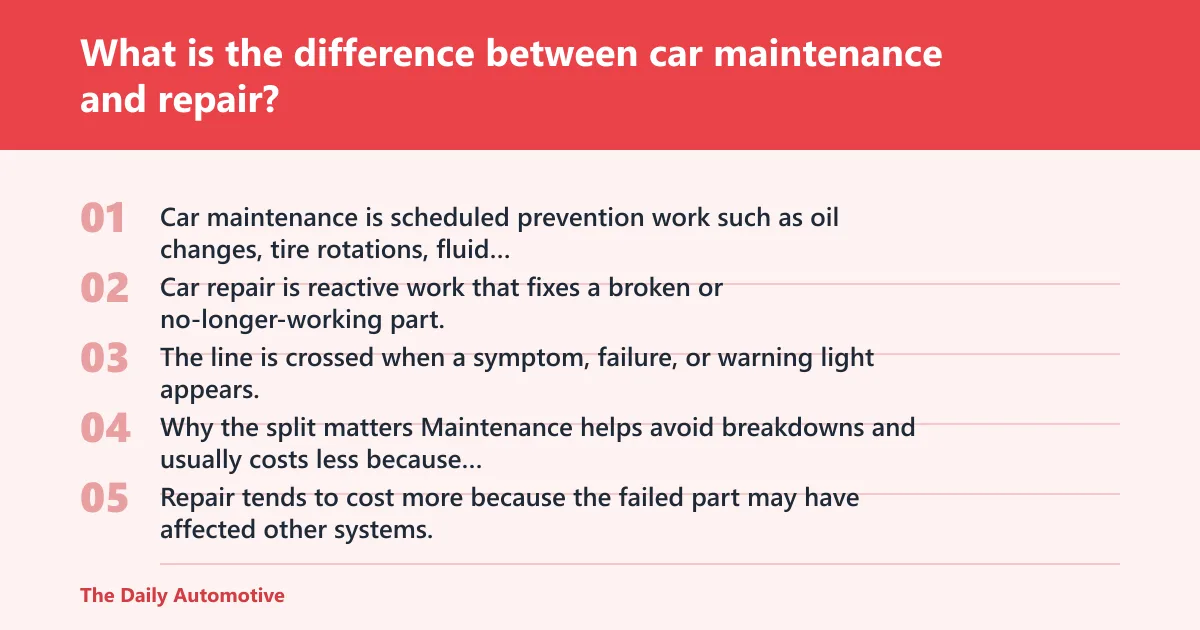
Car maintenance is scheduled prevention work such as oil changes, tire rotations, fluid checks, air filter replacement, and brake inspections. Car repair is reactive work that fixes a broken or no-longer-working part. The line is crossed when a symptom, failure, or warning light appears.
Why the split matters
Maintenance helps avoid breakdowns and usually costs less because it is done before damage spreads. Repair tends to cost more because the failed part may have affected other systems. Missed maintenance can also become repair later, which is why the first symptom should not be ignored.
Is car maintenance the same as service?
Car maintenance and service are often used to mean the same general thing, but “service” is broader. A service visit can include maintenance, inspection, and sometimes repair if the technician finds a fault. The label on the invoice matters less than the actual work performed.
Why the wording causes confusion
Drivers search “service” when they really mean upkeep, diagnosis, or both. A scheduled service reminder usually points to maintenance. A shop visit for a fault scan, leak diagnosis, or brake symptom is repair work even if the counter person calls it a service.
What are examples of car maintenance vs repair?
Examples of maintenance include oil changes, tire rotations, air filter replacement, fluid checks, and scheduled brake inspections. Examples of repair include broken belts, radiator leaks, transmission faults, brake problems, and a check engine light that leads to diagnosis and part replacement.
How missed maintenance turns into repair
Late oil changes can contribute to sludge and low oil pressure. Ignored tire pressure can create uneven wear that leads to replacement sooner than planned. Deferred brake checks can turn a simple pad job into rotor damage, and a small hose crack can become an overheated engine.
Is a check engine light maintenance or repair?
A check engine light is repair territory, not routine maintenance. It means the car’s diagnostic system has found a fault that needs attention. Even if the car still drives, the light is a symptom that should be scanned and interpreted, not treated as a normal service reminder.
What to do when the light appears
If the light is steady and the car feels normal, book diagnosis soon. If it flashes, or if the car runs rough, loses power, or shakes, stop driving and get help. The light is not the fix; it is the signal that a fix is needed.
Frequently asked questions
What is the difference between car maintenance and repair?
Maintenance is scheduled preventive care that keeps the car in good shape, such as oil changes, tire rotations, fluid checks, and filter replacement. Repair fixes something that has failed, from a broken belt to a no-start or a braking problem. The trigger is the clearest divider.
Is an oil change maintenance or repair?
An oil change is maintenance. It is routine service done to keep engine lubrication where it should be and to help extend vehicle life. It only shifts toward repair if the engine has low oil pressure, heavy sludge, or an oil leak that must be found and fixed.
When does car maintenance turn into a repair?
Maintenance turns into repair when a part has failed, a warning light stays on, or the car starts behaving differently. Noise, vibration, fluid loss, rough running, and hard starts are common escalation signs. Once drivability or safety changes, the issue should be treated as repair.
What are examples of car maintenance vs repair?
Maintenance examples include oil changes, tire rotations, air filters, fluid checks, and brake inspections. Repair examples include cracked belts, radiator leaks, brake problems, a check engine light, or a car that will not start. The difference is whether the system is still working normally.
Is a check engine light maintenance or repair?
A check engine light is repair, because it indicates a fault rather than a routine service item. It may be something minor or something serious, but it still needs diagnosis. If the light flashes or the car runs poorly, stop driving and get it checked right away.
Is car maintenance the same as service?
People often use the words interchangeably, but service is broader. A service visit can include maintenance, inspection, and even repair if a fault is found. The best way to read the invoice is by the actual work, not the label at the counter.
Products related to this article
Sponsored / affiliate links. As an Amazon Associate I earn from qualifying purchases. I may earn additional commission from eligible campaigns.