Car Seat Travel Bag Cost / Price / How Much
For most flying families, a padded backpack car seat travel bag is the best value because it fits more seat shapes than a thin cover, costs less than a rolling bag, and is easier to carry through an airport than a bare seat. As of October 2026, a car seat travel bag usually costs about $25 to $150, with basic covers often around $25 to $40, padded bags often around $50 to $90, and heavier-duty rolling options generally costing more. A cheap bag can tear or scuff, and it does not make a checked car seat safe from hidden damage.
Top pick and price ranges
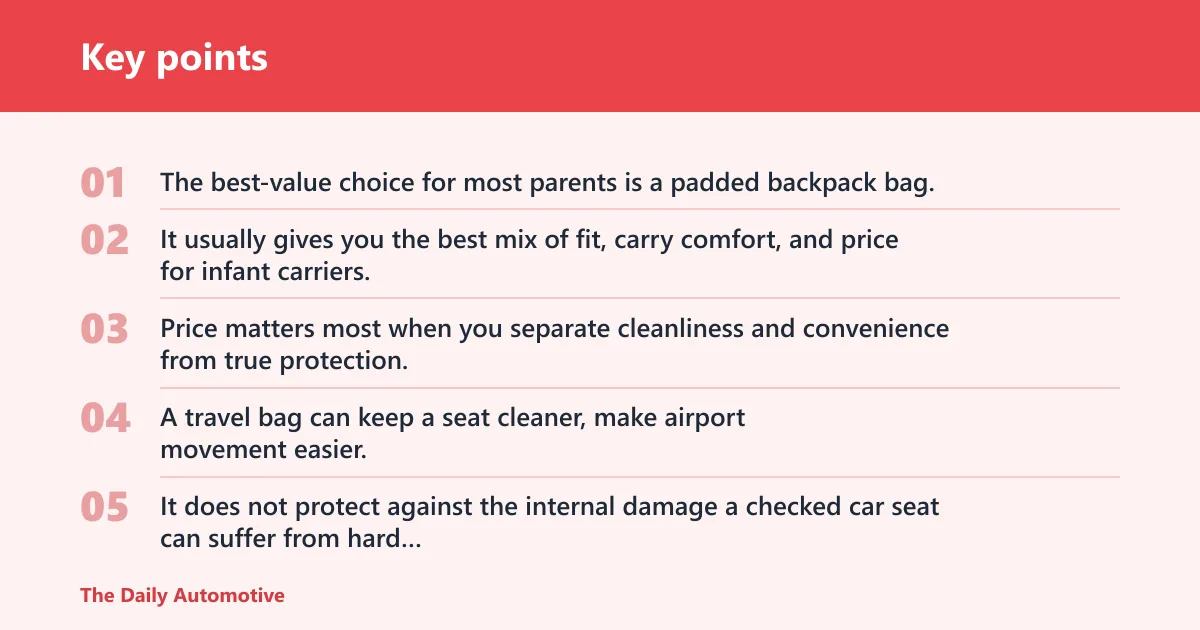

The best-value choice for most parents is a padded backpack bag. It usually gives you the best mix of fit, carry comfort, and price for infant carriers, many convertibles, and some boosters, without paying rolling-bag money for features you may not need.
Price matters most when you separate cleanliness and convenience from true protection. A travel bag can keep a seat cleaner, make airport movement easier, and reduce handling stress. It does not protect against the internal damage a checked car seat can suffer from hard drops or crushing.
Quick picks
| Best for | Typical type | Key spec | Typical price range | Buy / no-buy line |
|---|---|---|---|---|
| Jet bridge handoff, rare flyers | Gate-check cover | Lightweight, minimal or no padding | $9.99 to about $40 | Buy if you mainly want dirt and moisture protection |
| Most flying families | Padded backpack bag | Backpack straps, moderate padding, often packable | About $25 to $49.99 | Buy if you walk through terminals or check the seat more than once a year |
| Heavy convertible seats | Rolling bag | Wheels or cart base, bulkier build | About $50 to $150+ | Buy if seat weight makes carrying the bag the main problem |
Current examples support that ladder. SeatPorter lists a sale price of $24.95 and a regular price of $44.95, while Amazon’s best sellers include a travel bag at $9.99, a padded backpack travel bag at $32.71, and a premium travel bag at $49.99. Mom Loves Best also lists a budget gate-check option, plus a rolling pick with four spinner wheels and a padded shell.
Car seat travel bag price ladder
The key is not just what the bag costs. It is what the money buys: thin dirt protection, easier carrying, better fit for a larger shell, or fewer aches while hauling a heavy convertible seat through the terminal.
| Price tier | Common bag type | Typical feature set | Expected use case | Buy / no-buy threshold |
|---|---|---|---|---|
| Under $25 | Gate-check cover, thin dust-style bag | Minimal padding, simple drawstring or zipper, light fabric | Jet bridge handoff, short airport exposure, dirt and moisture protection | Buy for occasional flyers who want the cheapest cleaner option; no-buy if you need comfort with a heavy seat |
| $25 to $45 | Basic padded or entry backpack bag | Light padding, basic handles, sometimes a pouch fold | Occasional checked trips, some terminal walking, better general convenience | Buy if your seat fits and you want more carry comfort without paying for wheels |
| $45 to $90 | Padded backpack bag or simple rolling bag | Backpack straps or wheels, stronger fabric, better closure, sometimes tracker pocket | Frequent flying, heavier seats, baggage check, longer terminal walks | Buy if you fly often or the seat is awkward to carry; no-buy if the seat is small and trips are rare |
| $90 to $150+ | Rolling bag with a heavier build | Wheels or cart base, bulkier shell, more structure, higher storage footprint | Heavy convertible seats, long walks, parents who want the least lifting | Buy only if the seat weight and travel frequency justify the premium |
What is the cheapest option?
The cheapest travel car seat bag is usually a gate-check cover or thin dust-style bag. That tier can run from about $9.99 to the low $20s, and it mainly helps with dirt, moisture, and surface scuffs during a jet bridge handoff. It is the budget answer, not the most protective one.
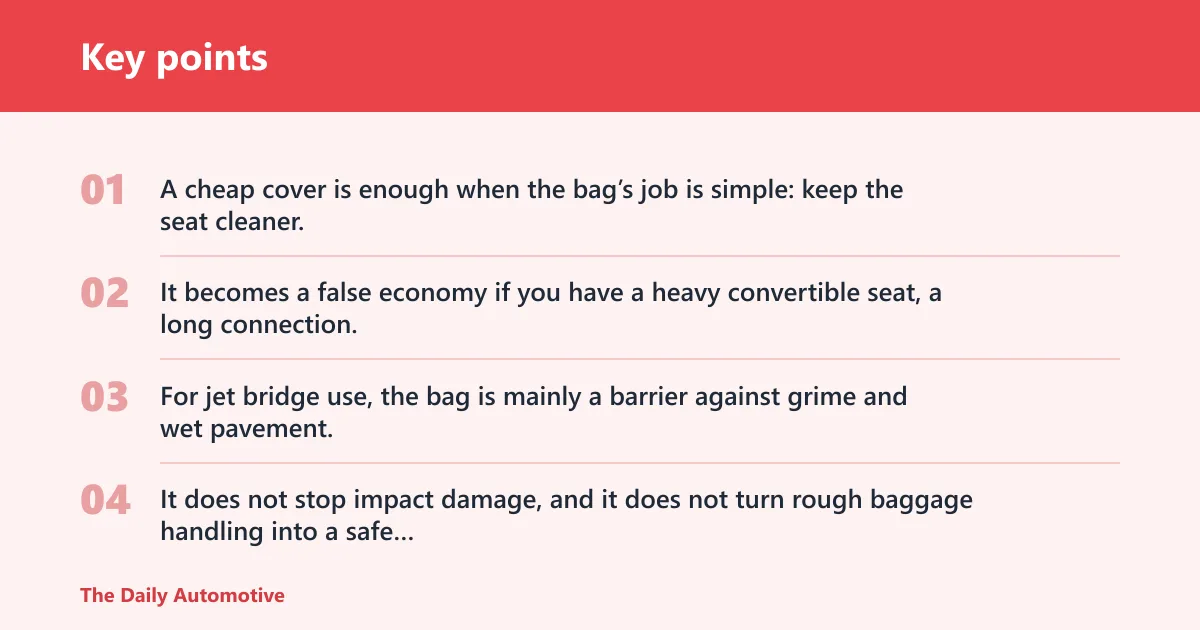
A cheap cover is enough when the bag’s job is simple: keep the seat cleaner, label it clearly, and avoid paying for features you will not use. It becomes a false economy if you have a heavy convertible seat, a long connection, or a family that checks gear often and wants easier carrying.
For jet bridge use, the bag is mainly a barrier against grime and wet pavement. It does not stop impact damage, and it does not turn rough baggage handling into a safe process.
When is a padded backpack worth it?
A padded backpack bag is worth the higher price when you want hands-free airport movement and a better fit range than a thin cover usually offers. Backpack straps change the experience because they let you manage a seat, a stroller, and carry-ons without dragging the bag by hand the whole way.
This tier often makes sense for infant carriers, many convertible seats, and boosters. Amazon lists a padded backpack travel bag at $32.71, and that kind of price sits in the middle of the market, where convenience starts to matter more than simply covering the seat.
Packability matters too. The same source says its bag folds into its own zip pouch, which is useful when you do not want an empty bag taking up trunk space after landing. A folded pouch is not a luxury detail; it is part of whether the bag stays useful after the trip.
Suppose you are carrying a 20-pound convertible seat through a crowded terminal with one child in tow. A backpack bag does not make the seat lighter, but it spreads the load better than a thin handle or a floppy cover.
Do rolling bags cost more?
Yes. Rolling car seat travel bags usually cost more because wheels, a frame base, and added structure raise material and assembly costs. They also take up more space in storage and transit, which is part of what you pay for.
That premium can be worth it for heavy convertible seats or for parents who want the least lifting. Mom Loves Best lists a rolling option with four spinner wheels and a padded shell, which shows how this tier usually trades price for easier movement rather than true impact protection.
Rolling bags are the heaviest and bulkiest option. They can be easier to move through a terminal, but they are less compact in the overhead of your own packing life, and they are harder to stash once the seat is out.
How fit and materials change the price
Fit drives price more than many shoppers expect. A bag that fits a small infant shell may cost less than one sized for a tall convertible seat, because larger dimensions need more fabric and more room at stress points.
Check the bag’s length, width, and height against the seat’s outer shell, not the car seat’s marketing label. The same source lists a fit limit of 33 x 17 x 17 in, which is the kind of number you can compare against the seat you already own.
Seat type by bag type
- Infant carrier: often fits the most budget covers and many padded backpacks.
- Convertible seat: usually benefits from a roomier backpack bag or rolling bag, especially if the seat is tall or wide.
- Booster seat: often fits in a backpack-style bag, though fit varies with arm rests and cup holders.
- All-in-one seat: more likely to need the larger end of the size range.
Materials matter because they shape cleanability and tear resistance. The same source says its bag uses water-resistant Oxford cloth, which is a practical sign that the shell is built to resist grime and wipe off more easily than flimsy fabric. Water-resistant polyester plays a similar role in many bags.
Padding level changes the cost, but mostly for handling convenience and scuff resistance. More padding can help the bag hold its shape and shrug off abrasion, yet it still does not make a checked seat crash-safe.
The same source reports an interior pocket sized for a Bluetooth tracker, and that kind of detail matters if you want a place for an AirTag, name card, or phone-number slip. A tracker pocket does not stop a misroute, but it can help you identify the bag faster if it goes missing.
How much should you spend?
Occasional flyers can usually stay near the low end. If you only check a seat a few times a year and mostly gate-check, a basic cover around $25 to $40 is often enough, especially if you mainly want a cleaner bag and clear ID labeling.
Frequent flyers should think in cost-per-trip terms. A padded backpack used about a dozen times a year can cost far less per trip than a $90 rolling bag, and the better carry system may matter more than extra structure if you walk through airports often.
A common first-timer mistake is buying the cheapest bag for a heavy convertible seat, then replacing it after the zipper or fabric gives out. At that point, the low upfront price was not the low total cost.
Picture a family that flies twice a year with an infant carrier. A $24.95 or $32.71 bag may be plenty. Now picture a family that checks a 25-pound convertible seat on several long trips each year. The extra money for a stronger backpack or rolling model starts to make more sense.
If the bag price gets close to the cost of the seat itself, stop and compare the numbers carefully. For many families, the right question is not whether the bag is cheap. It is whether the bag price is small enough relative to the seat, the travel frequency, and the hassle you want to avoid.
Frequently asked questions
How much does a car seat travel bag cost?
A car seat travel bag usually costs $25 to $150, with basic covers near the low end and rolling bags at the top. The right price depends on whether you want simple dirt protection, backpack carry comfort, or wheels for a heavy seat. Fit and fabric quality can move the price more than brand name alone.
What is the price of a car seat travel bag for airplane travel?
For airplane travel, expect about $25 to $40 for a basic gate-check cover, $50 to $90 for a padded backpack or simpler wheeled bag, and $100-plus for heavier-duty rolling options. The extra cost usually buys easier airport movement and better materials, not protection from hidden checked-bag damage.
Are cheap car seat travel bags worth it?
Cheap car seat travel bags are worth it if your goal is mainly to keep the seat cleaner during a gate check. They are less useful for frequent flyers, heavy convertibles, or families that want better carry comfort. The cheapest option can be smart, but only when the use case is simple.
How much is a padded car seat travel bag versus a gate check bag?
A gate check bag often sits around $25 to $40, while a padded car seat travel bag is more often in the $50 to $90 range. The difference buys backpack straps, more structure, and usually better fit for larger seats. It does not buy checked-bag crash protection.
Do car seat travel bags with wheels cost more?
Yes. Car seat travel bags with wheels usually cost more than backpack or gate-check styles because of the added hardware and bulk. That premium can be worth it if you have a heavy convertible seat or a long walk through the airport, but it is usually unnecessary for light infant carriers.
Can one car seat travel bag fit an infant seat and a convertible seat?
Sometimes, but only if the bag is sized for the larger seat. A bag listed around 33 x 17 x 17 in may cover many seats, while smaller covers may fit an infant carrier but not a wider convertible. Check the seat’s outside dimensions, including handles, arms, and the tallest point.
How much should I spend on a car seat travel bag?
Spend enough to match how you travel. Occasional gate-check users can often stay near the low end, while frequent flyers and parents of heavy convertible seats usually get more value from a padded backpack or rolling bag. If the seat is expensive and travels often, a slightly higher bag budget is usually easier to justify.
What features make a car seat travel bag more expensive?
Backpack straps, wheels, stronger fabric, more padding, a larger fit range, a tracker pocket, and better packability all tend to raise the price. SeatPorter’s water-resistant Oxford cloth and fold-into-pouch design are the kind of details that usually cost more than a basic thin cover with no extras.
How expensive are car seats?
Car seats vary widely, from budget models to premium seats that cost several hundred dollars. Because of that range, a travel bag can be a small add-on or a noticeable extra cost. If the seat is already pricey, protecting it from dirt and making airport handling easier often feels more worth paying for.
Products related to this article
Sponsored / affiliate links. As an Amazon Associate I earn from qualifying purchases. I may earn additional commission from eligible campaigns.