Car Seat Gap Filler Cost / Price / How Much
Car seat gap fillers usually cost about $8 to $35 per pair, with about $15 to $25 covering many decent options; higher prices are more common for vehicles with unusual seat gaps, airbag-sensitive fitment, or built-in storage that will actually be used. Cheap models slip, block buckles, or leave gaps anyway. This guide breaks down price tiers, fit types, and marketplace markups, then shows when a higher price is justified and when it is wasted.
Price ranges by material and tier
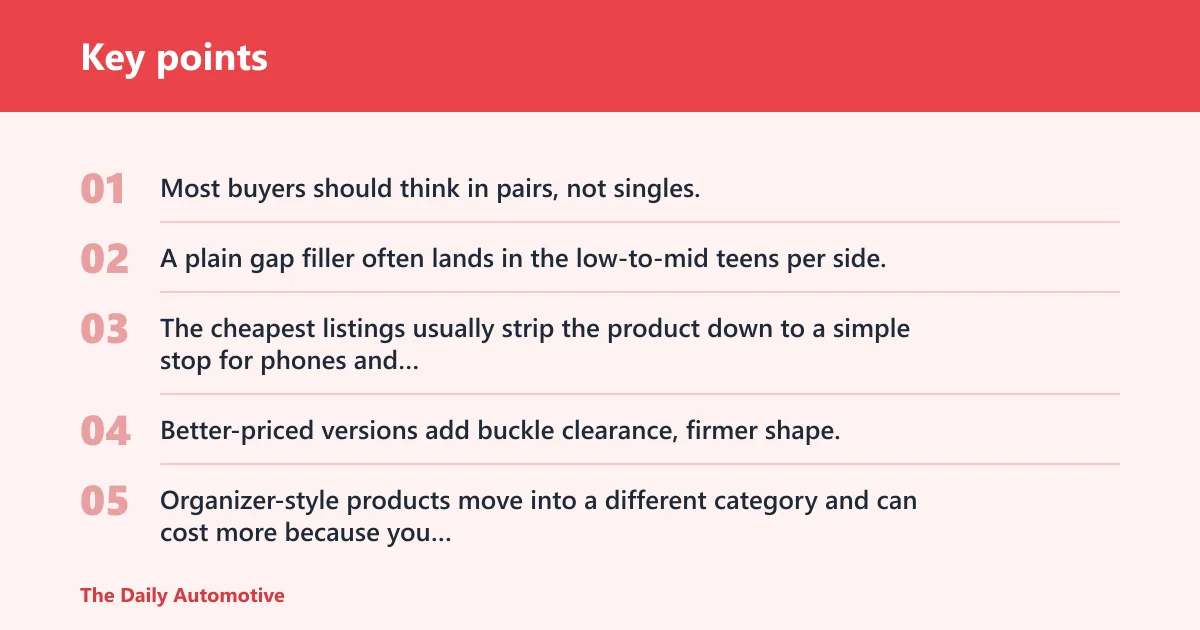


Most buyers should think in pairs, not singles. A plain gap filler often lands in the low-to-mid teens per side, while a set of 2 commonly lands around the upper teens to low 30s depending on material, fit, and whether the seller is a marketplace reseller or a direct brand.
The cheapest listings usually strip the product down to a simple stop for phones and coins. Better-priced versions add buckle clearance, firmer shape, or a tighter fit around the seat rail and center console. Organizer-style products move into a different category and can cost more because you are paying for storage, not only the gap block.
Typical price bands
| Buying tier | Expected price range | What you are paying for |
|---|---|---|
| Budget | $8 to $15 per pair | Basic foam, plastic, or simple fabric construction with minimal fit shaping |
| Mid-range | $15 to $25 per pair | Better material, better buckle cutout, more consistent sizing, and fewer fit complaints |
| Premium | $25 to $35 per pair | Higher-grade synthetic leather, neoprene, or better-shaped vehicle fit |
| Organizer-style | $20 to $40+ per pair | Storage pocket, spill resistance, and extra structure |
| Direct-brand bundles | $19.90 to $49.90 per pair | Brand packaging, stated fit promise, and direct return handling |
What drives the price
Material choice matters, but fit usually matters more. A higher price can reflect synthetic leather instead of foam, a stronger interior core, or a design that keeps the piece from shifting when the seat moves. If the seller adds pockets, spill resistance, or a vehicle-specific shape, the price climbs again.
Material differences
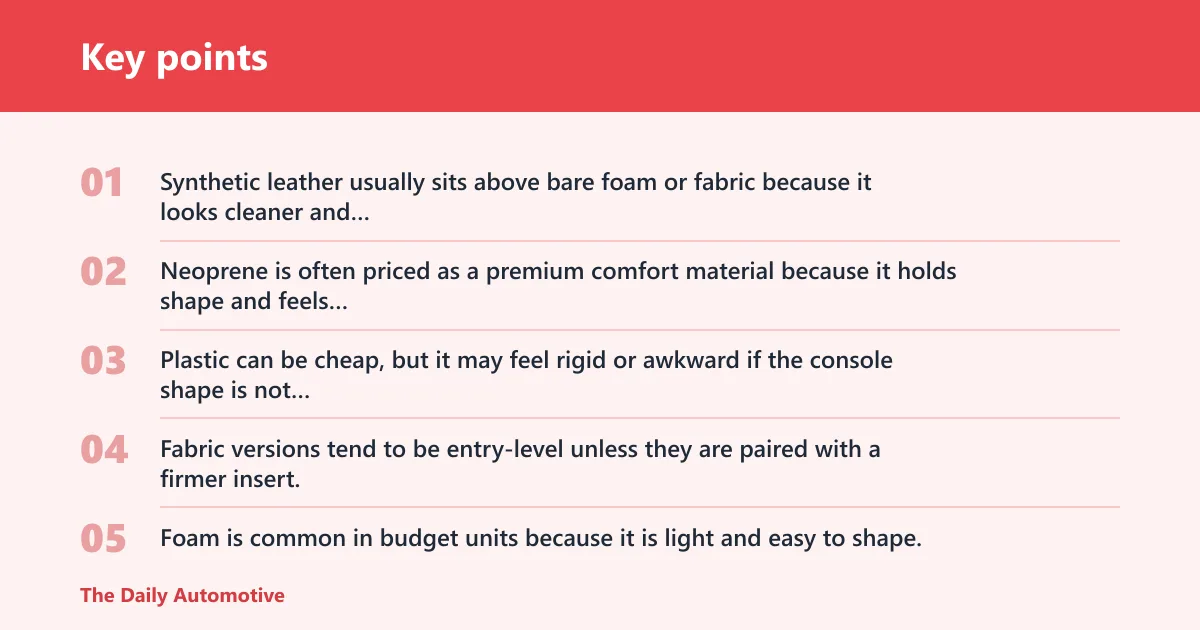
Synthetic leather usually sits above bare foam or fabric because it looks cleaner and resists surface wear better. Neoprene is often priced as a premium comfort material because it holds shape and feels more substantial. Plastic can be cheap, but it may feel rigid or awkward if the console shape is not forgiving.
Fabric versions tend to be entry-level unless they are paired with a firmer insert. Foam is common in budget units because it is light and easy to shape, but it can compress over time. That matters if the gap is deep or the seat rail creates a lot of movement.
Fit type: universal versus vehicle-specific
Universal fit is cheaper to manufacture and easier to sell, so it dominates the market. The tradeoff is direct: one size may work across many cars, SUVs, and trucks, yet still miss narrow gaps, tall console lips, or seats that move a long way on their rails.
Vehicle-specific fit usually costs more because the shape is tuned to a narrower target. That extra money makes sense when a generic piece would block seat adjustment, sit too high, or crowd the seatbelt buckle. It is wasted money if your car already has a simple, wide gap and a flat console edge.
Added features
A storage pocket raises the price because it turns a stopper into an organizer. That can be useful for phones, keys, and coins, but it also adds bulk. In tighter cabins, that bulk can interfere with seat movement or make buckle access worse.
Leak-resistant or spill-resistant versions cost more because they are built to handle more than dropped items. That makes sense for drivers who keep drinks, snacks, or loose change in the front row. It does not help much if your only problem is a phone slipping beside the seat.
Price tiers by type
Gap fillers split into clear price bands once you separate simple stoppers from organizer-style units. The cheapest pieces are fine for basic clutter control. The more expensive ones earn their price through better fit, sturdier construction, or storage that you will actually use.
Car seat gap filler price architecture
| Tier | Material | Common features | Likely failure mode | Best use case |
|---|---|---|---|---|
| Budget | Foam, plastic, or fabric | Simple shape, tool-free install, basic universal fit | Slips, compresses, or leaves an open edge | Low-cost clutter control in a straightforward cabin |
| Mid-range | Synthetic leather, foam core, or neoprene blend | Belt hole, firmer edge, better finish | Still may not fit narrow gaps or tall consoles | Most daily drivers with average seat spacing |
| Premium | High-grade synthetic leather or neoprene | Better shaping, stronger trim, more durable shell | Price is high if fit is still universal only | Longer-term use and cleaner cabin appearance |
| Organizer-style | Leather-look shell, fabric, or structured foam | Pocket, spill resistance, phone and key storage | Can interfere with seat travel or buckle access | Drivers who want storage as well as gap blocking |
| Direct-brand bundle | Usually synthetic leather or neoprene | Two-piece set, stated fit claim, direct return handling | Still depends on console geometry and seat rails | Buyers who want package clarity and easier returns |
What a set of 2 usually costs
A set of 2 is the common packaging format because it covers both the driver and passenger sides. That matters for value: one side alone may solve the worst gap, but a pair gives a matched look and avoids the “fixed one side only” problem. For most shoppers, pair pricing is the number that matters most.
Expect a pair to land around $15 to $25 for a standard mid-range purchase. Budget pairs can run lower, while branded or organizer-style pairs can move above that. The direct-to-consumer listing in the sourced facts is sold as a pair for $19.90, with a regular price of $49.90 and a sale price of $19.90, which shows how wide list-to-sale swings can be in this category.
That same listing is marketed as a set of 2, claims compatibility with many car seats, brands, and models, and shows a 4.8/5 rating from roughly 2,500 reviews. It also offers black or red. Those details matter because they affect perceived value, but they do not remove the need to check buckle clearance and seat movement.
Installation time and return policy basics
Installation is often described as taking seconds without tools, which is part of the appeal of this category. The catch is that easy installation does not guarantee good fit. If the piece shifts after the seat slides, the value drops fast.
When buying direct, a return policy or fit guarantee can be worth real money. A slightly higher price can be justified if the seller makes returns simple, because this category has enough fit variation that one-size claims are often overstated.
Where can you buy one?
You can buy a car seat gap filler from Amazon, Walmart, eBay, and direct-brand stores. The best channel depends on how much you want to spend, how quickly you need it, and whether you value easy returns over the lowest sticker price. Price alone is a poor guide here.
Amazon, Walmart, and eBay compared
| Seller channel | Price pattern | Shipping speed | Returns | Review volume |
|---|---|---|---|---|
| Amazon | Wide spread from low-cost generics to branded bundles | Often fast, especially for Prime-eligible listings | Usually straightforward, but terms vary by seller | Often the highest review counts |
| Walmart | Competitive pricing, especially on basic models | Varies by marketplace seller and stock location | Can be simple through the platform, but check the seller | Usually lower than Amazon for niche items |
| eBay | Can be the cheapest or oddly high, depending on seller | Often slower unless the seller is domestic and stocked | More variable; read the listing carefully | Often lower, with more listing fragmentation |
Amazon usually has the broadest review volume and the most visible price swings, which helps compare products quickly. Walmart can be cheaper on basic listings, but the buyer must watch seller identity and shipping timing. eBay can offer bargains, but the risk of weak product photos, inconsistent descriptions, or harder returns is higher.
Australia buyers can still find car seat gap fillers for sale, but stock, shipping, and return costs can change the real price quickly. Imported listings may look cheap until freight is added. For a low-cost accessory like this, shipping can wipe out the savings.
Buying safely without overpaying
- Check whether the listing is for one piece or a set of 2.
- Confirm the material before comparing price.
- Look for seatbelt hole or buckle clearance details.
- Verify return terms, especially on marketplace seller listings.
- Compare shipping cost, not only sticker price.
- Skip lookalike listings that hide fit details or packaging count.
Is a car seat gap filler worth the price?
Yes, if the piece actually fits your car and solves a real problem. A cheap model is enough when the gap is ordinary, the seat rails are stable, and you only want to stop phones or coins from falling. Paying more is justified when fit, finish, or storage matters enough to change daily use.
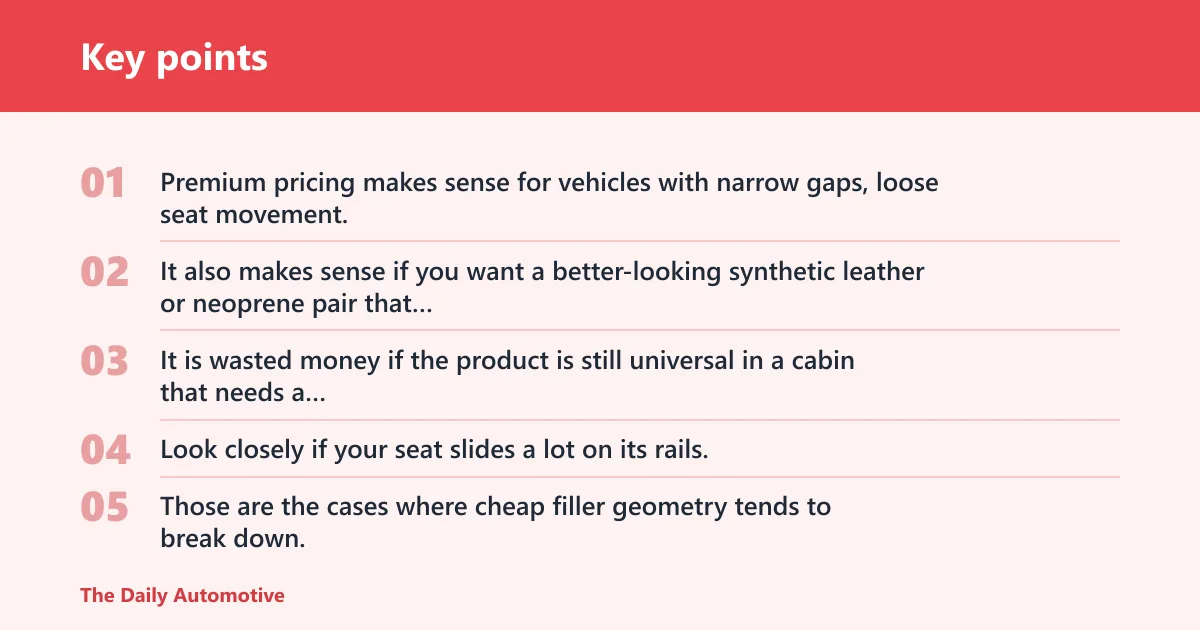
Premium pricing makes sense for vehicles with narrow gaps, loose seat movement, or tall console lips that make standard pieces fail. It also makes sense if you want a better-looking synthetic leather or neoprene pair that is likely to last longer. It is wasted money if the product is still universal in a cabin that needs a vehicle-specific shape.
Signs the product may fail in your vehicle
Look closely if your seat slides a lot on its rails, the gap narrows sharply near the front, or the buckle sits close to the console. Those are the cases where cheap filler geometry tends to break down. A standard universal piece can also fail when the seat edge is curved and the console rises too high.
Say your car has a very narrow gap on the driver side but a wider passenger side. A set of 2 may still be the right buy, but only if the seller’s shape can handle the tight side without pressing on the buckle. Otherwise, one side may work and the other may become a nuisance.
Suppose you want storage for a phone and a garage card, not only a stopgap. A pocket-style model can be worth the higher price, but only if the extra bulk does not push against the seat adjustment lever or block access to the seatbelt latch.
Who it’s for
This suits drivers who want a low-cost fix for dropped items, a cleaner center area, or extra storage in a daily commuter. It is less suitable for buyers who need exact fitment, have unusual seat geometry, or want a product that should not move at all once installed.
Frequently asked questions
How much does a car seat gap filler cost?
Most car seat gap fillers cost $8 to $35 per pair, with many decent options landing in the $15 to $25 range. Singles can appear cheaper, but pair pricing gives a better comparison because most products are sold as driver-and-passenger coverage, not as one isolated piece.
What price should I expect for a set of two gap fillers?
A standard mid-range set of 2 usually costs about $15 to $25. Budget pairs can fall below that, while premium or organizer-style pairs can run higher. Direct-brand bundles may sit at a sale price that looks low but have a much higher regular price.
Are car seat gap fillers cheaper on Amazon or Walmart?
Amazon often has the wider price spread and the highest review volume, while Walmart can be cheaper on basic models if the seller and shipping line up well. The cheaper sticker is not always the better deal, because seller terms, freight, and return handling can change the final cost.
Do premium leather gap fillers cost more than foam ones?
Yes. Synthetic leather usually costs more than plain foam because it looks cleaner, holds shape better, and often comes in more polished bundles. Foam is common in lower-priced units, but it can compress sooner and may not hold its shape as well in deeper or tighter gaps.
Are car seat gap fillers available for sale in Australia?
Yes, but availability and final price vary more once shipping and returns are added. Imported listings can look inexpensive at first, then become less attractive after freight. For Australia buyers, it is worth checking whether the seller has local stock or a practical return process.
Where can I buy a car seat gap filler?
You can buy one on Amazon, Walmart, eBay, or directly from a brand site. Amazon is usually best for comparison and review volume, Walmart can be competitive on price, and eBay can be cheaper but riskier. Direct-brand bundles can justify a higher price if the return terms are stronger.
Products related to this article
Sponsored / affiliate links. As an Amazon Associate I earn from qualifying purchases. I may earn additional commission from eligible campaigns.
 FLORICH Front Car Seat Covers, Leather Seat Covers for Cars, Waterproof Car Seat Protector Breathable, Front Seat Covers for Cars, Automotive Seat Covers Universal Fit for Most SUV Pick-up Truck
 Huidasource Universal Car Seat Covers, Waterproof Faux Leather, Airbag Friendly, Easy Installation, Unobstructed Cup Holders, Scratch Resistant for Family Trips, Black & Blue