Best Car Heater Blankets for Cold Commutes (2026): we compared
The best car heater blanket for cold commutes is a 12V heated blanket with auto shutoff and at least three heat settings; choose it when you want direct body heat and your drive is 20 minutes or longer. A weak pick leaves your knees cold, pulls too much from the outlet, or warms so slowly that the first part of the drive is over before you feel it. This guide compares heated blankets with 12V heater fans, heated seat covers, and remote start so you can buy the right cold-weather setup.
This guide is part of our Winter car care series.
Quick comparison
| Product | Badge | Best for | Price | ||
|---|---|---|---|---|---|
 |
IHEALTHCOMFORT 12V Car Heated Blanket, with a TimerIHEALTHCOMFORT | Our pick | 57×40 inch double-sided polar fleece | $29.71
Price as of 2 Oct 2026
|
View |
 |
shenruifa 12V 300W Car Heater, Portable Ceramic Vehicleshenruifa | Pair with it | 300W ceramic fan with auto thermostat | $35.89
Price as of 2 Oct 2026
|
View |
 |
Heated Car Blanket – 12V Electric Travel Blanket for Car,Stalwart | Budget pick | 59×43 inch navy fleece with 96-inch cord | $24.88
Price as of 2 Oct 2026
|
View |
 |
Blytra 12V Car Heater for 150W Car Defroster WindshieldBlytra | Also great | 150W PTC defroster with 360-degree airflow | $26.99
Price as of 2 Oct 2026
|
View |
The table below separates commute-friendly blankets from louder cabin heaters that draw more power. Use it to match cord reach, heat control, and power source before you buy.
For short drives and rear-seat use, cord length matters as much as warmth. For off-grid use, low wattage and portable power station compatibility matter more than fabric feel.
According to 8 Best Car Heaters for Winter Commutes (September 2026): Reviews — The Sealy blanket has an 85-inch cord.
How we chose
The picks below were compared on commute fit, not just headline warmth. I looked at heat settings, auto-off behavior, cord length, washability, and whether the power draw makes sense for a 12V outlet or a portable power station.
We also separated blankets from 12V heater fans and heated seat covers. Those products solve different problems.
A blanket is best for personal heat. A fan is better when you need moving air for fog clearing. A seat cover can be enough if only your lower back and hips need warmth.
IH EALTHCOMFORT 12V Car Heated Blanket: best for the best overall commute blanket
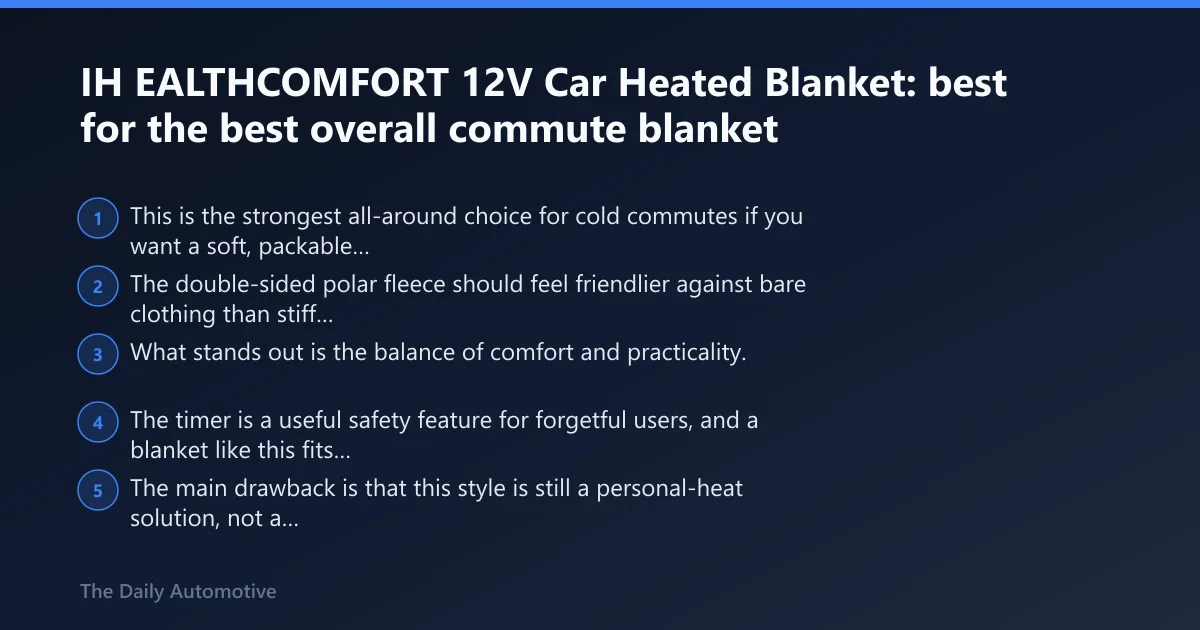
This is the strongest all-around choice for cold commutes if you want a soft, packable blanket with straightforward controls. The double-sided polar fleece should feel friendlier against bare clothing than stiff synthetic throw material, and the included storage bag makes it easier to keep in the trunk until the weather turns.
What stands out is the balance of comfort and practicality. The timer is a useful safety feature for forgetful users, and a blanket like this fits the core use case well: it warms the driver or passenger directly through a 12V vehicle outlet instead of trying to heat the entire cabin.
The main drawback is that this style is still a personal-heat solution, not a cabin-heater replacement. If your windshield is frosting over or the car is filling with condensation, a blanket will not do the fan’s job.
Sealy 12V heated blanket: best for rear-seat use and longer cord reach
Use the Sealy when cord reach is the deciding factor. Its 85-inch cord makes it easier to route from the front outlet to the passenger seat without forcing the plug under tension, and the three heat levels are enough for most commuter routines.
It also checks several trust signals buyers should ask for: machine washable construction, overheat protection, and a 4-hour auto-off feature. Based on the spec sheet, it pulls about 50 watts on high, which is a sensible figure for a vehicle outlet when you want steady warmth rather than a hard blast of heat.
The drawback is simple: three heat levels are fine, but not especially flexible compared with blankets that offer more timer control. It is a better fit for drivers who value a long cord and easy care over extra setting choices.
Comfytemp 12V heated blanket: best for value and control
This is the smart middle-ground pick for commuters who want more control without moving up into a premium price lane. The 4 heat settings and 11 auto-off timers give it more adjustment than most basic travel blankets, which helps if your commute length changes from day to day.
The 110-inch cord is the biggest practical advantage. That extra reach matters in SUVs, vans, and trucks where the back seat sits farther from the front outlet. It also helps if the only accessible 12V outlet is low on the console or dash.
The drawback is that extra flexibility can be overkill for a simple 15-minute drive. If you only want a light warm-up on the way to work, you may not need this many timer choices.
Stalwart heated car blanket: best budget pick
This is the budget option for drivers who want basic personal heat without paying for extra controls. The 59×43 inch size is large enough for lap-and-torso coverage, and the 96-inch cord gives it enough reach for many front-seat and some rear-seat layouts.
The polyester fleece feel should be familiar and easy to live with, and the low entry price makes this one sensible for emergency kits, older vehicles, or drivers who only need a backup blanket for a few cold months each year.
The drawback is the pared-back ownership experience. It is spot-clean-only, so it asks more of the owner after spills or salt stains. Budget buyers get value here, but not the easiest care routine.
shenruifa 12V 300W car heater fan: best when your main job is defrosting
This is not a blanket, and that is the point. Choose it when your bigger problem is foggy glass, damp air, or a windshield that needs moving heat more than personal warmth. The 300W ceramic fan and automatic thermostat make it the more direct tool for cabin air management.
It also offers heat and cooling modes, which gives it year-round utility. The adjustable mounting bracket and dual-function approach make it more flexible than a blanket if you drive in mixed seasons or need a fixed install in one vehicle.
The drawback is power draw. A fan like this is a different load class from a blanket, so it is a weaker fit for low-output 12V sockets and for users who only want quiet warmth on a short commute.
How we built the commute-fit matrix
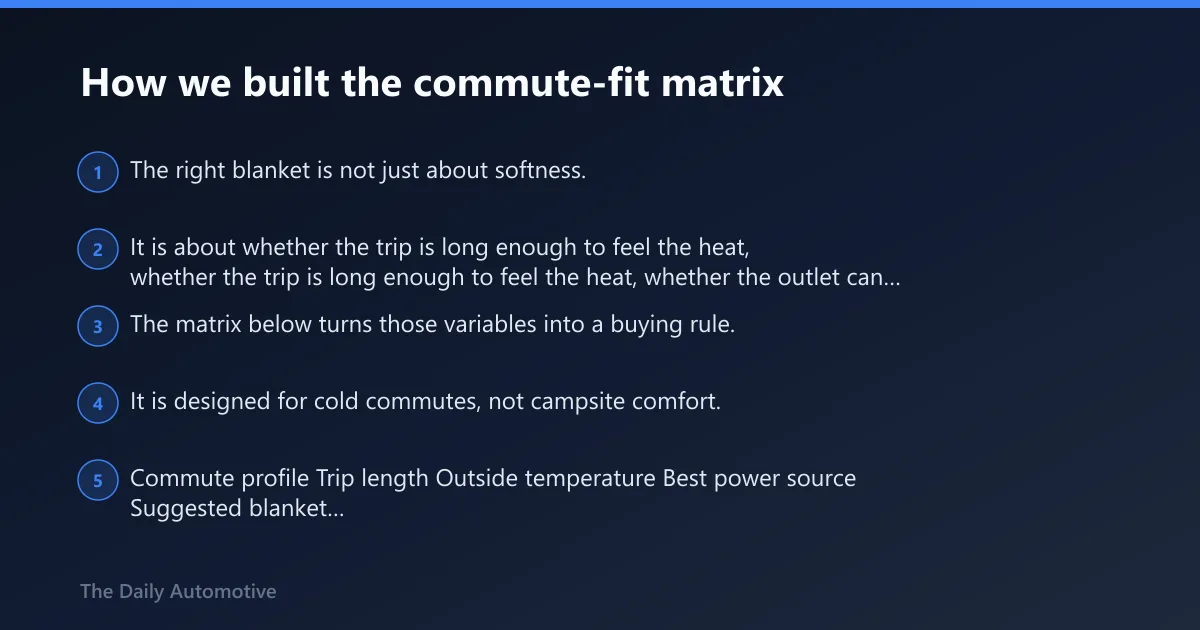
The right blanket is not just about softness. It is about whether the trip is long enough to feel the heat, whether the outlet can carry the load, and whether the cord reaches the seat you actually use.
The matrix below turns those variables into a buying rule. It is designed for cold commutes, not campsite comfort.
| Commute profile | Trip length | Outside temperature | Best power source | Suggested blanket wattage | Suggested cord length | Safety features to insist on |
|---|---|---|---|---|---|---|
| Short city commute | 10-20 minutes | Below freezing | 12V outlet with engine running | Low to moderate, about 30-50 watts | At least 85 inches | Auto-off timer, overheat protection |
| Daily highway commute | 20-40 minutes | Cold, but not brutal | 12V outlet | About 50 watts | 85-110 inches | Multiple heat settings, auto-off timer |
| Rear-seat rider in SUV or van | 20+ minutes | Freezing to very cold | 12V outlet or portable power station | Low watt blanket only | 110 inches or more | Long auto-off window, overheat protection |
| Off-grid or car camping use | Any length, but not while parked all night | Cold evenings | Portable power station | Low watt blanket only | Flexible routing helps | Auto-off timer, low draw, washability |
Trip length versus wattage and warm-up speed
Short drives reward blankets that warm the body faster than the cabin can heat up. For a 10- to 20-minute commute, a low- to moderate-watt blanket is usually enough if the goal is to take the edge off the cold.
Once a drive stretches past 20 minutes, a blanket with clearer heat settings becomes more useful. That is where about 50 watts starts to make sense, because the warmth has time to build without pushing the vehicle outlet too hard.
Vehicle type, seat position, and cord reach
Cord length is not a minor spec. It decides whether the blanket actually reaches the person using it or becomes a tangled plug problem between the console and the seatback.
Front-seat commuters can usually live with a shorter cord. Rear-seat riders in SUVs, trucks, and minivans should look for longer cords first, because the outlet-to-seat gap is often the real buying limit.
Outside temperature bands and when a blanket is enough
On very cold mornings, a heated blanket is enough when the cabin is only cold and dry. It is less useful when the car is icy inside, the glass is fogged, or the heating system is failing to clear moisture.
If the outside temperature is low but the trip is modest, direct body heat often feels better than waiting for the dashboard vents to catch up. That is where a blanket beats a remote start strategy that only warms the car after extra idle time.
Power source match: 12V outlet or portable power station
A 12V heated car blanket is built for plug-and-play use in a cigarette lighter or 12V outlet. That is convenient, but it also means the outlet is the limiter, especially in older vehicles with weaker electrical systems.
Portable power stations can work with low-watt blankets, but only when the battery capacity matches the draw and runtime goal. High-draw blankets are a poor fit off-grid because the battery can empty faster than many buyers expect.
What should I look for in a car heated blanket?
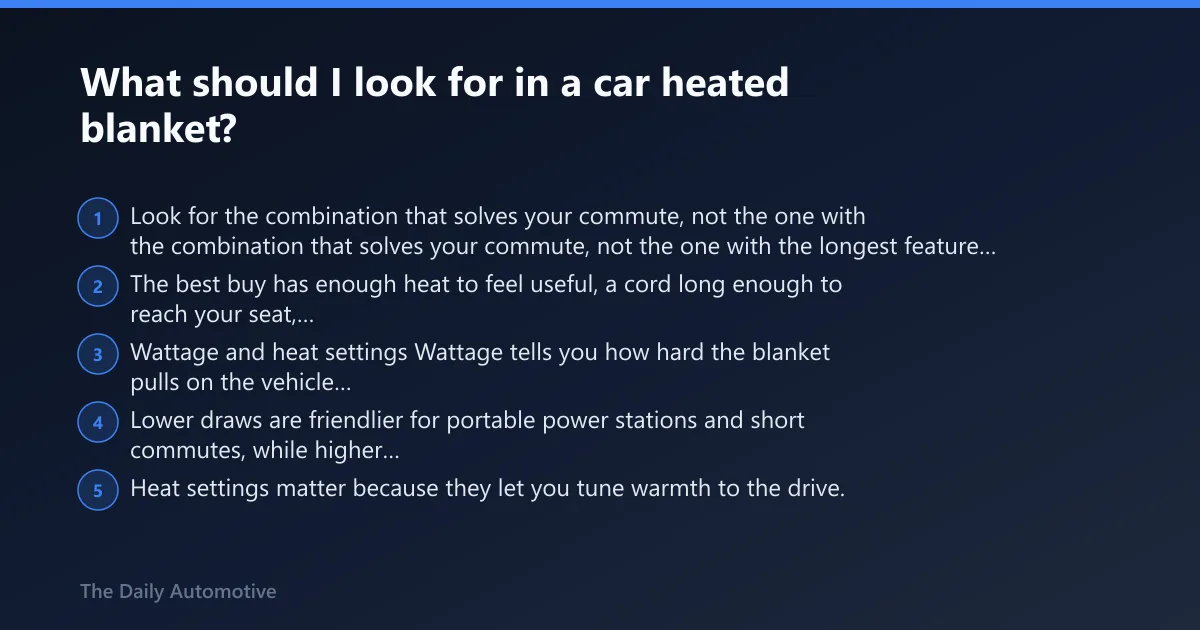
Look for the combination that solves your commute, not the one with the longest feature list. The best buy has enough heat to feel useful, a cord long enough to reach your seat, safety shutoff features, and fabric that can handle regular use.
Wattage and heat settings
Wattage tells you how hard the blanket pulls on the vehicle outlet. Lower draws are friendlier for portable power stations and short commutes, while higher draws can feel warmer sooner but ask more of the electrical system.
Heat settings matter because they let you tune warmth to the drive. Three settings is enough for many drivers. Four settings or more is helpful if your commute changes with weather and clothing layers.
Cord length and seat position
For front seats, a cord in the 85-inch range is usually workable. For back seats, trucks, and larger SUVs, longer is safer because it avoids sharp bends, awkward routing, and accidental unplugging.
When the cord is too short, the blanket may not sit correctly on the body. That is a comfort loss and a safety issue.
Auto-off timer and overheat protection
Auto-off timers are not decoration. They reduce overnight risk, help forgetful users, and stop the blanket from running longer than needed on a commute.
Overheat protection is the other key safety signal. It gives buyers confidence that the blanket can shut down if temperatures climb too far during normal use.
Material, washability, and daily wear
Soft fleece or polyester is the usual lane here, and it is the right lane for most commuters. Those fabrics feel better against winter clothes and are easier to fold into a trunk bag.
Machine washable blankets are easier to keep in service. If a blanket is not washable, daily use in salt, slush, and coffee spill season gets old quickly.
Which one should you buy
For 10- to 20-minute commutes, the IHEALTHCOMFORT blanket is the cleanest all-around buy because it balances comfort, a storage bag, and basic timer protection without overcomplicating the decision. If your drive is longer or your vehicle is an SUV, truck, or van, the Comfytemp is the better fit thanks to its 110-inch cord.
If your cabin heater is weak but the windshield needs clearing, buy the shenruifa heater fan instead of a blanket. If your budget is tight and you want something simple for emergency warmth, the Stalwart is the low-cost option, though it asks more of the user on care.
If you plan to use a portable power station, stay with the lowest-watt blanket option available and match runtime to battery capacity before you buy. A blanket is the right tool for personal heat. It is the wrong tool when the cabin itself needs to warm fast.
Do heated car blankets work in a car with a bad heater?
Yes, but only for personal warmth. A heated car blanket can make the driver or passenger feel much better when the cabin heater is weak or dead, yet it will not clear glass or heat the entire cabin the way HVAC does. That limit matters on wet, icy mornings.
In a bad-heater car, the blanket is best viewed as a stopgap. It helps the person, not the air. If the windows fog or frost up, a heater fan or a repaired cabin system is still needed.
How many watts does a 12V car heated blanket use?
Many 12V heated blankets sit in a low-power range that is easier on vehicle outlets than a cabin heater fan. A useful example is the Sealy model, which pulls about 50 watts on high. Lower watt blankets are usually the better bet for portable power stations and short trips.
What matters is not just the number. The wattage has to fit the trip length, the outlet’s ability to supply power, and the kind of warmth you want. Higher wattage can feel stronger, but it also raises the electrical load.
Will a car heater blanket drain my battery?
It can, especially if used with the engine off. With the engine running, a normal low-watt blanket is usually fine for commuting because the alternator is supporting the electrical load. With the engine off, even modest draw can become a battery problem if the blanket stays on too long.
The simple rule is this: engine on for driving, brief use only when parked, and no assumptions about all-night warmth. Off-grid use should be reserved for low-watt blankets paired with a battery that is sized for the runtime you actually need.
What size heated blanket is best for commuting?
The best commuting size is one that covers the lap, torso, and upper legs without crowding the seat belt or slipping off the shoulders. For most front-seat drivers, a mid-size travel throw is enough. For rear-seat riders, wider coverage and a longer cord matter more than oversized bulk.
Think in coverage zones, not just inches. A blanket that reaches the thighs and midsection usually feels better on a commute than one that looks large on paper but fails to sit correctly in the seat.
Are heated car blankets safe to leave plugged in?
They are safer when they include an auto-off timer and overheat protection, but they should still not be treated as leave-it-all-night gear. Auto-off helps with forgetfulness, yet any heating product in a vehicle should be used with attention to the trip length and the condition of the outlet.
If the blanket will be left plugged in while parked, the safer practice is to use the timer, verify the outlet fit, and avoid doing it with a weak battery. Overnight use is where caution matters most.
Can I use a heated car blanket with a portable power station?
Yes, but only with low-watt blankets and a power station that matches the blanket’s draw and runtime. Portable power stations are a good fit for off-grid use when you want personal warmth without idling the vehicle.
The catch is battery capacity. A blanket that is fine in a 12V outlet may run down a compact power station faster than expected. Match the wattage first, then estimate runtime before you depend on it.
What should I look for in a car heated blanket?
Look for a 12V plug, usable cord length, at least three heat settings, an auto-off timer, overheat protection, and a washable fabric. Those are the features that matter when the blanket is used on real commutes, not just opened in a product photo.
After that, choose based on your seat position and how cold the commute gets. A rear-seat rider needs reach. A short-hop commuter needs simple controls and fast comfort. A portable power station user needs low wattage above all else.
How fast does a 12V heated car blanket get warm?
Most heated blankets are meant to produce steady personal warmth rather than instant cabin heat. They usually feel useful faster than the car’s air system on a cold morning, but they are still gentler than a heater fan and should not be expected to blast heat immediately.
If the goal is fast comfort on a short drive, a blanket can start feeling effective early. If the goal is to warm the whole vehicle, the blanket is the wrong comparison.
Is a heated blanket better than a car heater fan?
For personal warmth on a commute, yes, often. For fog clearing and cabin airflow, no. A heated blanket is better when you want quiet, direct heat on the body during a short or medium drive. A heater fan is better when the windshield and cabin air need attention.
The right choice comes down to the job. If the problem is you, buy the blanket. If the problem is the glass, buy the fan.
Products related to this article
Sponsored / affiliate links. As an Amazon Associate I earn from qualifying purchases. I may earn additional commission from eligible campaigns.