Clothes Rod for Car: Fit, Load, and Stability
Choose a car clothes rod when you need garments to hang straight in the cabin, and make sure it has anti-slip end grips. If it flexes by hand or relies on loose suction cups or clips, skip it. Poor fit lets garments swing, wrinkle, or fall, and weak mounts can scratch trim or block rear visibility. If your main goal is the least wrinkling and you do not have a stable rod or solid anchors, a garment bag is the safer alternative. This guide explains how to measure your vehicle, spot stable mounting hardware, and avoid rods that fail under real road motion.
Top pick and best uses


The best general choice is a telescoping steel or alloy steel bar with anti-slip rings that fits your measured cabin width and mounts in the middle of its adjustment range. It works best for a few suits, shirts, or uniforms on a commute or overnight trip, not for a packed moving load.
Which garments it handles best?
Use a car clothes rod for garments that wrinkle easily on folds: suits, dresses, shirts, jackets, coats, and uniforms. Keep the load light enough that the bar stays straight under road motion. A short row of spaced hangers works better than crowding the center, because crowding adds sway and makes the rod sag faster.
Suppose a driver hangs four business shirts on a 34-inch bar in a sedan. If the hangers are bunched at one end, the rod can tilt and swing even though the weight is modest. Spread the load, center the mass, and keep long coats away from the weaker side of the mount.
Quick picks by vehicle type
Match the rod to the body style first, then to the mount. The same adjustable bar can behave very differently in a sedan, an SUV, or a van if the rear anchor points sit at different heights or if the cabin width pushes the bar near its limit.
- Best for sedans: A 30-63 inch or 30-64 inch telescoping bar with grab-handle or headrest-post mounting, if the rear seat area has solid anchor points.
- Best for SUVs and vans: A wider-span bar such as 34-70 inches or 30-66 inches, as long as the rear handles or posts can carry the load without flex.
- Best for trucks and RVs: A long-span bar only if the cabin gives you fixed anchors and enough rear headroom; otherwise skip the rod and use a garment bag or cargo cabinet.
Business travelers usually need the stiffest mount, not the longest bar. Rideshare drivers need the least rearview blockage. Family road-trippers need the easiest exit path, because passengers and bags can shift during a stop.
Best for cars with rear grab handles
Grab-handle mounting stays steadier when the handle is fixed to the body shell, sits at a consistent height, and lines up with the rod ends without forcing a twist. This setup is often the better choice for sedans and many SUVs because it resists side-to-side slip better than loose trim points, but only if the handle is designed to take the added load.
Why grab-handle mounting stays steadier
Grab handles give the bar a firmer lateral anchor, which matters during turns and lane changes. A bar with rubber grip sleeves or rubber rings can stay planted there better than one that depends on a smooth contact point. The rod still needs correct length, because overextension adds flex.
When to avoid this setup
Skip grab-handle mounting if the handle is small, weak, or not meant to take added horizontal load. Avoid it when the rear seat area is already crowded, when the rod blocks the mirror, or when the bar would sit so low that jackets brush the seatbacks and wrinkle.
Best for cars with coat hooks or side handles
Coat-hook mounting can work, but only when the hooks are solid and the rod’s end fittings sit securely without prying the hook downward. Side handles may help in some vans and SUVs, yet they often fail sooner than grab handles if the bar is long or the garment load is uneven.
Which hook shapes are most reliable?
Hooks with a deep lip and a rigid base are the better choice. Small plastic hooks and thin decorative fittings are weak points. If the rod uses a tool-free bracket, check that the bracket clamps firmly and does not rotate under load, because rotation quickly turns into sag.
Common slip points to check
Watch for three problems: the hook sliding off the mount, the rod end walking sideways during a corner, and the telescoping joint loosening after repeated bumps. Anti-slip rings help, but they do not fix a bad hook shape or a span that is too long for the cabin.
How do you choose the right clothes rod?
Start with cabin width, then check the anchors, then weigh the clothing. A rod that fits the opening but overstresses the mount is still the wrong rod. Length, load, and mount strength need to line up, or the bar will sag, shift, or hide the rear view.
Measure interior width first
Measure the distance between the two anchor points you plan to use, not the widest point in the cabin. That distinction matters in SUVs and vans, where the usable span may be far shorter than the open space. Common telescoping ranges include 30-63 inches, 30-64 inches, 34-54 inches, 35-60 inches, 34-70 inches, and 30-66 inches.
If the rod must stay near full extension to fit, pick a sturdier mount or a shorter option. A 34-54 inch bar can be useful in tighter cabins. A 34-70 inch bar gives more coverage, but longer spans can place more stress on the joint and make sag more likely.
Match load rating to garment weight
Load ratings around 50 lbs are listed on some rods, but that number alone is not a full safety verdict. Garment weight, hanger count, hanger spacing, and rod length all change the real stress. A short 50 lb bar with a few balanced jackets is one thing; a long span with heavy coats and clustered hangers is another.
Use a lower target than the maximum label when the bar extends near its long end. A longer rod bends more under the same weight, and that bend becomes sway on rough pavement. A claim like 110 lb may still be poor in a long, narrow cabin if the anchors are weak.
Check material and finish
Steel, alloy steel, carbon steel, and stainless steel are the main material choices. Steel and alloy steel usually offer the best stiffness for the money. Stainless steel can help resist corrosion in damp use, while powder-coated or rubber-wrapped finishes can reduce scuffing where the rod touches trim or a hanger ring.
The finish matters because it changes grip and wear. A slick metal end can slide more than a rubber-wrapped end. A rough or coated surface can help the bar stay planted, but only if the coat hook or grab handle is strong enough to hold it.
Use anti-slip features for turn stability
Rubber rings, rubber grip sleeves, non-slip surfaces, and divider rings are there to reduce sliding, not to rescue a poor fit. Divider rings help keep hanger groups apart so the load does not drift to one side in a turn. Anti-slip parts reduce sway, but they do not make a weak hook stronger.
Say a commuter hangs two jackets and three shirts on one side of the bar. The rod may stay up in a straight line, yet still tilt and move during a right turn. A divider ring near the center can split the load and keep the mass from migrating.
Clothes rod fit checklist
Use this checklist to match vehicle type, anchor points, rod length, and failure mode before you buy or install anything. The goal is not the longest bar. The goal is the bar least likely to slip, sag, or block the mirror in your exact cabin.
| Vehicle type | Rear anchor points available | Rod length to measure | Estimated garment load | Likely failure mode | Recommended mounting style |
|---|---|---|---|---|---|
| Sedan | Rear grab handles or sturdy side handles | Measure handle-to-handle span across the rear seat area | 2-6 garments, usually light to moderate | Rearview blockage or sag at the center span | Grab-handle mounting |
| SUV | Rear grab handles, headrest posts, or strong side handles | Measure the usable cabin width below the roof line | 4-10 garments, mixed weights | Hook slip on a long span | Grab-handle mounting if handles are solid; otherwise headrest-post setup |
| Truck | Often limited rear handles; check seatback and cab points | Measure only the anchored span you can actually support | Low to moderate, with short groups of hangers | Not enough anchors or too much flex | Use only if the cab has fixed anchors; otherwise no rod |
| Van | Rear grab handles, side handles, or overhead mounts | Measure the rear passenger opening, not the cargo space | Moderate to heavier groups of uniforms or coats | Rod sag across a wide span | Grab-handle mounting or a shorter, stiffer bar |
| RV | Fixed cabinet points or strong interior anchors | Measure from solid point to solid point | Varies; keep the load light if the mount is flexible | Joint loosening during vibration | Use only with rigid anchors; otherwise no rod at all |
Simple decision rule: choose grab-handle mounting when the rear handles are fixed and the bar sits within its midrange; choose coat-hook mounting only when the hooks are rigid and the load is light; use no rod at all when there are no solid rear anchors, when the bar must run near full extension, or when it blocks the mirror or emergency access.
How much weight can a car clothes rod hold?
Many rods are listed at around 50 lbs, and some are claimed at 60 lbs, 70 lbs, or even 110 lb. Treat those numbers as ceilings, not targets. The practical limit is lower when the span is long, the clothing is heavy, or the mounts are small and thin.
A 50 lb rating may be enough for a few shirts and a jacket, but not for a full row of winter coats on a 30-66 inch bar. The longer the span, the more sag you get. More sag means more swing, and more swing means more wrinkles.
How do you install a car clothes hanger bar?
Installation should be simple, but simple is not the same as secure. Place the bar across fixed points, extend it only until it locks firmly, and confirm that both ends sit level before loading any hangers. If the hardware twists by hand, stop and re-seat it.
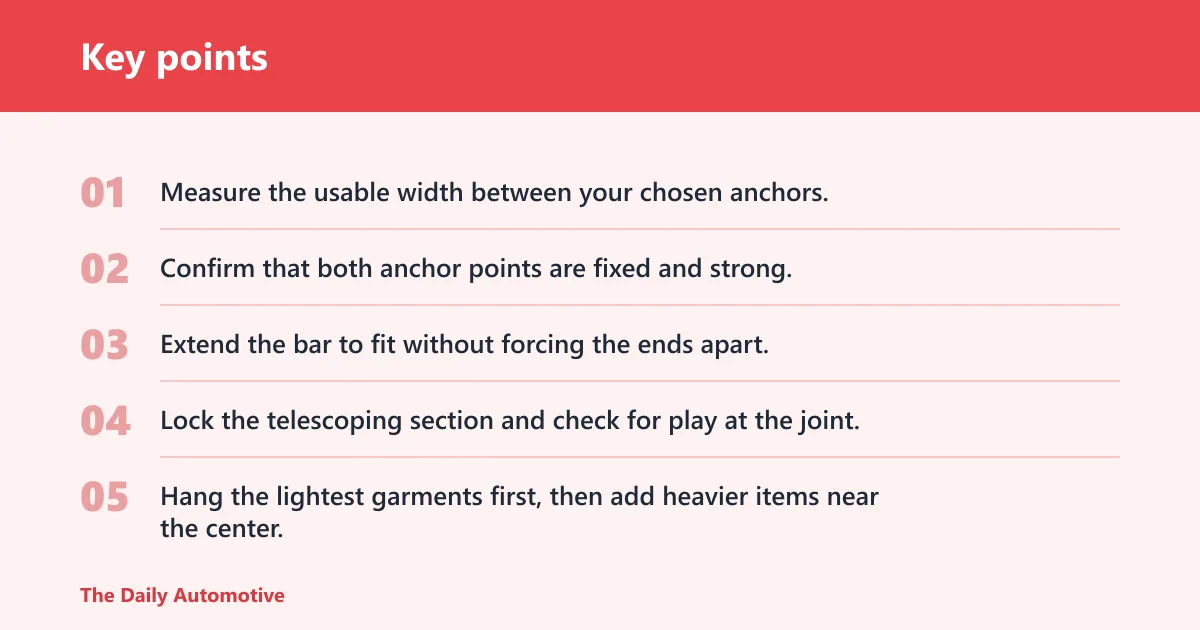
- Measure the usable width between your chosen anchors.
- Confirm that both anchor points are fixed and strong.
- Extend the bar to fit without forcing the ends apart.
- Lock the telescoping section and check for play at the joint.
- Hang the lightest garments first, then add heavier items near the center.
- Check rear visibility, headroom, and seatback clearance before driving.
Are car clothes bars safe on road trips?
They are safe only when the fit is right, the anchors are solid, and the load is modest. Road trip vibration can loosen a weak joint, and sudden braking can shift the load forward. Keep the bar clear of airbags, mirrors, and passenger head space, and remove it if it interferes with cargo access.
What size car clothes rod do I need?
Pick the shortest adjustable bar that fully spans your measured anchor points. Common choices such as 30-63 inches, 30-64 inches, and 30-66 inches suit many cars and crossovers, while 34-54 inches works better in tighter cabins. A 34-70 inch bar helps only if the vehicle truly needs that reach.
Choose length from measured width, not from the vehicle badge. An SUV can still need a shorter rod than a sedan if the anchors sit close together. If the bar must stay near the top of its adjustment range, expect more flex and more chance of slip.
Can I use a car clothes rod for dresses and suits?
Yes, if the bar holds the hangers steady and the clothes have enough breathing room. Dresses and suits wrinkle less when they hang straight, with space between garments and minimal sway. Use divider rings or wider spacing so hems and jacket shoulders do not press together during turns.
For long dresses, check headroom before loading the rod. For suits, keep jacket shoulders aligned and avoid stacking heavy coats on the same side. A balanced load with even hanger spacing is the difference between smooth fabric and a bent, swinging row of clothes.
Frequently asked questions
What is the best clothes rod for a car?
The best choice is a telescoping steel or alloy steel rod that fits your measured cabin width, mounts to fixed anchor points, and includes anti-slip rings or sleeves. A practical starting span for many cars is about 30-63 inches or 30-64 inches.
How do you keep suits from wrinkling in a car?
Keep suits on spaced hangers, centered on the rod, and away from heavy coats that pull the bar down. Use a rod that stays level, not one that sags near the middle. The less the suit swings, the less the fabric creases at the shoulders and sleeves.
Will a car clothes hanger bar fit my SUV?
It may, but only if the rear anchor points line up with the rod’s telescoping range and the handles can take the load. Many SUVs fit a 34-54 inch, 35-60 inch, or 30-66 inch bar, but the right length depends on the actual span between your mounts.
Products related to this article
Sponsored / affiliate links. As an Amazon Associate I earn from qualifying purchases. I may earn additional commission from eligible campaigns.