Dealer Service vs Independent Mechanic: Which Fits?
Use the dealer for warranty work, recalls, brand-specific software updates, and complex diagnostics. Use a trusted independent mechanic for routine maintenance and most post-warranty repairs, especially brakes, suspension, exhaust, and fluid services. Choosing the wrong shop can mean denied warranty coverage, misdiagnosed faults, or paying noticeably more than necessary. This guide compares dealer service vs independent mechanic by repair type, vehicle complexity, and cost so you can choose the right shop for the job.
This guide is part of our Car care and upkeep guide series.
Dealer service vs independent mechanic: the core trade-off
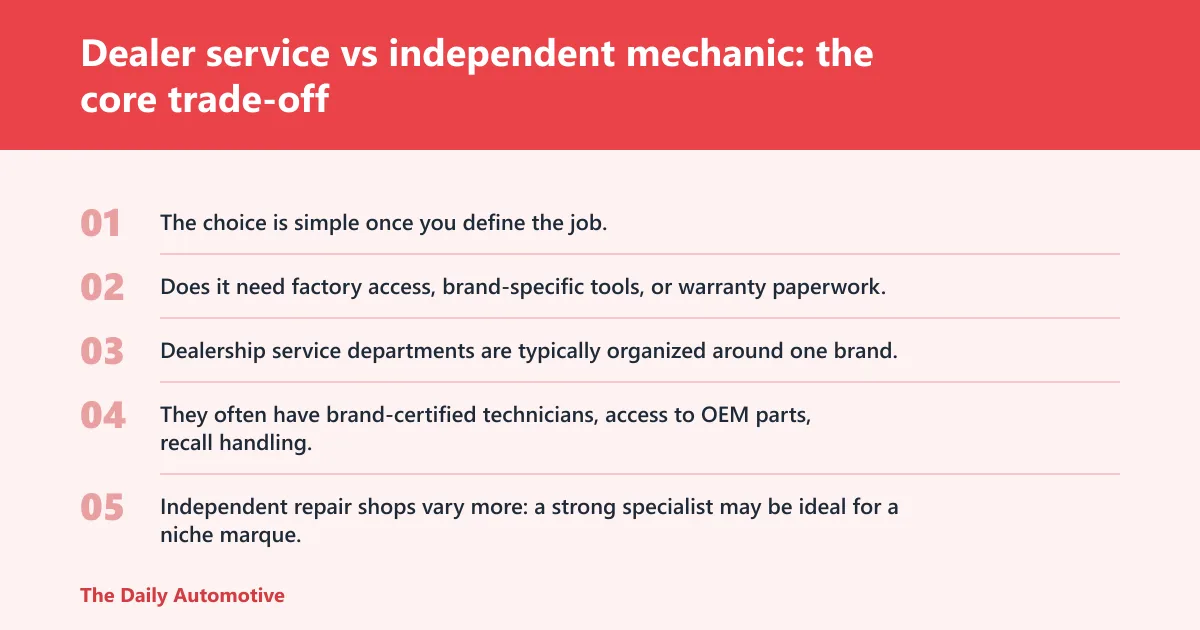
The choice is simple once you define the job. Does it need factory access, brand-specific tools, or warranty paperwork, or does it need lower labor rates and flexible parts sourcing for straightforward work?
Dealership service departments are typically organized around one brand. They often have brand-certified technicians, access to OEM parts, recall handling, and the manufacturer’s scan tools and programming options. Independent repair shops vary more: a strong specialist may be ideal for a niche marque, while a generalist shop may be the better value for routine service.
| Factor | Dealer Service | Independent Mechanic | Winner |
|---|---|---|---|
| Warranty and recall handling | Built for factory warranty work, recalls, and brand campaigns | Can perform maintenance and many repairs, but may not have full factory claim access | Dealer Service |
| Diagnostics and software access | Brand-specific scan tools, updates, and coding access are common | Varies by shop; strong independents may have excellent tools, but access is not uniform | Dealer Service |
| Price | Often higher labor rates and parts markup | Usually lower labor rates in many markets, with parts flexibility | Independent Mechanic |
| Routine maintenance | Good, but often priced at a premium | Usually a strong fit for oil changes, brakes, fluids, belts, and suspension wear items | Independent Mechanic |
| Complex brand-specific repair | Better for late-model electronics, ADAS, EV systems, and warranty repairs | Best only if the shop is a proven specialist with the right equipment | Dealer Service |
Warranty and recall handling
Dealer service wins where paperwork matters most. Factory warranty coverage depends on the vehicle’s age, mileage limits, and whether maintenance records show proper fluids, intervals, and approved parts where required. Independent service does not automatically void a warranty, but the shop has to follow the manufacturer’s specs and document the work clearly.
Diagnostics and programming access
Modern cars rely on software, not just hardware. A dealership is more likely to have the exact scan tool functions for coding modules, installing updates, and completing calibration routines after parts replacement. That matters when the fault is intermittent, multiple warning lights are present, or a repair touches camera, radar, or battery-management systems.
Price and turnaround
Independent shops often win on labor rate, and their estimates can be easier to negotiate. Dealers may offset higher cost with faster access to OEM parts, loaner cars, shuttle service, or recall processing, but that advantage is most useful when the job needs factory support rather than simple wrench work.
📊 About 80,000 of those repairs were at franchised dealers. Source: Independent vs. Dealer Shops for Car Repair.
How do dealer and independent quotes compare line by line?

Compare estimates by line item, not by total alone. A lower total can hide missing diagnostic time, vague parts descriptions, or a skipped calibration that becomes another visit later.
| Line item | Dealer Service | Independent Mechanic | What to verify |
|---|---|---|---|
| Diagnostic fee | Often separate and brand-specific | Often separate, but shop policy varies | Ask whether the fee applies to inspection only or to repair diagnosis and report |
| Parts source | Commonly OEM parts and accessories | OEM or aftermarket, depending on the shop and your request | Confirm exact part number, brand, and warranty on the part |
| Labor hours | Usually based on book time plus brand procedures | Usually based on book time, sometimes with shop-specific pricing | Check the listed labor hours against the repair plan |
| Fluids and specs | More likely to use factory-specified fluids | Can be correct if the shop follows OEM spec exactly | Look for viscosity, approval standard, and quantity |
| Calibration and software | More likely to include OEM scan, coding, or ADAS calibration access | May subcontract calibration or lack software access for some brands | Ask whether camera, radar, steering-angle, or module coding is included |
| Turnaround and transport | May offer shuttle or loaner support | Usually faster for simple repairs, but varies by workload | Ask for promised completion time and parts lead time |
Labor rate and diagnostic fee
Labor rate is one of the biggest differences, but it is not the only difference. A cheaper hourly rate can still cost more if diagnosis takes longer because the shop lacks brand-specific data, or if the repair has to be reopened after a missed step.
OEM parts, aftermarket parts, and markup
Dealers usually default to OEM parts, which match factory specification and can help preserve fitment and documentation. Independents may offer OEM or aftermarket options; that flexibility can save money, but you should confirm whether the part is equivalent, new, remanufactured, or sourced to meet a budget target.
Fluid specs, calibration charges, and software updates
Fluid choice matters more than many estimates admit. Transmission fluid, brake fluid, coolant, and low-viscosity hybrid or EV-specific fluids can have exact specs, and ADAS or module work may require calibration or software updates after replacement. If the estimate ignores those steps, the job may be incomplete.
Turnaround time, loaner cars, and shuttle service
Dealers can be easier to live with when a repair takes days instead of hours. Independent shops may finish routine work faster, but they are more variable on loaners and shuttles. If the car is your daily driver, transportation support can be part of the real cost.
When should I use a dealership for car service?
Use a dealership when the job depends on factory authorization, brand software, recall handling, or warranty documentation. That includes many late-model electronics repairs, emissions or emissions-related software campaigns, and any job that needs OEM-level access to coding or calibration functions.
Factory warranty and recall work
Factory warranty repairs belong at the dealer whenever practical, because the service department can document the claim under the manufacturer’s process. Recall work is also the dealer’s lane, since the campaign usually ties to brand records and approved parts or software.
Brand-specific diagnostics and programming
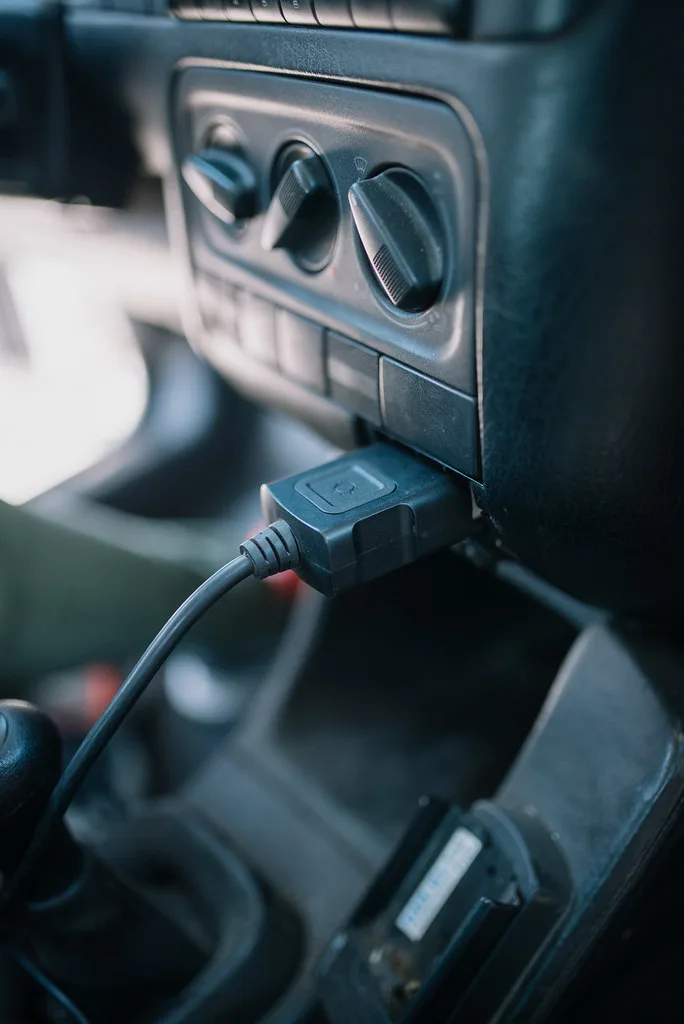
Some faults need more than a universal scan tool. If the issue involves module programming, coding, security access, or brand-specific diagnostic routines, the dealer is often better equipped to get to the root cause without guesswork.
ADAS calibration and EV-specific repairs
Camera, radar, lane-assist, and blind-spot systems often require careful calibration after windshield work, suspension repair, alignment, or bumper removal. EVs add high-voltage safety steps and software dependencies. If the repair touches those systems, factory procedures matter.
Complex warranty repairs on newer vehicles
Newer vehicles with active warranty coverage are a stronger dealer case when the job spans multiple modules or repeated failure codes. The dealer may cost more on paper, but it reduces the risk of a denied claim or a repair that leaves the warning light unresolved.
When is an independent mechanic the better fit?
An independent mechanic is often the better fit for routine maintenance, wear items, and post-warranty repairs that do not require factory-only access. The best independents can also beat a dealer on expertise for certain older or niche vehicles, especially when the shop specializes in that brand or system.
Routine maintenance and wear items
Oil changes, brakes, filters, batteries, shocks, struts, exhaust work, and many fluid services are usually straightforward. A competent independent shop can handle these quickly and often at a lower labor rate.
Older vehicles out of warranty
When warranty coverage is over, the dealer premium has to be justified by something other than claim handling. For an older vehicle, an independent shop often offers better value, especially if parts availability is broad and the repair does not require brand coding.
Independent specialists versus general repair shops
Not all independents are the same. A brand specialist may be the best choice for a German luxury car, a diesel truck, or a hybrid with known service patterns, while a generalist shop is fine for conventional maintenance and common repairs.
Cases where a second opinion can save money
A second opinion matters most when the first quote includes a high dollar diagnosis, multiple sensor replacements, or a large assembly swap. Because misdiagnosis is a real failure case, it is worth checking whether the fault code, symptom, and repair plan actually match.
Repair-decision matrix: choose the right shop by job, age, and complexity

Use the matrix below to route the car by repair type, not by habit. Age and warranty status matter, but system complexity often matters more than mileage alone.
| Service type | Under warranty | Out of warranty | Low complexity | High complexity | Best shop choice |
|---|---|---|---|---|---|
| Routine maintenance | Dealer if recordkeeping matters | Independent usually best value | Oil, filters, brake pads, basic fluids | Special fluids or service resets may need more care | Independent mechanic |
| Diagnostics and warning lights | Dealer if claim or software issue is likely | Independent if the shop has strong scan tool capability | Single sensor or simple mechanical fault | Multi-module fault, intermittent issue, or programming need | Depends on access |
| Brake, fluid, and suspension work | Dealer if tied to warranty or calibration | Independent usually best value | Pads, rotors, shocks, alignment | ADAS calibration after suspension or windshield work | Independent, or dealer if calibration is needed |
| Software, ADAS, and EV systems | Dealer preferred | Dealer or proven specialist | Basic update only | Module coding, radar/camera calibration, high-voltage service | Dealer Service |
Say your 3-year-old crossover throws a lane-departure warning after a windshield replacement. A general brake-and-oil independent shop may be excellent for maintenance, but this job needs camera calibration and possibly software verification, which pushes it toward the dealer or a highly equipped specialist.
Suppose a 10-year-old sedan needs front brakes, a cabin filter, and a coolant flush. That job is routine, parts are easy to source, and the vehicle is likely out of warranty, so an independent mechanic usually makes more sense on both cost and convenience.
Choose dealer service if… / Choose independent mechanic if…
Choose dealer service if the car is under factory warranty, the repair is tied to a recall or campaign, or the job needs brand-specific programming, calibration, or EV access. Choose an independent mechanic if the car is out of warranty, the repair is routine, or a trusted specialist has stronger experience with your exact brand.
Choose dealer service if…
Choose dealer service if you need warranty documentation, OEM parts by default, or a repair order that depends on factory software and coding. It is also the safer call for late-model ADAS, EV, and complex electronic repairs.
Choose independent mechanic if…
Choose an independent mechanic if the job is brakes, suspension, exhaust, fluids, or other standard maintenance on an older vehicle. It is also the better bet when a brand specialist has a stronger track record than a general dealer on your particular car.
Can you negotiate the price at a repair shop?
Yes, and the best savings come from details, not pressure. Ask for itemized estimates, question labor hours that seem high, compare parts sources, and get a second opinion on large repairs. On expensive jobs, service bulletins and symptom matching matter more than the final number alone.
Ask for itemized estimates
A clean estimate should separate diagnostics, labor, parts, fluids, and calibration. If those are bundled together, you cannot tell where the cost is coming from or whether a cheaper repair path exists.
Question parts pricing and labor hours
Parts markup can vary widely, especially on OEM components. Labor hours should also match the repair procedure, not just a generic guess. If one shop lists more time than another for the same repair, ask why.
Use second opinions on large repairs
Second opinions are most useful on repairs that cross a certain threshold of complexity or cost. That is where misdiagnosis, unnecessary parts replacement, or missed calibration requirements can become expensive fast.
Compare service bulletins, not just totals
When two estimates differ, ask whether either shop checked technical service bulletins or brand procedures. A slightly higher estimate may be cheaper in the end if it includes the correct diagnostic path the first time.
Frequently asked questions
Is dealer service better than an independent mechanic?
Dealer service is better for warranty work, recalls, and brand-specific software or calibration needs. An independent mechanic is often better for routine maintenance and many post-warranty repairs. The best choice depends on the job, the vehicle’s age, and whether factory access is required.
Is an independent mechanic cheaper than a dealer?
Usually, yes. Independents often have lower labor rates and more parts flexibility, and Consumer Reports found independents outscored dealers on price in a survey of more than 121,000 vehicles. That said, a dealer can be competitive on some repairs, especially when the job is simple or covered by a campaign.
Does dealer service use OEM parts?
Dealers commonly use OEM parts and accessories because they work within the manufacturer’s parts system. That helps with fitment and documentation. Independent shops may use OEM or aftermarket parts, so you should ask exactly what is being installed before you approve the work.
Will an independent shop void my warranty?
No, not by itself. Warranty coverage depends on whether the repair and maintenance were done to the manufacturer’s requirements, with proper parts, fluids, and records. Keep invoices, note the exact oil or fluid spec used, and verify the shop followed the service schedule.
What repairs are worth taking to the dealer?
Take warranty claims, recalls, software updates, ADAS calibration, EV service, and complicated electronic diagnostics to the dealer when factory access matters. Dealers are also a sensible choice when the car is newer and the repair order depends on brand-specific tools or claim documentation.
Can I negotiate the price at a repair shop?
Yes. Ask for an itemized estimate, compare diagnostic fees, question parts markup, and request a breakdown of labor hours. For major repairs, a second opinion can create real savings; among negotiators, Consumer Reports found many saved money, with median savings of $120 at dealers and $94 at independents.
Products related to this article
Sponsored / affiliate links. As an Amazon Associate I earn from qualifying purchases. I may earn additional commission from eligible campaigns.