Do Car Key Fobs Need Special Industrial Batteries
Have you ever wondered if your car key fob needs a special kind of battery? Many people find this question a bit tricky, especially when they’re not sure what to look for. It seems simple, but there’s a little more to it than just grabbing any battery.
Don’t worry though, because figuring this out is easier than you think. We’ll walk through it step-by-step. Get ready to learn what kind of power your key fob needs.
What Kind Of Battery Does A Car Key Fob Use
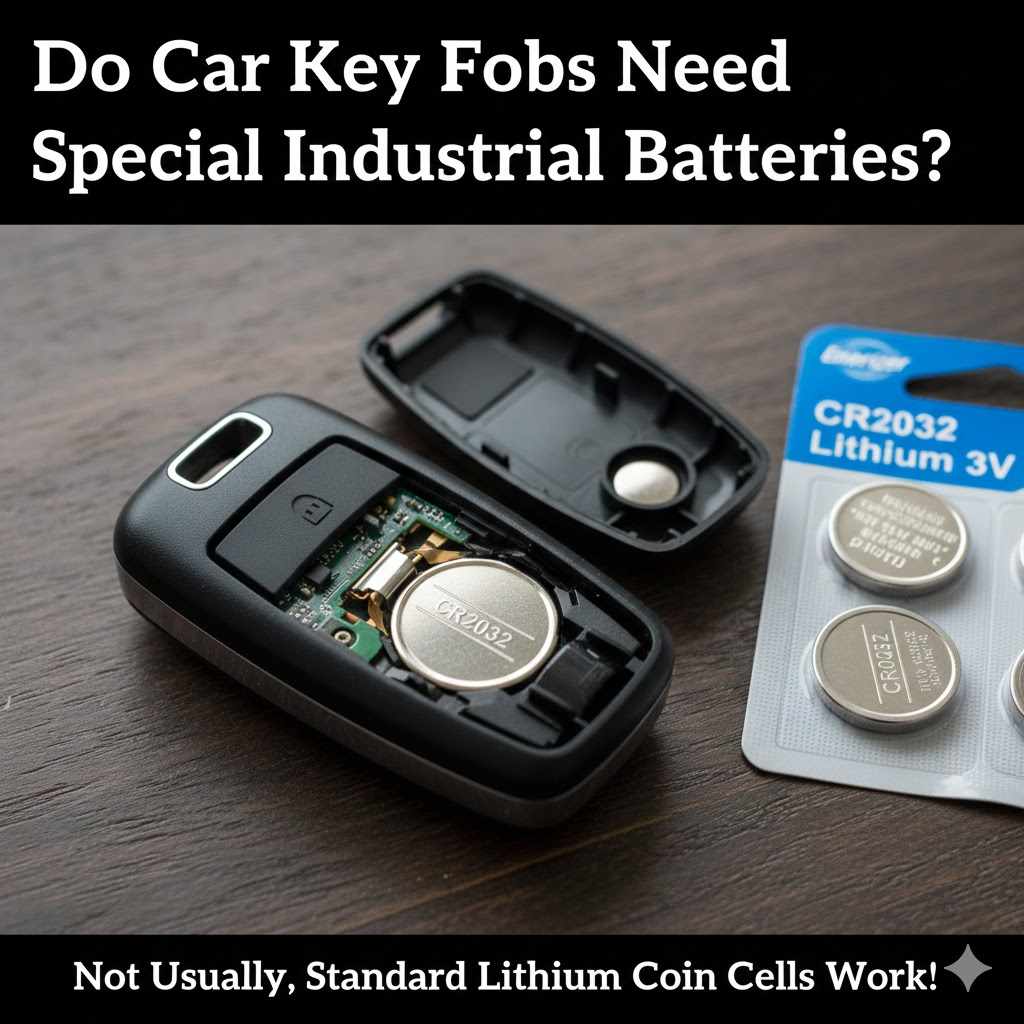
Understanding the battery inside your car key fob is key to keeping it working smoothly. Many people mistakenly believe that all batteries are the same, or that a standard household battery will do the job. However, car key fobs rely on small, coin-shaped batteries that are designed for specific electronic devices.
These are often called button cell batteries or coin cell batteries. They provide the consistent, low-level power needed for the fob to send signals to your car without needing frequent replacement.
Types Of Coin Cell Batteries
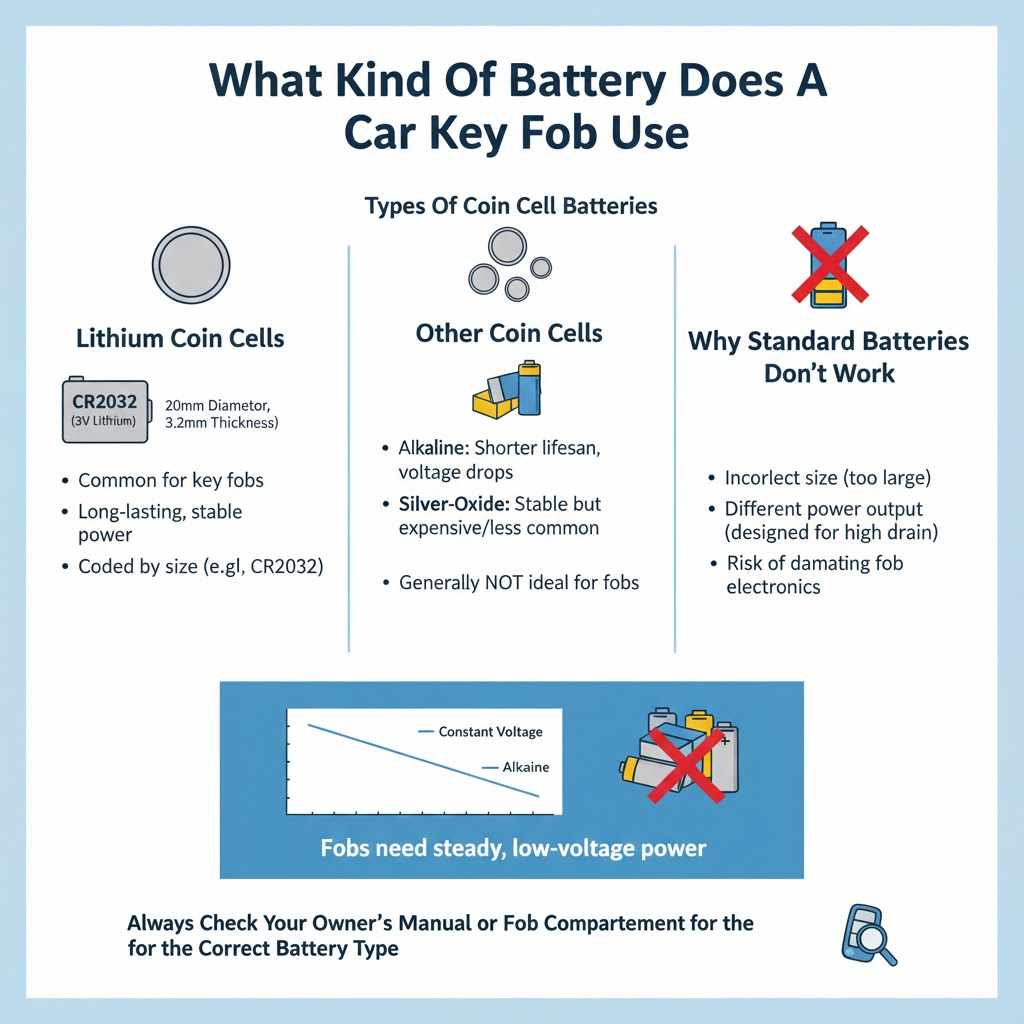
The world of coin cell batteries is quite diverse, with different sizes, voltages, and chemistries. For car key fobs, you’ll most commonly find lithium coin cells. These are popular because they offer a good balance of power, longevity, and stability.
They are known for holding their charge for a long time, which is perfect for a device you might only use a few times a day.
Lithium coin cells are named by a code, like CR2032 or CR2025. The “CR” means they are lithium-based. The numbers that follow indicate the size: the first two digits are the diameter in millimeters, and the last two digits are the thickness in millimeters.
So, a CR2032 is 20mm in diameter and 3.2mm thick. These specific dimensions ensure the battery fits snugly within the fob’s housing.
Other types of coin cells exist, such as alkaline or silver-oxide batteries. While they can be coin-shaped, they are generally not ideal for car key fobs. Alkaline batteries tend to lose their charge faster, and their voltage can drop more dramatically as they are used.
Silver-oxide batteries offer more stable voltage but are often more expensive and less common for this application.
The choice of battery chemistry is important because it affects performance and lifespan. For example, a CR2032 lithium battery typically provides 3 volts. This consistent voltage is crucial for the electronic components within the fob to function reliably.
If the voltage fluctuates too much, the fob might struggle to communicate with your car, leading to failed lock or unlock attempts.
Why Standard Batteries Might Not Work
You might be tempted to use a battery from a small electronics store or even a watch battery. However, the specific requirements of a car key fob often mean these aren’t the best choices. Standard batteries, like AA or AAA, are much larger and designed for different power outputs.
They simply won’t fit inside the compact space of a key fob. Even if you could somehow make a smaller standard battery fit, its power output and discharge characteristics might not be suitable.
Car key fobs contain microprocessors and radio transmitters that require a steady, low-voltage power source. They are designed to draw minimal power when not actively sending a signal, but they need a burst of energy when you press a button. Lithium coin cells are excellent at providing this type of power delivery.
They can maintain a consistent voltage over their lifespan, ensuring reliable operation of your fob’s functions.
Using an incorrect battery could lead to several problems. The fob might not work at all, or it might work intermittently. In some cases, an incompatible battery could even damage the delicate electronics within the key fob.
This is why it’s so important to identify the correct battery type for your specific car model and key fob. The cost of replacing a damaged key fob far outweighs the small expense of buying the right battery.
It’s also worth noting that some older key fobs might have used different battery types, but the trend across most modern vehicles is towards these specific lithium coin cells. Always check the battery compartment or your car’s owner’s manual to be absolutely sure.
Do Car Key Fobs Need Special Industrial Batteries
The question of whether car key fobs need “special industrial batteries” can be a little misleading. While they don’t typically require batteries labeled as “industrial,” they do need batteries that are specifically designed for electronic devices with consistent power needs, like coin cell batteries. These are often produced using industrial-grade manufacturing processes to ensure quality and reliability, which is why they might be perceived as “special.”
The term “industrial batteries” often brings to mind large, heavy-duty power sources used in heavy machinery, backup power systems, or electric vehicles. Car key fobs, on the other hand, are small, portable electronic devices that require a low-power, long-lasting energy source. The batteries used are often called consumer electronics batteries or button cell batteries, and they are widely available.
The “special” aspect comes more from their specific size, shape, and chemistry rather than an industrial-grade purpose.
These batteries are manufactured to precise specifications. For example, the purity of the lithium and other materials used, as well as the manufacturing environment, are controlled to produce a reliable product. This is why a high-quality brand of coin cell battery is generally recommended over a generic, unbranded option.
The reliability of these batteries is crucial, as a dead key fob can leave you stranded or locked out of your vehicle.
When you look at a car key fob battery, you’re looking at a product that is mass-produced but adheres to strict quality control. This ensures that each battery can perform its intended function for an extended period. The manufacturing standards are high, even though the application is for everyday consumer use.
So, while not “industrial” in the heavy-duty sense, they are certainly manufactured with a level of precision and quality that sets them apart from batteries found in toys or simple flashlights.
Understanding Battery Specifications
When you open your key fob to replace the battery, you’ll find a small, round battery. On the side of this battery, there’s a code printed on it. This code is the battery’s specification.
For example, you might see “CR2032.” This code tells you everything you need to know about the battery’s type, size, and chemistry. It’s not an industrial code; it’s a standardized identifier.
The “CR” prefix indicates that it’s a lithium battery. These are favored for their high energy density and long shelf life. Lithium batteries can operate over a wide temperature range, making them suitable for various climates.
They also have a very slow self-discharge rate, meaning they can sit unused for years and still retain most of their charge. This is a significant advantage for a device like a car key fob, which is not constantly in use.
The numbers that follow “CR” specify the battery’s dimensions. For instance, “2032” means the battery has a diameter of 20 millimeters and a thickness of 3.2 millimeters. This precise sizing is vital.
The battery must fit perfectly into the designated slot within the key fob to make proper contact with the terminals. If the battery is too thick or too thin, it might not connect properly, or it could even damage the fob.
Other common codes you might see include CR2025 (20mm diameter, 2.5mm thickness) and CR2016 (20mm diameter, 1.6mm thickness). Each of these is a different size and might be used in different fob designs. It is essential to match the code on your old battery exactly to the code of the new battery you purchase.
Using the wrong size or type can lead to malfunctions or prevent the fob from working altogether.
The voltage of these lithium coin cells is typically 3 volts. This consistent voltage output is crucial for the electronic components inside the key fob. The microcontroller, the radio transmitter, and any other small chips all require a stable power supply to operate correctly and communicate with your car’s receiver.
A battery that provides a fluctuating voltage could cause the fob to behave erratically.
Longevity And Performance
The batteries in car key fobs are designed for longevity and consistent performance. They don’t power a bright screen or a loud speaker; instead, they send short radio signals. This means they use very little power on average.
A typical CR2032 battery can last anywhere from two to five years, depending on how often the fob is used and the quality of the battery itself.
When you press a button on your key fob, it sends a brief radio signal. This signal is a burst of energy. The lithium coin cell is capable of providing this burst of power efficiently.
Over time, the battery will naturally degrade, and its ability to hold a charge will decrease. You might notice the range of your key fob shrinking, or it might require you to be closer to your car for it to work. This is a clear sign that the battery is weakening.
Performance isn’t just about lasting a long time; it’s also about reliability. You want your key fob to work every time you press a button. A high-quality lithium coin cell provides a stable voltage throughout its operational life.
This means the signal strength and clarity remain consistent, ensuring your car receives the command without issues. Cheaper, unbranded batteries might offer a lower initial voltage or a faster decline in performance, leading to frustration.
Consider this: if your key fob battery dies when you’re in a hurry, trying to get into your car in the rain, or trying to lock it when you’re away from home, it can cause significant inconvenience. This is why investing in reliable, reputable battery brands is often a wise choice for key fobs. The slightly higher cost upfront can save you from potential trouble down the line.
The performance of the battery is also influenced by external factors like temperature. Extreme cold can temporarily reduce battery performance, while extreme heat can shorten its overall lifespan. However, lithium coin cells generally perform better in a wider range of temperatures compared to other battery chemistries, making them a robust choice for a device that you carry with you everywhere.
How To Replace Your Car Key Fob Battery
Replacing your car key fob battery is usually a straightforward process that most people can do themselves without any special tools. The first step is always to identify the correct battery type. Once you have the new battery, you’ll need to open your key fob.
Most key fobs have a small seam around the edge that can be gently pried open.
Once the fob is open, you’ll see the old battery. Take note of how it’s positioned. Most coin cell batteries sit in a small compartment and can be removed by gently prying them out with a fingernail or a small, non-metallic tool like a plastic spudger.
Avoid using metal screwdrivers as they can scratch the fob or potentially short-circuit the battery.
Opening The Key Fob
Most car key fobs are designed with a specific way to open them for battery replacement. Many have a small slot or a seam that runs along the perimeter of the casing. You can often use a small, flathead screwdriver, a coin, or even a sturdy fingernail to carefully insert into this seam and twist gently.
This action should pry the two halves of the fob apart.
Some key fobs might have a small release latch or a tiny screw that needs to be removed first. Always check your car’s owner’s manual if you’re unsure about how to open your specific fob. For example, a Mercedes-Benz key fob might have a small button on the side to release a metal key, and then a hidden seam to open the plastic casing.
A Toyota key fob might simply have a seam around the edge that you can pry apart with a small tool.
When prying the fob open, be gentle. You don’t want to force it or break any internal clips. Work your way around the seam, applying light pressure until it pops open.
Some fobs might have a soft click as they separate. Once open, you’ll usually see the circuit board and the battery compartment. Make sure you lay out the pieces in an organized manner so you don’t lose any small parts, like buttons or springs.
The circuit board contains sensitive electronic components. Avoid touching them unnecessarily. It’s also a good idea to do this on a clean, flat surface, like a table or desk, to prevent small parts from getting lost.
If your fob has multiple buttons, make sure you remember the order and orientation of these buttons and any rubber membranes that cover them.
If you are struggling to open your key fob, it’s better to consult your owner’s manual or a professional automotive locksmith than to risk damaging the fob. A broken key fob can be expensive to replace.
Removing And Installing The Battery
Once the key fob is open, you’ll see the old battery nestled in its compartment. It’s usually held in place by small clips or a retaining ring. You can typically remove it by gently prying it out from one edge.
A small plastic tool or even a toothpick can be useful here. Be careful not to bend the metal contacts that the battery rests against, as these are essential for the fob to function.
After removing the old battery, clean the battery compartment if there’s any visible dirt or corrosion. Then, take your new battery and insert it into the compartment. Pay close attention to the polarity.
Most coin cell batteries have a positive (+) side and a negative (-) side. The positive side usually has the battery’s markings on it and is typically facing upwards or outwards, towards the circuit board. Check how the old battery was oriented to ensure you install the new one correctly.
The new battery should sit snugly in its compartment. If it feels loose, you might have the wrong size battery, or it might not be seated properly. Once the new battery is in place, carefully reassemble the key fob.
Align the two halves of the casing and press them together until they click into place. Make sure all the buttons and their rubber membranes are properly positioned before snapping the case shut.
After reassembling the fob, test it to make sure it’s working. Point the fob at your car and try locking and unlocking the doors. You should notice an immediate improvement in responsiveness if the old battery was weak.
If the fob still doesn’t work, double-check that the battery is correctly installed, that the contacts are clean, and that you have the right type of battery for your car model.
If it still doesn’t work, there might be an issue with the fob itself, such as a damaged circuit board or a problem with your car’s receiver. In such cases, you may need to contact your car dealership or an automotive locksmith for assistance. However, in most instances, a simple battery replacement will solve the problem.
Troubleshooting Common Issues
Even after replacing the battery, your key fob might not work as expected. One common issue is incorrect battery installation. Make sure the positive and negative terminals are facing the right way.
The battery should fit snugly. If it’s loose, the connection might be intermittent.
Another problem could be the battery itself. Even new batteries can be faulty, although this is rare with reputable brands. Try a different new battery to rule this out.
Also, ensure you bought the correct battery model. A CR2032 is different from a CR2025, and using the wrong size won’t work and might even damage the fob.
Sometimes, the issue isn’t the battery but the key fob itself. Over time, the internal components can wear out or get damaged. If you dropped the fob recently, this could be the cause.
The circuit board inside might be cracked, or the transmitter might have failed.
You might also encounter issues if your key fob has been exposed to moisture. Water can corrode the internal electronics. If this happens, you might need to clean the circuit board with isopropyl alcohol or, in severe cases, replace the entire fob.
Another factor is interference from other electronic devices, though this is usually temporary.
If your key fob still isn’t working after trying these steps, it’s time to seek professional help. An automotive locksmith or your car dealership can diagnose the problem and either repair or replace the key fob. They have the specialized tools and knowledge to handle complex key fob issues.
When To Consider Professional Help
While battery
Professional help is also recommended if you’re unsure about how to open your key fob. Some models have intricate designs, and forcing them open can lead to damage. A broken key fob can be costly to
Dealing With Damaged Fobs
If your key fob has sustained physical damage, like being dropped or run over, it’s likely beyond a simple battery replacement. The casing might be cracked, buttons might be missing, or the internal circuit board could be compromised. In such situations, you’ll probably need to have the fob repaired or replaced entirely.
Professionals can assess the damage and determine the best course of action.
A damaged fob might not be able to send a strong enough signal to your car, or it might not send a signal at all. Sometimes, the internal antenna can be damaged, severely limiting the range of the fob. If the circuit board has suffered a major impact, components can become dislodged or broken, rendering the fob useless.
It’s important to have an expert evaluate the extent of the damage.
For minor casing damage, a professional might be able to find a replacement shell and transfer the internal electronics. However, if the internal components are damaged, a full replacement of the fob is usually necessary. This often involves programming a new fob to your car’s system, which requires specialized equipment.
The cost of repairing or replacing a key fob can vary widely depending on the make and model of your car and the extent of the damage. It’s always a good idea to get a quote from a few different service providers, such as your dealership, an independent auto repair shop, or an automotive locksmith, to find the best price.
When The Fob Stops Working Completely
There are several reasons why a key fob might stop working completely, even after a new battery has been installed. One possibility is that the fob has lost its programming. Modern car key fobs are programmed to communicate with a specific vehicle using a unique code.
Over time, or if the car’s battery has been disconnected, this programming can sometimes be lost.
Another reason could be a failure of the internal circuitry. The small chips and components on the circuit board can wear out or suffer damage. Radio frequency (RF) components can also fail, preventing the fob from sending its signal.
If the fob has been exposed to extreme temperatures, moisture, or strong magnetic fields, it could also cause a complete failure.
Sometimes, the problem isn’t with the fob itself but with the car’s receiver. The antenna in the car could be damaged, or there might be an issue with the car’s central locking system. This is why it’s important to consider all possibilities when troubleshooting a non-functioning key fob.
If you suspect your fob is completely dead, a professional can test both the fob and your car’s receiver to pinpoint the exact cause of the problem. They can then reprogram a new fob or repair the existing one if possible. They also have the ability to reprogram your car to accept a new key fob, which is often necessary when the original fob is no longer functional.
It’s important to note that the battery is just one component powering the fob. If that’s replaced and it still doesn’t work, it’s time to consider other factors.
Battery Replacement Frequency And Tips
The frequency with which you’ll need to replace your car key fob battery depends on several factors, including the type of battery, the usage of the fob, and environmental conditions. Generally, high-quality lithium coin cell batteries, like the CR2032, can last for several years. You might start noticing signs of a weakening battery before it dies completely.
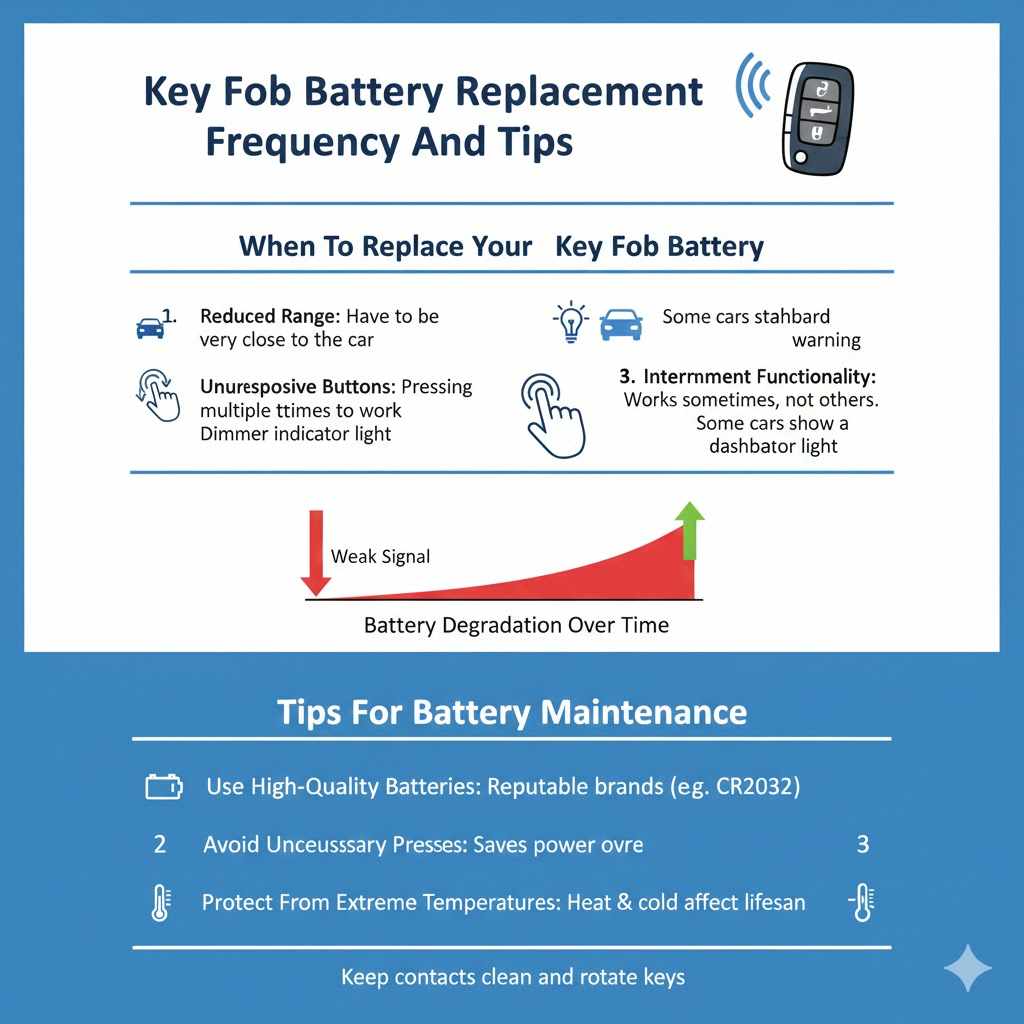
These signs often include a reduced range—meaning you have to be closer to your car for the fob to work—or the buttons becoming less responsive. Sometimes, you might need to press a button multiple times for the fob to register. When you start noticing these issues, it’s a good idea to consider replacing the battery soon.
Signs Your Key Fob Battery Is Weak
One of the most common signs that your key fob battery is weak is a decrease in range. You might have previously been able to lock or unlock your car from across a parking lot, but now you have to be right next to the vehicle. This happens because a weak battery can’t send as strong a signal.
Another indicator is that the buttons on the fob become less responsive. You might find yourself having to press the lock or unlock button multiple times, or hold it down longer than usual, for the car to react. This is because the weaker battery struggles to provide the consistent power needed for the fob’s transmitter to function optimally.
Intermittent functionality is also a common symptom. The fob might work sometimes but not others. You might be able to lock the car but not unlock it, or vice versa.
This inconsistency points to a battery that is struggling to maintain a stable voltage. The internal electronics need a certain voltage to operate reliably, and a degrading battery can’t always provide that.
Some modern key fobs might also have a small indicator light that flashes when you press a button. If this light becomes dimmer or stops flashing altogether, it’s a strong sign that the battery needs replacement. While not all fobs have this feature, it’s a useful visual cue if yours does.
Finally, some car systems might display a warning message on the dashboard if the key fob battery is low. This is a more advanced feature, but if your car has it, it’s the most direct way to know your battery needs changing. It’s always better to replace the battery when you first notice these signs rather than waiting until the fob stops working entirely.
Tips For Battery Maintenance
While key fob batteries are designed to last a long time, there are a few tips to help maintain their performance. First, always use high-quality, reputable brands of coin cell batteries. These are manufactured to stricter standards and are more reliable than generic or unbranded options.
This ensures a more stable power output and a longer lifespan for the battery.
Avoid unnecessary button presses. Every time you press a button on your key fob, it uses a small amount of battery power. While this might seem insignificant, frequent, unnecessary presses can add up over time.
For example, constantly pressing the lock button to see if it works, or pressing it multiple times when one press is sufficient, can drain the battery faster.
Keep your key fob away from extreme temperatures. Both excessive heat and cold can affect battery performance and longevity. Leaving your key fob in a hot car during the summer or in a freezing environment during the winter can shorten its lifespan.
Storing it in a moderate environment, like a pocket or a bag, is best.
If you have multiple car keys, try to use them periodically. If you only use one key for an extended period, its battery might degrade faster than the others due to sitting idle for too long, even though lithium batteries have a very slow self-discharge rate. Rotating their use can help ensure they all remain functional.
When replacing the battery, make sure the contacts inside the fob are clean. Any dirt or corrosion can impede the electrical connection, leading to poor performance. You can gently clean them with a soft cloth or an eraser.
This simple maintenance step can ensure optimal battery performance.
Finally, if you find yourself in a situation where your key fob battery has died and you’re unable to
Frequently Asked Questions
Question: What is the most common type of battery used in car key fobs?
Answer: The most common type of battery used in car key fobs is the lithium coin cell battery, typically a CR2032 or CR2025 model.
Question: Do I need to go to a car dealership to replace my key fob battery?
Answer: No, you usually do not need to go to a dealership. Most car key fob batteries can be
Question: How long does a car key fob battery typically last?
Answer: A good quality car key fob battery can last anywhere from two to five years, depending on usage and battery quality.
Question: What happens if I use the wrong type of battery in my key fob?
Answer: Using the wrong type of battery might prevent the fob from working, or in some cases, it could damage the fob’s internal electronics.
Question: Can a weak key fob battery affect my car’s performance?
Answer: A weak key fob battery affects the key fob’s ability to communicate with your car, but it does not directly impact your car’s driving performance.
Summary
In short, car key fobs use specific lithium coin cell batteries, not heavy-duty industrial ones. These batteries are essential for reliable operation. Replacing them is usually simple.
Identify the code, open the fob, swap the battery, and reassemble. If problems persist, professional help is available.