
Does Capital One Have Rental Car Insurance? Coverage Guide
Many Capital One credit cards include auto rental collision damage waiver, and it usually applies only if you pay with the card and decline the rental company’s collision damage waiver. Miss one condition and you can lose coverage, leaving you on the hook for damage, loss-of-use charges, or the rental agency’s claim. This guide spells out when Capital One coverage applies, when it does not, and the common booking mistakes that void it.
Does Capital One have rental car insurance?
Some Capital One credit cards include rental car coverage as a card benefit, not as a standalone auto policy. The benefit may help pay for damage to or theft of a rental vehicle, and some guides also list towing and loss-of-use charges. It does not include liability protection.
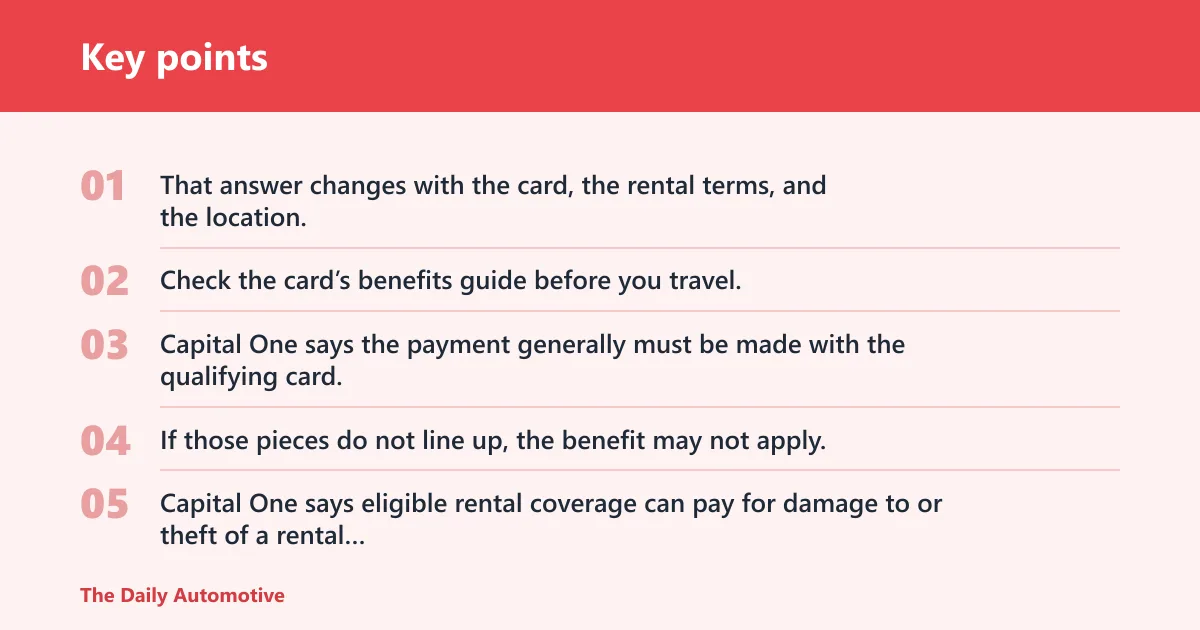
That answer changes with the card, the rental terms, and the location. Check the card’s benefits guide before you travel. Capital One says the payment generally must be made with the qualifying card, all drivers should be listed on the rental agreement, and the renter should decline the rental company’s optional CDW or LDW when required. If those pieces do not line up, the benefit may not apply.
What the benefit covers
The same source says eligible rental coverage can pay for damage to or theft of a rental vehicle. Some card guides also list towing charge coverage and loss-of-use charge coverage. That is the narrow value here: the rental car itself, not the broader risk around driving it.
Say your midsize sedan is hit in a parking lot while you are away from the car. If your card’s benefits guide includes primary or secondary rental coverage and you met the rental terms, the card benefit may help with vehicle damage. It still does not turn into liability coverage.
What it does not cover
The same source notes that rental coverage typically does not include liability protection. It also does not cover injuries or medical costs tied to an accident. If the other driver, a passenger, or a pedestrian makes a claim, you are in a different insurance lane entirely.
That split matters because a renter can have card coverage for the rental car and still be personally exposed to third-party claims. Do not treat the card benefit as a replacement for personal auto liability, umbrella coverage, or the rental company’s own liability options.
Why the answer depends on your card
The same source says some credit cards include rental car insurance, but not every card does. The exact benefit language lives in the card’s benefits guide, and that guide controls the exclusions, limits, and claim steps. KAYAK notes that Capital One Venture X Rewards Credit Card may include this perk, but the card guide still decides what applies.
That is why “Capital One coverage” is too broad by itself. You need the exact product name, then the benefits guide for that card.
Which Capital One cards may qualify?
Only some Capital One cards include rental car insurance, so the first check is the card’s benefits guide. The guide tells you whether the benefit exists, whether it is primary or secondary, what vehicles are excluded, and whether towing or loss-of-use charges are included. Without that guide, you are guessing.
Check your benefits guide first
The same source says claim details are in the card’s benefits guide. That document should be your source for the exact rental benefit tied to your card. Do not rely on a general travel page or a marketing summary when you are deciding whether to decline the rental counter waiver.
Primary versus secondary coverage
Primary coverage pays eligible damage or theft first, up to the policy limit. The same source says it can directly cover eligible damage or theft, and that usually means your personal auto policy does not need to be involved first. That can also help you avoid a personal deductible.
Secondary coverage works differently. The same source says it pays eligible costs not covered by other insurance, so it may sit behind your personal auto policy. If you do not have a car, secondary coverage can sometimes act more like primary coverage, but claim coordination still matters.
Why card tier matters
Card tier matters because rental coverage is often attached to specific premium travel cards, not every entry-level product. The benefits guide is the only clean way to separate a true eligible card from a card that has no rental benefit at all. That difference decides whether the rest of the rental setup even matters.
How to activate coverage at the counter
To get Capital One rental coverage working, you need the right card, the right paperwork, and the right rental-counter choices. Pay with the eligible Capital One card, list every driver, and decline the rental company’s CDW or LDW when the guide requires it. One missed step can break the claim before it starts.
Pay with the eligible card
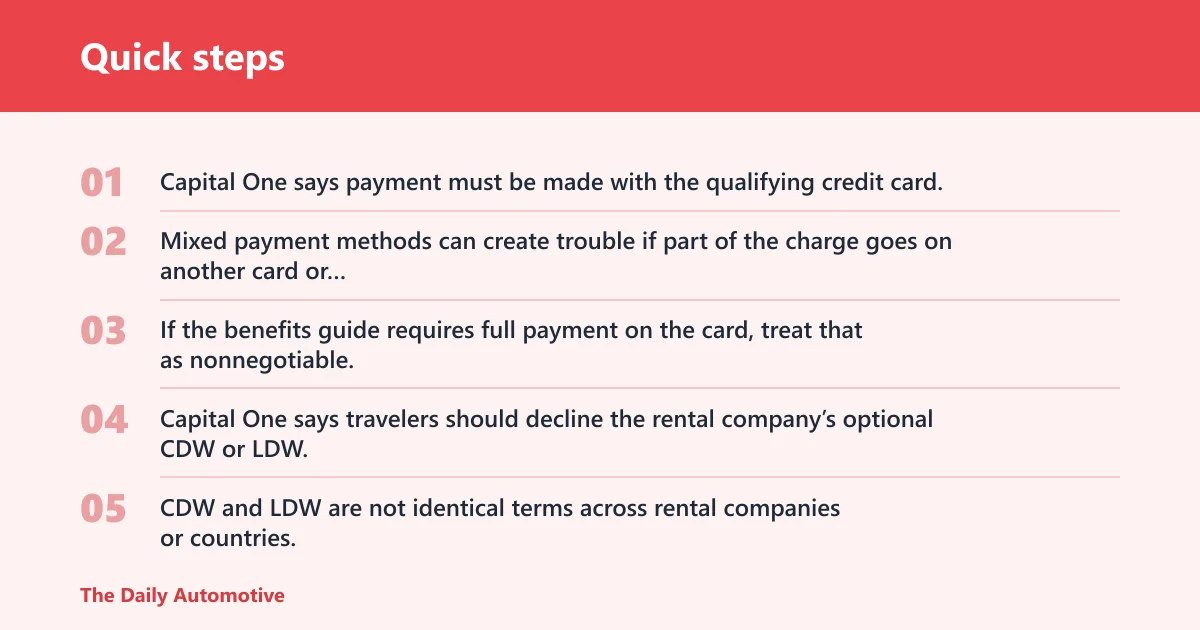
The same source says payment must be made with the qualifying credit card. Mixed payment methods can create trouble if part of the charge goes on another card or if the rental company treats the rental as not fully paid with the eligible card. If the benefits guide requires full payment on the card, treat that as nonnegotiable.
Decline CDW or LDW
The same source says travelers should decline the rental company’s optional CDW or LDW. CDW and LDW are not identical terms across rental companies or countries, so read the counter wording carefully. Accepting the waiver can end the card benefit because the rental company has already taken over the damage or theft risk.
A common first-timer mistake is accepting the counter waiver because it sounds like “extra protection,” then assuming the card benefit still applies. Usually, that is the wrong move. The card benefit often depends on the waiver being declined, not accepted.
List every driver
The same source says all drivers must be listed on the rental agreement. That is more than paperwork hygiene. If an unlisted driver is behind the wheel when damage happens, the rental company can dispute the rental terms and the card issuer can question eligibility.
Suppose one spouse books the car, but a second spouse takes over driving for the airport run and never gets added to the agreement. If damage happens on that leg, the missing driver can become the quiet reason a claim fails.
Avoid mixed-payment mistakes
Split payments are a common failure point. If the rental company runs the rental on one card and the deposit or incidentals on another, or if a corporate card is involved in part of the transaction, eligibility can get murky fast. Match the benefits guide exactly, then keep the receipt trail clean.
Rental coverage checklist
This checklist helps you verify the setup before you leave the counter. If any answer is “no,” coverage may not apply. If the guide for your specific card says something stricter, follow that instead.
| Card used | Full rental paid on card | All drivers listed | CDW/LDW declined | Vehicle type | Country | Coverage likely to apply |
|---|---|---|---|---|---|---|
| Capital One Venture X Rewards Credit Card | Yes | Yes | Yes | Standard sedan | United States | Likely, if the benefits guide confirms eligibility |
| Capital One card with no rental benefit in its guide | Yes | Yes | Yes | Compact SUV | United States | No |
| Eligible Capital One card | No, split with another card | Yes | Yes | Standard sedan | Canada | Unclear to unlikely until the guide confirms mixed-payment acceptance |
| Eligible Capital One card | Yes | No | Yes | Standard sedan | United States | Unlikely |
| Eligible Capital One card | Yes | Yes | No | Standard sedan | United States | Unlikely |
| Eligible Capital One card | Yes | Yes | Yes | Antique or exotic car | Any | No |
What rental setups can void coverage?
Coverage can fail because of the rental setup, not just because of the accident. Capital One excludes antique cars, exotic cars, and high-capacity vans. A business rental, an international rental, a missing driver, or a counter waiver can also block the benefit even when the card itself looks eligible.
Excluded vehicle types
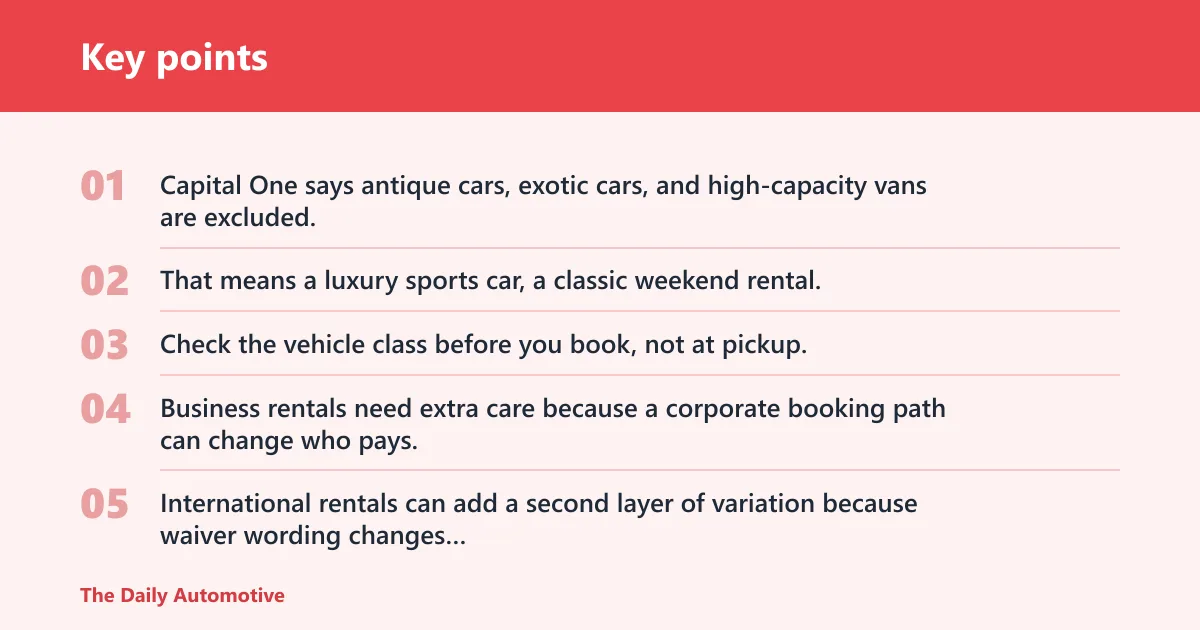
The same source says antique cars, exotic cars, and high-capacity vans are excluded. That means a luxury sports car, a classic weekend rental, or a large van for a group trip may fall outside the benefit even if the card is otherwise eligible. Check the vehicle class before you book, not at pickup.
Business and international rentals
Business rentals need extra care because a corporate booking path can change who pays, whose name is on the agreement, and which rules govern the claim. International rentals can add a second layer of variation because waiver wording changes by location and rental company. Do not assume a domestic booking rule will carry over intact.
Missing paperwork
The claim file usually needs the rental agreement, a police report when required, and an itemized repair estimate. The same source says claim details live in the benefits guide, so the deadline and paper list should come from that document. A missing report or late submission can sink a claim even if the rental was otherwise eligible.
Counter waiver conflicts
If you accept the rental company’s CDW or LDW, you may remove the condition the card benefit needs to operate. That is why the rental counter script matters so much. Decline the waiver, keep the receipt, and make sure the rental agreement matches what the benefits guide expects.
How do you file a claim?
Start with the benefits administrator, then file the claim with the documents they request. The same source says claim details are in the card’s benefits guide, and the administrator can explain exclusions, deadlines, and the claim packet. Do not wait until repairs are finished to learn what the file needs.
Contact the benefits administrator
Before pickup, the benefits administrator can confirm whether the rental fits the card’s rules. After a loss, that same office usually tells you how to submit the claim and what deadline applies. This is the cleanest way to avoid guessing about a rule that could void the benefit.
Gather required documents
Keep the rental agreement, the police report if required, and the itemized repair estimate. Add photos, the final invoice, and any rental-company correspondence if the administrator asks for them. The easier you make the paper trail, the less room there is for a coverage dispute.
Watch the deadline
Claims are deadline-driven. The same source says the card’s benefits guide controls the timing, so do not assume the window is generous. If the loss happens on a Friday and the repair shop is closed until Monday, start the claim anyway and keep the administrator in the loop.
Does Capital One rental coverage work outside the United States?
It can, but the answer depends on the specific card and the rental terms in that country. International rentals often change the meaning of CDW, LDW, and the local waiver language, so you need the benefits guide and the administrator’s confirmation before pickup. Do not assume foreign rentals follow U.S. counter rules.
Capital One’s rental benefit is still tied to the same basics: eligible card, eligible payment, listed drivers, and the required waiver choice. Outside the United States, those basics can be harder to verify because the rental company may present the paperwork differently.
Frequently asked questions
Which Capital One cards include rental car insurance?
Not every Capital One card includes the benefit. The exact answer sits in the card’s benefits guide, and some travel cards are more likely to include it than basic cards. KAYAK identifies the Capital One Venture X Rewards Credit Card as a card that may include this coverage.
Is Capital One rental car insurance primary or secondary?
It can be either, depending on the card’s benefits guide. The same source says primary coverage pays eligible damage or theft first, while secondary coverage pays eligible costs not covered by other insurance. That difference affects whether your personal auto policy has to be involved first.
Do I need to decline the rental company’s CDW to use Capital One coverage?
Usually, yes. The same source says travelers should decline the rental company’s optional CDW or LDW for the card benefit to apply. If you accept the waiver, you may lose the condition the benefit needs, so read the counter language carefully before you sign.
What rental cars are excluded from Capital One coverage?
The same source says antique cars, exotic cars, and high-capacity vans are excluded. Other exclusions can appear in the card’s benefits guide, so do not stop with the headline list. Vehicle class, location, and rental-company terms can all change the answer.
Does Capital One rental car insurance cover liability or injuries?
No. The same source notes that the coverage typically does not include liability protection, and it does not replace injury or medical coverage. The benefit is aimed at damage to or theft of the rental vehicle, not at third-party claims or personal injury costs.
How do I file a rental car insurance claim with Capital One?
Start with the benefits administrator, then submit the documents listed in the card’s benefits guide. Expect to provide the rental agreement, a police report when required, and an itemized repair estimate. The claim must be filed within the deadline in the guide.
Products related to this article
Sponsored / affiliate links. As an Amazon Associate I earn from qualifying purchases. I may earn additional commission from eligible campaigns.