How Much Is Car Insurance in Massachusetts? 2026 Rates
In Massachusetts, 2026 car insurance costs track coverage level, driving record, and location more than any one statewide average. Full coverage usually costs far more than state-minimum liability. If you ignore those factors, you can end up underinsured, paying too much, or facing a much higher renewal after a ticket, claim, or vehicle change. This guide lays out likely 2026 quote ranges, the driver profiles that sit above or below average, and how coverage choices change price.
Massachusetts car insurance costs in 2026
For 2026, a clear statewide benchmark is about $1,124 a year for full coverage in Massachusetts, which works out to about $94 a month. Liability coverage averages $290, while liability-only coverage can cost as little as $344 for a limited policy that leaves out collision and comprehensive coverage.
Those figures help with comparison, but they do not describe every quote. A 40-year-old driver with full coverage and $500 deductibles averages $1,124, while a higher deductible example lowers the average to $964 and a lower deductible example raises it to $1,436.
How much is car insurance in Massachusetts in 2026?
For a typical full-coverage policy, Massachusetts drivers can use $1,124 a year as the 2026 anchor point. Liability coverage is much cheaper at $290 on average, but that lower price reflects far less protection if you damage your own car or need broader repair coverage.
What is the average monthly car insurance cost in Massachusetts?
Using a full-coverage average of about $1,124, the monthly cost is about $94. Liability coverage averages about $24 a month. That monthly view helps, but the quote you see can still move sharply with age, ZIP code, deductible, and vehicle choice.
What changes your quote most?
Three factors usually move a Massachusetts premium the most: age and driving record, ZIP code, and vehicle type. A clean record and a lower-risk car can keep a quote near the state average, while a recent violation, dense city ZIP code, or expensive repair list can push it much higher.
Age and driving record
Age matters because insurers price in claim frequency and driving experience. A 16-year-old can reach $4,134 for full coverage, which sits at the top of the Massachusetts range, while a high-risk driver may pay $2,426. Recent violations and at-fault accidents tend to raise renewal quotes because they point to a greater chance of future claims.
A common first-timer mistake is assuming one speeding ticket affects all policies the same way. In practice, the impact depends on the insurer’s surcharge rules, how recent the violation is, and whether the policyholder also had an accident or lapse in coverage.
ZIP code and commuting patterns
ZIP code changes quotes because insurers price local claim frequency, vehicle theft risk, traffic density, and repair costs. Revere, Brockton, and Lynn are called out as more expensive areas, so a driver who moves from a lower-cost suburb to one of those cities can see a meaningful jump even with the same car and record.
Commuting also matters. A long daily drive through dense traffic usually raises exposure to accidents and glass claims, while lower annual mileage can reduce the insurer’s expected loss. The effect is usually strongest when the move or commute change happens in a high-density part of Greater Boston.
Vehicle type and repair costs
Make and model change the premium because parts prices, labor time, and theft appeal vary by vehicle. Popular cars with low repair costs often price better than larger SUVs, turbocharged trims, or vehicles with expensive sensors and body panels. The same driver can receive very different quotes just by changing cars.
Suppose a driver swaps a basic compact sedan for a newer SUV with advanced cameras and costly headlamps. The coverage limits stay the same, but the collision and comprehensive portions often rise because the insurer expects higher repair bills if the car is damaged.
Massachusetts coverage rules that shape price
Massachusetts policies are priced around the limits you choose, not only the car you drive. Liability coverage pays for injuries and property damage you cause to others, while collision coverage helps repair your car after a crash and comprehensive coverage helps with theft, fire, hail, and similar losses. Higher liability limits usually raise the price, but they also reduce the chance that a serious claim leaves you exposed.
Liability limits, collision, and comprehensive coverage
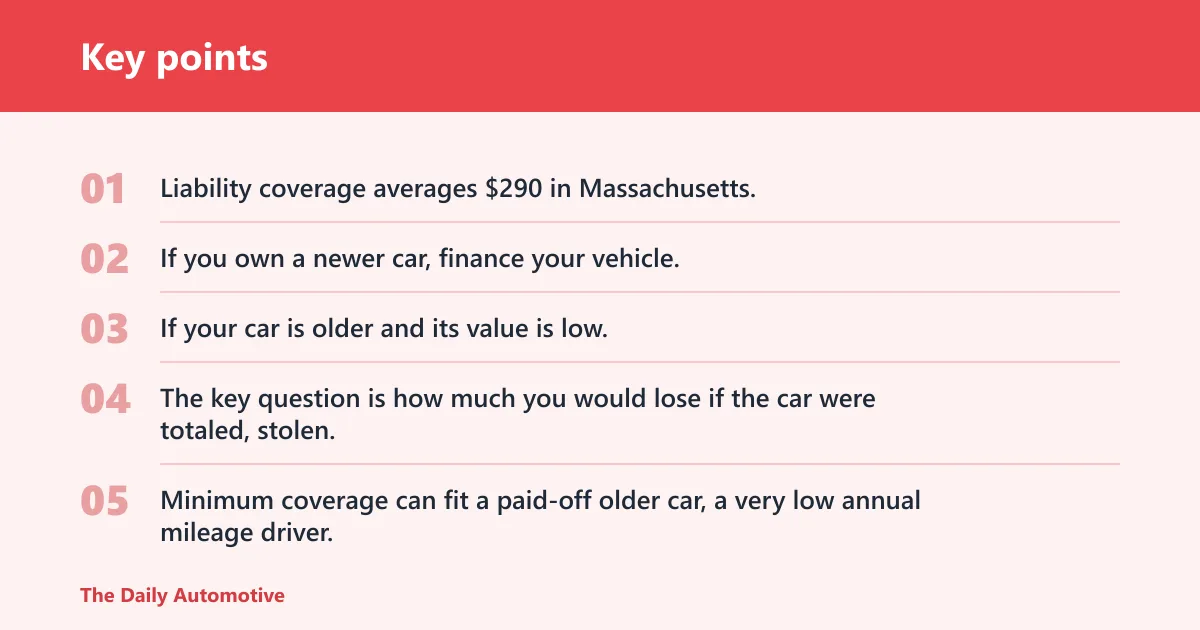
Liability coverage averages $290 in Massachusetts, but the cheapest policy is not always the safest one. If you own a newer car, finance your vehicle, or could not afford a replacement after a loss, full coverage often makes more sense than liability-only coverage.
If your car is older and its value is low, dropping collision and comprehensive can make sense, especially when the annual premium starts to approach the car’s market value. The key question is how much you would lose if the car were totaled, stolen, or badly damaged.
When minimum coverage makes sense
Minimum coverage can fit a paid-off older car, a very low annual mileage driver, or someone who could replace the car out of pocket. It is a weaker fit for drivers with loans, expensive vehicles, or a low risk tolerance, since liability-only insurance will not pay to fix your own car after a crash.
Massachusetts car insurance scenario table
The table below shows how six common Massachusetts driver profiles can move above or below the statewide average. The ranges are estimates for 2026 quotes, not guarantees, because insurer pricing still depends on exact vehicle, address, record, and coverage choices.
| Driver profile | Estimated annual premium | Estimated monthly premium | Top three cost drivers | First coverage change to test for savings |
|---|---|---|---|---|
| Good driver, 40 years old, suburban ZIP | $1,050-$1,250 | $88-$104 | Clean record, average vehicle repair cost, moderate mileage | Raise collision and comprehensive deductibles |
| Teen driver, full coverage, family policy | $3,200-$4,134 | $267-$345 | Age, inexperience, higher claim frequency | Compare a safer, lower-power car before changing limits |
| Urban commuter, dense Boston-area driving | $1,300-$1,900 | $108-$158 | High traffic exposure, parking risk, commuting mileage | Test a higher deductible on comprehensive coverage |
| High-risk driver, recent violation or accident | $2,000-$2,426 | $167-$202 | Recent loss history, surcharge exposure, insurer-specific rating | Shop after the surcharge posts, then compare liability limits |
| Low-mileage older driver, paid-off car | $344-$900 | $29-$75 | Low annual miles, older vehicle value, lower collision exposure | Test liability-only coverage if the car is worth little |
| Urban ZIP comparison, same driver in Revere, Brockton, or Lynn | $1,250-$1,850 | $104-$154 | ZIP code, theft exposure, claims density | Compare quotes with the same limits after moving ZIPs |
How much do cities change rates?
City pricing can move a Massachusetts quote enough to matter. Revere, Brockton, and Lynn are specifically called out as more expensive areas, and the reason is usually a mix of denser traffic, more claims, higher theft risk, and costlier repairs at local shops. Even with the same driver profile, the address can change the quote.
Revere vs. brockton vs. lynn
A Boston-area driver comparing these cities should expect them to sit above a lower-density suburban ZIP. The exact spread depends on the insurer, but the pattern is consistent: denser urban and inner-suburban locations generally price higher than quieter areas with fewer claims and lower theft exposure.
Why ZIP codes price differently
Insurers do not price by city name alone. They use ZIP code data because small areas can have different accident rates, traffic patterns, repair costs, and vehicle theft histories. That is why two nearby addresses can produce different quotes even when the driver, car, and limits stay the same.
Picture two identical drivers with the same sedan and the same clean record. If one parks in a denser Revere neighborhood and the other in a lower-claim suburban ZIP, the insurer can still produce different rates because the loss expectation is different.
Which companies are cheapest in Massachusetts?
No single insurer is cheapest for every Massachusetts driver, but the listed averages show a useful spread. GEICO is listed at $859, MAPFRE Insurance at $893, and Liberty Mutual at $1,771, so the gap between carriers can be large even before you adjust coverage or deductibles. Arbella Insurance and Progressive also belong on the quote list because pricing can flip by ZIP code and driver profile.
Insurer snapshot
- GEICO: $859 average rate in the list provided.
- MAPFRE Insurance: $893 average rate in the list provided.
- Liberty Mutual: $1,771 average rate in the list provided.
- Arbella Insurance: compare it directly against your current policy and the other major carriers.
- Progressive: worth comparing for drivers whose record, mileage, or vehicle may price differently than the state average.
How to compare them without guessing
Use the same limits, same deductible, and same vehicle on every quote. If one company looks cheaper, check whether it trimmed liability limits, removed rental coverage, or used a different deductible. A lower price is only useful if the policy still matches your risk tolerance.
What can you do to lower your premium?
The best savings moves in Massachusetts are usually practical, not cosmetic. Test a higher deductible, reconsider full coverage on an older car, compare quotes after a violation or accident once the surcharge is reflected, and choose a vehicle that is cheaper to repair and insure. Those changes affect the quote more than minor policy tweaks.
- Raise the deductible first. A higher deductible lowered the example average to $964.
- Check whether full coverage still makes sense. On a low-value paid-off car, liability-only may be enough.
- Get a fresh quote after a violation or accident. Rate changes often show up only after the insurer updates the record.
- Compare the same limits across carriers. This is where the GEICO, MAPFRE, Liberty Mutual, Arbella, and Progressive spread matters most.
- Switch to a cheaper car to insure. Repair cost and theft exposure can change the quote more than many drivers expect.
Frequently asked questions
How much do liability only and full coverage cost in Massachusetts?
Liability coverage averages $290, while full coverage averages $1,124. Liability-only coverage can cost as little as $344. Full coverage costs more because it includes collision and comprehensive protection for your own car, not only the damage you cause to other drivers.
How much more does car insurance cost for high-risk drivers in Massachusetts?
High-risk Massachusetts drivers may pay $2,426, which is well above the full-coverage average. Recent violations, at-fault accidents, and similar records usually drive that jump. The exact surcharge depends on the insurer, how recent the event was, and whether multiple losses are on record.
How much does age affect car insurance in Massachusetts?
Age creates a wide spread. Younger drivers usually pay more because insurers expect more claims, less experience, and higher loss severity.
What cars are cheapest to insure in Massachusetts?
Cheaper-to-insure cars are usually the ones with lower repair costs, less theft appeal, and simpler parts. In practice, that often means modest sedans and common vehicles rather than expensive trims with advanced sensors or high repair bills. The exact car still matters less than the combination of car, ZIP code, and driver history.
Products related to this article
Sponsored / affiliate links. As an Amazon Associate I earn from qualifying purchases. I may earn additional commission from eligible campaigns.
 Car Scratch Repair Wax, 2026 New Scratch Remover for Vehicles – Universal Polishing Paste for Deep Scratches & Various Surfaces, with Wipe & Sponge (1)
 Hail Protection Car Cover for Smart 6(2026-),with Thickened Multi-Layer Padding, Windproof & Scratch-Resistant, All-Weather Outdoor Use for Sedan SUV Hatchback