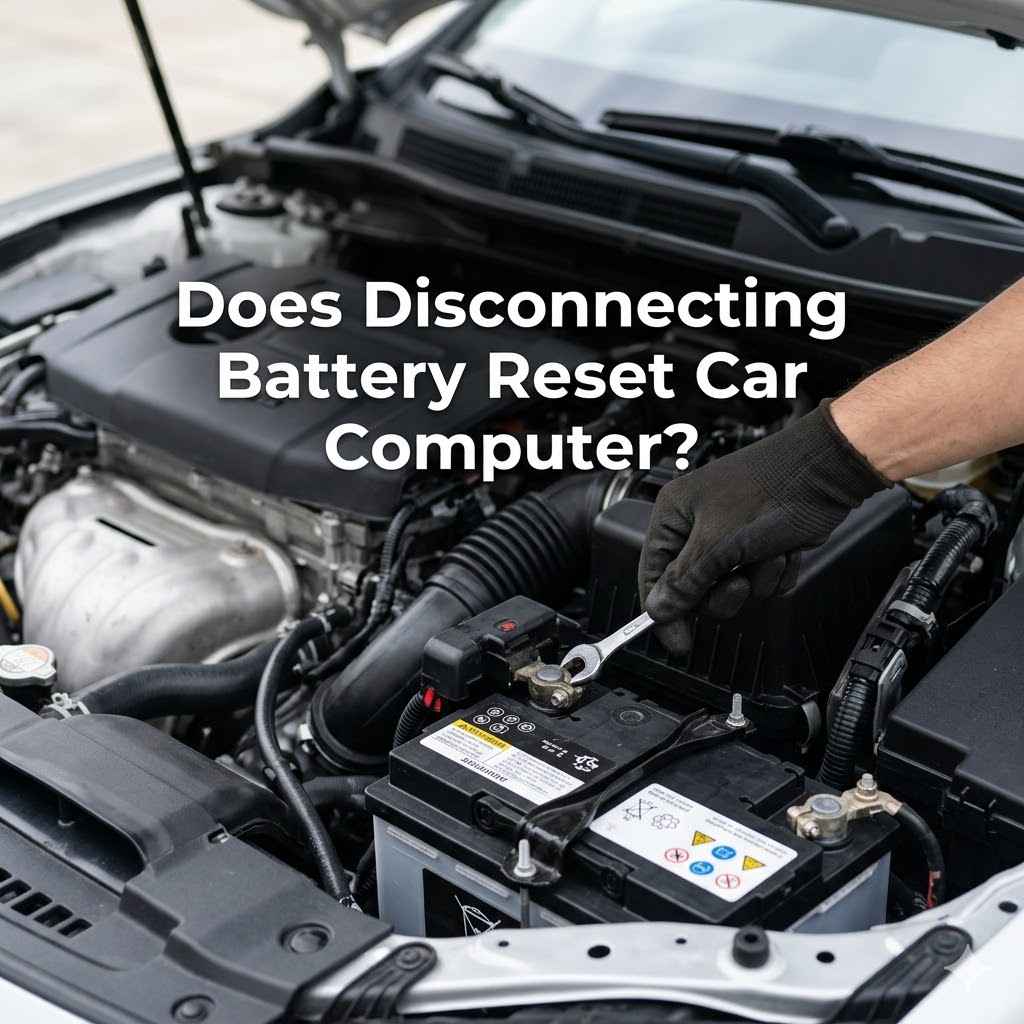
Does Disconnecting Battery Reset Car Computer?
Many car owners wonder, does disconnecting the battery reset the car computer? It’s a common question, especially for those new to car maintenance. Sometimes, issues with your car’s electronics might lead you to consider this step.
It can seem a bit technical, but understanding if and how this works is simpler than you might think. This guide will break down exactly what happens when you disconnect your car battery and provide easy steps to follow. Let’s explore how this process impacts your car’s brain and what you can expect.
The Basics Does Disconnecting Battery Reset Car Computer
This section explains why disconnecting the car battery is often suggested as a fix for minor electronic glitches and what exactly it resets. We’ll look at the car’s computer systems and how they store information. You will learn what parts of the car’s memory are affected by this action.
Understanding these core concepts will help you see why this method can sometimes solve simple problems. It is a widely discussed topic among car enthusiasts and DIY mechanics for good reason.
What is the Car Computer?
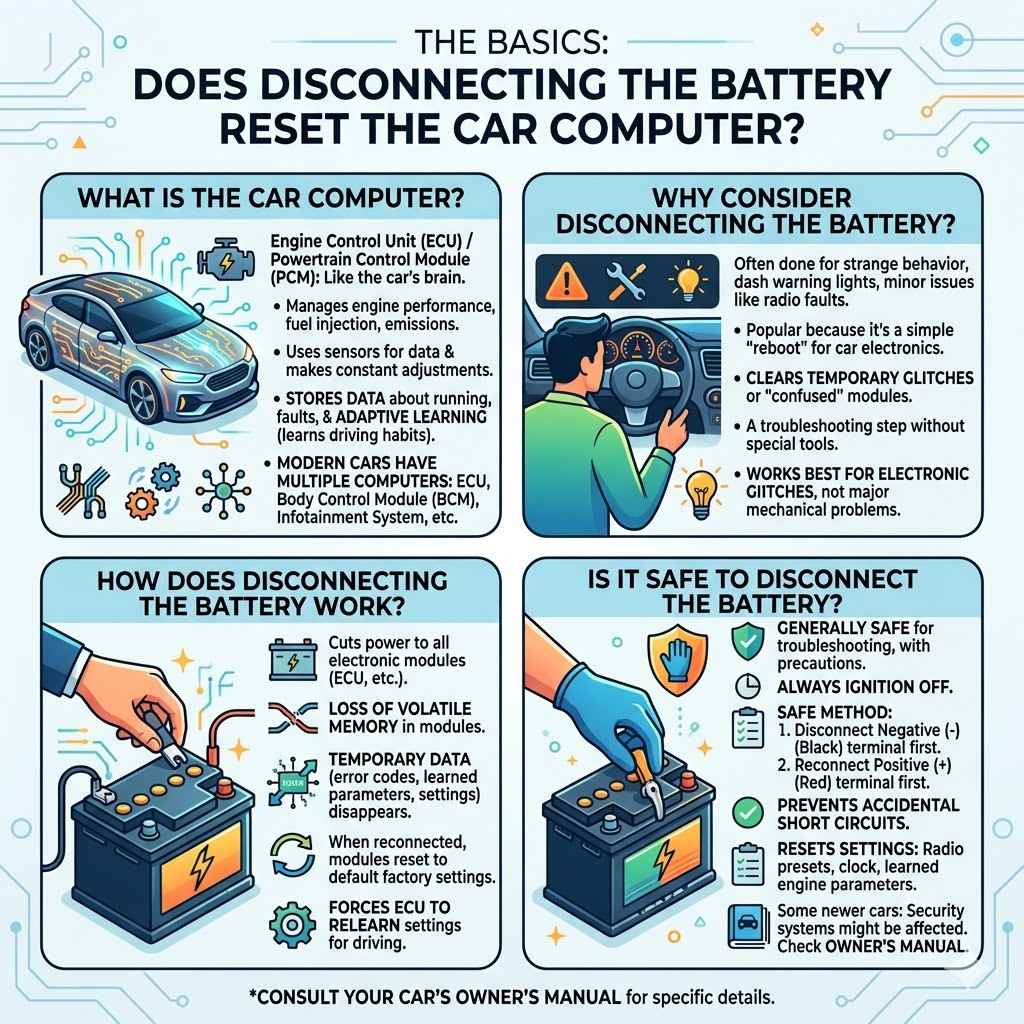
Your car’s computer, often called the Engine Control Unit (ECU) or Powertrain Control Module (PCM), is like the car’s brain. It manages almost everything your car does. This includes engine performance, fuel injection, emissions, and even things like your anti-lock brakes and transmission shifts.
The ECU uses sensors placed all over the car to gather data. It then uses this data to make constant adjustments to keep your car running smoothly and efficiently. Think of it as a very sophisticated thermostat, but for many more functions than just temperature.
The ECU is a complex piece of hardware and software. It stores data about how the engine is running, any detected faults, and can even learn your driving habits to optimize performance over time. This learning capability is called adaptive learning.
For example, it might adjust fuel mixture based on how you typically accelerate or how much weight is in the car.
Modern cars have multiple computers, not just one. There’s a body control module (BCM) for lights, windows, and locks, and an infotainment system computer for your entertainment. The ECU is the main one people refer to when talking about resetting the car’s computer, as it controls the core functions of driving.
Why People Consider Disconnecting the Battery
People often consider disconnecting the car battery when they notice strange behavior from their car. This can include warning lights on the dashboard that don’t seem to have a clear cause, or minor issues like a radio not working correctly. Sometimes, after a repair, a persistent warning light might remain, and a battery reset is a suggested first step.
This method is popular because it is a simple, non-invasive procedure that many people can do themselves. It’s seen as a digital “reboot” for the car’s electronics. The idea is that by cutting power, you clear temporary memory glitches or “confused” electronic modules.
It’s a troubleshooting step that doesn’t require special tools beyond a basic wrench.
It’s important to note that this works best for temporary electronic glitches. If there’s a serious mechanical problem, simply disconnecting the battery won’t fix it. It’s a tool for minor electronic hiccups, not for major engine failures or component breakdowns.
Think of it like restarting your home computer when an app freezes; it often resolves the immediate issue without fixing the underlying software problem.
How Does Disconnecting the Battery Work
When you disconnect the car battery, you are essentially cutting off the power supply to all the car’s electronic modules, including the main computer (ECU). The ECU, like most electronic devices, has a memory that stores temporary information. This includes error codes, learned engine parameters, and settings for various systems.
By disconnecting the battery, you allow these electronic modules to lose power. This causes them to lose any temporary data stored in their volatile memory. Think of volatile memory like the RAM in your computer; when you turn it off, the data in RAM disappears.
When you reconnect the battery, the modules power up again and reset to their default factory settings.
This process can often clear minor software glitches or temporarily stored error codes that might be causing a warning light to stay on. For learned engine parameters, disconnecting the battery forces the ECU to relearn these settings based on your driving. This is why some people feel their car drives differently after a battery disconnect.
Is It Safe to Disconnect The Battery
Generally, it is safe to disconnect your car battery for troubleshooting purposes. However, there are a few precautions to keep in mind. Always ensure the car’s ignition is completely off.
It’s best to remove the negative (black) terminal first, as this is the ground connection. Then, remove the positive (red) terminal.
When reconnecting, always attach the positive terminal first, followed by the negative terminal. This order helps prevent accidental short circuits. Make sure the terminals are clean and the connections are secure.
You might want to wear gloves and eye protection for added safety.
It’s also worth noting that disconnecting the battery can reset certain settings in your car. This can include things like your radio presets, clock, and the learned parameters for your engine management system. Some newer cars have more complex electronics, and in rare cases, disconnecting the battery might affect security systems or require a code to reactivate certain features.
Always consult your car’s owner’s manual if you are unsure.
What Happens When You Disconnect Your Car Battery
This section delves into the detailed effects of disconnecting your car battery, covering what gets reset and what doesn’t. We will explore the temporary and permanent data loss. You will also learn about the adaptive learning process of the car’s computer.
This will give you a clear picture of the impact this action has on your vehicle’s electronic systems. Understanding these outcomes helps you decide if this is the right step for your car’s issues.
Clearing Error Codes
One of the most common reasons people disconnect their car battery is to clear diagnostic trouble codes (DTCs) stored in the ECU. When a sensor detects a problem, the ECU records a code. This code illuminates a warning light on your dashboard, like the check engine light.
Sometimes, a code might be stored due to a temporary issue, like a loose gas cap, or a transient electrical fault.
Disconnecting the battery cuts power to the ECU, and in doing so, it can erase these stored DTCs from the ECU’s memory. This is why, after disconnecting the battery, a check engine light might go off. However, if the underlying problem that caused the code still exists, the light will likely reappear after some driving time as the ECU detects the issue again.
It’s crucial to understand that this does not fix the problem; it only clears the symptom (the warning light). A diagnostic scan tool is needed to properly identify the original DTCs and the cause of the problem for a permanent fix. Simply clearing the codes without addressing the root cause is like turning off a smoke alarm without putting out the fire.
Resetting Adaptive Learning Parameters
Modern car computers use a system called adaptive learning. This means the ECU learns your driving habits and the specific conditions under which your car operates. It constantly adjusts engine parameters like fuel-air mixture, idle speed, and ignition timing to optimize performance and fuel economy based on this learned data.
When you disconnect the battery, you erase these learned parameters. The ECU is then forced to revert to its factory default settings. Upon reconnecting the battery, the ECU begins to relearn these parameters.
This relearning process can take some time, often a few driving cycles. During this period, your car might feel a bit different, perhaps not running as smoothly or with slightly altered acceleration.
This resetting of adaptive learning is sometimes beneficial. If the ECU has learned incorrect parameters due to a faulty sensor or a previous issue, relearning from scratch can help. However, it also means you may experience a temporary change in how your car drives until the ECU fully recalibrates itself.
It is like a computer refreshing its basic settings to start anew.
What Gets Reset and What Doesn’t
When you disconnect the car battery, several things get reset. These primarily involve the temporary memory of electronic control units (ECUs). This includes clearing most diagnostic trouble codes (DTCs) and resetting learned engine parameters, as mentioned.
Radio presets, clock settings, and sometimes power window memory are also commonly reset.
However, not everything is reset. Permanent fault codes, which indicate more serious or ongoing issues, may remain stored in the ECU’s non-volatile memory. Similarly, the car’s odometer reading (mileage) is permanently stored and will not be affected.
The car’s VIN (Vehicle Identification Number) is also permanently embedded in various modules.
Important systems like the anti-theft system, airbag system, and ABS (Anti-lock Braking System) computers typically retain their critical programming. While they lose power, their core functions and safety calibrations are not erased. If these systems were malfunctioning before the disconnect, they will likely continue to malfunction afterward unless the underlying issue is fixed.
Impact on Different Car Systems
The impact of disconnecting the battery can vary across different car systems. The Engine Control Unit (ECU) is the most directly affected, with its temporary memory cleared. This can resolve minor engine performance quirks.
The transmission control module (TCM), which works closely with the ECU, also has its adaptive settings reset.
For entertainment systems like radios and navigation, presets are often lost. For power features like windows and sunroofs, you might need to re-initialize their operation by holding the button for a few seconds after reconnecting the battery. The car’s alarm system might be temporarily deactivated and require a specific procedure to re-arm.
Safety systems like the airbags and ABS are designed to retain critical data and calibrations even when power is lost. However, if there was a fault logged in these systems, it might persist. It’s generally not recommended to disconnect the battery if you suspect a problem with the airbag system due to potential safety implications.
The Role of the Alternator
The alternator is a crucial component in your car’s electrical system, and it plays a role in how the battery is managed. Its primary job is to generate electricity to power the car’s systems and recharge the battery while the engine is running. It works in conjunction with the battery, which provides the initial power to start the car and supplies electricity when the alternator isn’t producing enough (like at idle).
When the battery is disconnected, the alternator is essentially isolated from the rest of the system. If the engine were somehow running without a battery connected (which is highly unlikely and not recommended), the alternator’s voltage output could surge unpredictably. This is because the battery acts as a voltage stabilizer for the alternator.
However, in the context of a typical battery disconnect procedure, the engine is off, so the alternator isn’t actively generating power.
The alternator itself does not have a computer memory that gets reset by disconnecting the battery. It’s a mechanical and electrical device that either works or it doesn’t. Its output is regulated by a voltage regulator, which is often integrated into the alternator or is a separate module.
This regulator ensures that the charging voltage is within the correct range, protecting the battery and the car’s electronics.
How to Properly Disconnect and Reconnect Your Car Battery
This section offers a clear, step-by-step guide on how to safely disconnect and reconnect your car battery. We will cover the necessary tools and precautions. Following these instructions ensures you perform the task correctly and avoid potential damage to your car’s electrical system.
This practical approach empowers you to perform this common automotive maintenance task with confidence.
Tools You Will Need
To safely disconnect and reconnect your car battery, you will need a few basic tools. The most important tool is a socket wrench or an adjustable wrench that fits the nuts on your battery terminals. Most battery terminals use 10mm or 13mm nuts, but it’s good to have a set of sockets or an adjustable wrench to be prepared.
You will also need a wire brush or a battery terminal cleaning tool. This is used to clean corrosion off the battery terminals and the cable clamps. Corrosion can prevent a good electrical connection, leading to charging issues or intermittent power problems.
Safety glasses are highly recommended to protect your eyes from any potential sparks or battery acid.
Gloves are also a good idea to keep your hands clean and to protect them from any grime or potential acid residue on the battery. Having a rag or shop towel handy can be useful for wiping down terminals or any spills.
Step-by-Step Disconnection Process
First, ensure your car is turned off completely and the keys are removed from the ignition. Open the hood and locate the car battery. It is usually a rectangular box, typically black, with two terminals on top.
Identify the negative terminal, which is marked with a minus sign (-) and is usually black or has a black cable attached.
Using your wrench, loosen the nut on the negative terminal clamp. You don’t need to remove the nut completely, just loosen it enough so you can slide the clamp off the terminal. Once loosened, gently twist and pull the negative cable clamp off the battery post.
It’s important to do this first because the negative cable is connected to the car’s chassis, providing a ground.
Next, identify the positive terminal, which is marked with a plus sign (+) and is usually red or has a red cable attached. Loosen the nut on the positive terminal clamp. Once loosened, carefully twist and pull the positive cable clamp off the battery post.
Keep the two cable clamps from touching any metal parts of the car simultaneously.
Allowing the Car to Reset
Once both battery terminals are disconnected, the car’s electronic systems will begin to lose power. This is the crucial period where the computer’s memory is effectively cleared. For most modern vehicles, leaving the battery disconnected for about 15 to 30 minutes is usually sufficient to allow all modules to fully discharge and reset.
Some sources recommend touching the two disconnected cable ends together for a few seconds while they are off the battery. This is a controversial method and can potentially cause a surge that could damage sensitive electronics. It is generally safer and recommended to simply leave the battery disconnected for the specified time.
During this time, you can use the opportunity to clean your battery terminals and cable clamps.
This waiting period ensures that all residual power dissipates from the various control modules. It gives the systems a true “power cycle.” Once the time has elapsed, you are ready to reconnect the battery.
Step-by-Step Reconnection Process
After the waiting period, it’s time to reconnect the battery. Start by attaching the positive (red) cable clamp back onto the positive battery terminal. Make sure it is seated firmly and evenly.
Use your wrench to tighten the nut on the clamp. Do not overtighten, but ensure it is snug and secure.
Next, attach the negative (black) cable clamp back onto the negative battery terminal. Again, ensure it is seated properly and tighten the nut securely. It is important to connect the positive terminal first and the negative terminal last.
This sequence helps prevent accidental sparks or short circuits.
Once both terminals are securely connected, you can start your car. You may notice that some settings, like your radio presets, have been erased. You might also observe that the engine idle speed or shifting behavior feels slightly different as the ECU begins its relearning process.
Give your car some time to adjust.
Re-initializing Specific Systems
After reconnecting the battery, some car systems may require re-initialization. This is common for power windows, sunroofs, and sometimes even the steering angle sensor. Your car’s owner’s manual will detail the exact procedure for your specific make and model.
For power windows, a common procedure involves rolling the window all the way down by holding the switch, and then rolling it all the way up by holding the switch. You may need to hold the switch for a few seconds at the top or bottom position for the system to recognize the full travel range.
The steering angle sensor is crucial for stability control systems. If this sensor loses its calibration, a warning light may illuminate. Re-initialization typically involves turning the steering wheel from lock to lock while the car is running, or following a specific sequence outlined in the manual.
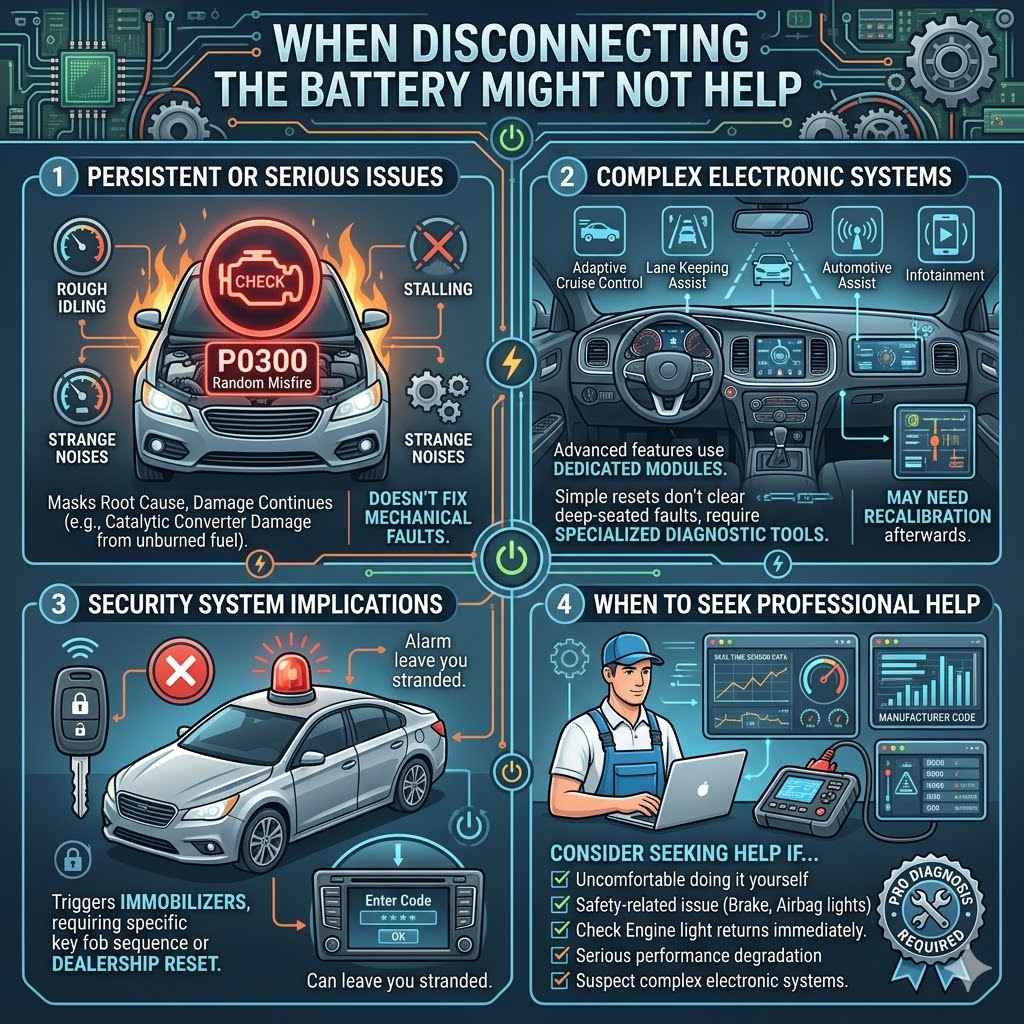
When Disconnecting The Battery Might Not Help
This section addresses situations where disconnecting the battery is not the right solution or might even be counterproductive. We will discuss when professional diagnosis is necessary. Understanding these limitations helps you avoid unnecessary steps and ensures you seek appropriate help when needed.
This knowledge is key to troubleshooting your car effectively.
Persistent or Serious Issues
If your car is experiencing a persistent issue, such as a check engine light that returns immediately after clearing, or if you notice significant performance problems like rough idling, stalling, or strange noises, simply disconnecting the battery is unlikely to provide a lasting solution. These symptoms often point to underlying mechanical or electrical faults that require proper diagnosis.
Serious issues like transmission problems, engine misfires, or failures in safety systems like airbags or ABS are not fixed by a battery reset. In fact, attempting to clear codes for such issues without addressing the root cause could mask important warning signs, potentially leading to more significant damage or safety risks down the line.
For example, if your car is showing a P0300 code (random multiple cylinder misfire), disconnecting the battery will clear the code and the check engine light temporarily. However, the misfire will continue, potentially damaging your catalytic converter due to unburned fuel entering the exhaust system.
Complex Electronic Systems
Modern vehicles are equipped with increasingly complex electronic systems. While disconnecting the battery can reset the basic ECU, it might not resolve issues with advanced features like adaptive cruise control, lane keeping assist, or sophisticated infotainment systems. These systems often have their own dedicated control modules that may retain error information or require specialized diagnostic tools for troubleshooting.
Attempting to reset such systems by disconnecting the battery might sometimes even cause new issues, such as disabling these features until they are recalibrated by a dealership or qualified technician. The interconnectedness of these systems means a simple reset might not isolate the problem effectively.
For instance, a fault in a complex parking sensor system might not be cleared by a battery disconnect if the fault is related to a specific sensor module or its communication bus. The system might remain inoperative until a diagnostic tool is used to identify and clear the fault code within that specific module.
Security System Implications
Many vehicles have sophisticated anti-theft or immobilizer systems that are integrated with the car’s computer. Disconnecting the battery can sometimes trigger these security systems, requiring a specific key fob sequence or a trip to the dealership to re-enable them. This can leave you stranded if you don’t know the correct procedure.
While the intention of disconnecting the battery is to clear minor glitches, inadvertently interfering with security systems can create more significant problems. Always check your owner’s manual for any warnings or specific procedures related to your car’s security features before disconnecting the battery.
In some cases, a car might require a special code to be entered into the stereo system after the battery is disconnected, or the alarm system might need to be disarmed and re-armed using the key fob. If these procedures are not followed, the car may not start or the alarm might continue to sound.
When to Seek Professional Help
If you are unsure about any aspect of disconnecting your car battery, or if the problem persists after attempting a reset, it is always best to seek professional help. A qualified mechanic has the diagnostic tools and expertise to accurately identify the root cause of any issue. They can read detailed error codes that a simple battery reset cannot fix.
This is especially true for issues related to safety systems, such as airbags or ABS, or for complex engine performance problems. Attempting to fix these yourself without the proper knowledge or equipment could lead to further damage or compromise your safety. A mechanic can also advise whether a battery reset is appropriate for your specific situation.
Consider seeking professional help if:
- You are uncomfortable performing the procedure yourself.
- The problem is serious or safety-related (e.g., brake warning lights, airbag lights).
- The check engine light returns immediately after disconnecting the battery.
- Your car has experienced significant performance degradation.
- You suspect an issue with advanced electronic systems.
A mechanic can perform a thorough diagnosis, which might involve checking sensor data, reading manufacturer-specific trouble codes, and performing physical inspections.
Frequently Asked Questions
Question: Will disconnecting the battery erase my car’s mileage?
Answer: No, disconnecting the battery will not erase your car’s mileage. The odometer reading is stored in non-volatile memory, meaning it retains its data even when power is removed.
Question: How long should I leave the battery disconnected to ensure a full reset?
Answer: For most modern cars, leaving the battery disconnected for about 15 to 30 minutes is usually sufficient to allow electronic modules to fully discharge and reset.
Question: Will disconnecting the battery affect my car’s warranty?
Answer: In most cases, no. Disconnecting the battery for basic troubleshooting is a common procedure and generally does not void your car’s warranty, provided no damage is caused by improper execution.
Question: Can disconnecting the battery fix a check engine light that came on after filling up with gas?
Answer: Yes, sometimes it can. A common cause for a check engine light after refueling is a loose gas cap. Disconnecting the battery can clear the code, and if the cap was indeed the issue, it may not return.
Question: What should I do if my car won’t start after reconnecting the battery?
Answer: If your car won’t start, double-check that both battery terminals are clean and securely connected. Ensure the battery has sufficient charge. If the issue persists, there might be another problem, and it’s best to seek professional assistance.
Summary
Disconnecting your car battery can indeed reset certain aspects of your car’s computer, clearing temporary error codes and adaptive learning parameters. It’s a simple DIY fix for minor electronic glitches. Remember to always disconnect the negative terminal first, wait about 15-30 minutes, and reconnect the positive terminal first.
This process can resolve many small issues, but it won’t fix underlying mechanical problems.