Best Selling 5 Car Buffer Attachment for Drill
For DIY paint correction, a 5-inch foam polishing pad on a backing plate with a 1/4-inch shank is a common choice for a drill; wool or cutting foam may be better for deeper swirls, especially if the drill has variable speed. Match the wrong pad to the wrong defect and you can haze clear coat, stall the drill, or burn through paint on edges. This guide shows which attachment fits light swirls, moderate defects, and heavier oxidation, plus how to match pad type to drill chuck size and speed.
Quick comparison
| Product | Badge | Best for | Price | ||
|---|---|---|---|---|---|
 |
SIQUK 16 Pieces Buffing Pads 5 Inch Car Polishing Pad KitSIQUK | Our pick | 5-inch · 16-piece · foam pad kit | $18.59
Price as of 3 Nov 2026
|
View |
 |
QEUOBUE 5 Inch Microfiber Car Polishing PadsQEUOBUE | Also great | 5-inch · 4-piece · microfiber pad kit | $11.99
Price as of 3 Nov 2026
|
View |
 |
Yourkar 5 Inch Wool Polishing Buffing PadYourkar | Budget pick | 5-inch · 1-pad · wool pad | $7.49
Price as of 3 Nov 2026
|
View |
 |
Holikme 8Pack 5Inch Car Polishing PadsHolikme | Pair with it | 5-inch · 8-pack · foam and wool kit | $9.99
Price as of 3 Nov 2026
|
View |
 |
Linkstyle 11PCS 5 Inch Wool Polishing Buffing Pad KitLinkstyle | Upgrade pick | 5-inch · 11-piece · wool pad kit | $19.98
Price as of 3 Nov 2026
|
View |
The quickest way to buy is to match the pad to the defect first, then check the drill chuck fit. In the broader market, the tracked set included 134 products, the top 10 averaged 3,700 units, $25.04, and 4.4 stars, with the $10.00 to $20.00 band taking 41% of the assortment.
How we chose
This roundup uses manufacturer specs, listing details, and published buyer feedback only. The selection criteria were pad material, pad diameter, drill fit details, backing support, and whether the kit matches the defect level you are trying to fix.

One market signal stands out: a 5-inch foam pad kit can handle more jobs than a specialty wool pad, which is why foam leads the list for most beginners. The fastest-growing product in the tracked market was up 100.0% month over month, but growth alone does not tell you whether it fits your paint defect.
Quick picks
| Need | Pick | Why it fits | Likely drawback |
|---|---|---|---|
| Beginner-friendly finish work | SIQUK 16 Pieces Buffing Pads 5 Inch Car Polishing Pad Kit | Foam variety, hook-and-loop backing, washable and reusable pads | No adapter is listed in the supplied details |
| Polishing and waxing with adapter included | QEUOBUE 5 Inch Microfiber Car Polishing Pads | Microfiber pad set with M14 drill adapter and quick pad changes | Microfiber is less focused for cutting than wool |
| Light-to-moderate cutting | Yourkar 5 Inch Wool Polishing Buffing Pad | Single wool pad with M10 drill adapter for compound work | One pad limits coverage and finish refinement |
| Mixed compounding, polishing, waxing | Holikme 8Pack 5Inch Car Polishing Pads | Foam and wool mix for several defect levels | Type mix can confuse first-time users |
| Wool kit with backing support | Linkstyle 11PCS 5 Inch Wool Polishing Buffing Pad Kit | Eight wool pads plus backing pad and M14 drill adapters | Wool needs more heat control than foam |
SIQUK 16 Pieces Buffing Pads 5 Inch Car Polishing Pad Kit: best for beginner finish work
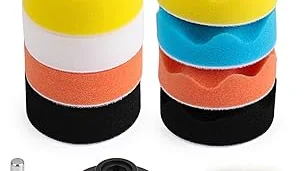
This is the safest default for a DIY owner who wants better gloss, less mild haze, and simple pad choice. The 5-inch size is broad enough for doors and hoods, and the listing’s mix of pad shapes and softness levels helps you move through polishing and waxing without jumping straight to aggressive cutting.
Its hook-and-loop backing suits drill buffer attachments, and the pads are washable and reusable. That said, the supplied details do not list a drill adapter, so you need to confirm how your drill chuck and any backing plate will connect before buying.
Use this when the paint has light swirls, wash marks, or dull finish, not when the clear coat has deeper scratches or oxidation that needs more cut. A 5-inch foam pad is usually the better middle ground because it covers panels faster than a 3-inch pad while staying easier to control than a 6-inch pad.
QEUOBUE 5 Inch Microfiber Car Polishing Pads: best for polishing and waxing
This is the strongest fit when you want a pad that leans toward polish application and final finish work. The kit includes an M14 drill adapter, microfiber material, and magic-tape backing, so it is easier to match to a compatible backing setup than many bare pad-only listings.
Microfiber works well for spreading polishing compound and finishing products, but it is not the first choice for heavy defect removal. If you are chasing deeper swirls or oxidation, wool or a cutting foam pad will usually be the better match.
The drawback is the same thing that makes it useful: microfiber favors refinement over aggressive correction. That means it can take longer on defects that need actual cutting, and you still need to confirm the drill itself accepts the shank or chuck setup used by your adapter.
Yourkar 5 Inch Wool Polishing Buffing Pad: best for heavier cutting
This is the pick for spot correction where cutting ability matters more than finish softness. Wool moves faster on oxidized paint and stronger swirl marks than foam, and the included M10 drill adapter helps with accessory-side fit once the drill chuck side is sorted out.
Wool has a more aggressive paint finish impact, which is useful only when the job calls for it. That same cut can leave more haze, so expect a follow-up polish step if you want a clean finish instead of a corrected-but-dull panel.
The single-pad format is the main tradeoff. It is inexpensive, but it gives you less flexibility than a kit with several pad densities, and wool demands more heat management than foam because friction rises quickly on curved panels and edges.
Holikme 8Pack 5Inch Car Polishing Pads: best for mixed jobs
This kit fits shoppers who want one box that can handle compounding, polishing, and waxing without buying separate pad types. The presence of both foam and wool makes it easier to match pad aggressiveness to defect severity instead of forcing every task through one pad material.
The pads are bendable, washable, and reusable, so the set makes sense if you plan to do more than one vehicle or want separate pads for compound and finishing polish. The drawback is that mixed kits can tempt you to use the wrong pad on the wrong stage, which is how cross-contamination happens.
Use wool for correction, then switch to foam for refinement. Keep separate pads for compound and wax. A common first-timer mistake is loading a wool pad with finishing wax and expecting it to remove oxidation at the same time; that usually wastes product and leaves the panel uneven.
Linkstyle 11PCS 5 Inch Wool Polishing Buffing Pad Kit: best for wool correction with backing support
This is the strongest wool-focused kit in the list because it includes eight wool pads, a backing pad, and M14 drill adapters. The backing pad matters because it helps spread pressure more evenly and supports the pad during use, which improves attachment stability when the drill is moving across larger panels.
It suits correction work, polishing, compounding, and finishing, but the wool format still means you need to keep speed low and pressure light. The tradeoff is simple: more cutting potential than foam, more finish risk if you rush the panel.
Because it is wool-heavy, this is not the easiest choice for a first-time user. It is better for someone who already knows the difference between a defect that needs correction and a finish that only needs gloss restoration.
Which one should you buy?
If you are a beginner, start with the SIQUK foam kit. It gives you the most forgiving path for light swirls, wash marks, and final gloss work, and the 5-inch size is manageable on most panels.
If the paint has oxidation or deeper swirl marks, choose the Yourkar wool pad or the Linkstyle wool kit. Wool cuts faster, but it also raises heat faster, so it belongs on defects that actually need that extra bite.
If your goal is polishing or waxing rather than correction, the QEUOBUE microfiber kit is the cleaner match. If you want one kit that can do several jobs, the Holikme mixed set is the broadest option.
For tight spots, 3-inch pads are the better precision choice. For larger panels, 5-inch or 6-inch pads cover more area, but the larger the pad, the harder it is to control on curves and edges.
Attachment decision matrix
| Car task | Attachment type | Pad size | Backing or adapter requirement | Safe drill speed band | Risk level |
|---|---|---|---|---|---|
| Light scuffs on clear coat | Soft foam polishing pad | 5-inch | Backing pad recommended; shank must fit the drill chuck | Low RPM | Low |
| Swirl marks and dull gloss | Foam polishing pad with medium softness | 5-inch or 6-inch | Backing pad preferred for even pressure | Low to moderate RPM | Low to medium |
| Oxidation on painted panels | Wool buffing pad | 5-inch or 6-inch | Backing pad strongly recommended; verify adapter or shank fit | Low RPM only | Medium to high |
| Trim-edge work and tight contours | 3-inch foam or microfiber pad | 3-inch | Small backing pad helps control pressure near edges | Low RPM | Medium |
| Wax application and final finish | Soft foam or microfiber pad | 5-inch | Hook-and-loop backing or listed adhesive backing | Very low to low RPM | Low |
| Light scratch removal kit work | Scratch remover kit pad | 5-inch typical | Kit should include backing support and microfiber towel | Low RPM | Medium |
How to choose
- Identify the defect first: light scuffs, swirls, oxidation, or a true scratch in the clear coat.
- Match pad aggressiveness to the defect, not the price tag. More cut only helps when the defect needs it.
- Check the drill chuck fit before buying. The drill needs a shank that fits the chuck securely; M10 and M14 belong to accessory threads on backing plates or adapters, not direct drill fit standards.
- Favor a backing pad when the listing includes one. It distributes pressure more evenly and helps the pad stay stable.
- Keep speed low at first. Variable-speed drills are safer for paint because they give you more control over heat and pad drag.
Drill-mounted polishing works best when the pad, adapter, and defect all line up. A drill is not a true polisher, so control matters more than raw speed. If the pad starts to hop, drag, or heat the panel quickly, stop and check the fit and product pairing.
Picture a black sedan with faint wash swirls on the hood. A 5-inch foam polishing pad at low RPM can refine the gloss without the cutting force that a wool pad would bring. Now change only one variable: the hood also has oxidation. That is the point where wool starts to make more sense, but only with careful heat control.
Wool buffing pad: best for heavy correction
Wool buffing pads cut faster than foam, which makes them useful for oxidation and more stubborn swirl marks. They can also be washable and reusable, and they are sold in size options such as 3-inch and 6-inch, with 5-inch and 6-inch sizes better for broader panels and 3-inch pads better for precision work.
The finish impact is the catch. Wool is more likely to leave haze or a rougher finish than foam, so it usually needs a second step with a foam polishing pad or a finishing compound. That is why wool belongs to heavier correction, not routine wax application.
When wool cuts faster than foam
Wool is the better choice when oxidation is visible, the clear coat looks tired, or swirl marks are deep enough that a soft foam pad would only gloss over them. It also helps on flatter, larger panels where the extra cut can be controlled more easily.
Finish quality and heat risk
Wool creates more friction than foam. That raises heat faster, especially on edges, body lines, and curved panels, so keep the drill at low RPM and use light pressure. If the panel feels hot, stop and let it cool.
3-inch versus 6-inch wool pads
A 3-inch wool pad gives more control near mirrors, pillars, and bumper corners. A 6-inch pad covers more area faster, but it is less maneuverable and can be harder to keep flat on the panel.
Foam polishing pad: best for finish work
Foam polishing pads are softer than wool and are usually the better choice for polishing and waxing. They often come in color-coded stages, with softer pads reserved for finishing and firmer foam used for polishing or light correction, and they commonly use hook-and-loop or adhesive backing.
Foam is more forgiving on clear coat, which is why it is the safer starting point for most DIY users. It is also the better pick for pairing with finishing polish or wax, because it spreads product more evenly and leaves less risk of haze than a wool pad.
Softness levels and color stages
Manufacturers often sort foam pads by softness, and many kits use color to separate cutting, polishing, and finishing stages. The exact colors vary by brand, so check the listing for that model instead of assuming one color means one job.
Polishing versus waxing use
Use firmer foam for polishing compounds and softer foam for wax or finish sealant. A polishing compound is for removing light defects or oxidation, while wax is for finishing and protection. Mixing the two jobs in one step usually leaves uneven results.
Hook-and-loop versus adhesive backing
Hook-and-loop backing makes pad swaps faster and is common on drill buffer attachments. Adhesive backing can work too, but it needs secure bonding and careful pad alignment. In either case, a backing pad improves support and helps the pad stay flat under load.
Scratch remover kit: best for light marks
A scratch remover kit is useful for light scratches and scuffs that sit in or near the clear coat, not for deep paint damage. The better kits are drill-mounted, include a microfiber towel, and are described as clear-coat safe when used correctly.
That said, these kits are not a cure-all. If the scratch catches a fingernail, the damage may be too deep for a drill attachment to fully remove, and pushing harder only raises the risk of haze or paint loss on edges.
Clear-coat safe use
Clear-coat safety depends on using the right compound, low speed, and light pressure. A drill can generate heat quickly, so keep the pad moving and avoid sitting in one spot.
What the kit should include
Look for a pad, a drill-friendly mounting method, and a microfiber towel for wipe-off. If the listing includes a compound, make sure it is meant for scratch removal rather than heavy abrasive correction alone.
When a kit is not enough
If the panel has deep oxidation, strong swirl patterns, or scratches that are clearly into the paint, a scratch remover kit will usually be too mild. In those cases, a wool pad with compound, followed by a foam finishing pad, is a more realistic route.
Drill adapter: best for secure fit
A good drill adapter starts with shank fit for the drill chuck. That is the actual connection that keeps the attachment from wobbling. M10 and M14 belong on the accessory side of the setup, where they describe thread standards on backing plates or adapters, not the drill chuck itself.
Secure attachment matters because wobble creates uneven pressure, heat, and pad drag. If the pad does not run true, the risk to the paint rises quickly, especially on edges and curved metal.
Shank fit for standard drill chucks
Confirm that the adapter or backing system has a shank sized for your drill chuck. If the listing does not make that clear, check the manufacturer’s listing for your model before buying.
M10 and M14 only as accessory-thread standards
M10 and M14 are accessory thread standards used on some backing plates and adapters. They are not direct proof that a pad will fit your drill. The drill still needs a chuck-compatible shank or a proper adapter path.
Wobble prevention and clamp security
Look for a tight chuck grip, a backing pad that supports the pad face, and a setup that does not flex under light pressure. If the attachment shifts in the chuck, stop and reset it before touching paint.
Can a drill buffer attachment damage car paint?
Yes. A drill buffer attachment can haze clear coat, leave swirls, or even burn through paint on edges if the pad is too aggressive, the speed is too high, or the user stays in one spot. The risk rises when wool is used on a finish job or when a soft pad is forced to correct heavy damage.
Use low RPM, keep the pad moving, and start with the least aggressive pad that can still do the work. A variable-speed drill gives you more control, but it does not turn the tool into a true polisher.
Common failure cases
Heat buildup is the most common problem. Pad drag happens when the pad is too large or too aggressive for the panel shape. Adhesive failure can happen if the backing system is weak or misaligned. Cross-contamination happens when compound and wax share the same pad.
Safe workflow for paint
Apply product to the pad lightly, start at low speed, and work a small section at a time. Keep pressure even and stop if the panel gets hot. Follow the vehicle and product manual, and keep any moving parts or accessories clear of trim, emblems, and airbag zones where relevant.
What comes in a good car buffer drill attachment kit?
A good kit should match the job, include the right pad material, and tell you how it attaches to the drill. For polishing work, look for foam or microfiber pads. For correction, look for wool or cutting foam. A backing pad is a plus because it improves support and stability.
If the kit is meant for scratch removal, it should include a drill-mounted pad and a microfiber towel. If it is meant for broader correction, it should explain whether the adapter is for the drill chuck or for the pad-side thread standard.
What to prioritize
- Pad material that matches the defect level.
- A shank that fits the drill chuck securely.
- A backing pad for even pressure distribution.
- Clear backing details if the listing uses M10 or M14 on the accessory side.
- Reusable pads if you plan to do more than one panel or vehicle.
Which drill buffer attachment is best for polishing versus scratch removal?
For polishing and waxing, foam or microfiber is the better choice because it is softer, easier to control, and less likely to haze the finish. For scratch removal, start with the least aggressive compound-safe option that can still move the defect, which usually means wool or a firmer cutting foam pad.
The key is to separate finish work from correction work. Polishing improves gloss and removes mild marks; scratch removal asks the pad to cut more aggressively, which raises heat and finish risk.
Do I need a 3-inch or 6-inch buffing pad for my car?
Use a 3-inch pad for tight spots, trim edges, mirrors, and small correction zones where control matters most. Use a 5-inch or 6-inch pad for larger panels when you want faster coverage. The tradeoff is simple: bigger pads move faster, but smaller pads are easier to place accurately.
If you are unsure, 5-inch is the safest middle ground for most DIY owners. It covers enough surface to be efficient without making the drill feel as unwieldy as a 6-inch setup.
What adapter do I need for a drill buffer attachment?
You need an adapter or shank that fits the drill chuck securely, not a thread match between the drill and the pad. M10 and M14 are accessory-side thread standards used on backing plates or adapters. If the listing does not explain the chuck side clearly, check the manufacturer’s listing for your model.
Secure fit matters more than thread labels on the pad side. A wobbling adapter can create uneven cutting, heat, and paint damage.
Are wool buffing pads better than foam pads for car polishing?
Wool cuts faster than foam, so it is better for oxidation, deeper swirls, and heavier correction. Foam is better for polishing and finishing because it leaves a cleaner surface and is easier to control. For most DIY users, foam is the first pad to buy, wool the second.
If the job is gloss restoration or wax application, foam wins. If the job is actual correction, wool may be the better tool, but it carries a higher risk of haze and heat buildup.
Frequently asked questions
What is the best car buffer drill attachment for a drill?
For most DIY users, a 5-inch foam polishing pad is the best all-around choice because it balances control, coverage, and finish safety. If the paint has oxidation or stronger swirls, move to wool or cutting foam. Make sure the drill has variable speed and the chuck fit is secure.
Which drill buffer attachment is best for beginners?
Beginners should start with a soft or medium foam pad kit with hook-and-loop backing. Foam is easier to control, less likely to haze clear coat, and more forgiving if your speed or pressure is not perfect yet. A 5-inch pad is usually the easiest size to manage.
Can I use the same pad for compound and wax?
You should not. Compound and wax do different jobs, and cross-contamination can leave residue or reduce finishing quality. Keep one pad for correction and another for wax or finishing products. That separation also helps the pad last longer and keeps the result more consistent.
Products related to this article
Sponsored / affiliate links. As an Amazon Associate I earn from qualifying purchases. I may earn additional commission from eligible campaigns.