Dome Lights for Cars: Style, Function, and Fitment
Choose bulb kits for factory fit and low glare, fixed fixtures for a cleaner permanent upgrade, and rechargeable lights for flexible placement. Fitment should come first, brightness second. Pick the wrong type, and you can end up with flicker, glare, wasted money, or a cabin that still feels dim. This guide compares those three dome-light paths by fitment risk, use case, and glare control so you can buy the right setup.
Vehicle-specific LED bulb kits

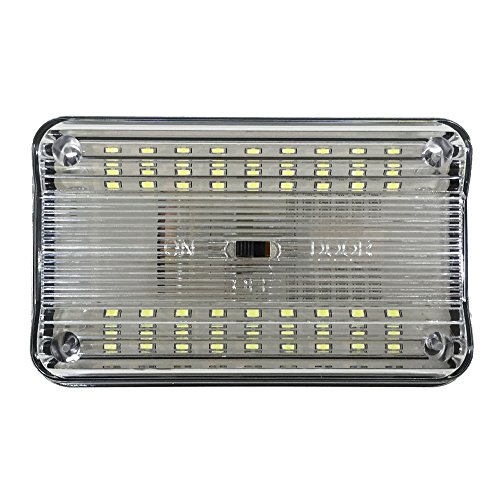
The top pick for most daily drivers is a vehicle-specific LED bulb kit, because it usually keeps the original lens, keeps install time low, and limits fitment surprises. Start here if your dome light already uses a known socket size and you want a fast swap without changing the housing.
Best for daily drivers that want a fast swap
A bulb kit is the safer first buy when the factory fixture is intact, the socket is easy to verify, and you want a cleaner cabin without drilling, rewiring, or changing the lens. Kits that list the exact socket family, such as T10 or DE3175, reduce the chance of buying the wrong base.
When a bulb kit is the safer first buy
Pick a bulb kit when you want to preserve the factory look, avoid clearance issues inside the headliner, and keep the option to return to stock. Zakolak 42-piece kits cover multiple bulb sizes for dome, map, tail, cab, and width lamps, while iFunyLED is listed with DE3175, 194, 31mm, and 42mm support. That kind of size coverage matters more than a bigger lumen claim.
Quick picks by use case
Use case should lead the decision. A bright bulb that works in a truck may be a poor match in a compact car if it throws harsh light across the cabin. The best choice changes with lens depth, mounting space, and how often the light stays on.
- Compact cars and commuters: vehicle-specific LED bulb kits with warm white or natural white output, because they keep glare down and usually fit the original lens.
- Trucks and work vehicles: direct replacement assemblies or stronger bulb kits, especially where cab depth, map-light access, and warning-light sensitivity matter.
- RVs, campers, and boats: fixed fixtures or higher-output dome lamps with wider voltage coverage, since these spaces often need broader ambient light.
- Classic cars and restoration projects: period-correct roof dome lamps or direct replacement assemblies when appearance and housing shape matter more than output alone.
Say your compact sedan uses a DE3175 bulb and the lens sits close to the ceiling liner. A low-profile bulb kit with natural white output is less likely to create glare than an oversized board that presses into the lens.
Suppose a work truck needs light in the cab and warning-free operation on a modern electrical system. A vehicle-specific assembly with CANBUS support is usually a better bet than a generic bulb marked only “universal.”
What size dome light bulb do you need for your car?
You need the socket size before you buy anything else. Remove the lens, verify the base shape, and check whether the lamp uses a wedge, festoon, or board-style bulb. Common dome-light sizes often include T10, DE3175, 3021, 3022, 31mm, 36mm, 41mm, and 42mm, but the exact fit depends on the housing rather than the package label.
How to verify socket type by lens removal
Remove the lens gently, then read the bulb or measure the old one from end to end if it is a festoon style. If the lamp uses spring clips, check the clip-to-clip distance, because 31mm, 36mm, 41mm, and 42mm festoon lamps are generally not interchangeable. If the base is wedge-style, T10 is a common size to verify first.
- Remove the lens without flexing the headliner trim.
- Inspect the bulb base shape: wedge, festoon, or board.
- Measure end-to-end length for festoon bulbs.
- Check clip position and spring tension in the holder.
- Measure lens depth so the new bulb does not touch the cover.
How to check clearance, length, and clip shape
Clearance matters as much as socket size. A bulb may fit the socket and still fail once the lens is back on because the LED board or heat sink sits too tall. Check the depth from bulb seat to lens face, and compare it with the new bulb’s overall height, not just its advertised base type.
Which dome light type fits your vehicle?
Choose the fixture type before you choose output. A bulb kit works inside the stock housing. A dome light fixture replaces the lamp body. A double-dome fixture spreads light across a larger area. A direct replacement assembly fits best when the OEM housing is cracked, shallow, or poorly matched to modern LEDs.
Bulb kit versus direct replacement assembly
Bulb kits are the lowest-risk swap if your current fixture is sound and the socket is known. Direct replacement assemblies make more sense when the lens is yellowed, the reflector is weak, or the original housing creates uneven light. For a newer vehicle, a vehicle-specific assembly often solves both fitment and appearance in one part.
When a double-dome fixture makes more sense
A double-dome fixture is useful in larger cabins, work vans, and rear seating areas where a single bulb leaves dark corners. It can also help in RV and camper spaces that need more even light for reading or gear handling. The trade-off is more installation complexity and more chance of clearance conflict.
When a roof dome lamp should stay stock
Some classic cars and older roof dome lamps fit best with a stock-style look. If the trim, lens, and mounting points are original and uncracked, a subtle bulb replacement may be the better move. Changing the whole lamp can create mismatch, especially if the original opening is shallow or oddly shaped.
Dome light decision table
This table maps the safest choice by common scenario. Use it to separate bulb replacement from full fixture replacement, then confirm socket size, voltage, and warning-light risk before you order.
| Scenario | Socket size | Fixture type | Brightness range | Color temperature | CANBUS need | Install complexity | Common mistakes |
|---|---|---|---|---|---|---|---|
| Compact car reading light | T10 or DE3175 | Bulb kit | About 200 lumens per bulb | Warm white or natural white | Usually optional | Low | Wrong socket, overly cool color, lens glare |
| Truck cab map and dome light | 31mm, 36mm, 41mm, or 42mm | Direct replacement assembly | About 200 to 550 lumens | Natural white or 6500K xenon white | Often needed | Medium | Bulb-out warning risk, polarity reversal, clearance issues |
| RV or camper ceiling light | 3021 or 3022 | Double-dome fixture | 550 to 1280 lumens | Warm white or natural white | Depends on coach wiring | Medium to high | Wrong socket, wiring mismatch, harsh glare |
| Classic car restoration | 31mm, 36mm, or 42mm | Roof dome lamp | About 200 lumens per bulb | Warm white or amber yellow | Usually no | Medium | Period mismatch, clearance issues, wrong lens depth |
| Nissan Frontier or NAVARA cabin upgrade | T10 or DE3175 | Vehicle-specific assembly | About 200 to 550 lumens | 6500K xenon white or natural white | Recommended | Low to medium | Fitment mismatch, warning-light risk, polarity reversal |
| Toyota Tacoma interior upgrade | DE3175 or T10 | Direct replacement assembly | Up to 1280 lumens | Natural white or 6500K xenon white | Recommended | Low to medium | Wrong socket, color too cool, lens contact |
Common mistakes repeat for a reason. A bulb can match the socket and still fail because the lens is shallow, the LEDs are too blue for the cabin, or the car watches the circuit for a bulb-out alert. Vehicle-specific fitment lowers that risk, but it does not erase it on every platform.
Are LED dome lights brighter than stock bulbs?
Yes, LED dome lights are often brighter than stock incandescent bulbs, but brightness alone should not decide the purchase. For reading, cargo loading, and night visibility, the useful target is even light with controlled glare. A lamp that floods the roof liner can feel harsher than a slightly dimmer one with better beam spread.
Reading light use versus ambient cabin light
For reading, map work, or child-seat access, a focused beam with modest output is often better than a harsh high-output board. About 200 lumens per bulb works well for many cabin tasks. A 550-lumen fixture suits larger spaces, while 1280 lumens is more appropriate for a larger RV or a wide Toyota-specific board.
Why glare control can matter more than peak output
Glare makes a cabin feel brighter without making it easier to use. Warm white and natural white usually feel easier on the eyes in a small cabin, especially when the lens is close to occupants. Ice blue can look modern, but it can also look cold and less comfortable in a dark interior.
Will LED dome lights trigger bulb-out warnings?
They can, depending on the vehicle. Modern body control modules may look for a specific electrical load, and some LED replacements draw so little current that the car flags a bulb-out warning, flickers, or delays turn-on. CANBUS compatibility, an IC driver, and vehicle-specific fitment reduce that risk, but they do not guarantee it on every model.
When CANBUS compatibility matters
CANBUS support matters most on newer vehicles and on platforms that monitor interior lamp circuits closely. “Error-free” usually means the bulb includes electronics intended to imitate factory load behavior and prevent warning lights. That claim is useful, but it still depends on the exact car, socket, and module logic.
What error-free and IC driver claims really mean
An IC driver is the control electronics inside the LED bulb or fixture. It helps regulate current and may reduce flicker or reverse-polarity problems. It does not mean universal compatibility. If a seller lists error-free, verify the specific vehicle or socket family it supports, such as DE3175 or T10, before buying.
How vehicle-specific fitment reduces warning-light risk
Vehicle-specific parts are safer because they are designed around a known mounting point, known connector, and often a known electrical load. That matters for Nissan Frontier and NAVARA cabin upgrades, and it matters on Toyota Tacoma applications where a board-style replacement may solve both fit and warning-light issues better than a generic bulb kit.
How do you choose the right color and installation style?
Color temperature should match the job. 6500K xenon white gives a clean modern look. Warm white is easier on the eyes for long night drives. Natural white sits between them. Ice blue is more stylistic than practical. Amber yellow is the calmest option for reduced glare in a dark cabin.
6500K xenon white, warm white, natural white, ice blue, and amber yellow
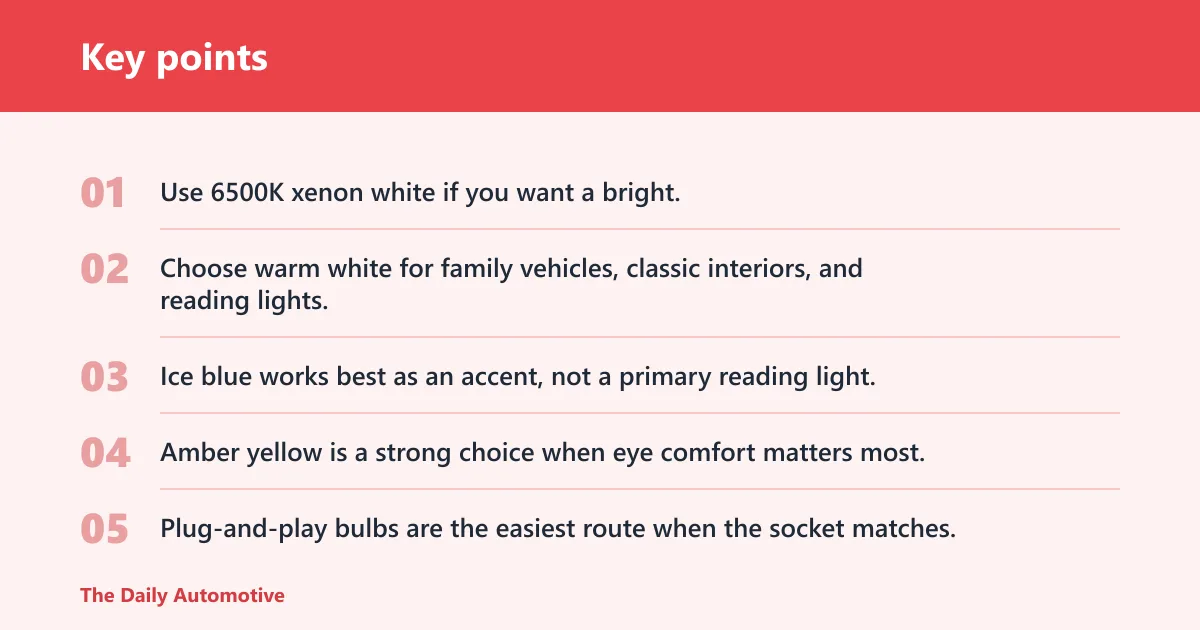
Use 6500K xenon white if you want a bright, crisp look and the cabin materials are already dark enough to handle it. Choose warm white for family vehicles, classic interiors, and reading lights. Natural white is the safest middle ground. Ice blue works best as an accent, not a primary reading light. Amber yellow is a strong choice when eye comfort matters most.
Plug-and-play, polarity alignment, magnetic mounting, USB rechargeable, adhesive mounting, screws, and wire connections
Plug-and-play bulbs are the easiest route when the socket matches. Some LEDs still need correct polarity alignment before they light. Magnetic mounting and USB rechargeable lights are useful when you want removable placement. Adhesive mounting, screws, and wire connections make sense for fixed fixtures, but they add install time and more points of failure.
When a permanent wired install beats a removable light
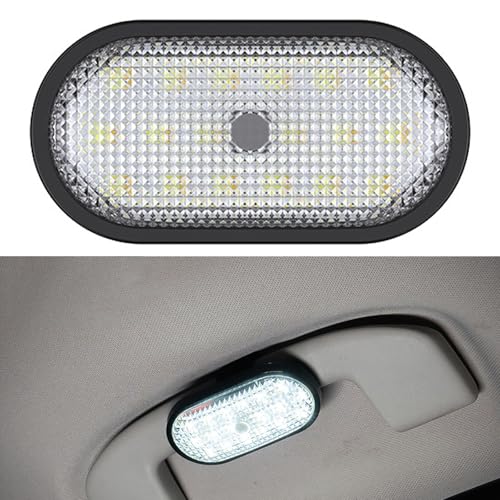
A permanent wired install is better when the light will be used every day, when charging upkeep would be annoying, or when the cabin needs a cleaner final look. Rechargeable magnetic lights are convenient, but they need battery attention. Ohleats is described as a magnetic, USB rechargeable ceiling light, and TYMXGHF uses a 400mAh battery and can run up to about 5 hours, which suits temporary use better than a primary cabin lamp.
Picture a camper that needs ceiling light after dark and again the next morning. A wired 550-lumen fixture is usually easier to live with than a removable battery light that needs regular charging.
Suppose a classic car owner wants subtle light for the dome area without cutting the original roof panel. A low-output bulb swap in a 31mm or 36mm socket is less invasive than an adhesive-mounted rechargeable unit that changes the interior look.
Frequently asked questions
What size dome light bulb do I need for my car?
Start by removing the lens and checking the base type, then measure the bulb if it is a festoon style. The right size depends on the socket and clip spacing, not the model year alone.
How do I know if a dome light kit will fit my vehicle?
Check socket size, lens depth, and clearance first. Then confirm whether you need a bulb kit, a direct replacement assembly, or a roof dome lamp. If the seller lists your exact socket family and vehicle segment, such as Toyota Tacoma or Nissan Frontier/NAVARA, the odds of a clean fit are better.
Should I buy a universal bulb kit or a vehicle-specific dome light assembly?
Choose a universal kit only if the socket size is confirmed and the housing has enough clearance. Choose a vehicle-specific assembly when warning-light risk, lens shape, or mounting depth makes the original housing hard to adapt. For many newer vehicles, the specific assembly is the safer buy.
Can I install a dome light myself without rewiring?
Yes, often you can if you are replacing only the bulb and the socket matches. Many bulb kits are plug-and-play, though some still need correct polarity alignment. If the job requires screws, wire connections, or a different fixture, expect a more involved install and verify the circuit before closing the lens.
Are rechargeable magnetic dome lights worth it?
They are worth it when you need temporary light, flexible placement, or a non-permanent setup in a camper, boat, or work area. They are less ideal as a primary cabin light because battery upkeep becomes part of ownership. For permanent use, a wired fixture is usually the cleaner choice.
Products related to this article
Sponsored / affiliate links. As an Amazon Associate I earn from qualifying purchases. I may earn additional commission from eligible campaigns.