Best Plastic Scrapers for Cars (2026): Based on Specs
The safest plastic scraper choice depends on the surface: use a soft, thin, straight-edge scraper for glass and adhesive, a rounded plastic razor for paint-safe decal work, and a wider, stiff blade for interior trim. Using the wrong edge can scratch glass, haze clear plastic, or lift paint and film. Choose the scraper that matches the residue and the panel, not a single tool for every job. This guide shows the best plastic scraper shapes for interior, glass, badge, decal, adhesive, and wrap jobs, plus which geometry fits each task.
Quick comparison
| Product | Badge | Best for | Price | ||
|---|---|---|---|---|---|
 |
CKAuto Non-Marring Super Grip Plastic Chisel Scraper, WheelCKAuto | Our pick | Nylon chisel scraper · red · high-impact | $9.99
Price as of 21 Oct 2026
|
View |
 |
FOSHIO 2PCS Orange Plastic Razor Blade Scraper Tool andFOSHIO | Also great | Plastic razor scraper · 100 blades · orange | $9.89
Price as of 21 Oct 2026
|
View |
The right choice changes with residue, not price. A thin plastic razor blade handles labels and adhesive better; a stiffer, wider scraper gives steadier control on trim and emblem residue.
How we chose
The picks and guidance here are based on four things: edge stiffness, blade width, corner access, and whether the tool uses replaceable blades or a fixed edge. Surface sensitivity matters just as much. Glass, soft-touch trim, piano-black panels, and PPF punish the same mistake: too much pressure at too steep an angle.
Manual control also matters. The bodyshop guidance says hand tools are better in tight corners, and paint scrapers can use replaceable blades, which makes blade condition part of the decision instead of an afterthought.
FOSHIO plastic razor blade scraper: best for mixed adhesive jobs
This is the better all-around choice for labels, sticker residue, and adhesive cleanup when you need the scraper to stay gentle on glass and trim. The 100 replacement plastic blades make it useful for repeat work, and the ergonomic handle helps keep pressure steady instead of sloppy.
What stands out is the replaceable-blade format. That matters because a worn edge starts dragging residue across the panel instead of lifting it cleanly. The drawback is that plastic razor blades are still a precision tool, not a force tool. On soft-touch plastics, piano-black trim, or wrap edges, the wrong angle can still leave a haze or lift a corner.
CKAuto plastic chisel scraper: best for trim cleanup
This fits jobs where you need more blade support and a firmer push, such as adhesive on door-card trim, badge glue near textured plastic, or wheel-weight cleanup. The high-impact nylon blade is meant to take abuse better than a thin disposable-style edge, and the baffle grip helps keep your hand from sliding forward.
The tradeoff is precision. A stiffer, chisel-like scraper can move residue faster, but it also raises the risk of marring soft-touch trim and leaving witness marks on gloss black surfaces. It is the stronger pick when you need control and durability, not the gentlest blade for fragile panels.
What is the best plastic scraper for car detailing?
A plastic razor blade scraper with a replaceable edge is often the best plastic scraper for car detailing, because it can handle labels and adhesive while staying less aggressive than metal. For trim and emblems, a stiffer fixed-edge scraper can be better. The best tool is the one that fits the residue and the panel sensitivity.
Think in terms of job, not one universal tool. A thin blade works best for narrow seams and sticker edges. A wider, stiffer edge works better when you need to keep the tool flat across a larger patch of trim or glue.
Plastic scraper types that matter
Plastic razor blade tools are commonly a safe starting point for paint-safe decal work, especially when used with adhesive remover. Fixed-edge scrapers are better when you want more rigidity and fewer blade changes. Credit-card-style tools are cheap and handy, but they flex too much for stubborn residue. Nylon wedges and trim tools are best for prying and lifting, not scraping clean adhesive.
A common first-timer mistake is using a soft, floppy card on a sticker that has baked on for years. The card bends, the edge chatters, and the panel gets rubbed more than the residue gets removed. A stiffer edge with a low angle usually solves that faster and with less abrasion.
Manual control versus powered removal
Manual scrapers win on control, especially at corners, around badges, and next to panel edges. Power tools move faster, but they are less forgiving on paint, clear coat, and wrap edges. If the surface has any risk of lift or haze, hand control is the safer default.
Speed matters less than the risk of one bad pass. A manual scraper lets you stop at the first sign of drag, which is useful when the residue changes from loose film to hard adhesive in the same job.
Are plastic scrapers safe on car paint?
Plastic scrapers can be safer than metal on paint and clear coat, but they are not automatically safe. Pressure, angle of attack, surface type, and whether you use lubricant or adhesive remover decide the result. A low angle with light pressure is the difference between lifting residue and leaving marks.
Use a plastic razor blade only when the residue needs it. For paint-safe decal work, soften the adhesive first with a suitable remover or gentle heat, then work the edge flat. If the residue starts to grab, stop and re-wet the area rather than pushing harder.
Use with adhesive remover
Adhesive remover works best after a short dwell time, not instantly. Let it sit long enough to soften the bond, then wipe the residue off with the scraper and a clean cloth. Always spot-test on plastic trim first, because some plastics and coatings react badly with solvents.
Suppose a badge adhesive ring is still hard after the first pass. Adding more pressure is the wrong move. A second application of remover, a short wait, and a flatter angle will usually reduce marring risk more than brute force ever will.
Which plastic scraper is best for stuck stickers on windows?
For stuck stickers on windows, a plastic razor blade scraper is often a good starting point because glass generally tolerates a sharper plastic edge better than soft interior trim does. Use a thin blade, keep the angle low, and pair it with adhesive remover or glass-safe lubricant. That combination helps the blade lift residue without dragging across the surface.
Glass edges and corners need special attention. Corner access is where a narrow blade helps most, but contamination risk also rises there because grit collects at the perimeter. Clean the area first, then scrape. A dirty edge can turn a sticker job into a scratch job.
Glass and windshield edges
Glass-safe scraping is about control, not force. A plastic blade can remove stickers from windows, but the windshield border, frit area, and lower corners often hold grit, old adhesive, and road film. If the edge is loaded with contamination, wipe it clean before scraping.
For tight corners, a manual scraper with a narrow working edge is easier to place than a wide one. The bodyshop guidance notes that hand scrapers help in tight corners, which is exactly where window work tends to go wrong.
How do I remove adhesive from car trim without scratching it?
Start with the softest edge that can still move the glue, then step up only if needed. On car trim, that usually means a plastic razor blade or a flexible scraper used with adhesive remover, short dwell time, and very light pressure. Soft-touch plastics and gloss black surfaces scratch or burnish quickly if the blade is too stiff.
Trim is where residue type matters most. Fresh sticker glue behaves differently from hardened emblem adhesive. If the panel is soft-touch, a wide stiff blade can leave a sheen line even when it does not cut through. Test first, then work in small passes and wipe often.
Interior trim risks
Soft-touch plastics, navigation screens, door cards, and dash inserts do not all behave the same. Gloss black surfaces show haze and micro-marring fast. Screens are especially sensitive and should generally be cleaned with the least aggressive method available, not a scraper unless the manufacturer specifically allows it.
For a dashboard insert with residue near a seam, a flexible edge is safer than a rigid chisel. For a thick adhesive patch on a door card, a stiffer blade can help, but only if the trim material is hard enough to tolerate it.
What scraper is safe for vinyl, PPF, and wrap edges?
For vinyl, PPF, and wrap edges, the safest scraper is a very low-angle plastic razor blade or a soft, rounded edge used only on the residue itself. Edge lift is the main risk, not just marring. If the blade catches a film edge, it can start a peel that spreads across the panel.
Keep the angle shallow and work away from the edge, not into it. Heat may help loosen adhesive, but too much heat can soften the film and make lifting easier. If the wrap edge is already loose, a scraper may be the wrong tool.
Exterior badges and decals
Badges and decals vary a lot in adhesive strength. Some come off with mild heat and a plastic razor blade; others leave thick glue that needs a remover and several passes. Panel material matters too. Painted metal, textured plastic, and film edges all respond differently to the same blade.
The goal is to lift the decal without biting into the substrate. That is why a rounded plastic razor is often better than a hard chisel on painted emblems. The rounded edge reduces the chance of gouging when the tool slips off a corner.
Fixed edge versus replaceable blade
Replaceable-blade tools are better when the job creates a lot of wear on the edge, such as label removal or repeated glass work. Fixed-edge scrapers are useful when you want one geometry and a consistent feel in hand. If the edge gets nicked, replace it instead of forcing it through another panel.
The bodyshop source notes that paint scrapers can use replaceable blades, which is a useful clue for detailing too. A clean edge cuts cleaner. A damaged edge drags residue and raises the chance of marring.
Detailing job decision table
This table maps common detailing jobs to the safest scraper profile, the right stiffness, the best angle, and the biggest failure risk. The last row in each job block tells you when to stop and use another method instead of forcing the blade.
| Detailing job | Safest scraper profile | Recommended edge stiffness | Ideal angle | Biggest failure risk | Do not use |
|---|---|---|---|---|---|
| Soft-touch interior trim adhesive | Plastic razor blade with rounded leading edge | Soft to medium | 10 to 20 degrees | Burnishing or sheen marks | Do not use a stiff chisel blade on textured soft-touch trim. |
| Gloss black console residue | Thin plastic razor blade | Soft | 10 to 15 degrees | Micro-marring and haze | Do not use a wide, rigid scraper that bridges and rubs the panel. |
| Window sticker removal | Thin plastic razor blade for glass | Medium | 15 to 20 degrees | Grit-related scratching at the edge | Do not use a dirty blade on the windshield border or lower corner. |
| Badge glue on painted panel | Rounded plastic razor blade with remover | Medium | 10 to 20 degrees | Clear coat scratching from a caught edge | Do not use metal, and do not pry under the emblem base. |
| PPF or vinyl wrap edge cleanup | Very thin plastic razor blade | Soft | 5 to 10 degrees | Edge lift and film tear | Do not use a chisel-style edge that pushes toward the film seam. |
| Hard adhesive on textured exterior trim | Stiffer nylon scraper with controlled width | Medium to stiff | 15 to 25 degrees | Scuffing high spots and corners | Do not use a floppy card that flexes and rubs the same spot repeatedly. |
How to choose the right scraper
Match rigidity to surface sensitivity first, then choose width for access. Thin blades work best in seams, corners, and around badge edges. Wider blades cover more area on trim, but they are less precise in tight spaces. If the surface is delicate, keep the blade soft and the angle low.
Use adhesive remover before you reach for more force. Most removers need a short dwell time before the residue softens enough to lift cleanly. Heat can help, but only enough to loosen the bond. Too much heat can make trim softer and wrap edges more vulnerable.
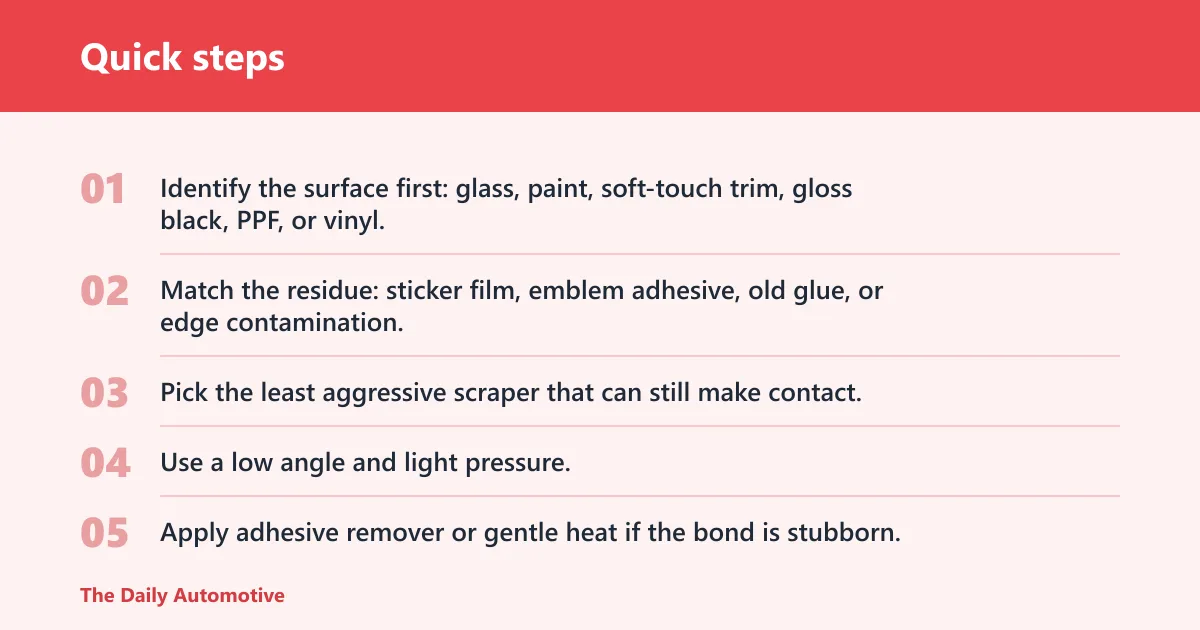
- Identify the surface first: glass, paint, soft-touch trim, gloss black, PPF, or vinyl.
- Match the residue: sticker film, emblem adhesive, old glue, or edge contamination.
- Pick the least aggressive scraper that can still make contact.
- Use a low angle and light pressure.
- Apply adhesive remover or gentle heat if the bond is stubborn.
- Stop if the edge starts to chatter, snag, or leave a haze.
Say your door card has a sticker ring that will not budge after one pass. A softer blade with remover is the better move than a harder scraper, because the panel is more likely to mark than the glue is to fail. Suppose the same adhesive is on a rear window instead. A thin plastic razor blade and careful corner cleaning become the safer choice.
Maintenance matters too. Wipe the blade after each use so residue does not harden on the edge. Replace or resharpen damaged plastic blades if the tool supports it. A nicked edge is more likely to scratch than a clean one, and a dirty edge can smear adhesive back onto the panel.
The detailing accessories pages also point to related tools, including a product for precise measuring and applicators for wax, sealant, and plastic dressing. Those items are not scrapers, but they matter because clean prep and careful post-cleanup reduce the chance of overworking the panel with the wrong tool.
Which one should you buy?
Buy the FOSHIO plastic razor blade scraper if you want the most useful starting point for mixed detailing work, especially stickers, glass, and adhesive cleanup. Buy the CKAuto nylon chisel scraper if your main job is firmer trim residue and you want a tougher, more controlled edge. Neither tool should be treated as universal.
If your work is mostly windows and decals, prioritize a replaceable plastic razor blade. If you deal more with emblem glue and trim cleanup, prioritize stiffness and grip. For wrap edges and PPF, pick the gentlest edge you can manage and stay at a low angle. The category page also lists three ice scraper products for winter use, including a 60-inch telescoping model, one with a one-touch pivoting head, a 25-inch model sold in a pack of two, and a Rain-X scraper that extends to 50 inches. Those lengths are for winter use, not detailing, but they show how geometry and reach change the job.
Frequently asked questions
What size plastic scraper should I use for detailing?
Use the narrowest scraper that still covers the job cleanly. Small blades help with corners, seams, and emblem edges. Wider blades are better for flat trim sections, but they are less precise near delicate borders. Size should follow access first and coverage second.
Can I use a plastic scraper on car glass?
Yes, a plastic scraper can be used on car glass for sticker removal and adhesive cleanup. Keep the glass clean, use a shallow angle, and avoid dragging grit across the surface. Windshield edges and lower corners deserve extra caution because contamination collects there.
What tool removes emblems and glue without damaging trim?
A rounded plastic razor blade with adhesive remover is usually the best starting point for emblem glue. It offers enough edge to lift residue while reducing the chance of gouging the panel. Do not pry under the emblem base with a hard edge, and stop if the trim begins to haze or flex.
Products related to this article
Sponsored / affiliate links. As an Amazon Associate I earn from qualifying purchases. I may earn additional commission from eligible campaigns.