3 Best Truck Bed Covers for Trucks (2026): We Compared
For most truck owners, a hard tri-fold cover is the best all-around pick because it balances security, weather protection, and day-to-day use better than a soft roll-up or a premium low-profile fold. Pick the wrong style, and you can end up with leaks, rattles, warped panels, or a cover that no longer fits after one season. This guide ranks three cover types, explains fitment traps, and compares weather protection, security, access, and everyday convenience.
Quick comparison
| Product | Badge | Best for | Price | ||
|---|---|---|---|---|---|
 |
SAMNOVERA Retractable Hard Tonneau Cover with RackSAMNOVERA | Our pick | $1,368.43
Price as of 23 Oct 2026
|
View | |
 |
Truck Bed Tonneau Cover Lock Pop-up T-Handle Clockwise withTECHVALET | Also great | $110.00
Price as of 23 Oct 2026
|
View | |
 |
Gator EFX Hard Tri-Fold Truck Bed Tonneau Cover –Gator | Also great | $599.00
Price as of 23 Oct 2026
|
View |
The main trade-off is plain: soft roll-up covers give you the easiest full-bed access, hard tri-fold covers give you the strongest theft deterrence for the money, and low-profile quad-fold covers lean toward cleaner looks and better access around the open panels. The right choice depends less on brand loyalty than on bed length, rail fit, climate, and how often you need the bed fully open.
Truck bed cover decision matrix
| Buyer scenario | Soft roll-up | Hard tri-fold | Low-profile quad-fold | Best pick | One-line recommendation |
|---|---|---|---|---|---|
| Daily weather protection | 3/5 | 4/5 | 4/5 | Hard tri-fold | Choose a hard tri-fold if you want the best mix of sealing and routine protection without moving to a full hard-shell setup. |
| Theft deterrence | 2/5 | 5/5 | 4/5 | Hard tri-fold | Pick a hard tri-fold when lock strength and panel rigidity matter more than low weight or low price. |
| Full bed access | 5/5 | 3/5 | 4/5 | Soft roll-up | Choose soft roll-up if you remove cargo often and want the bed open with the fewest steps. |
| Winter use | 3/5 | 4/5 | 4/5 | Hard tri-fold | Go hard tri-fold for colder climates because panel structure and latch security usually hold up better than vinyl tension. |
| Jobsite durability | 2/5 | 5/5 | 4/5 | Hard tri-fold | Pick hard panels if tools, lumber, and repeated loading are part of the routine. |
| Install difficulty | 5/5 | 4/5 | 3/5 | Soft roll-up | Choose soft roll-up when you want the shortest clamp-on install and the fewest moving parts. |
| Removal frequency | 5/5 | 4/5 | 3/5 | Soft roll-up | Pick soft roll-up if you expect to remove or stow the cover often. |
That matrix reflects the practical differences buyers feel after month six, not just on day one. The weak points usually show up at the rails, at the latch, and at the folds, where bad fitment turns into water intrusion, rattles, or binding.
How we chose
The comparison centers on fitment, sealing, security, access, and long-term durability. One widely used method stresses seal quality across the bed edges and lock mechanism integrity under repeated cycling, and those are the right failure points to watch.
Two other checks matter: bed-length fit and climate behavior. Popular Mechanics notes that bed lengths vary by trim level, and that matters because a cover can miss by inches even within the same truck nameplate.
We also weighed ownership cost in a practical way. That includes return risk, warranty headaches, and accessory compatibility with bed rails, tie-downs, and toolboxes, because a cheap cover that interferes with your setup is not actually cheap.
Soft roll-up cover: best for budget use
A soft roll-up cover fits buyers who want low cost, full bed access, and a simple clamp-on setup. Based on published product details and buyer feedback, the appeal is direct: vinyl construction, quick roll-back access, and no-drill installation help when you use the bed often and do not need hard-panel security.
Its weakness is clear. Vinyl can contract in cold weather, edge seals can loosen over time, and repeated UV exposure can leave the material looking tired long before a hard cover would show the same wear.
That makes this style best for milder climates, lighter cargo, and owners who accept that weather protection is good rather than top tier. It is also the easiest style to remove if you need occasional tall cargo clearance.
A common first-timer mistake is buying a soft roll-up for a truck with a bed cap or toolbox already mounted, then finding the rails conflict with the clamps or the rolled cover blocks the rear edge of the box. Measure the rail height and clearance before ordering.
Where it leaks or loosens
The usual leak points are the tailgate seam, the front bulkhead seal, and the outer rail edge. If the rails sit unevenly or the clamps are not tightened evenly, water can work under the cover during steady rain or highway spray.
Cold weather can also change tension. Vinyl shrinks, the cover loosens at the side rails, and that slack can cause flutter at speed. If the cover rattles, the first place to check is clamp tension and side-rail alignment.
Best fitment and use case
This style fits best on a truck with a clean bed rail, no bulkhead-mounted toolbox, and a driver who values full access more than hard security. It also makes sense for owners who regularly stack cargo above rail height because the rolled cover gets out of the way fast.
Hard tri-fold cover: best for security
A hard tri-fold is the best choice when security matters most. With locking hard panels and a rigid build, this style usually resists casual theft better than vinyl, and the published product details for this Gator cover point to durable aluminum panels and a heavy-duty build.
It is also a better fit for owners who need some load-bearing ability. Hard panels can handle more abuse from tools, gear, and weather than a soft cover, though the exact weight limit still depends on the design and the truck’s rail structure.
The drawback is convenience. Tri-fold panels can block part of the bed opening when folded, and repeated hinge cycling is a real wear point over time. If the tailgate seal is weak or the rail fit is off, water can still creep in despite the hard shell.
The price also matters. This type can cost materially more than a soft cover, and the version listed here is priced at $599.00. That is not budget territory, but the added rigidity can be worth it if theft deterrence is part of the decision.
Locking panels and theft deterrence
Hard panels do the heavy lifting here. A tailgate lock helps, but the real advantage comes from the rigid lid and center clasp design that resist casual prying better than vinyl ever can.
That said, no cover turns a bed into a safe. A determined thief can still exploit weak latch points, poor rail fit, or a tailgate that does not close tightly.
Load-bearing limits and removability
Hard tri-folds usually handle more cargo pressure than soft covers, but they are not a substitute for a rack or cargo bar. They are best treated as a protective cap, not a storage platform unless the maker clearly rates them for it.
Removal is still manageable, but it takes more effort than a soft roll-up. If you plan to remove the cover often, the extra weight and panel handling will matter.
Winter and jobsite tradeoffs
Hard panels are better than vinyl in snow, slush, and repeated freeze-thaw cycles, but hinges and seals still need attention. In winter, the common failure is not panel strength. It is ice at the seal line or a latch that becomes stiff after repeated cold exposure.
For jobsite use, the hard tri-fold is the safer all-rounder. It tolerates more abrasion, better resists shifting cargo, and usually keeps shape better than a soft cover when the bed is loaded and unloaded all day.
Low-profile quad-fold cover: best for premium access
A low-profile quad-fold is the style to consider when you want a flush-mounted look, better aerodynamics, and easier cargo access than a traditional hard fold. It usually sits closer to the bed rails, which helps the truck look cleaner and can improve visibility when the panels are folded open.
That profile comes at a price. Quad-fold designs often cost more, and their multiple hinges add more points where wear can build up if the cover is cycled constantly or left in harsh sun for long periods.
Because this article is ranking by use case, this category is the best premium compromise, not the cheapest answer. A competitor source from Truck Gear Nation says it ranked a low-profile quad-fold as best overall, while also separating best-value and best-security picks by dry factor, install factor, and wallet factor.
The 2026 comparison pages also show how wide the pricing spread can be. One top pick costs $143.99, while a hard tri-fold appears at $431.96 on one list and another hard fold option at $399.99 on another. The gap is a reminder that materials and fit details drive the bill as much as the folding style.
Flush profile and aerodynamics
This style appeals to buyers who care about a lower visual profile and cleaner rail line. The lower sit can reduce the chance of snagging cargo along the bed edge and may help airflow slightly, though any fuel-economy gain should be treated as modest rather than dramatic.
If the cover sits flush but the rails are misaligned, the look can fool you. A good-looking install that leaks at the front seal is still a poor install.
Visibility when open
When folded, quad-panel covers can give a better balance between open-bed access and partial coverage than a two-panel design. That makes them useful for owners who keep cargo close to the cab but still need frequent access to the rear half of the bed.
For tall cargo, the open-panel stack may still get in the way. If you haul appliances, furniture, or a dirt bike, a soft roll-up or full removal may be easier.
When the extra price makes sense
Spend more for a low-profile quad-fold when appearance, low drag, and frequent partial access matter together. It is a stronger fit for newer trucks with better rail integration and owners who want hard-cover security without a bulky look.
Which truck bed cover should you buy?
The right answer depends on what you carry and how often you open the bed. Choose soft roll-up if budget and full access matter most. Choose hard tri-fold if security, winter use, or jobsite durability matter more. Choose low-profile quad-fold if you want a cleaner look and a premium balance of access and protection.
Choose by budget
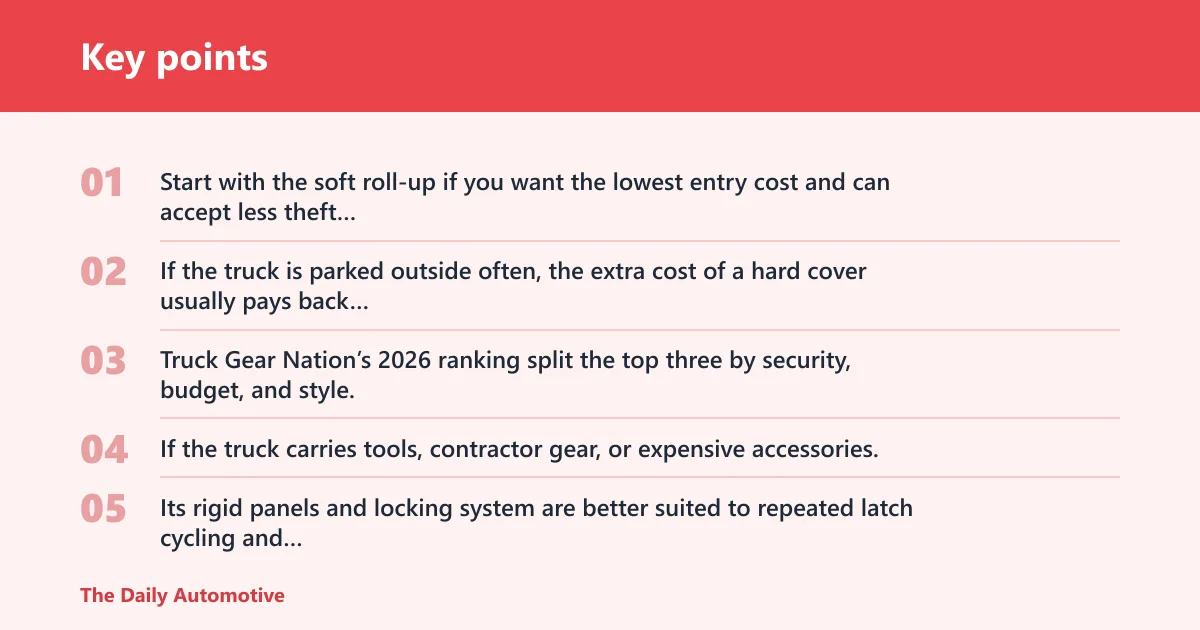
Start with the soft roll-up if you want the lowest entry cost and can accept less theft deterrence. If the truck is parked outside often, the extra cost of a hard cover usually pays back in better security and better shape retention.
Truck Gear Nation’s 2026 ranking split the top three by security, budget, and style, which is the right way to think about it. Budget buyers get one answer. Security buyers get another.
Choose by security need
If the truck carries tools, contractor gear, or expensive accessories, start with a hard tri-fold. Its rigid panels and locking system are better suited to repeated latch cycling and casual tamper resistance than a soft cover.
For the strongest theft deterrence, the lock mechanism matters as much as the panel material. A weak latch with a hard shell is still a weak latch.
Choose by cargo height and access
If you often carry tall cargo or need the full bed open without fuss, the soft roll-up is the simplest answer. The low-profile quad-fold is the middle ground when you want partial coverage without giving up too much access.
Picture a contractor loading 8-foot trim boards on Monday and a camping setup on Friday. A soft roll-up is easier to clear out, but a hard tri-fold is better if the truck also sits overnight with tools in the bed.
Choose by climate and use pattern
Hot sun, repeated freeze-thaw cycles, and steady rain change the choice. Vinyl shrinkage, UV fade, seal shrinkage, and freezing hinges all become more important in harsher climates, which is why fit and material longevity matter as much as the badge on the box.
Say your truck lives in a snowy area and you open the bed every morning. A hard cover is usually the safer call because it keeps its shape better, even if the seals still need periodic checks.
What should you check before ordering?
Before you order any tonneau cover, confirm bed length, rail height, tailgate style, exact bulkhead-to-tailgate measurement, and toolbox clearance. Those five checks prevent most return headaches, because a cover can be right for the truck model and still be wrong for the actual bed configuration.
Bed length and exact measurement
Do not rely on the trim name alone. Bed lengths vary by trim level, and full-size trucks often come in 5.5-foot short bed, 6.5-foot standard bed, and 8-foot long bed layouts.
Measure from the bulkhead to the inside edge of the closed tailgate. That exact number matters more than the badge on the tailgate.
- Open the tailgate and measure from the front bulkhead to the tailgate edge.
- Check whether the truck has a short, standard, or long bed.
- Confirm the cover is vehicle-specific for that exact bed length.
- Verify whether the cover is meant for rails with or without factory bed caps.
Rail height and tailgate style
Rail height changes how a cover seals and whether the clamps sit flat. If the rails are too tall or shaped differently from the cover’s design, you may get gaps, rattle, or a lid that does not sit square.
Tailgate style matters just as much. Some tailgates have a stamped edge or a liner that changes how the rear seal closes, and that is where many water intrusion complaints start.
Toolbox and accessory interference
If you already have a cross-bed toolbox, bed rack, tie-down system, or cargo divider, check for interference before buying. A cover that collides with an accessory is a bad fit even if the rails line up.
Toolbox interference is especially common with soft roll-up designs and some hard folding covers because the front rail, folded stack, or clamp placement can block the box lid.
Cold-weather fit and seal tension
Ask how the cover behaves when temperatures fall. Cold-weather tension loss is a real complaint on vinyl covers, and hard covers can also get sticky at the hinges or latches if the tolerances are tight.
Look for bed-edge sealing that stays flat after repeated cycling. A cover that fits well in warm weather but gaps in cold weather is a seasonal problem waiting to happen.
Frequently asked questions
What is the best truck bed cover?
For most buyers, the best truck bed cover is a hard tri-fold because it gives the strongest balance of security, weather resistance, and daily usability. If your top priority is easy full-bed access, a soft roll-up is simpler. If you want a cleaner premium look, a low-profile quad-fold is the better fit.
Which truck bed cover is best for security?
A hard tri-fold is usually the best choice for security because rigid panels and locking hardware deter casual tampering better than vinyl. The lock mechanism still matters, though. Weak rail fit, poor tailgate closure, or a flimsy latch can reduce the benefit even on a hard cover.
Should I choose a soft or hard truck bed cover?
Choose soft if you want the lowest cost and the easiest full-bed access. Choose hard if you care more about theft deterrence, shape retention, and winter durability. If your truck lives outside or carries tools, hard usually makes more sense. If the bed is open often, soft may be enough.
Do truck bed covers actually improve fuel economy?
They can, but the gain is usually modest and depends on speed, truck shape, and how well the cover fits. Do not buy one for fuel savings alone. Think of any improvement as a small side benefit, not the main reason to spend on a cover.
How do I measure my truck bed for a cover?
Measure from the bulkhead to the inside edge of the closed tailgate, then confirm the truck’s bed length category. That exact measurement matters more than the model name. Also check rail height, tailgate shape, and any toolbox or rack that could change the fit.
Are expensive hard truck bed covers worth it?
They are worth it if you need better theft deterrence, stronger materials, or better resistance to weather and repeated use. If you only want light weather protection and full access, the extra cost may not be justified. Price alone is not the best measure of value.
Can I install a truck bed cover myself?
Usually yes, especially with no-drill clamp-on designs. A typical install target is about 30 minutes, but that depends on rail fit, accessory interference, and how much adjustment the cover needs. Keep basic hand tools ready and expect a second pass on alignment.
What should I check before ordering a tonneau cover?
Check bed length, rail height, tailgate style, exact bulkhead-to-tailgate measurement, and toolbox clearance. Then confirm the cover matches your truck’s exact bed configuration. Those checks prevent most returns, especially on trucks where trim level changes the bed dimensions or accessory fit.
What is the difference between tri-fold and quad-fold covers?
A tri-fold uses three large sections and is usually simpler, heavier, and easier to understand at the latch point. A quad-fold uses four panels, often sits lower, and can offer better partial-open access. The tradeoff is more hinges, more moving parts, and more long-term wear points.
Products related to this article
Sponsored / affiliate links. As an Amazon Associate I earn from qualifying purchases. I may earn additional commission from eligible campaigns.