Best Fan for Sleeping in a Car (Safe, No Engine Idling)
The best fan for sleeping in a car is a quiet rechargeable clip fan or USB fan with 360-degree adjustment, multiple speed settings, and enough runtime for the full night from a power bank or auxiliary battery. Weak airflow can leave you hot, sweaty, and awake, and poor power choices can drain the starter battery or create wiring risk. This guide matches fan type to your sleep setup, then covers noise, power source, runtime, and battery safety.
Quick comparison
| Product | Badge | Best for | Price | ||
|---|---|---|---|---|---|
 |
QIFUN Car Fan Adjustable Dual Head 12V 360° Rotatable 4QIFUN | Our pick | 4-inch · 12V · dual-head car fan | $27.99
Price as of 30 Oct 2026
|
View |
 |
ADUST Camping Fan Battery Powered 20000mAh Outdoor TentADUST | Also great | 20000mAh · rechargeable · camping fan | $39.99
Price as of 30 Oct 2026
|
View |
 |
Camping Fan Rechargeable – 20000mAh Cordless BatteryDABOUHORS | Pair with it | 20000mAh · cordless · tent fan | $31.69
Price as of 30 Oct 2026
|
View |
The default pick for most sleepers is a rechargeable battery fan because it avoids car-battery draw and moves with the sleeper. If you already carry a power station, a USB-powered fan can be the better long-trip setup.
How we chose
We compared manufacturer specs, listing details, and published buyer feedback. The filters were runtime, mounting method, noise claims, power source, and whether the fan fits a parked car without needing to idle.
We also weighed safety notes that matter overnight: car-battery drain, cracked-window airflow, bug control, and whether the fan can stay in place when the vehicle shifts or a sleeper rolls over.
One more check mattered: the fan had to make practical airflow, not just stir air inside a sealed metal box with limited air exchange.
QIFUN Car Fan: best for continuous 12V power
This QIFUN dual-head clip fan fits sleepers who plan to use the vehicle’s 12V socket while parked for short periods or while the engine is running. The clamp, 360° rotation, and broader airflow from dual heads make it a straightforward choice for front-seat or rear-seat placement in SUVs and RVs.
The drawback is the same one that comes with most 12V plug-in fans: if you leave it on all night in a parked car, it can pull from the vehicle battery. That makes it a poor match for long overnight sleeping unless you have a separate power source or a very specific vehicle setup.
ADUST camping fan: best for portable battery power
This ADUST rechargeable fan is the strongest fit for most car sleepers because it runs cordless, includes a large 20000mAh battery, and adds timer, oscillation, remote control, hanging hook, and built-in light. Based on the manufacturer’s specs and published buyer feedback, it suits sleepers who want the fan beside the mattress, on a seatback, or hanging from a grab point.
The honest tradeoff is size and recharge planning. A large internal battery usually means more flexibility, but you still need to charge it between nights, and oscillation or higher speeds shorten runtime compared with low-speed use. As a cordless fan, it is easiest to position, not the lightest option to pack.
DABOUHORS camping fan: best for longer cordless trips
This DABOUHORS rechargeable fan fits road-trippers who want a cordless fan with a 20000mAh battery, oscillation, timer settings, and a built-in LED light. It works well when you need portable placement in a car, SUV, or tent and do not want to depend on the vehicle battery overnight.
The drawback is the same one that applies to many battery fans with added features: oscillation, light use, and higher speed settings can cut into runtime. If the goal is a silent, all-night setup, you still need to verify the battery life claimed for the exact speed you plan to use.
Which one should you buy?
If you sleep in a parked car most nights, start with the rechargeable battery fan. It is the simplest way to avoid car-battery drain, and rechargeable internal batteries provide the most flexibility.
If you already carry a power station, a USB fan becomes more attractive because it can run from that external battery instead of the car’s starter battery. If your plan is short stops with the engine on, the 12V clip fan is the simplest fit. For cracked-window airflow, a window-mounted setup works best when you can mount it securely and keep bugs out.
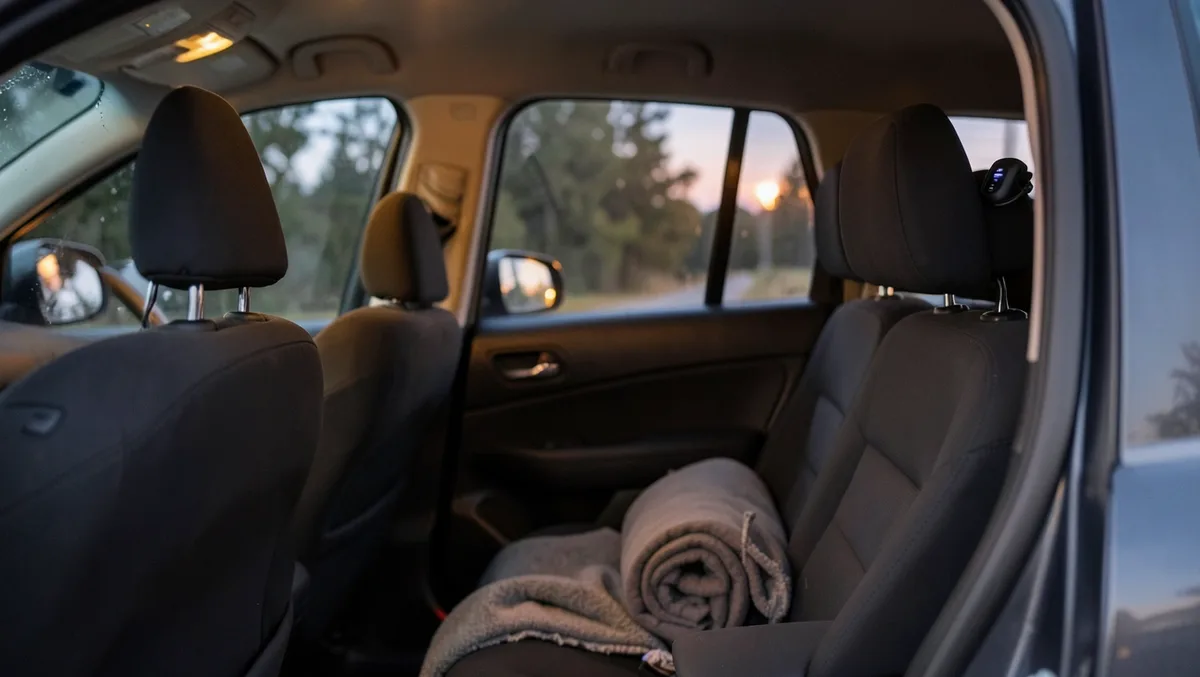
Say your SUV has rear windows cracked an inch and you sleep on the folded cargo floor. A clip-on rechargeable fan can point air toward your face while a window screen keeps insects out. That is a cleaner setup than trying to run a 12V fan from the car socket for eight hours.
Suppose you road-trip in a hatchback and carry a portable power station. A USB fan can be the better call because runtime depends on the external battery you already own, not the vehicle battery you need to start the car in the morning.
Rechargeable battery fan: best for portability
A rechargeable battery fan is the default pick for most sleepers because it can move with you, does not depend on the car socket, and avoids the starter-battery risk that comes with all-night plug-in use. The most useful listing details are built-in battery capacity, USB-C or USB charging, a stable clamp or base, and a noise rating below 40 decibels.
Check for a brushless motor if you are noise-sensitive. Brushless designs usually sound smoother than brushed motors, and that matters when airflow is close to your head in a quiet cabin.
What to verify before you buy
- Built-in battery capacity and claimed runtime at low speed.
- USB-C or USB charging, plus how long a full recharge takes.
- Mounting method: clamp, hook, stand, or seatback placement.
- Noise rating. The sleep-friendly threshold is below 40 decibels.
- Whether the fan has a brushless motor for quieter operation.
Who should skip it?
Skip a rechargeable fan if you need unlimited runtime without charging, or if you do not want to manage battery level between trips. It is also the wrong pick if the fan’s shape makes it unstable on your seat or dash.
USB-powered fan: best for longer trips
A USB-powered fan is the better choice when you already use a power bank or portable power station. Its runtime depends on the external battery capacity, so it can be a practical long-trip solution without touching the vehicle battery.
That flexibility is the main reason many car campers prefer USB power over 12V plug-in use. A portable power station keeps the starter battery separate from the sleep setup, which is safer for overnight parking.
Power bank versus portable power station
A power bank can handle smaller USB fans for shorter runtime targets. A portable power station is the better match when you want longer overnight use, multiple charge ports, or a more stable power source for the fan and a carbon monoxide detector.
Do not assume any USB fan will run all night just because it has a USB plug. Runtime depends on the fan setting and the capacity of the battery feeding it.
12V cigarette-lighter fan: best for continuous power
A 12V cigarette-lighter fan makes sense when you have a short parking stop, a setup that keeps the engine running, or a vehicle accessory plan built around continuous power. Continuous use while plugged in is the main selling point.
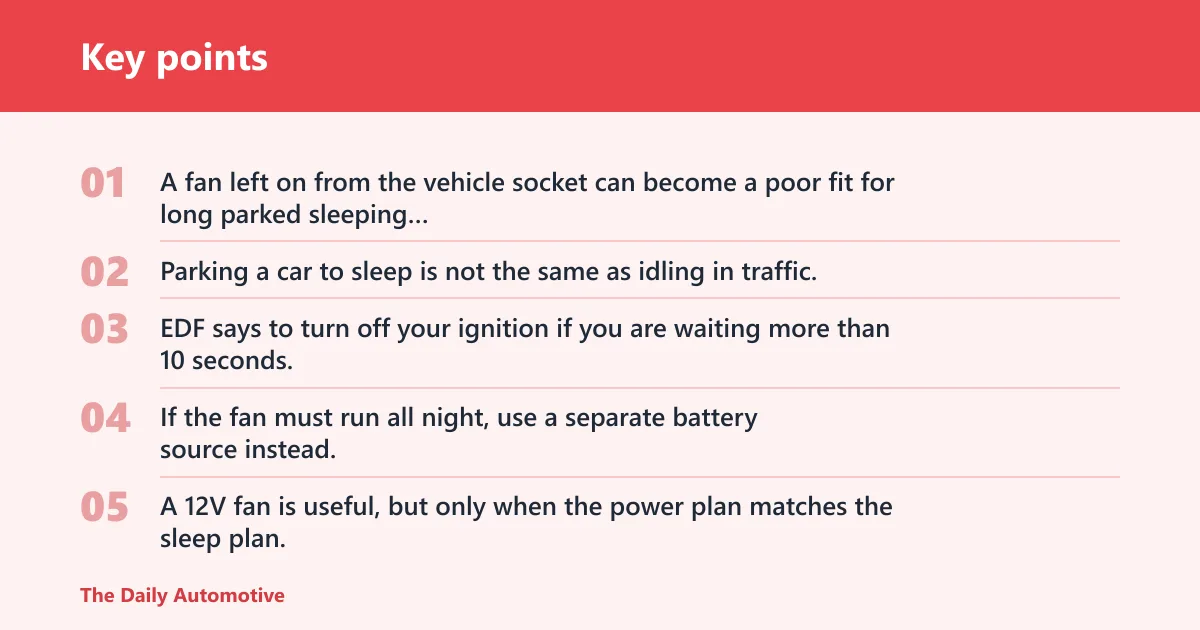
The problem is overnight battery drain. A fan left on from the vehicle socket can become a poor fit for long parked sleeping because it draws on the car battery unless the engine is running or you have a separate supply.
Why battery drain matters overnight
Parking a car to sleep is not the same as idling in traffic. EDF says to turn off your ignition if you are waiting more than 10 seconds, and that same logic points away from long engine-idling just to power a fan. If the fan must run all night, use a separate battery source instead.
A 12V fan is useful, but only when the power plan matches the sleep plan. If the fan is your only cooling strategy and the car sits still for hours, battery risk moves to the top of the list.
Window-mounted fan: best for cracked windows
A window-mounted fan is the best fit when you want cracked-window airflow and a more directed path for fresh air. Suction or clip mounting lets the fan sit where it can move air across the cabin instead of just stirring the same pocket of warm air.
This setup works best with cross-ventilation through the vehicle. A fan should create cross-ventilation through the vehicle, not just blow at one spot, and a window screen or bug screen helps you keep the window cracked without inviting insects in.
Why mounting matters
If the fan shifts during sleep, airflow changes and noise often gets worse. That is especially true when a fan vibrates against trim or a loose clamp starts tapping as the vehicle cools overnight.
Window-mounted fans also depend on a secure seal around the mount. Poor placement can let air leak where you do not want it and reduce the benefit of the cracked window.
Car sleep fan decision matrix
| Option | Power source | Mounting method | Runtime target | Noise target | Battery-drain risk | Best use case | Do not buy if |
|---|---|---|---|---|---|---|---|
| Rechargeable battery fan | Built-in battery, usually USB-C or USB charging | Clip, hook, or portable base | All-night low-speed use if the battery rating supports it | Below 40 decibels | Low, because it does not need the starter battery | Most car sleepers who want the simplest engine-off setup | You need unlimited runtime or do not want to recharge between trips. |
| USB-powered fan | Power bank or portable power station | Clip, stand, or hanging hook | Depends on the external battery capacity | Below 40 decibels | Low if you avoid the vehicle battery | Longer trips with a separate battery source | You do not carry a suitable external battery. |
| 12V cigarette-lighter fan | Vehicle socket | Clip or dashboard/cabin mount | Continuous while plugged in | Below 40 decibels if the listing says so | Higher, because parked use can draw on the car battery | Short stops or setups with continuous power | You plan to sleep all night with the engine off and no separate power source. |
| Window-mounted fan | Battery, USB, or 12V depending on model | Suction or clip mounting at the window | Nightlong cross-ventilation through cracked windows | Below 40 decibels | Depends on the power source used | Cracked-window airflow with bug control | Your windows cannot hold a secure mount or a bug screen. |
How do you choose the right setup?
The right fan depends on three things: how you power it, where it mounts, and how much noise you can tolerate near your head. If you want the simplest answer, a rechargeable battery fan is the default pick. If you already own a power station, a USB fan is usually the cleaner fit for longer trips.
Check the listing for decibel rating, and compare like-for-like. A fan that advertises a quiet low-speed mode is more useful than a vague “silent” claim, because sleep-friendly noise is below 40 decibels.
Also check airflow direction. A fan that can aim across the cabin is better than one that only stirs a small pocket of air. That matters in a sealed metal box with limited air exchange.
Use a real ventilation plan
Sleeping in a car without engine idling means you need fresh-air exchange, not just fan noise. Carbon dioxide buildup is the sealed-vehicle sleep risk to plan around, and it can bring morning headaches, fatigue, and reduced cognitive performance. Cracked windows help only when the setup actually moves air through the cabin.
Carbon monoxide is a separate danger. A carbon monoxide detector is a smart companion device for overnight vehicle sleeping, especially if any part of the setup involves the engine, fuel-burning equipment, or nearby exhaust exposure.
Window screens or bug screens matter because they let you keep the window cracked without handing the cabin to insects. They also help reduce the common first-night mistake of opening a window and discovering that airflow improved but bugs did too.
Condensation can build up on cool glass when warm breath and outside air meet. A fan can help move that moisture, but only if the airflow is directed and the window opening supports exchange.
How do I keep a car cool overnight while sleeping inside?
You keep a car cooler overnight by combining airflow, cracked windows, and a fan that moves air through the cabin instead of into one spot. The safest engine-off setup pairs a quiet battery or USB fan with one or two cracked windows, plus a screen to stop bugs and a carbon monoxide detector for overnight safety.
Do not rely on cracked windows alone. A car is a sealed metal box with limited air exchange, so the goal is continuous movement of outside air through the vehicle, not just a small opening.
Is it safe to sleep in a car with the windows cracked and a fan?
It can be safer than sleeping in a fully sealed car, but it is not automatically safe. A fan helps only if it supports cross-ventilation and the setup keeps fresh air moving in and stale air moving out. You still need to think about carbon dioxide buildup, carbon monoxide exposure, bugs, and a secure mounting point.
If the window is cracked without a screen, insects can become the first problem. If the fan is loose, vibration noise can wake you. If the airflow is weak, the cabin may still feel stuffy by morning.
Do I need a battery fan or a USB fan for car camping?
Choose a battery fan if you want the easiest cordless setup and the least dependence on outside power. Choose a USB fan if you already carry a power bank or portable power station and want runtime tied to that external battery instead of the fan’s own internal pack.
For many sleepers, rechargeable internal batteries provide the most flexibility. For longer trips, USB power can be better because you can size the battery source to the trip.
How many hours should a car sleeping fan run overnight?
It should run long enough to cover your sleep window at the lowest practical speed, with some margin for warm conditions and battery aging. A fan marketed with overnight runtime is only useful if that runtime applies to the speed you can actually sleep beside.
The practical target is not a fixed number for every car. It depends on battery capacity, fan speed, oscillation, and how much airflow your setup needs to keep the cabin from feeling stale.
What fan noise level is quiet enough to sleep in a car?
A sleep-friendly target is below 40 decibels. That threshold is useful because it gives you a concrete spec to verify in a listing instead of guessing from marketing language. For light sleepers, a brushless motor is worth looking for because it usually sounds smoother than a brushed motor.
Compare the same speed setting across products when possible. A low-speed claim means little if the listing does not say what noise level goes with it.
Can a fan drain a car battery if I leave it plugged in all night?
Yes. A 12V cigarette-lighter fan can draw on the vehicle battery when the car is parked, and that is why it is a poor fit for long overnight sleeping without another power source. If you need all-night airflow, use a rechargeable fan, a USB fan with a power bank or portable power station, or a separate auxiliary battery.
The safe habit is simple: do not treat the starter battery as a sleep battery. It should be there to start the car in the morning.
What kind of fan works best with car window screens?
A window-mounted fan works best with car window screens because it supports cracked-window cross-ventilation while the screen keeps bugs out. A clip or suction mount also helps keep the fan positioned where it can move air across the cabin instead of just into the glass.
If the screen is loose or the mount is unstable, the setup falls apart fast. The fan can shift, the airflow can bounce back, and the noise can climb.
How do I ventilate a car at night without attracting bugs?
Use cracked windows with a bug screen or window screen, then pair them with a fan that pulls fresh air through the cabin. That gives you airflow without leaving a wide-open gap for insects. A window-mounted fan or a clip fan aimed across the car usually works better than an unfocused fan on the floor.
A common first-timer mistake is opening a rear window and skipping the screen. The air improves, but the cabin becomes a bug trap by midnight.
Do I need a carbon monoxide detector if I sleep in my car?
Yes, it is a wise companion device for overnight vehicle sleeping. Carbon monoxide is different from carbon dioxide buildup, and a fan does not make either one irrelevant. A detector is especially important if any part of the night involves the engine, nearby exhaust, or fuel-burning equipment.
Fresh-air exchange helps with stale air and carbon dioxide. It does not replace a detector when carbon monoxide risk is on the table.
Frequently asked questions
What is the best fan for sleeping in a car without running the engine?
The best choice is usually a quiet rechargeable clip fan, especially one with a brushless motor, a stable mount, and a listed noise level below 40 decibels. That setup avoids starter-battery drain and moves with the sleeper, which matters more than raw airflow in a parked car.
Products related to this article
Sponsored / affiliate links. As an Amazon Associate I earn from qualifying purchases. I may earn additional commission from eligible campaigns.