Best Fine Sandpaper for Car Paint (2026): We Compared
For the last sanding step before compound or polish, a common choice for most clear-coat refinishing is 3000-grit wet/dry film, 2500-grit if the defect still needs more cutting, and no sanding on thin clear or through-coat areas. The wrong grit can leave marks that take longer to remove, or cut through clear coat and turn a small repair into a repaint. This guide compares three fine sandpaper picks, explains when each fits paint correction, and shows when you should polish instead of sanding.
Quick comparison
| Product | Badge | Best for | Price | ||
|---|---|---|---|---|---|
 |
3M Wetordry™ Sandpaper, 2000 Grit, 9 in x 11 in, 5 Sheets,3M | Our pick | 2000 grit · wet/dry · 9 x 11 sheets | $12.66
Price as of 24 Oct 2026
|
View |
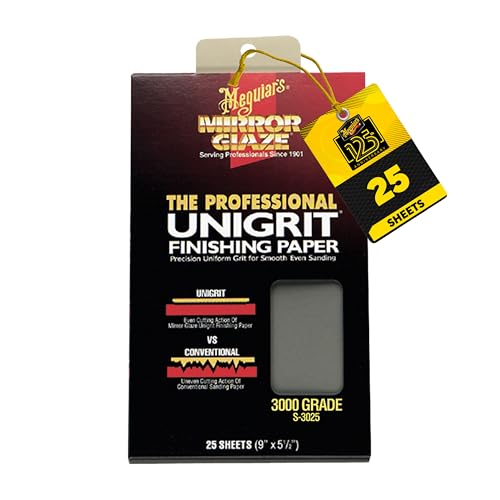 |
Meguiar’s Professional Unigrit Finishing Paper, 3000 Grit |Meguiar’s | Upgrade pick | 3000 grit · waterproof · finishing paper | $40.46
Price as of 24 Oct 2026
|
View |
The trade-off is simple: faster cut means more risk, while finer grits leave lighter marks. A coarser fine grit levels haze, nibs, or light texture faster before polish, but 3000-grit is easier to buff out.
For clear coat, that usually means starting at 2000 to 2500 when the defect needs real leveling, then finishing at 3000 before compound or polish.
How we chose
These picks stay inside the fine-finishing range only. The comparison is based on grit range, wet or dry use, backing durability, package format, and whether the sheet suits clear coat finishing rather than heavy sanding.
The goal is simple: help you choose the last sanding step, not a general bodywork kit.
- Grit range: only fine-finishing options that fit paint correction.
- Backing type: waterproof paper for wet sanding durability, or sheet format for hand control.
- Use case: clear-coat finishing, defect removal, or final refinement before polishing.
- Compatibility: wet/dry use, hand sanding, or DA orbital sanding.
- Risk profile: how likely the grit is to leave marks or cut too hard on thin clear coat.
| Product | Grit range | Best for | Backing / format | Wet/dry use | Key drawback |
|---|---|---|---|---|---|
| 3M Wetordry 2000 Grit | 2000 | General clear-coat leveling before compound | 9 in x 11 in sheet | Wet or dry | Only one grit; not enough if you need a finer final pass |
| Meguiar’s Professional Unigrit 3000 Grit | 3000 | Final refinement before buffing | Finishing paper | Waterproof | Too fine to correct deeper defects on its own |
Wetordry sheets: best for general clear-coat finishing
3M Wetordry 2000 grit is the safer middle ground when the surface still needs a little cut before compound. It fits the fine-finishing range, uses waterproof silicon carbide, and is marketed for wet or dry sanding, which makes it a practical all-around sheet for clear coat and paint defect removal.
Its biggest strength is versatility. The 9 in x 11 in sheet format works well with wrap-around block use, and the sheet size is easy to trim for tight areas without wasting material. 3M lists 2000 grit in this Wetordry line, and the broader line includes 1000, 1500, 2000, and 2500 grit sheets for step-by-step refinement.
The drawback is simple: 2000 grit still leaves visible sanding marks that must be removed by compound or polish. It is not the final finish grit if you want the cleanest possible surface before buffing.
Hook-and-loop discs: best for DA sanding
A hook-and-loop disc backing belongs on a dual-action orbital sander when you want faster grit changes and more even pressure across a panel. That setup is useful for broad, flat sections where hand sanding would be slow.
The trade-off is control. A DA can level a larger area quickly, but it is less precise than a hand sheet in edges, body lines, and small repaired spots. For the last sanding step on clear coat, that makes discs better for uniform refinement than for delicate touch-up work.
If you are choosing between sheet and disc formats, use the disc only when the repair area is large enough that machine sanding stays flat and predictable. For tight spots, a hand sheet is usually the safer choice.
9 x 3.6 inch sheets: best for tight spots
A 9 x 3.6 inch sheet format is a hand-sanding option built for wrap-around block compatibility and tighter area control. It is useful when you need to flatten a small defect without letting a large sheet bridge over the repair.
That format works well on bumper corners, mirror caps, and localized clear-coat blemishes. The smaller footprint gives better feedback, especially when you are trying to stop before breaking through the clear coat.
The limitation is coverage. It is slower on broad panels, and a small sheet can load up faster if you do not keep it clean during wet sanding.
What grit should you use before polish?
For most clear coat, 2000 to 3000 grit is the safe fine-finishing range before polish. If the clear is thin, skip sanding and polish first.
Silicon carbide is the preferred abrasive for automotive paint because it cuts cleanly, self-fractures to stay sharp longer, and works well wet or dry. That is why wet/dry automotive sheets are the standard choice for fine finishing on paint and clear coat.
What 3000 grit does well
3000 grit is a very fine finishing grit. It is used for polishing clear coats and restoring shine, so it belongs at the end of the sanding sequence rather than as a defect remover. It is the grit to reach for when the surface already looks close and only needs final refinement before buffing.
3M Performance 3000 grit is described for polishing clear coat and restoring shine. Meguiar’s Professional Unigrit 3000 grit is also built for even sanding marks that buff out fast, which makes it a strong final-step option when you want the least aggressive finish that still sands.
Say your repaired door edge has a light orange-peel patch the size of a credit card. A 2000-grit sheet can level it, but 3000 grit is the better last pass before polish because it reduces the chance of stubborn sanding marks.
Where 1000 to 2500 grit fits
The 1000 to 2500 grit progression is the fine-finishing range for defect refinement, not for heavy correction. It can be useful when a repair still needs measurable leveling before polish. That said, 1000 grit can be too aggressive on thin or unknown clear coat, especially on edges and body lines.
Thewearify’s guidance points to a clear-coat refinement ladder of 1000 to 1500 to 2000 to 3000. That sequence is useful as a theoretical ladder, but DIY work should treat 1000 grit as a narrow-use option, not a default starting point.
A common first-timer mistake is to start at 1000 grit because the defect looks visible. If the clear coat is already thin, that choice can remove too much material before the scratch is actually leveled.
Is wet sanding better than dry sanding for car paint?
Wet sanding is usually the better choice for car paint because it reduces dust and clogging, keeps the paper cutting more evenly, and lowers the chance of dry abrasion marks on clear coat. Dry sanding has a narrower role and is riskier unless the product is explicitly rated for it.
3M Wetordry 03024 is marketed for wet or dry sanding, and 3M Wetordry 03006 is described as ideal for clear coat sanding and paint defect removal. Those details matter because they separate general fine sanding from paint-specific finishing work.
When dry sanding is acceptable
Dry sanding can work on products that explicitly support it, especially when you need to spot-check a tiny area or avoid adding water near an edge that cannot stay wet. Even then, keep the pressure light and stop as soon as the defect levels.
For most DIY clear-coat work, though, dry sanding is the higher-risk option. It clogs more easily, cuts less evenly, and can leave harsher marks that take longer to polish out.
Why waterproof backing matters
Waterproof paper backing matters because it resists delamination during wet sanding and helps reduce clogging. That keeps the sheet usable longer and makes the cut more predictable on a glossy finish.
Miady’s set is described as waterproof silicon carbide, which is the right material and backing combination for wet finishing. It also includes 12 grits from 120 to 3000 in 36 sheets total, so it covers the fine range even though only the upper grits matter for this article’s purpose.
Fine sandpaper decision matrix
Use this matrix to match the grit to the repair stage. The safest choice is the least aggressive grit that still removes the defect.
| Grit range | Best use | Safe on clear coat | Wet/dry suitability | Risk level | Recommended follow-up step |
|---|---|---|---|---|---|
| 1000 to 1500 | Limited defect refinement when more cut is needed | Sometimes, but only on healthy clear coat with caution | Best wet | High | Compound, then polish |
| 1500 to 2000 | Moderate clear-coat leveling and defect cleanup | Usually, if the panel has enough clear | Wet preferred; dry only if product allows it | Medium | Compound, then polish |
| 2000 to 2500 | Fine finishing before polish or light clear-coat correction | Yes, for most controlled repair work | Wet preferred; dry less ideal | Low to medium | Compound or polish |
| 3000 | Final refinement before buffing | Yes, with light pressure | Wet preferred; dry only when approved by the product | Low | Compound, then polish if needed |
| Paint scenario | Correct fine grit |
|---|---|
| Minor haze | 3000 grit, or skip sanding if polish alone clears it |
| Nibs | 2000 to 2500 grit, then compound |
| Orange peel | 2000 grit if the clear coat is healthy; finish with 3000 |
| Light scratches | 2000 grit if they are in the clear only; otherwise polish first |
| Failed touch-up | 1500 to 2000 grit only if the spot still needs leveling |
Picture a hood with a few dust nibs after fresh clear. A 3000-grit sheet will smooth the nibs only if they are already nearly level; if they stand proud, 2000 or 2500 grit is the correct fine step before polish.
Another common case: a bumper has surface haze but the clear coat is thin near the edge. In that situation, sanding should be skipped entirely and the finish should move straight to compound or polish.
Which one should you buy?
Buy the 3M Wetordry 2000 grit sheet if you need one dependable fine-finishing step that can level a repair before compound. Buy the Meguiar’s Professional Unigrit 3000 grit paper if your main goal is the last sanding step before buffing. If you are unsure where the job starts, a grit assortment is smarter than single-grit sheets.
That is especially useful for a first repair kit because the correct sanding stage often depends on how much clear coat remains after inspection. Miady’s 12-grit waterproof silicon carbide set fits that role better than a single-grit purchase, even though its broad range is wider than this article’s fine-finishing focus.
Choose single-grit sheets when you already know the stage. If the job is a final pass before polishing, 3000 grit is the cleaner choice. If the surface still needs real leveling, 2000 grit is more practical.
Match the format to the repair area. Use a 9 x 11 sheet or 9 x 3.6 inch sheet for hand control and edge work. Use hook-and-loop discs only when a DA orbital sander can keep the panel flat and the area is large enough for machine sanding.
- Inspect the clear coat thickness and stop if the area already looks thin or uneven.
- Pick the least aggressive grit that can still remove the defect.
- Use wet sanding unless the product clearly supports dry use and the job is small.
- Keep the paper clean and use light pressure.
- Move from sanding to compound, then polish.
- Skip sanding if the defect is only surface haze or the clear coat is already close to breakthrough.
Choose 3M Wetordry if… / Choose Meguiar’s Unigrit if…
Choose 3M Wetordry 2000 grit if… you want a fine-finishing sheet for clear-coat leveling before compound, you value wet or dry flexibility, or you prefer a standard sheet size that can be trimmed for hand work. The downside is that one grit will not cover every finish stage.
Choose Meguiar’s Professional Unigrit 3000 grit if… your repair is already close to finished, you want the final sanding step before buffing, or you need the cleanest possible sanding marks before polish. The drawback is that it will not remove deeper defects quickly.
Frequently asked questions
What grit sandpaper should I use on car paint?
For the last sanding step on car paint, use 2000 to 3000 grit wet/dry silicon-carbide paper. Skip sanding if the clear coat is thin.
What is the best fine sandpaper for clear coat?
The best fine sandpaper for clear coat is a wet/dry silicon-carbide sheet in the 2000 to 3000 grit range.
Can I use 3000 grit sandpaper on car paint?
Yes. 3000 grit is a very fine finishing grit for car paint, and it is commonly used on clear coat before buffing. It is not meant to correct deep defects by itself. Use it as the last sanding step, not the first one.
Should I buy a grit assortment or single-grit sheets?
Buy single-grit sheets if you already know the finish stage. For most DIY clear-coat touch-ups, a small assortment makes more sense because one repair can need different steps.
How do I avoid scratching clear coat when sanding?
Use the least aggressive grit that will still work, keep the paper clean, and use very light pressure. Inspect the panel first, because thin clear coat can break through fast on edges and raised lines. Stop sanding before the defect disappears completely if the finish is already at risk.
Products related to this article
Sponsored / affiliate links. As an Amazon Associate I earn from qualifying purchases. I may earn additional commission from eligible campaigns.