Flashing Lights for Cars: Enhance Safety and Style on the Road
Flashing lights for cars are commonly described as falling into two categories: legal emergency warning lights and style-only lights. Buy the wrong type, and you can fail inspection, get stopped, or leave a work vehicle hard to see at night. This guide explains which light fits each vehicle, what voltage and mounting to check, and where legality changes by use case.
Best flashing lights for cars
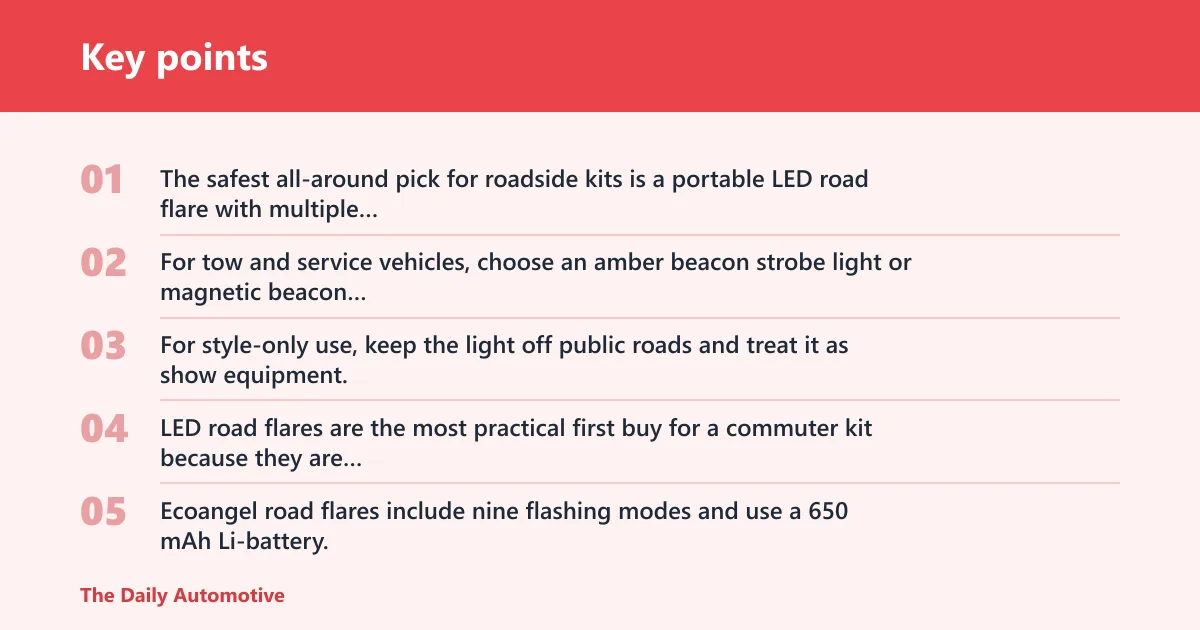


The safest all-around pick for roadside kits is a portable LED road flare with multiple flash modes and a battery you can recharge. For tow and service vehicles, choose an amber beacon strobe light or magnetic beacon light built for 12V-24V systems. For style-only use, keep the light off public roads and treat it as show equipment.
Top pick for roadside emergency kits
LED road flares are the most practical first buy for a commuter kit because they are portable, rechargeable options are common, and they can be used as a roadside warning device without depending on the vehicle’s battery. Ecoangel road flares include nine flashing modes and use a 650 mAh Li-battery, which fits the emergency-kit role better than a fixed roof light.
Best option for tow and service vehicles
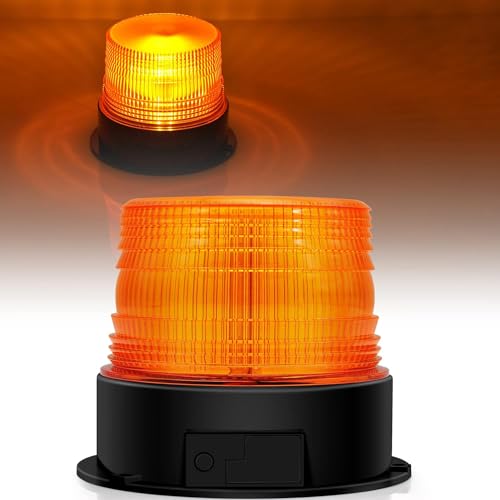
For tow trucks, service vans, and other authorized work vehicles, amber beacon strobe lights and magnetic beacons are the stronger fit. PKINGLAKE uses 40 LEDs, supports 12-24V compatibility, and is built for 360° coverage, while a magnetic beacon light with USB-C charging and up to 12 hours runtime fits temporary deployment.
Best choice for style-only use
Style-only flashing lights belong in the “display only” bucket, not the roadside-warning bucket. If the goal is appearance, keep the light off public roads unless local rules explicitly allow it. Decorative flashers can create legal risk if they look like emergency equipment or are used where only authorized warning devices are allowed.
Quick picks by use case
Choose by job first, not by flash count. A commuter needs a portable warning light. A tow driver needs a vehicle-powered amber unit. A winter driver needs rain, snow, and fog resistance plus fast deployment. A style-only buyer needs a product that stays out of public-road warning use.
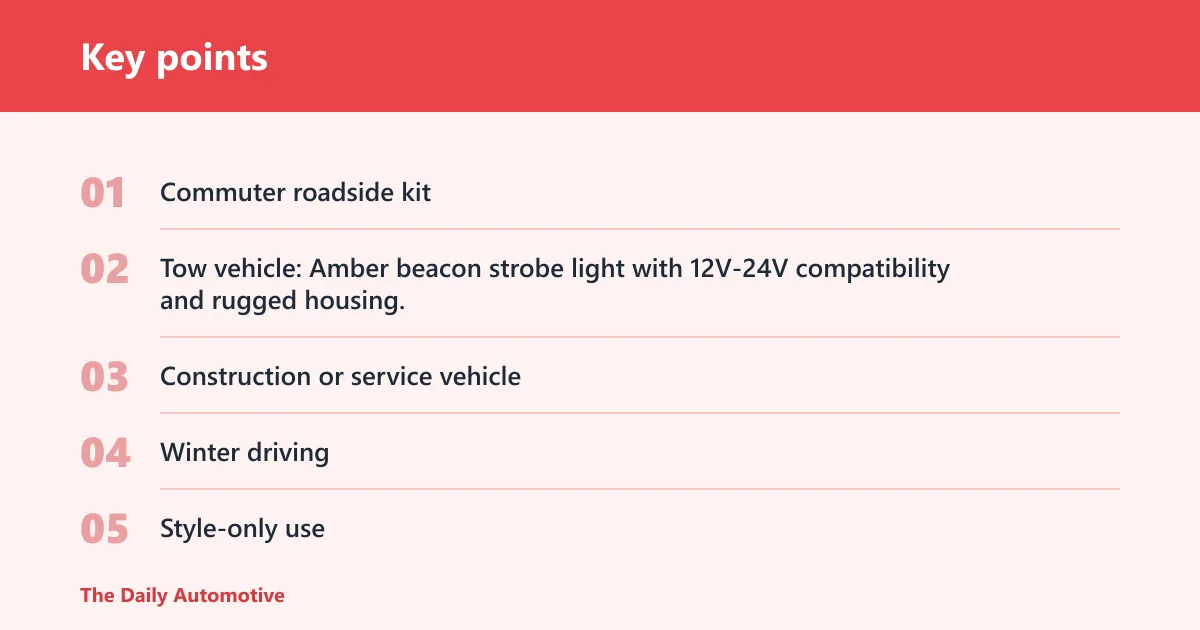
- Commuter roadside kit: LED road flares with USB recharge, multiple modes, and a stable base for temporary placement.
- Tow vehicle: Amber beacon strobe light with 12V-24V compatibility and rugged housing.
- Construction or service vehicle: Magnetic beacon light or roof-mounted warning light for authorized use.
- Winter driving: Weather-resistant light with ABS housing or PC lens for rain, snow, and fog.
- Style-only use: Decorative flasher kept for private property or off-road display only.
Say your sedan breaks down on a wet shoulder and you need something you can deploy fast without hardwiring. A rechargeable LED road flare with a magnetic base is the better fit than a roof beacon, because it is portable and does not depend on a permanent install.
Suppose a service van works through snow, slush, and road spray every week. A weather-resistant amber beacon with a rugged housing and vehicle power connection is a better long-term choice than a suction-cup dash light that can lose grip in cold weather.
Which flashing light fits your vehicle?
The right light depends on the vehicle class and the legal use. Passenger cars usually need portable roadside warning gear, not permanent emergency-style lighting. Trucks, forklifts, and service vehicles may use warning lights only when the vehicle and job qualify under local rules.
Passenger car versus truck
Passenger cars should generally stay with LED road flares or other portable warning devices for emergencies. Tow trucks and work trucks can justify amber beacon strobe lights or roof-top placement when the vehicle is used for authorized roadside work, recovery, or service response.
Fleet, forklift, and service-vehicle use
Fleet managers should focus on 12V-24V vehicle power systems because many warning lights are built for that common range. Forklifts, service vans, and utility trucks often benefit from plug-and-play operation, but only when the light matches the vehicle’s electrical system and the legal use case.
Where 12V-24V compatibility matters
12V-24V compatibility matters because it determines whether the light can work with cars, trucks, forklifts, and service vehicles without a mismatch. A 12V-only light on a 24V system can fail fast. A unit rated for 12V-24V gives more installation flexibility for mixed fleets.
Car flashing lights decision matrix
| Use case | Light type | Mounting method | Power source | Must-have specs |
|---|---|---|---|---|
| Commuter roadside kit | LED road flare | Magnetic base or flat ground placement | Rechargeable battery | Multiple flash modes, SOS signaling, weather resistance, compact storage |
| Tow vehicle | Amber beacon strobe light | Magnetic base or roof-top placement for authorized use | 12V-24V vehicle power | Rugged ABS housing, 360-degree warning coverage, plug-and-play operation |
| Construction or service vehicle | Magnetic beacon light | Temporary magnetic mount | USB-C charging or vehicle power | Tool-free mounting, weather resistance, memory recall, stable retention |
| Winter driving | Portable warning light | Magnetic base or temporary setup | Rechargeable battery | Cold-weather usability, rain and snow resistance, visible flash modes |
| Style-only use | Decorative flasher | Private-property mounting only | Varies by product | Off-road use only, no public-road warning use, secure wiring |
How do magnetic and suction mounts compare?
Magnetic mounts are the quickest temporary option, but they only work well when the base is strong enough and the mounting surface is clean and flat. Suction cups can be useful on glass or smooth interiors, but they are more sensitive to heat, cold, dirt, and vibration.
Magnetic base
A magnetic beacon light attaches by resting its base on a steel surface. That makes it tool-free and fast to deploy. The catch is retention. You should not assume a magnetic base is safe for road speed unless the manufacturer states the intended use and mounting limit.
Suction cups and windshield mounting
Dash strobe lights often use windshield or dashboard mounting with suction cups. XRIDONSEN includes 18 selectable flash patterns and uses six suction cups, which makes it a better example of a temporary interior mount than a permanent roof light. Memory recall is useful here because it returns to the last pattern after power cycles.
Roof-top placement limits
Roof-top placement is usually for authorized work vehicles, not ordinary passenger cars. The roof gives better placement for warning use, but it also raises legal and retention questions. Check whether the unit is meant for fixed installation, temporary use, or a specific vehicle class before putting it on the roof.
What specs matter most?
The most useful specs are the ones that affect reliability: flash modes, memory recall, weather resistance, charging method, and housing material. A long feature list means little if the light loses suction, dies quickly, or cannot handle rain and road spray.
Flash patterns and memory recall
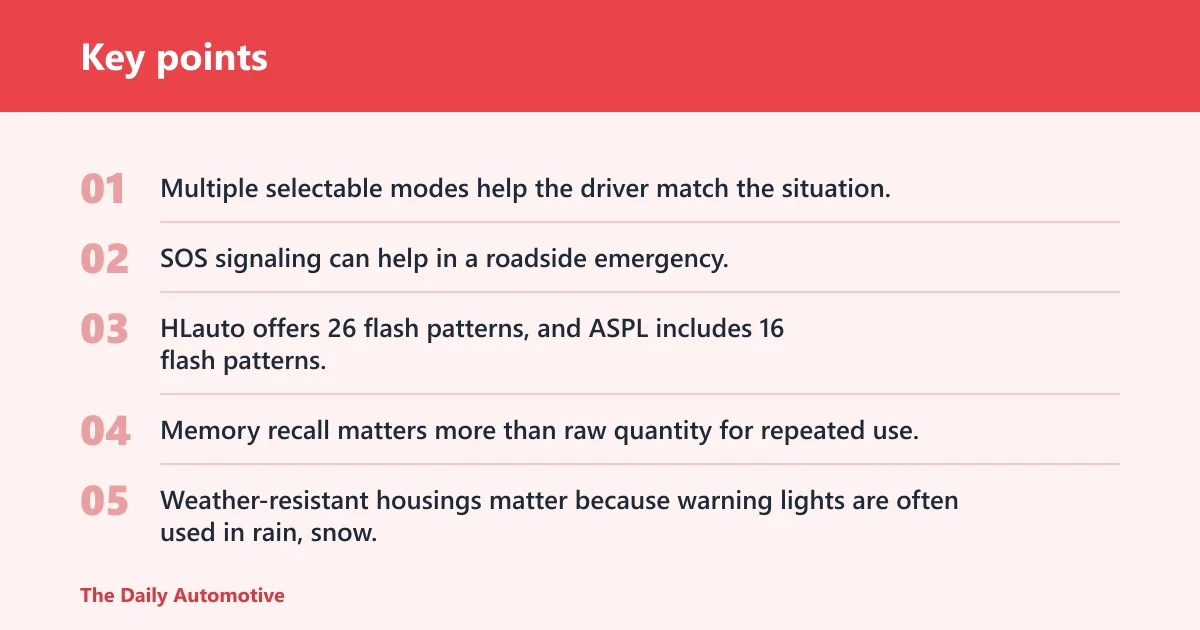
Multiple selectable modes help the driver match the situation. SOS signaling can help in a roadside emergency, while hazard warning use cases may need a slower or more noticeable flash. HLauto offers 26 flash patterns, and ASPL includes 16 flash patterns, but count alone is not the point. Memory recall matters more than raw quantity for repeated use.
Weather-resistant housings
Weather-resistant housings matter because warning lights are often used in rain, snow, fog, and work-site exposure. ABS housing is a common choice for impact resistance, while a PC lens helps protect the light face. For outside use, look for a build that is meant to survive moisture and vibration, not just a dry garage.
USB-C charging and runtime
USB-C charging is worth paying for if the light lives in a kit and needs quick top-offs. NeaLia charges via USB-C and can run up to 12 hours, which is a useful reference point for portable use. Battery-powered units still make sense when the vehicle is not running or when you need a light you can carry away from the car.
ABS housing and PC lens durability
ABS housing and a PC lens are good signs for work use because they help the light survive knocks, spray, and repeated handling. They do not guarantee a unit will survive everything, but they are better than a generic plastic shell with no clear protection claim.
Are LED road flares better than traditional flares?
For most drivers, yes. LED road flares are reusable, rechargeable options that reduce waste and avoid the burn and replacement issues of pyrotechnic flares. They are also easier to store in a glove box or cargo area. Traditional flares still have a place in some emergency kits, but LED units are usually the cleaner choice for repeated use.
Ecoangel road flares show the practical advantage: nine flashing modes and a 650 mAh Li-battery make them more flexible than a single-use flare. The tradeoff is charging. If the battery is low, the flare is only useful after it is powered back up.
What flashing lights are legal for cars?
Legality depends on local law, vehicle class, and whether the light is being used for emergency, work, or display purposes. Ordinary drivers should not assume that dash strobes, roof beacons, or forward-facing flashers are allowed on a passenger car. Check state, provincial, and country rules before buying.
Legal limits for ordinary drivers
For most private cars, the safe assumption is that warning-style flashers are limited or restricted. Decorative flashing lights are not the same as emergency warning lights. If the light resembles police, tow, or service equipment, you may need special authorization even if the product itself is sold online.
When work-vehicle use may apply
Work vehicles may be allowed to use amber beacon strobe lights, magnetic beacons, or roof lights when they are part of authorized roadside work, towing, or service response. That does not carry over automatically to a family car. Vehicle class and job use matter as much as the light itself.
How to verify local rules before buying
- Check your state, provincial, or country vehicle code for warning-light rules.
- Confirm whether your vehicle class is covered.
- Verify whether amber, white, or other colors are permitted for your use.
- Read the manufacturer’s mounting and voltage limits.
- Keep the product for the exact use allowed by law.
How many flash patterns should a car strobe light have?
There is no required number of flash patterns for every job. What matters is whether the light has enough selectable modes for warning, hazard signaling, and roadside use, plus memory recall so it returns to the last setting. More patterns can help, but they are not a substitute for legal use or reliable mounting.
LINKITOM uses 40 LEDs and provides seven flash patterns, while XRIDONSEN includes 18 selectable flash patterns. Either can work if the mounting and legal use are right. A driver who only needs one or two dependable warning modes may care more about the switch layout than the total pattern count.
Can I use flashing lights on a truck or tow vehicle?
Yes, but only when the truck or tow vehicle is being used in a way local law allows. Amber beacon strobe lights, magnetic beacons, and roof-mounted warning lights are common for authorized towing and service work. They are not a free pass for general passenger use or casual decoration.
PKINGLAKE’s 40 LEDs, 360° coverage claim, and 12-24V compatibility fit the kind of vehicle-powered setup tow operators usually look for. HLauto’s 16.4-foot cable can also help on larger vehicles where a simple plug-and-play run is easier than a hardwired install.
What are the best flashing lights for cars?
The best flashing lights for cars are the ones matched to the job: LED road flares for emergency kits, amber beacon strobe lights for authorized work vehicles, magnetic beacons for temporary deployment, and dash strobes only where local law allows them. For ordinary drivers, portable warning gear is usually the safest starting point.
Do not buy by flash count alone. Check legality first, then mount type, then power source, then housing. That order avoids most bad purchases.
Frequently asked questions
Are rechargeable LED road flares worth it?
Yes, for most drivers. Rechargeable LED road flares are worth it because they can be reused, they are easier to store than pyrotechnic flares, and they often include multiple flash modes. The main tradeoff is charging discipline. If the battery is not topped up, the flare will not help in a roadside emergency.
What voltage do vehicle warning lights use?
Many vehicle warning lights are designed for 12V-24V systems, which covers a broad range of cars, trucks, forklifts, and service vehicles. That range matters because a mismatch can cause failure or poor operation. Always confirm the rated input before wiring or plugging in the light.
How do magnetic strobe lights attach to a vehicle?
Magnetic strobe lights attach by sitting on a steel surface with a magnetic base. That makes them fast to move between vehicles and useful for temporary deployment. The limit is retention. A magnet should only be used within the manufacturer’s stated mounting guidance, especially if the vehicle will be moving.
Products related to this article
Sponsored / affiliate links. As an Amazon Associate I earn from qualifying purchases. I may earn additional commission from eligible campaigns.