Neon Underglow Lights for Cars: Top Picks and Legal Rules
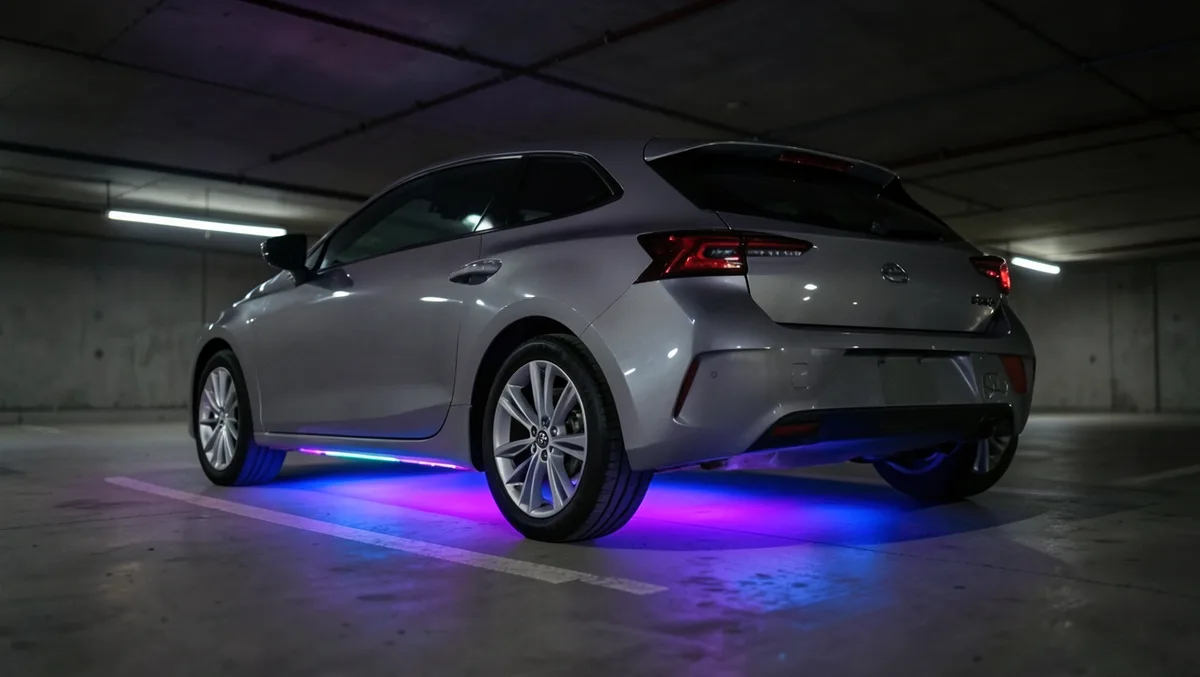
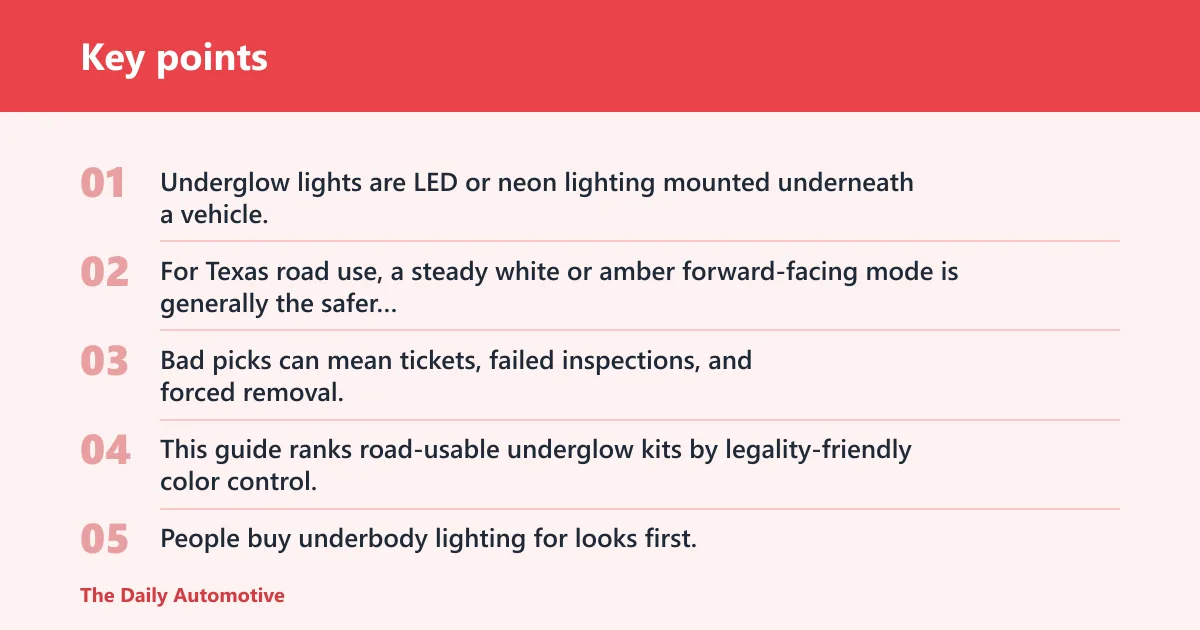
Underglow lights are LED or neon lighting mounted underneath a vehicle. For Texas road use, a steady white or amber forward-facing mode is generally the safer choice, and red, blue, or flashing patterns should be avoided. Bad picks can mean tickets, failed inspections, and forced removal. This guide ranks road-usable underglow kits by legality-friendly color control, waterproofing, brightness, and install quality, then explains Texas rules before you buy.
What underglow lights


Why buyers choose underglow
People buy underbody lighting for looks first, but the real question is whether the kit can stay legal on public roads. A kit can look aggressive in a parking lot and still be a bad street buy if it cycles colors, flashes, or throws light forward in a restricted color.
That split matters. A show-use setup may be fine on private property, while the same kit becomes a problem once the car is on a public road with the lights active.
Show use versus road use
Keep the two use cases separate. Show mode is for private property. Road mode should be limited to a static, legal color and a mounting layout that avoids front-visible red or any moving effect.
A common first-timer mistake is buying an app-driven RGB kit because the listing says “custom colors,” then discovering the app makes the light cycle through blue and red every time the car starts. That is a compliance problem if the car leaves private property that way.
Are neon underglow lights legal on cars?
In Texas, aftermarket lighting itself is not the issue. The key reference is Texas Transportation Code Chapter 547, and the state guidance focuses on how the lights behave and what colors are visible on the road. Static, legal-color underglow is the safer path; flashing or moving light is the risk.
How Texas law fits underglow
Texas law does not prohibit installing aftermarket or non-mandatory lights. The problem starts when the lighting violates the state’s visibility and behavior rules. Texas guidance says flashing, oscillating, moving, or otherwise non-stationary lights are illegal.
That means the compliance question is not “does the kit exist?” It is “what does the kit show when the car is driving?”
What public-road legality means in practice
Public-road legality means the setup must stay within state lighting rules while the vehicle is on the street. In Texas, that pushes buyers toward static white or amber underglow with no moving pattern and no front-visible red. Texas also says violations may lead to a citation for a non-moving traffic violation.
Texas guidance also says a violation can require the car to be modified to conform to legal standards. That makes the purchase decision bigger than looks alone.
What color underglow is legal in Texas?
White and amber are the safest color choices in Texas guidance. Red visible from the front is restricted, and blue and green are often avoided because they can create emergency-vehicle confusion. If you want the lowest-risk road setup, start with white or amber and keep the pattern static.
Why red visible from the front is a problem
Texas guidance says red lights must not be visible from the front of the vehicle. That matters even if the actual strip is mounted under the car and hidden from a casual glance. What counts is what other road users can see.
Suppose an underglow kit has a red accent channel under the front bumper. Even if the strip is tucked behind the lip, a forward view at night can still expose red light. That is the kind of visibility issue that creates citation risk.
Why many buyers avoid blue and green
Blue and green are often avoided for road use because they can resemble emergency lighting cues. Texas guidance says displaying red, blue, green, or combinations with white can lead to fines. If the goal is a street-safe look, those colors are the wrong starting point.
Underglow buyer checklist
Use this checklist before you buy. It ties product specs to road use and shows where a kit can fail even if the color looks legal in a listing photo.
| Compliance check | Pass or fail | What to verify | Road-use note |
|---|---|---|---|
| Static-only mode | Pass if the kit has a true steady mode | No flash, chase, pulse, oscillation, or motion effects in street mode | Static is the safer Texas choice |
| Front-visible color risk | Pass if the forward view stays white or amber | No red visible from the front; avoid blue and green for road use | Front-facing red is the clearest problem case |
| Waterproof rating | Pass if the exterior rating is suitable for weather exposure | IP66, IP67, or IP68 are common; higher is better for rain and spray | Better sealing matters under the car |
| App and color-lock risk | Pass if the app can lock a legal mode | The kit should stay in one compliant color without reset drift | Multicolor control is fine only if road mode stays locked |
Static-only mode and color-lock check
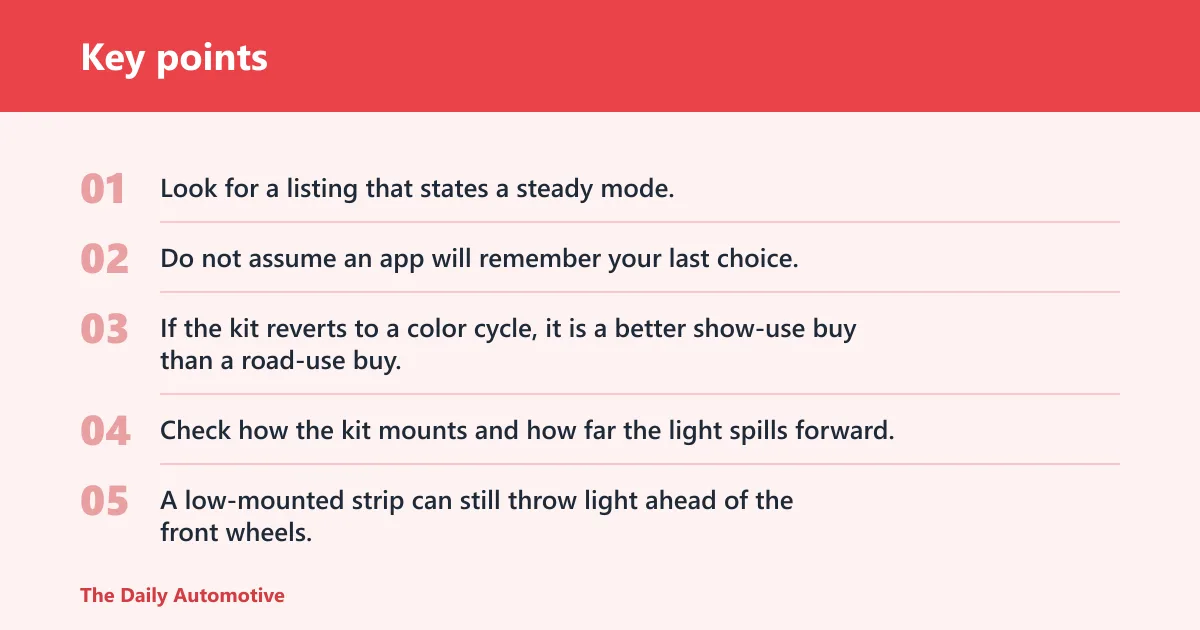
Look for a listing that states a steady mode, not only “music mode,” “fade mode,” or “RGB effects.” The safest purchase is a kit that can lock white or amber and return to that setting after the vehicle restarts.
Do not assume an app will remember your last choice. If the kit reverts to a color cycle, it is a better show-use buy than a road-use buy.
Front-visible color risk check
Check how the kit mounts and how far the light spills forward. A low-mounted strip can still throw light ahead of the front wheels, and that is where red becomes a legal problem in Texas. The question is not only the color chip; it is the visible beam path.
Water-resistance rating check
Exterior underglow lives in splash, rain, and road grit. IP66, IP67, and IP68 are common ratings you will see in listings, and the higher rating is the better target for underbody mounting. Lower protection can mean faster failure after wet roads or potholes.
App control and lockout risk
App control is convenient, but it creates compliance risk if the kit can wake up in a noncompliant mode. If the listing does not clearly say the street mode can be locked, treat it as show-use first and road-use second.
One practical filter is simple: if the listing markets “16 million colors” more than it markets a steady white or amber mode, the kit is probably built around custom looks rather than street compliance.
What are the best underglow lights for cars in 2026?
The best picks for 2026 are the kits that balance legal color control, steady-road mode, sealing, and a useful lighting layout. Two common roundup names are Xprite Underglow Lights for Cars as best overall and KORJO Underglow Lights for Cars as best budget, but the right buy still depends on whether the listing confirms a static legal mode and proper sealing.
How to read product listings
Start with mode control. A good street-use listing should mention steady white or amber output, not only color effects. Then check the enclosure rating, mounting style, and whether the app lets you lock one compliant color.
Brightness also matters. Competitor reviews often compare 120 LEDs with 300 LEDs and report that the higher count gives better output and more even coverage. That is a useful buying clue, but it does not replace a legality check.
Cost-to-compliance guidance
A cheap kit can become a poor value if it needs extra controllers, separate relays, or app settings just to stay legal on the road. The real cost is the total setup, including any add-ons needed to keep the lights static and color-locked.
Some competing listings also carry Amazon ratings in roughly the 3.8/5 to 4.5/5 range. Use those ratings as a rough popularity signal, not as proof that the kit is road legal.
Road-use vs show-use kits
A kit can be legal in one mode and risky in another. That is the key buying split. For public roads, the safer setup is steady white or amber with no motion effects; for private-property show use, a multicolor kit can do more without creating the same legal exposure.
What to verify before buying a multicolor kit
- Confirm the kit has a static mode that stays on one color.
- Confirm the forward-facing view does not expose red.
- Check that the app or controller can lock the legal mode.
- Check the waterproof rating for exterior mounting.
- Read the listing for any “show mode only” language.
How to spot compliance clues in listings
Watch for phrases like “music sync,” “chasing,” “pulse,” and “strobe.” Those are fine for private property, but they raise road-use risk. Better wording includes “steady,” “single-color mode,” and a clearly described white or amber setting.
If the listing only shows color-changing demo photos and never says how to lock the output, assume the kit needs more scrutiny before street use.
Are motorcycle underglow lights treated differently than car underglow?
Yes. Texas motorcycle lighting guidance is separate, and it allows non-flashing amber or white light. That rule applies to motorcycles rather than cars, so do not assume a bike-friendly setup automatically fits a passenger vehicle.
Why the motorcycle rule is not the same
Motorcycle ground-effect lighting gets its own treatment in Texas guidance. The important phrase is non-flashing amber or white. For bikes, that still means no flashing effect and no color spread that would create the same road-use problems seen with car underglow.
For cars, stay with the stricter reading: static white or amber and no front-visible red.
What should I check before buying an underglow kit for street use?
Check the legal color mode first, then the static setting, then the waterproof rating, then the app lockout behavior. If the kit cannot stay white or amber without effects, it is a show kit at best. Texas also says private-property use is allowed, so the road-use decision and the show-use decision do not have to be the same.
Purchase checklist
- Look for a steady white or amber street mode.
- Avoid kits that force flashing, chasing, or pulsing on startup.
- Confirm the front view cannot show red.
- Prefer IP66, IP67, or IP68 for underbody exposure.
- Choose the kit with the clearest color-lock claim.
- Check the manufacturer’s listing for your model before buying.
Penalty and enforcement risk
Texas guidance says misuse can lead to a non-moving traffic citation, and it can require the car to be modified to legal standards. Displaying red, blue, green, or combinations with white can also lead to fines. That is serious enough to make emergency-vehicle impersonation concerns part of the buying decision, not an afterthought.
Texas also says underglow on private property is allowed. That makes the distinction clean: buy the show kit for show use, or buy the compliant kit if you want the lights on the street.
Frequently asked questions
Can you drive with underglow lights on public roads?
Yes, but only if the setup follows the state’s lighting rules. For Texas, that means a static mode, a legal color, and no front-visible red. If the kit flashes, moves, or cycles through restricted colors, it is much more likely to draw a citation.
Is red underglow illegal if it is hidden under the car?
Hidden mounting does not automatically make red safe. Texas guidance says red lights must not be visible from the front of the vehicle, so the real question is what other drivers can see. A low front-mounted strip can still expose red light even if the LEDs are tucked away.
What underglow colors should I avoid for safety and police attention?
Avoid red, blue, and green for road use, especially if the kit can show them toward the front of the car. Texas guidance also warns about combinations with white. White and amber are the conservative choices when the goal is to reduce citation risk.
Products related to this article
Sponsored / affiliate links. As an Amazon Associate I earn from qualifying purchases. I may earn additional commission from eligible campaigns.