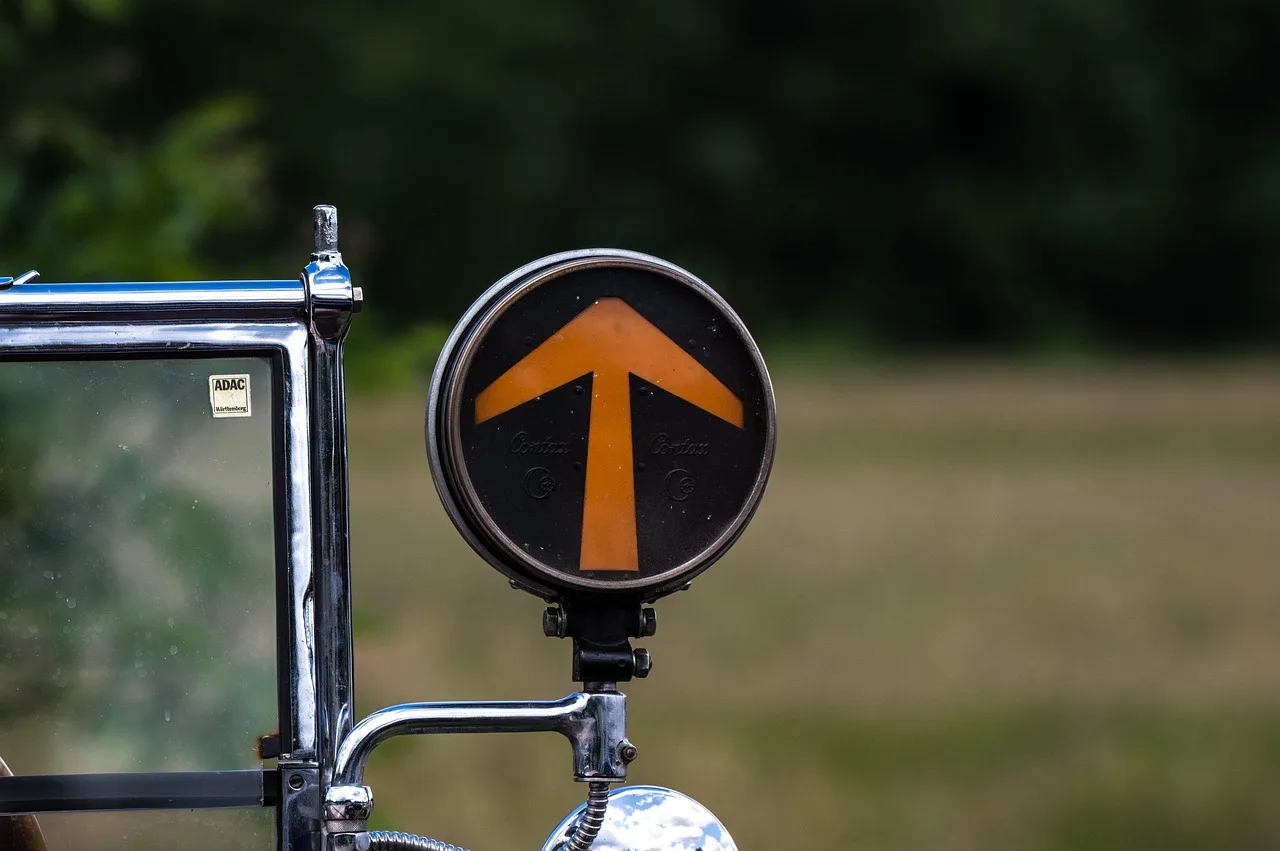
Signal Light for Car: Safety, Fitment, and Upgrades
A signal light for car safety is a front, rear, or mirror-mounted lamp that flashes at a legal rate, and the right upgrade is the one that matches the socket, voltage, beam direction, and load type. Bad fitment can cause hyperflash, dim signaling, bulb-out warnings, or signals that other drivers miss. This guide explains how the signal path works, how to choose halogen or LED replacements, and what causes failure or noncompliance.
Faster LED response improves signal timing
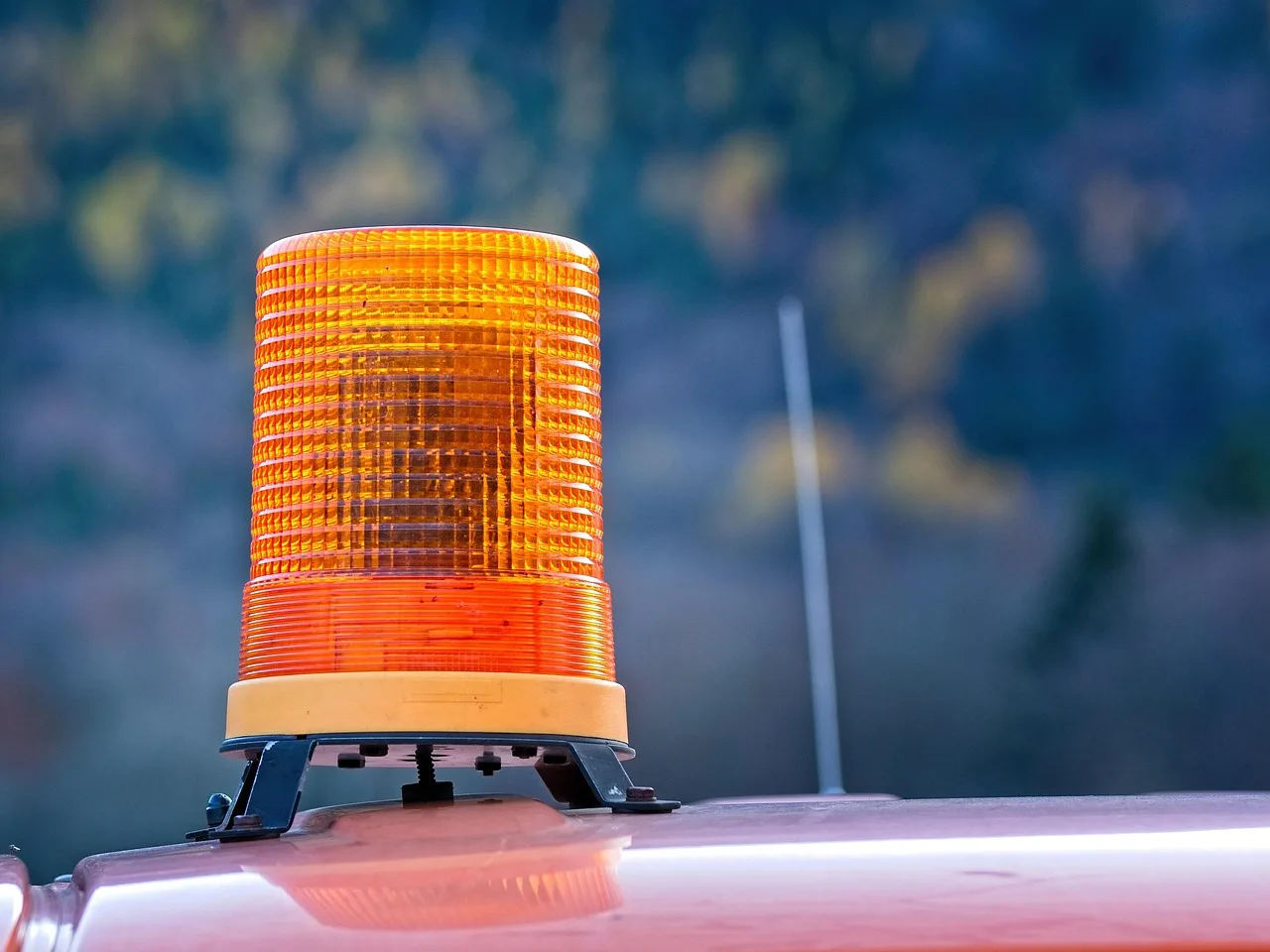


A car signal light tells other road users where the vehicle is going to turn, merge, or change lanes. Front units are usually the first cue in daylight, rear units matter most in traffic behind you, and mirror-mounted signals add side visibility where blind spots are common.
Front, rear, and mirror-mounted roles
HELLA says signal lights show deceleration and direction changes. That is the safety job: an amber flash should be seen fast, then understood without guesswork. J.W. Speaker notes that automotive LED signal lights can be mounted on the front, rear, or side mirrors, which matters because each position faces a different viewing angle and traffic threat.
Amber color and visibility
Amber is the standard turn-signal color because it separates turn intent from red brake and tail functions at the rear, and because the color stays easier to pick out in low light, rain, snow, and glare. That makes the flash easier to spot in mixed traffic lighting.
Why response time matters
Faster response helps the signal appear as soon as the driver starts the maneuver. J.W. The same source says LED signal lights have fast response time, which can make the onset of the flash more immediate than incandescent bulbs. That does not replace correct aiming, bulb color, or legal flash rate.
LED vs halogen turn signal bulbs
LED bulbs can produce more light per watt, quicker response, and less maintenance than incandescent halogen-style bulbs, but they are not a universal swap. Fitment, heat management, optics, and the vehicle’s control strategy all affect whether the upgrade works cleanly or triggers warning behavior.
Brightness and lumen output
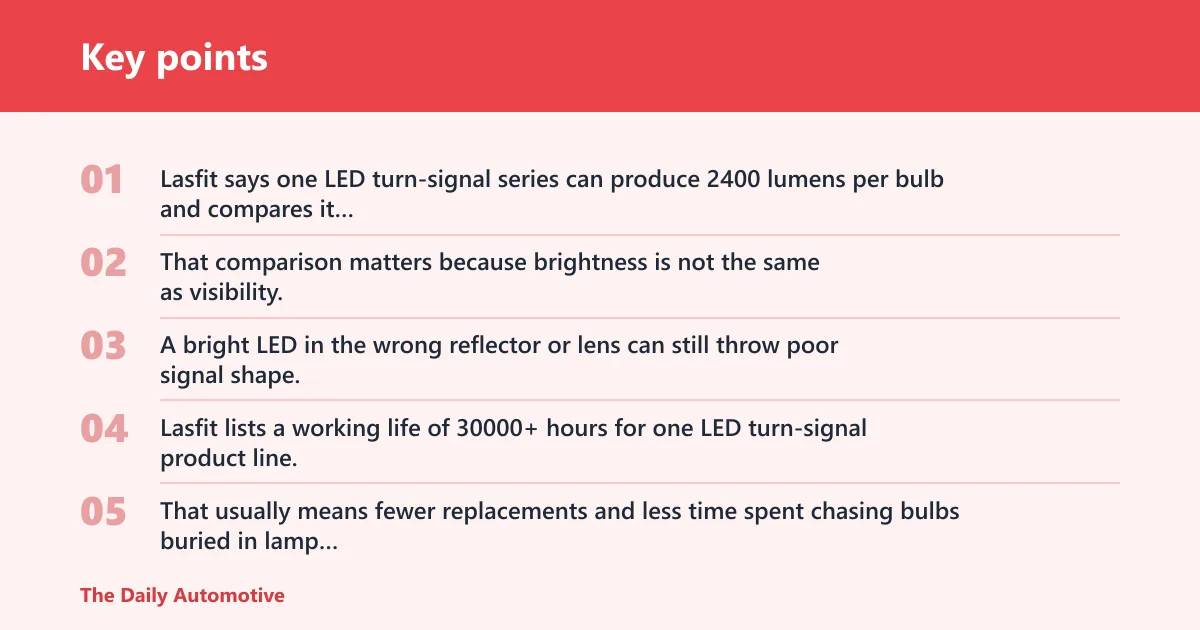
Lasfit says one LED turn-signal series can produce 2400 lumens per bulb and compares it against a 21W halogen baseline. That comparison matters because brightness is not the same as visibility. A bright LED in the wrong reflector or lens can still throw poor signal shape, while a lower-output bulb with good optics may communicate better than a harsh, unfocused source.
Lifespan and maintenance
Lasfit lists a working life of 30000+ hours for one LED turn-signal product line. That usually means fewer replacements and less time spent chasing bulbs buried in lamp housings. It does not mean the rest of the system can be ignored. Heat, moisture intrusion, and poor connectors still shorten real-world service life.
Common bulb sizes and plug-in swaps
Lasfit lists common turn-signal bulb sizes as 7443/7440, 3157/3156, 1157, and 1156. Those sizes cover many front and rear applications, but the socket, base style, and dual- or single-function layout still need matching. Plug-and-play only applies when the bulb shape, polarity, and load behavior line up with the vehicle.
Say your rear lamp uses a 3157 bulb and the new LED physically locks into the socket. If the car’s lighting module expects the higher current draw of an incandescent bulb, the install may still flash too fast or trigger a warning until the load issue is addressed.
Why your signal flashes too fast
Hyperflash is a turn-signal blink rate that speeds up because the vehicle thinks a bulb has failed or the circuit load has changed. It often appears after an LED swap, but it can also come from wiring faults, poor grounding, corroded contacts, or a control module that reads the circuit differently than the old bulb.
How low LED power draw triggers it
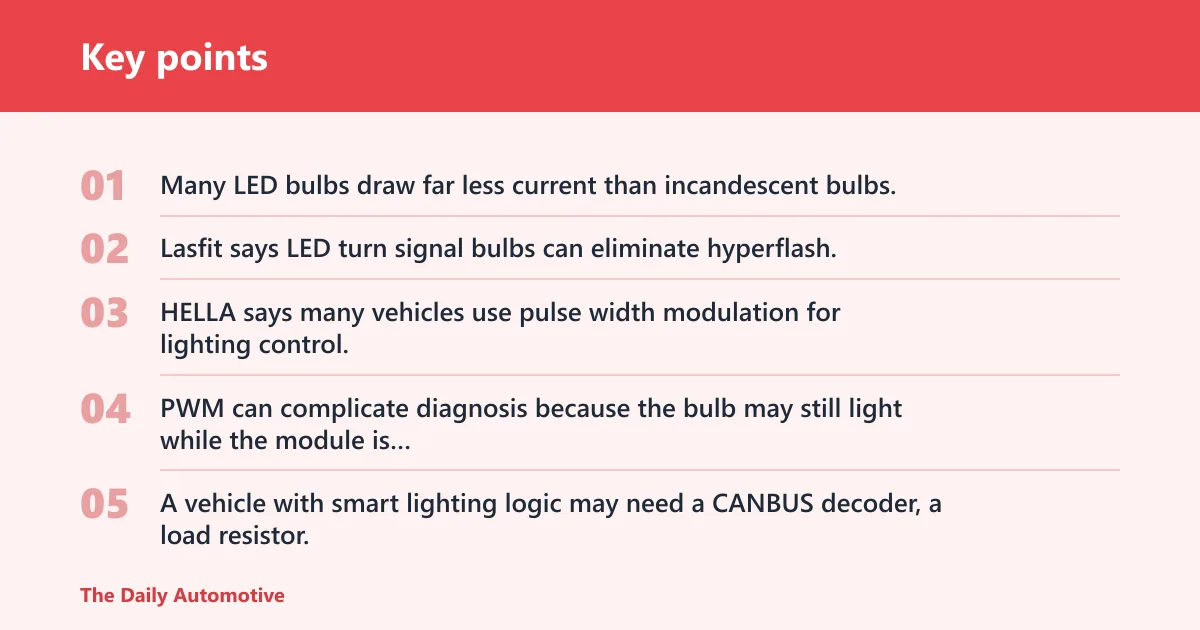
Many LED bulbs draw far less current than incandescent bulbs, so the flasher or body control module sees a low-load condition. The result is the familiar fast blink. Lasfit says LED turn signal bulbs can eliminate hyperflash, but only when the product and vehicle control logic are matched correctly.
Where PWM and control modules complicate diagnosis
The same source says many vehicles use pulse width modulation for lighting control. PWM can complicate diagnosis because the bulb may still light while the module is actively monitoring load, frequency, or fault status. A vehicle with smart lighting logic may need a CANBUS decoder, a load resistor, or a bulb that already includes decoder support. Those are not the same fix.
Fix options and when they apply
A load resistor adds electrical load so the circuit behaves more like the original bulb. A CANBUS decoder is used to prevent error codes and can help avoid hyperflash on vehicles that monitor lighting circuits closely. Lasfit describes its turn-signal bulbs as having built-in CANBUS decoder support, which can reduce the number of extra parts, but only if the vehicle is compatible.
A common first-timer mistake is buying a “no error” LED for a truck with a monitored rear circuit, then installing it in a mirror signal that is not the real problem. The fault can be in the rear lamp, the connector, or the module reading the wrong load point.
Signal light upgrade decision matrix
The right upgrade depends on what changed, the bulb itself, the load the vehicle expects, or the lamp design you want to replace. Use this matrix to narrow the parts list before you buy anything.
| Scenario | Required parts | Likely compatibility issues | DIY difficulty |
|---|---|---|---|
| Halogen-to-LED bulb swap | Correct LED bulb, possible CANBUS decoder or resistor | Socket match, polarity, heat fit, bulb-out warning, hyperflash | Easy if access is open |
| Hyperflash fix | Load resistor or CANBUS decoder, mounting hardware, wiring taps | Wrong resistor value, poor heat placement, module sensitivity | Moderate |
| Sequential mirror signals | Sequential LED assembly or mirror insert, vehicle-specific harness | Mirror housing shape, side visibility, legality, control timing | Moderate to hard |
| Rear combination lamp replacement | Complete lamp assembly or matched bulb set | Stop/tail/turn separation, ECE-R7 context, sealing and alignment | Moderate |
| Truck and SUV fitment | Vehicle-specific LED bulbs or assemblies, decoder if needed | Large reflector housings, higher load monitoring, long harness runs | Moderate |
| Dead-indicator troubleshooting | Bulb, fuse, connector cleaner, repair terminals, wiring test tools | Corrosion, poor grounding, damaged holder, contact interruption | Easy to moderate |
What the matrix means in practice
If the only change is a bulb swap, start with fitment and load behavior. If the lamp design itself changes, such as a sequential rear unit or mirror signal, expect more wiring and more time. If the indicator is dead, do not assume the bulb is the cause; HELLA recommends checking bulbs, holders, voltage supply, and plug connections.
How to check fitment before you buy
Fitment starts with year, make, and model, then moves to socket type, bulb spec, and the vehicle’s lighting control behavior. That sequence matters because two vehicles can use the same bulb size but require different electrical support or different lamp geometry.
Year, make, and model matching
Use the exact year, make, and model before you compare bulbs or lamp assemblies. Lasfit says some LED turn signals are available for 2014-2026 Toyota 4Runner and 2014-2026 Chevrolet Silverado 1500, which shows how specific fitment can be. A part that fits one trim or generation may not fit the next one.
Socket and bulb-spec lookup
Also check whether the signal shares a housing with a brake or tail function. That affects bulb choice, beam direction, and whether the lamp must meet stop/tail requirements as well as turn-signal needs.
When built-in CANBUS support matters
Built-in CANBUS decoder support matters most on vehicles that report bulb faults or hyperflash after low-load changes. It can reduce add-on wiring and clean up the install. It does not guarantee compatibility, because some modules are sensitive to PWM behavior, while others need a different resistor strategy or a vehicle-specific lamp.
- Match the exact vehicle year, make, model, and trim.
- Confirm the bulb size or lamp assembly number.
- Check whether the circuit is monitored for bulb-out warnings.
- Decide whether the fix needs a resistor, a CANBUS decoder, or neither.
- Verify the color, flash rate, and mounting position before installation.
Regulations and legality for signal lights
Legal compliance depends on color, function, and the standard the lamp was built to meet. ECE-R6 covers direction indicators, while ECE-R7 covers stop/tail lights. For a swap to stay compliant, the lamp must still signal clearly, use the proper color, and match the manufacturer’s bulb specification or approved replacement path.
Direction indicators and stop/tail context
HELLA names direction indicators under ECE-R6. If the rear lamp shares space with stop or tail lighting, that function sits in a different regulatory bucket. A rear LED upgrade that changes the appearance of the turn signal can also affect how the brake or tail section reads, so the whole assembly matters, not just the flashing segment.
Color and spec adherence
Amber remains the safest default for signal function. White or red may be legal only in specific positions and designs, depending on the vehicle and market. Follow the manufacturer bulb spec when possible, because that is the fastest way to avoid fitment errors, optical mismatch, and inspection trouble.
Sequential LED signals
Sequential LED signals use a sweeping or dynamic light pattern that can add visibility as well as style, especially on mirrors or rear lamps. They can be safe when the flash rate, color, and placement remain compliant, but they are not automatically legal everywhere. Check whether the unit is approved for the application, not just whether it fits the housing.
Frequently asked questions
What is a signal light for a car?
A signal light is the lamp that tells other drivers when the vehicle is turning or changing direction. Front signals help oncoming traffic and pedestrians, rear signals help vehicles behind you, and mirror-mounted signals improve side visibility. The key job is clear, timely communication through an amber flash.
Are LED turn signal lights brighter than halogen bulbs?
Often, yes, but brightness alone does not decide visibility. An LED can produce more output and faster response, and Lasfit lists 2400 lumens per bulb in one series with a 21W halogen baseline for comparison. The lens, reflector, aim, and color still determine how useful that light is on the road.
Do LED turn signal bulbs need resistors to stop hyperflash?
Sometimes. If the vehicle expects incandescent current draw, an LED can trigger fast flashing and need a load resistor or CANBUS decoder. Some bulbs include decoder support, which can remove the extra part. Others still need a resistor, especially on older vehicles or on circuits with strict load monitoring.
How do I know if a turn signal bulb fits my car?
Check the exact year, make, model, and trim, then match the socket size and function. If the vehicle uses a monitored lighting module, also confirm whether the replacement includes CANBUS support or needs a separate decoder.
What color should car signal lights be?
Amber is a common turn-signal color and a safe default for visibility. It stands apart from red brake lighting and is easier to identify in low light or bad weather. Some markets allow different treatments in specific lamp designs, but the signal function still has to be obvious and legal.
Can I replace turn signal bulbs myself?
Usually, yes, if the socket is accessible and the housing is not sealed or complex. The main steps are to verify fitment, remove the old bulb, check the socket and connector for corrosion, install the new bulb correctly, and confirm that the flash rate and warning behavior are normal after startup.
Products related to this article
Sponsored / affiliate links. As an Amazon Associate I earn from qualifying purchases. I may earn additional commission from eligible campaigns.