Best Car Batteries for Hot Climates (2026): we compared
For hot climates, pick the battery that best resists heat-driven water loss: AGM for severe heat and short-trip use, or a high-quality flooded battery with the highest reserve capacity and warranty when the car charges fully. Choose by CCA alone and you can buy a battery that fails early from electrolyte loss, corrosion, or chronic undercharge. This guide explains which chemistry, reserve capacity, and warranty fit desert heat, stop-start driving, and parked vehicles.
Quick comparison
| Product | Badge | Best for | Price | ||
|---|---|---|---|---|---|
 |
OPTIMA Batteries High Performance 34/78 RedTop Sealed AGMOPTIMA | Our pick | 800 CCA · 100 min RC | $279.99
Price as of 14 Oct 2026
|
View |
 |
Daakmax Platinum AGM Car Group 65 Battery – 12V 70Ah, 750Daakmax | Budget pick | 750 CCA · Group 65 | $169.99
Price as of 14 Oct 2026
|
View |
 |
Mighty Max Battery 12V 75Ah Internal Thread BatteryMighty Max Battery | Also great | 12V 75Ah · Group 24 | View | |
 |
Yuasa YUAM3RH2S YTX12-BS Battery, Multi-ColoredYuasa | Upgrade pick | 180 CCA · 10 Ah | $82.00
Price as of 14 Oct 2026
|
View |
AGM usually makes the strongest overall case in heat because sealed construction limits water loss and helps the battery tolerate demanding electrical loads. Flooded batteries still make sense when cost is the main filter, while EFB sits between them for stop-start cars that need better cycling than a basic flooded battery.
How we chose
The shortlist favors batteries that fit common hot-weather failure modes: heat soak, electrolyte loss, plate corrosion, and short-trip undercharge. We also weighed reserve capacity, warranty terms, fitment requirements, and whether the battery chemistry matches stop-start systems or heavier accessory loads.
Fitment matters as much as chemistry. Group size, terminal layout, hold-down style, venting, and any AGM charging requirement can make a technically good battery a poor buy for a specific vehicle.
OPTIMA RedTop 34/78: best for severe heat and heavy electrical demand
This is the strongest overall pick for hot climates when you want a sealed AGM starting battery with serious reserve. The spec sheet lists 800 CCA and 100 min RC, which gives it a clear edge for vehicles with a lot of accessories, frequent hot restarts, or harsh under-hood temperature exposure.
It makes the most sense for drivers who want a tough starting battery and can pay more than a flooded replacement. The drawback is simple: AGM costs more than flooded, and the vehicle still needs the correct group fit and terminal layout. Some cars also expect an AGM-compatible charging profile or battery management support.
Daakmax Platinum AGM Group 65: best for stop-start cars on a midrange budget
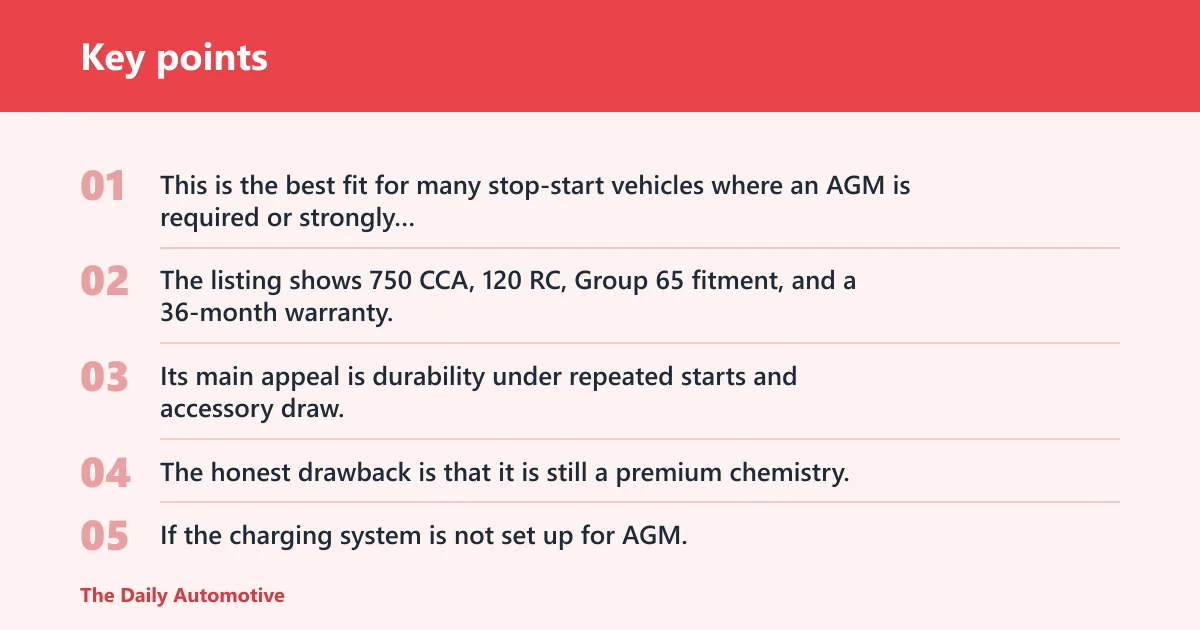
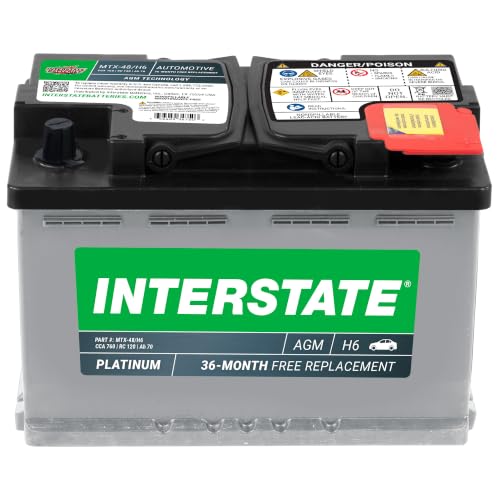
This is the best fit for many stop-start vehicles where an AGM is required or strongly preferred, but the buyer wants a lower price than premium-branded options. The listing shows 750 CCA, 120 RC, Group 65 fitment, and a 36-month warranty, which is a useful mix for hot-weather commuting.
Its main appeal is durability under repeated starts and accessory draw. The honest drawback is that it is still a premium chemistry, so the price is higher than a basic flooded battery, and the vehicle must accept Group 65 and AGM requirements. If the charging system is not set up for AGM, the battery may not live up to its spec sheet.
Mighty Max Group 24 sealed battery: best for basic sealed replacement
This sealed Group 24 battery suits buyers who want a maintenance-free replacement and do not need a stop-start-specific AGM. The 12V 75Ah rating and sealed design make it a straightforward choice for some vehicles, backup applications, and drivers who value a no-water-loss format.
The drawback is that the listing does not place it as a purpose-built automotive AGM starting battery in the same way the others do. That means fitment and system compatibility deserve extra attention, especially if the vehicle expects a battery designed around engine cranking, heat cycling, and onboard electronics rather than general sealed use.
Yuasa YTX12-BS: best for motorcycles and small equipment in heat
This is the right kind of battery for powersports, not for a full-size car. The listing shows 180 CCA, 10 Ah, sealed construction, and maintenance-free operation, which is the right profile for a motorcycle or similar small application that still sees hot-weather stress.
The drawback is obvious for this article’s audience: it is not a passenger-car battery. It belongs here only because heat affects smaller engines too, and sealed lead-calcium construction can be a sensible choice where the vehicle spec calls for this format.
What each battery type is best for in very hot weather
AGM is the best overall chemistry for severe heat when the vehicle has higher electrical demand, stop-start use, or long accessory loads. EFB is the smart middle ground for many stop-start cars that do not need full AGM hardware, while flooded lead-acid remains the lowest-cost choice for simple daily drivers that fully recharge often.
AGM battery
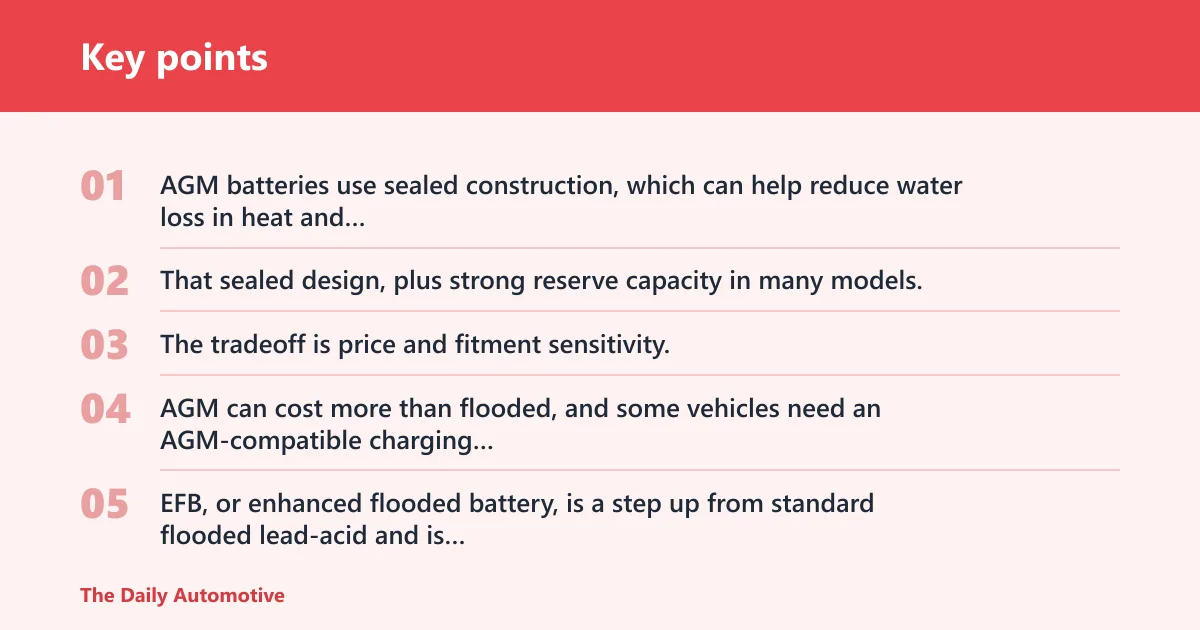
AGM batteries use sealed construction, which can help reduce water loss in heat and avoid routine topping-off maintenance. That sealed design, plus strong reserve capacity in many models, is why AGM often holds up better under under-hood temperature and accessory load than standard flooded batteries.
The tradeoff is price and fitment sensitivity. AGM can cost more than flooded, and some vehicles need an AGM-compatible charging profile or battery management support to avoid chronic undercharging or shortened life.
EFB battery
EFB, or enhanced flooded battery, is a step up from standard flooded lead-acid and is commonly used in stop-start applications. It is built for better cyclic durability than a basic flooded battery, so it can handle repeated engine restarts and accessory use better in daily commuting.
That makes EFB a practical choice when the vehicle was designed around stop-start behavior but the budget does not stretch to AGM. It is not the best answer for the hottest, most demanding vehicles, though, where AGM usually offers a safer margin.
Flooded lead-acid battery
Flooded batteries still sell because they are the usual OEM replacement baseline and they keep the upfront cost low. For vehicles with simple electrical loads and regular full charging, a good flooded battery can still be a reasonable hot-climate buy.
The drawback is heat sensitivity. Flooded batteries can lose water more easily in high temperatures, which can increase maintenance needs and may shorten service life through electrolyte loss and plate corrosion. If the vehicle sits in heat and makes many short trips, the margin is thin.
Hot-climate battery decision table
| Battery type | Reserve capacity | Heat tolerance | Maintenance burden | Expected lifespan in hot climates | Best use case |
|---|---|---|---|---|---|
| AGM | Often strong; choose the highest RC that fits | High, with better resistance to water loss | Low | Usually better than basic flooded when charging is correct | High-electronics vehicles, stop-start cars, severe heat |
| EFB | Moderate to strong | Better than standard flooded | Low to moderate | Better than flooded in stop-start use | Stop-start commuters, midrange budgets |
| Flooded lead-acid | Varies widely; verify the label | Lower; more sensitive to water loss | Moderate | Often shortest in extreme heat | Simple vehicles, lowest upfront cost |
How do reserve capacity and warranty matter in heat?
Reserve capacity matters because hot-climate driving often keeps the electrical system working hard after startup. Fans, infotainment, charging ports, pumps, and long idling can draw power even when the engine is running, so RC tells you how long the battery can support the system if charging dips.
Warranty terms matter because heat failures often show up earlier than buyers expect. A battery with a longer replacement term can be more useful than one with a long pro-rated tail, since pro-rated coverage usually returns less money as time passes and does not fully offset early heat-related failure.
Heat also changes how warranties should be read. A long warranty is not proof of heat resistance, but it does signal how much risk the maker is willing to absorb. For desert use, that matters more than a headline CCA figure.
Is AGM better than flooded in hot weather?
Yes, AGM is usually better in hot weather because its sealed design limits electrolyte loss and tends to handle vibration and accessory load better than a basic flooded battery. That advantage becomes more important when the battery sits under a hot hood, sees short trips, or powers a lot of electronics.
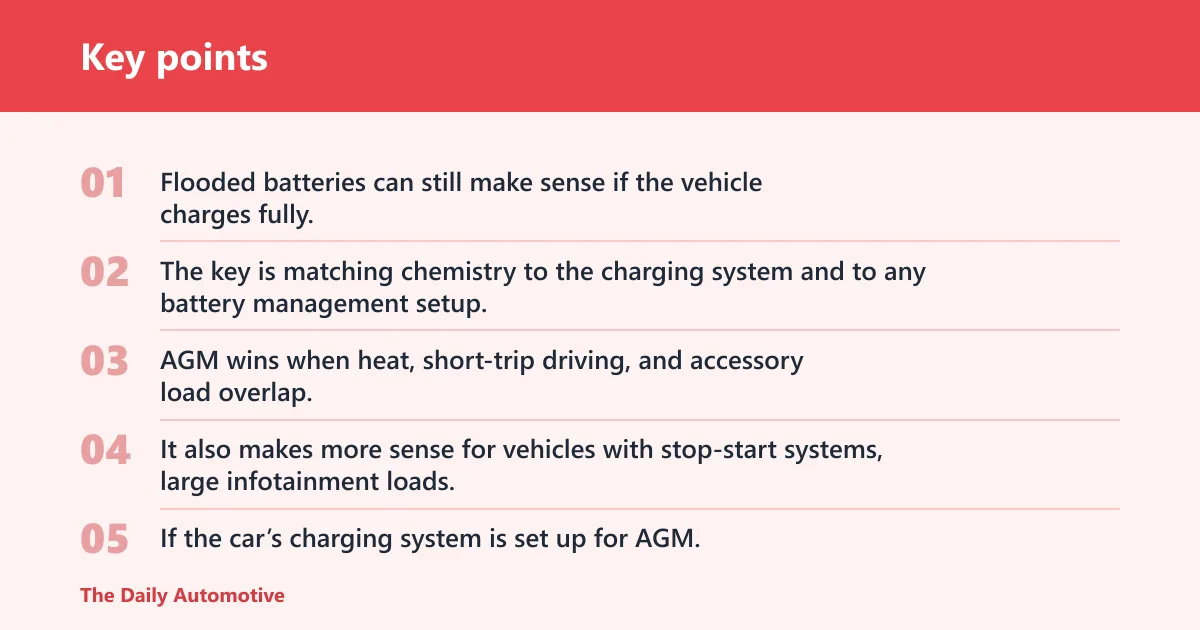
Flooded batteries can still make sense if the vehicle charges fully, the electrical load is modest, and cost matters most. The key is matching chemistry to the charging system and to any battery management setup, since some vehicles expect AGM behavior and may punish the wrong battery choice.
Where AGM wins in heat
AGM wins when heat, short-trip driving, and accessory load overlap. It also makes more sense for vehicles with stop-start systems, large infotainment loads, or frequent idling in traffic. If the car’s charging system is set up for AGM, the chemistry often gives the best durability margin.
Where flooded can still make sense
Flooded can still be the right answer for a basic commuter that does not sit in extreme heat all day and does not carry heavy electronics. The lower upfront price is useful, especially if the vehicle is nearing the end of its service life and the owner wants a practical OEM-style replacement.
How hot is too hot for a car battery?
There is no single cutoff that fits every battery, but sustained high under-hood temperature is the real problem, not a one-time hot day. Battery life falls faster when the battery spends long periods in heat soak, loses water, or stays undercharged after short trips.
If the hood area is consistently very hot to the touch after shutdown and the car often makes short runs, the battery is working in a harsh zone. At that point, chemistry and reserve capacity matter more than a high CCA number on the label.
What battery lasts longest in hot climates?
AGM usually lasts longest in hot climates when the vehicle’s charging system is compatible and the battery is a correct fit. A good EFB can also last well in stop-start use, but a standard flooded battery is usually the most vulnerable to electrolyte loss and corrosion in sustained heat.
Longevity still depends on use pattern. A battery that charges fully and sits in a ventilated tray will outlast a better chemistry that is chronically undercharged or forced into the wrong size and terminal layout.
What should I look for in a battery for desert heat?
Look first for the right group size, terminal layout, hold-down style, and venting setup. Then compare reserve capacity, warranty terms, and whether the battery chemistry matches the vehicle’s charging system, stop-start function, or battery management requirements.
- Confirm the correct group size and terminal orientation.
- Choose AGM for high-electronics, stop-start, or harsh heat duty.
- Use EFB when the vehicle calls for better cycling than flooded.
- Check reserve capacity before chasing the highest CCA.
- Read the warranty carefully, including replacement term and pro-rated coverage.
A common first-timer mistake is buying the biggest CCA number that fits the tray. In desert heat, that can still fail early if reserve capacity is weak, the battery is the wrong chemistry, or the car expects an AGM-friendly charging profile.
How do you protect a car battery from heat?
The best protection is choosing the right chemistry first, then keeping the battery in a vehicle that can charge it correctly. A battery maintainer helps when the car sits parked, but it does not turn a heat-sensitive battery type into a desert-duty solution.
Parking in shade, ensuring ventilation around the battery tray, and avoiding chronic short-trip undercharge all help. Still, those steps support the battery; they do not replace a heat-tolerant design when the climate is severe.
Which one should you buy?
Buy AGM if your vehicle has stop-start, high electronics, repeated short trips, or severe heat exposure. Buy EFB if the car is stop-start compatible and you want a middle-ground price with better cycling than flooded. Buy flooded only if the vehicle is simple, fully charges often, and cost matters most.
For the widest range of hot-climate drivers, the safest default is AGM with the correct group size and charging compatibility. For a budget purchase, a flooded battery with strong reserve capacity and a decent replacement term is better than chasing CCA alone.
Suppose a sedan in Phoenix runs school-drop-off trips, idles with the A/C on, and sits outside all afternoon. That car benefits more from reserve capacity and AGM compatibility than from a flashy CCA number that looks strong on paper but does little for heat life.
Say a basic pickup gets a 30-minute commute, charges fully, and uses few accessories. A good flooded replacement can be reasonable there, provided the fit is correct and the warranty terms are sensible.
Frequently asked questions
What is the best car battery for hot weather
AGM is usually the best overall choice for hot weather because it resists water loss better than flooded batteries and handles accessory load well. If the vehicle is a simple commuter with full charging and lighter electrical demand, a strong flooded battery can still be acceptable.
Does hot weather affect car battery life
Yes. High temperatures speed up evaporation and wear, which shortens service life, especially for flooded batteries. Heat also worsens the impact of short trips because the battery may never fully recharge before the next start.
Products related to this article
Sponsored / affiliate links. As an Amazon Associate I earn from qualifying purchases. I may earn additional commission from eligible campaigns.