High-Output Alternator for Car Audio: How Many Amps to Buy
For a daily or moderate high-power car-audio build, choose an alternator sized to the car’s normal electrical load plus the audio system’s continuous draw, then add headroom; many setups land around about 180 to 300 amps, and idle output is the real test. Undersizing it causes voltage sag, dim lights, alternator heat, and shorter battery life. This guide shows how to convert audio power, vehicle load, and idle-RPM output into a defensible amp target.
How many amps do you need?
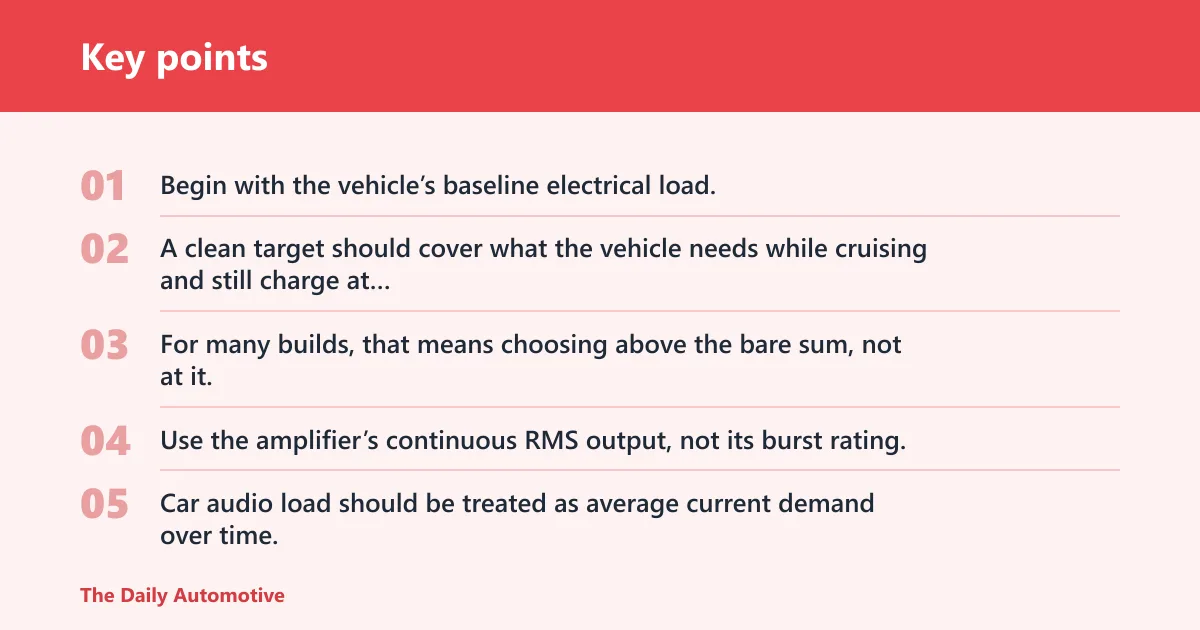


Begin with the vehicle’s baseline electrical load, add the audio system’s continuous draw, then add headroom for heat, voltage stability, and low-RPM operation. A clean target should cover what the vehicle needs while cruising and still charge at idle. For many builds, that means choosing above the bare sum, not at it.
Convert audio power to charging current
Use the amplifier’s continuous RMS output, not its burst rating. Car audio load should be treated as average current demand over time, because alternators charge batteries and support sustained playback, not brief peaks. A simple estimate is:
Amps needed ≈ total continuous watts ÷ system voltage
On a running vehicle, charging voltage is often above 12 volts, so a 1,000-watt RMS system does not always demand 1,000 watts of alternator output in the same way a brochure number suggests. Still, the current draw is large enough that a stock alternator often falls short once factory loads are added.
Separate average draw from peak demand
Average amps are the number that matters for alternator sizing. Peak bass demand is different. It lasts too briefly for the alternator to supply on its own, which is why the battery and, in some cases, a capacitor bank remain part of the system.
That distinction matters. A system that averages 80 amps can still hit sharp peaks well above that for a beat or two, but you should size the charging system for the sustained load first.
What factory accessories add to the total
Headlights, HVAC blowers, fuel pumps, ignition, infotainment, and engine controls all consume current before the audio system gets anything. The alternator has to support the whole vehicle, not the amplifier alone. If the car already uses a large share of available output at idle, the audio target must rise fast.
F1 says an alternator should produce at least 120% of total continuous power requirement, and F2 says 150% is better for sizing. For car audio, that extra margin helps cover heat, low idle speed, and battery recharge after a hard bass hit.
Alternator sizing table
This table turns common build tiers into a practical alternator target. The ranges below assume a daily-driver electrical system, not a show-only or SPL-only setup. They are sized around continuous load, not peak wattage.
| Build tier | Assumed factory load | Audio continuous draw | Recommended alternator | Minimum headroom | Idle-RPM caution | Second battery? |
|---|---|---|---|---|---|---|
| Stock-plus daily driver | 40–60 amps | 20–40 amps | 160–180 amps | At least 30% | Watch traffic idle; many factory units are weak below cruise speed | Usually no, unless music stays loud with engine off |
| 1000W RMS daily driver | 40–70 amps | 70–100 amps | 200–250 amps | At least 30% to 50% | Published output may look strong on paper and still sag at idle | Often advisable for buffering and recharge stability |
| 2000W RMS daily driver | 50–80 amps | 140–180 amps | 250–300 amps | At least 50% | Idle output and hot output matter more than max rating | Yes, especially for stop-and-go use |
| Higher-output daily build | 60–90 amps | 180–250 amps | 300 amps and up | At least 50% | Choose a unit with published idle amps, not just peak amps | Usually yes; consider split electrical planning |
F7 gives a 100-amp audio example needing a 300-amp alternator. That example is aggressive, but it reflects the same logic: once you add factory load, heat loss, and idle weakness, the nameplate number stops being the real number.
Idle-RPM caution and second-battery note
For daily drivers, idle output can decide whether the system behaves well in traffic. A unit that looks adequate at cruise can still fall behind at a stoplight. F3 notes alternators may produce little or no power at idle, and F4 says full output is typically reached around 2,000 to 2,500 rpm.
Say your car uses 55 amps for normal vehicle load and your amp rack averages 90 amps at music volume. That is 145 amps before any headroom. A 180-amp alternator may look close on paper, but if it only makes strong output above 2,000 rpm, you can still see dimming in city traffic.
Why idle output matters
Idle output matters because the alternator cannot make its catalog number at every engine speed. If you spend time in stop-and-go traffic, staging lanes, or long idle periods with the audio up, the system must charge where the engine actually lives most of the time. A strong cruising number alone is not enough.
Published output versus idle output
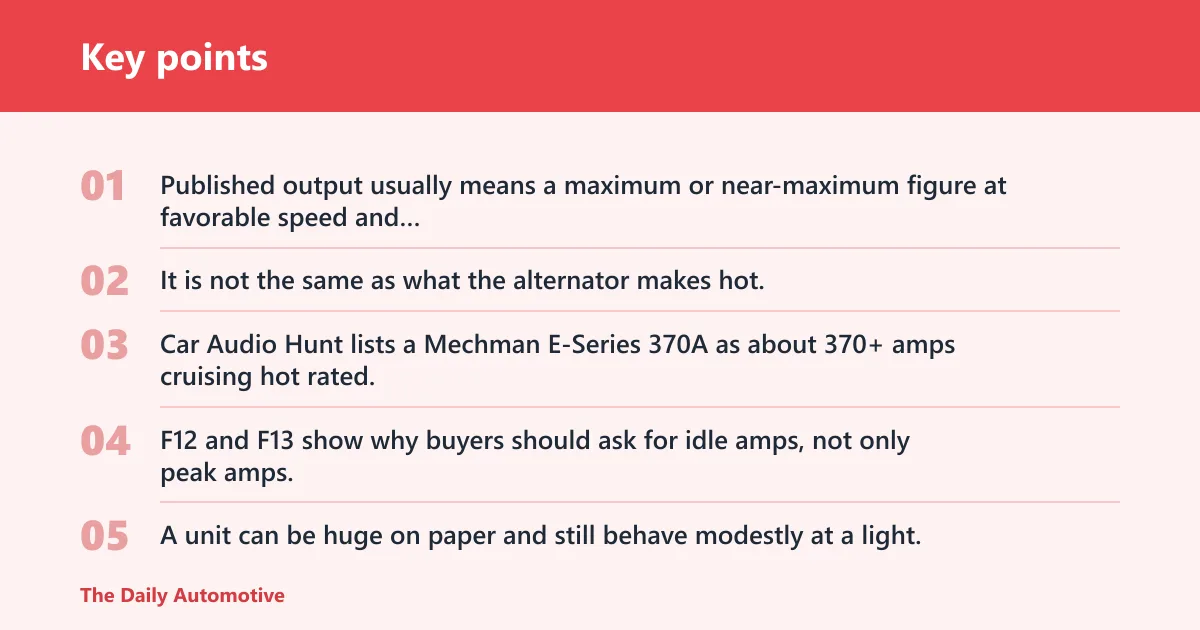
Published output usually means a maximum or near-maximum figure at favorable speed and temperature. It is not the same as what the alternator makes hot, with the engine idling and the cabin loads on. Car Audio Hunt lists a Mechman E-Series 370A as about 370+ amps cruising hot rated, and also lists idle output at about 180+ amps. That gap is the point.
F12 and F13 show why buyers should ask for idle amps, not only peak amps. A unit can be huge on paper and still behave modestly at a light.
Stop-and-go driving limits
Traffic is where a weak alternator shows itself first. Voltage falls, headlights dim, and the battery fills the gap until it cannot. Short drives worsen the problem because the alternator has less time at higher RPM to recover charge.
Heat makes the problem worse. Alternator output drops as temperature rises, so the usable number after a few minutes of hard use is often lower than the number on the box.
Pulley ratio and engine speed effects
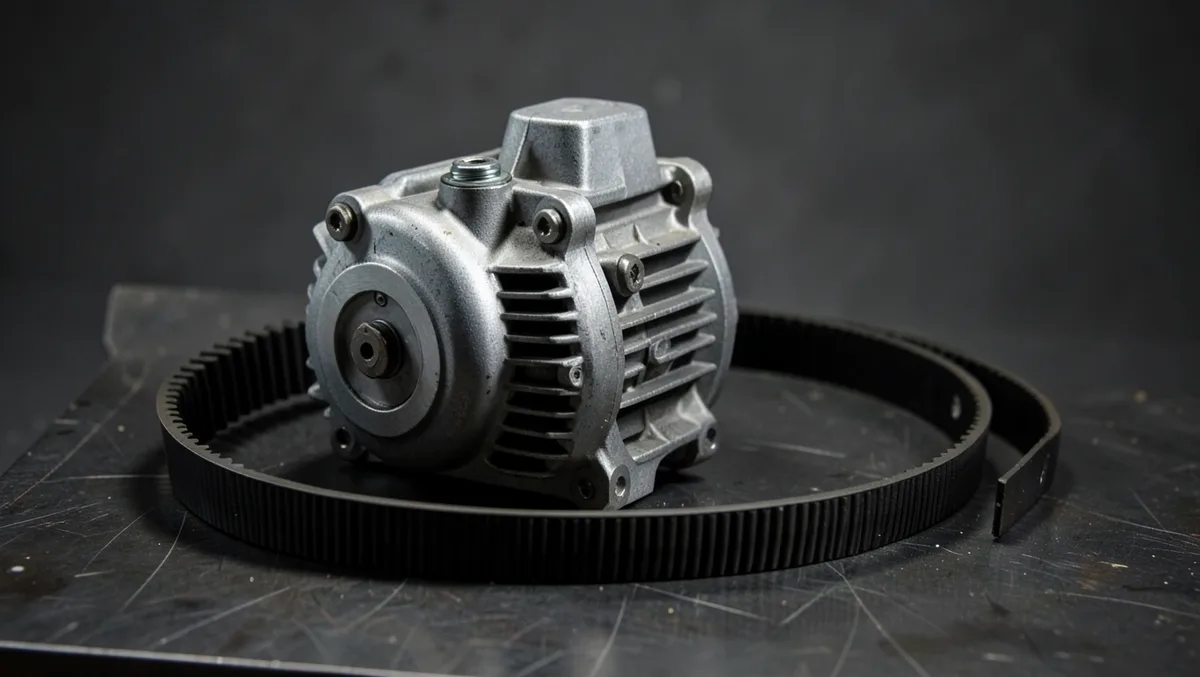
Pulley ratio changes alternator speed relative to engine speed. A smaller alternator pulley can improve low-speed output, but it also changes belt load and can affect how the system behaves at higher rpm. That is why fitment and pulley choice matter together, not separately.
F4’s 2,000 to 2,500 rpm figure is a practical warning: if your normal commute keeps the engine below that range most of the time, size the alternator for stronger low-speed output or build in more headroom.
F15 flags about a three percent voltage-drop limit in an alternator calculator copy. That is a useful target for planning wiring and connector loss. If the system loses too much voltage between alternator and load, the rated amp number matters less than the delivered voltage at the amplifier terminals.
Do you need a second battery?
A second battery is advisable when the audio system needs more buffering than the starting battery can provide, or when the car sees long idle sessions and repeated bass hits. It is not a substitute for alternator output, but it can stabilize voltage and give the system a reserve for brief demands.
Battery capacity and 50% discharge planning
F5 uses 30 minutes as a battery-capacity benchmark for audio systems, and F6 says battery capacity should not be exhausted beyond 50%. That means you should plan usable reserve, not nameplate reserve. A battery bank may sound large, but only part of that capacity is wise to use repeatedly.
The practical lesson is simple: batteries buffer. Alternators recharge.
Deep-cycle versus starting battery
A starting battery is built for short, high-current cranking. A deep-cycle battery is better suited to repeated discharge and recharge for audio use. For a heavy daily build, pairing the right battery type with the right alternator matters more than simply adding any second battery.
Suppose a daily driver has a 200-amp alternator, a 1000W RMS amplifier setup, and a stock starting battery. If the headlights dim only during short bass hits, a capacitor bank may help with those instant peaks. If voltage stays low for minutes, a second battery and more alternator output are the better fixes.
When a capacitor bank helps
A capacitor bank helps with peak demand support and ultra-short-term response. It is useful for sharp transients, but it will not cover sustained playback. If the amplifier load is heavy for more than a few seconds, the alternator and battery bank still carry the system.
What size alternator do I need for a split electrical system?
A split electrical system uses a dedicated audio battery bank and isolates it from the stock starting system. That setup can be the best choice when the audio load is large enough that you want the starting battery protected from repeated discharge. The alternator size still needs to match the audio bank’s charging demand.
Dedicated audio battery bank
In a split system, the audio batteries feed the amplifiers while the stock battery handles starting and vehicle electronics. This arrangement reduces the chance that heavy listening leaves you stranded, especially if the car sits with the system playing at idle or engine off.
Isolated stock starting system
Isolation keeps the starting system stable. That is valuable on daily drivers where reliability matters more than maximum demo time. The charging system must still be strong enough to replenish the audio bank after use, so the alternator target usually rises with the size of the dedicated bank.
Secondary charging alternator tradeoffs
A secondary charging alternator can make sense on very large systems, but cost and packaging rise quickly. More hardware means more fitment work, more belt planning, and more heat to manage. For many daily drivers, one properly sized high-output alternator plus a matched battery bank is the better value.
What to check before you buy
Do not buy by amp number alone. Confirm fitment, output curve, hot performance, and wiring support first. A 270-amp unit that fits the engine bay and makes useful idle output can be a better purchase than a larger unit that only works well on paper.
OEM fitment and billet units
High-output alternators come in OEM-fit housings and custom billet units. OEM fitment is easier when you want a direct replacement. Custom billet units may offer higher output or better internal cooling, but they need careful bracket, pulley, and wiring checks.
Cardetailflow says a Farrme alternator is a direct fit for many Hyundai and Kia V6 models, while it says a HAYIAUTO unit is for many 2007–2010 Dodge, Jeep, and Chrysler vehicles. F9, F10, and F11 are reminders that application compatibility is not universal.
Thermal derating and hot output
Alternators lose real output as they heat up. That is thermal derating. A unit that meets your target cold may fall short after a long drive with headlights, A/C, and audio load all active. For that reason, hot output matters more than peak brochure output.
Wire gauge and voltage drop
Use the alternator output calculator to account for system voltage, total accessory load in watts, voltage drop, pulley ratio, and wire gauge selection. Keep the charging path short and properly sized, and treat the alternator as part of a system rather than a standalone part.
A high-output alternator alone will not fix poor grounds or undersized wire. If voltage drop is large, the audio system still sees less than it should.
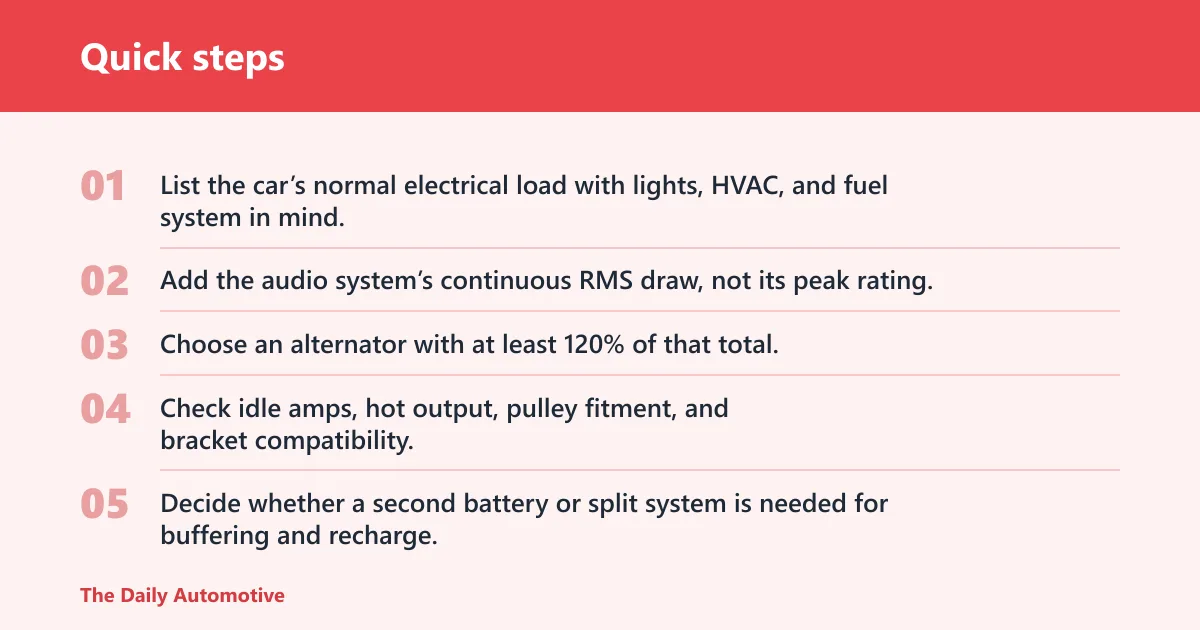
- List the car’s normal electrical load with lights, HVAC, and fuel system in mind.
- Add the audio system’s continuous RMS draw, not its peak rating.
- Choose an alternator with at least 120% of that total; 150% is better when idle use is common.
- Check idle amps, hot output, pulley fitment, and bracket compatibility.
- Decide whether a second battery or split system is needed for buffering and recharge.
Frequently asked questions
How many amps do I need for my car audio system?
Start with the vehicle’s normal electrical load, add the amplifier’s continuous RMS draw, then add headroom. For many daily systems, that lands between 180 and 300 amps. The right answer depends on idle behavior, hot output, and how much time the car spends in traffic rather than cruising.
Is 200 amp alternator enough for car audio?
Sometimes, yes. A 200-amp alternator can work for moderate builds if the factory load is modest and idle output is strong. It is much less convincing for larger systems or traffic-heavy use. If the alternator’s useful output is weak at idle, the 200-amp label may not be enough in practice.
Do I need a high-output alternator for 1000W RMS?
Often, yes. A 1000W RMS system commonly pushes beyond what a stock alternator can support once factory load is included. The exact need depends on the vehicle, but a 200- to 250-amp unit is a common starting range when you want stable voltage and usable idle performance.
Will a bigger alternator stop my headlights from dimming?
It can help, but only if dimming is caused by charging shortfall. If the wiring, grounds, or belt drive are weak, the problem can remain. A larger alternator also needs enough idle output to cover the car’s load during slow driving, not only during highway use.
How much alternator headroom should I buy for car audio?
Use at least 120% of total continuous power requirement, and 150% is better when you idle a lot or run heavy bass in traffic. That headroom covers heat, voltage stability, and recovery after peaks. It is more useful than buying to the minimum catalog number.
Why does my alternator not make full amps at idle?
Alternators often make little or no power at idle, and many do not reach full output until around 2,000 to 2,500 rpm. Pulley ratio, engine speed, and heat all affect usable output. That is why a strong cruising rating can still fall short in stop-and-go driving.
Products related to this article
Sponsored / affiliate links. As an Amazon Associate I earn from qualifying purchases. I may earn additional commission from eligible campaigns.