Hitch Trailer for Car: Cargo Carrier vs Hitch
Use a hitch cargo carrier when you need extra space for light, bulky items and your vehicle’s receiver and tongue weight can handle it; use a trailer hitch and light trailer when the load is heavier, taller, or better carried on its own axle. The wrong setup can overload the rear axle, hurt braking, or make the trip unstable. This guide explains hitch cargo carriers, trailer hitches, roof storage, and light trailers so you can match the setup to your vehicle and trip.
| Decision factor | Cargo Carriers | Trailer Hitches | Winner |
|---|---|---|---|
| Best-fit job | Extra storage for luggage, coolers, camping gear, and dirty items | Towing, where the load needs its own axle and coupler | Depends on the job |
| Setup complexity | Bolt into the receiver and go | Needs a matched hitch, ball mount, and trailer setup | Cargo Carriers |
| Access and parking | Can block the trunk, tailgate, or rear-door swing | Trailer length changes parking and backing behavior more than a carrier does | Cargo Carriers |
| Weather protection | Open carriers leave gear exposed; enclosed styles add cover | Trailer cargo can be enclosed or open, depending on trailer type | Trailer Hitches |
| Handling impact | Rear overhang and extra weight can affect departure angle and balance | Trailer changes braking, sway, and tracking more noticeably | Tie |
| Fuel penalty | Usually less drag than a trailer | Usually more drag and more rolling resistance | Cargo Carriers |
| Vehicle types | Best on cars, crossovers, compact SUVs, and light-duty trucks with enough tongue rating | Best when the vehicle is rated to tow and has the right receiver and wiring | Depends on the vehicle |
Cargo carriers vs trailer hitches: which fits your job?
A cargo carrier solves the storage problem. A trailer hitch solves the towing problem. If you only need to move luggage, muddy boots, coolers, or camp totes, a hitch-mounted carrier is usually the simpler tool. If the load is too heavy, too tall, or needs its own axle, a trailer hitch setup is the right direction.
What a hitch cargo carrier does
A hitch cargo carrier mounts to a vehicle’s tow hitch and sits behind the rear bumper. It gives you a place to carry gear outside the cabin without buying a trailer. Open basket-style carriers fit muddy boots, firewood, wet coolers, and odd-shaped camp bins, while enclosed carriers help protect gear from dust and rain.
What a trailer hitch does
A trailer hitch is the mounting hardware that lets the vehicle tow a trailer. On passenger vehicles, that usually means a receiver hitch with a square steel receiver that accepts a removable ball mount. The hitch itself is not the load bed; it is the connection point for towing equipment.
Why the wrong setup creates fit and handling problems
Rear cargo is not free weight. A carrier adds mass behind the axle, which can change departure angle, visibility, and how the vehicle feels on rough roads or in parking lots. A trailer adds even more moving parts, but it also keeps the cargo on its own axle, which is why heavier or taller loads often belong there instead of on the bumper end of the vehicle.
Receiver hitch basics
A receiver hitch is the square steel receiver mounted to the rear frame area of the vehicle. It comes in common opening sizes such as 1-1/4 inch, 2 inch, 2.5 inch, and 3 inch, and the class rating tells you how much load the system is typically rated to handle. Industry references and manufacturer specs commonly place these classes in broad ranges, but the vehicle placard, hitch label, and owner’s manual are the final authority. The receiver accepts a removable ball mount or a cargo carrier shank.
Class I through V sizing
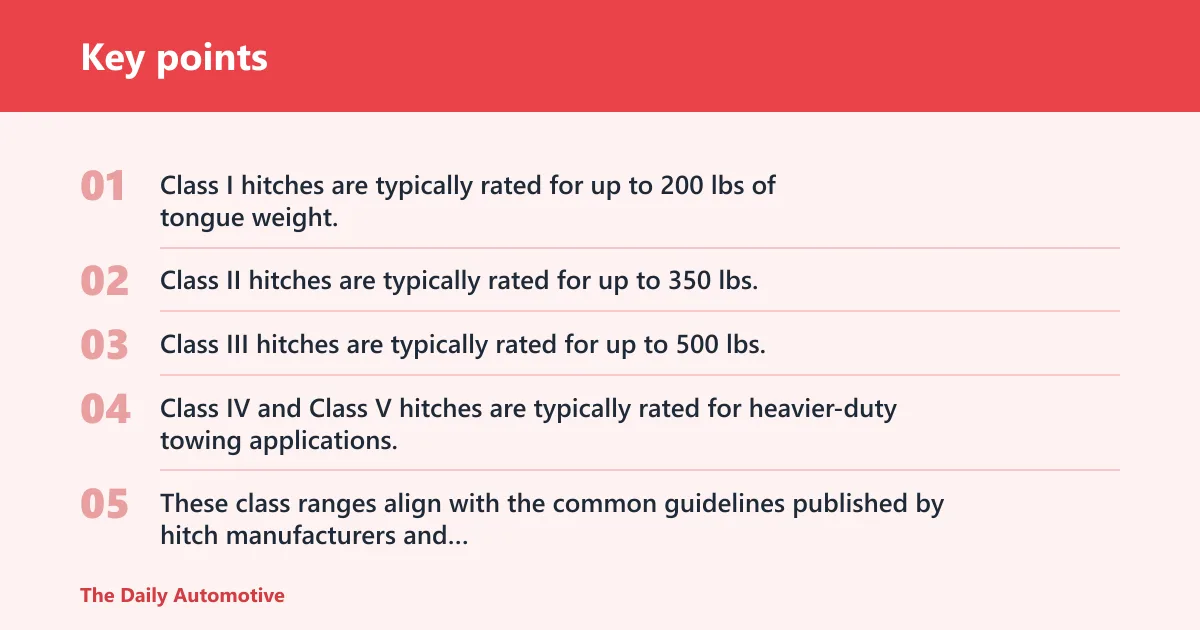
Class I hitches are typically rated for up to 200 lbs of tongue weight. Class II hitches are typically rated for up to 350 lbs. Class III hitches are typically rated for up to 500 lbs. Class IV and Class V hitches are typically rated for heavier-duty towing applications, often 500 lbs and above depending on the vehicle and hitch design. These class ranges align with the common guidelines published by hitch manufacturers and towing references, but the actual rating can vary by vehicle and installation.
That range matters because a cargo carrier is only as useful as the vehicle’s rear load limit. A receiver with a bigger opening is not automatically better; the vehicle, the hitch, and the carrier all have to agree on the rating.
Rear-frame mounting and ball-mount use
Receiver hitches mount to the rear frame structure, not just the bumper skin. That is what lets them support a carrier or tow hardware. If you plan to tow, the removable ball mount is the part that holds the hitch ball and connects the trailer coupler.
Hitch cargo carrier basics
A hitch cargo carrier is a rear-mounted storage platform, not a towing tool. It is used for luggage, coolers, camping gear, and dirty items that you do not want inside the cabin. The main tradeoff is simple: it is easier than a roof box, but it eats into rear clearance and hitch capacity.
Open basket vs enclosed carrier
Open basket-style carriers are used for muddy boots, firewood, propane canisters, and camp totes that do not need a sealed box. They are the straightforward option when a duffel bag, firewood, or a camp tote needs to ride outside the vehicle. Enclosed carriers protect gear from dust and rain, but they add bulk and can make access harder.
Fold-up and tilt-down features
Many carriers fold up when empty so the rear of the vehicle is easier to park. Some tilt down for access, which can help if you need to reach a liftgate or hatch. Even with those features, check whether the carrier clears the bumper, exhaust, and rear hatch before loading it.
Common cargo uses
These carriers make sense for road trips, camping, and dirty gear that would be unpleasant in the cabin. They are also useful when a trunk is small but you still need extra volume for soft bags or coolers. They are less useful for tall cargo that catches wind or blocks your rear view.
Tongue weight and capacity math
Tongue weight rating is the maximum weight hung off the rear, and it includes the carrier itself. That means the carrier weight must be subtracted from the available cargo capacity before you load a single bag. The vehicle-specific limit is the final limit, even if the carrier itself looks sturdy.
How to subtract carrier weight from usable capacity
Use this rule: available cargo capacity = vehicle tongue weight rating − carrier weight. Then subtract any other rear-mounted gear that rides on the same hitch setup. If the remaining number is lower than what you planned to load, the carrier is the wrong tool for that trip.
Worked example: simple calculator scenario
- Vehicle tongue weight rating: 350 lbs.
- Carrier weight: 60 lbs.
- Usable cargo capacity: 350 − 60 = 290 lbs.
- If the bags and cooler weigh 310 lbs, the load is too heavy.
- At 280 lbs of cargo, the setup stays within the remaining margin.
Say your compact SUV has a Class II receiver and you want to load two checked-size suitcases, a cooler, and a folding chair. If the carrier weighs 55 lbs, and the vehicle limit is 350 lbs, the cargo side can only use 295 lbs total after the carrier is counted. That is the number that decides the trip, not the basket size.
Which setup is better for your vehicle?
Vehicle shape changes the answer. Sedans often run out of rear clearance before they run out of cargo ideas. Compact SUVs and crossovers usually give you more hatch access, but the hitch rating still decides how much you can safely hang off the rear. Trucks can support more hardware, but that does not mean a trailer is unnecessary.
Sedans and compact cars
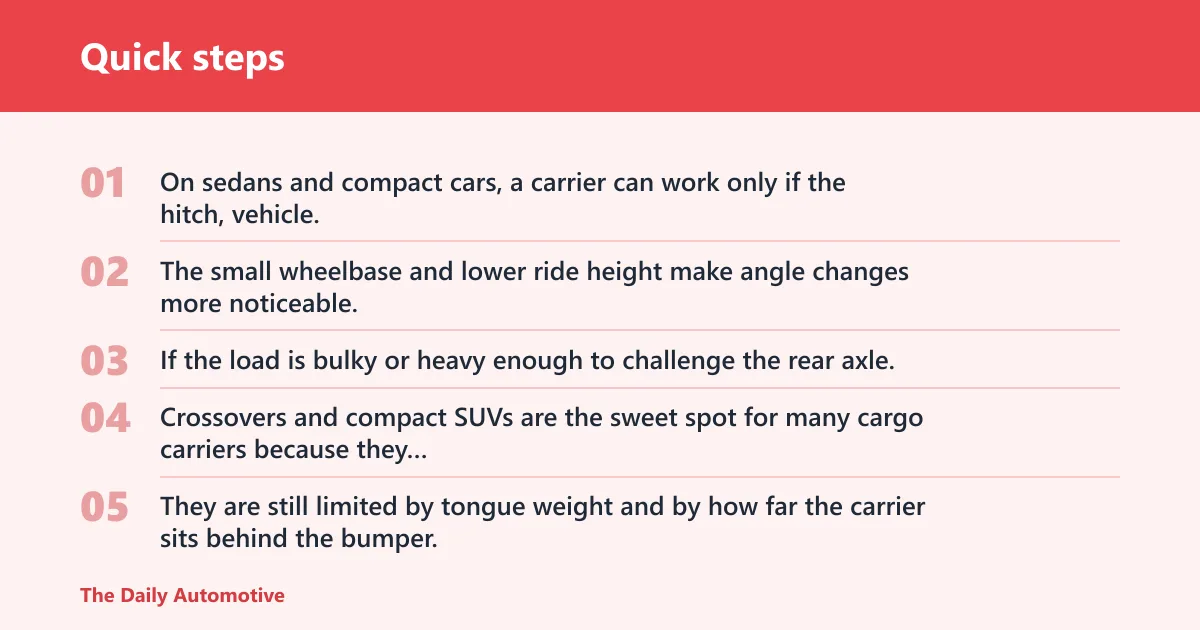
On sedans and compact cars, a carrier can work only if the hitch, vehicle, and rear clearance all cooperate. The small wheelbase and lower ride height make angle changes more noticeable, so tailpipe clearance, departure angle, and rear visibility matter a lot. If the load is bulky or heavy enough to challenge the rear axle, a trailer or roof storage may be the better path.
Crossovers and compact SUVs
Crossovers and compact SUVs are the sweet spot for many cargo carriers because they often have a usable receiver, decent hatch access, and enough rear structure for light loads. They are still limited by tongue weight and by how far the carrier sits behind the bumper. If the hatch cannot open without hitting the carrier, choose a different setup.
Trucks and larger SUVs
Trucks and larger SUVs can handle more rear hardware, but the right answer still depends on the load. If you need a cargo solution for dirty gear or a cooler, a carrier may be enough. If the job involves towing a trailer, moving a boat, or carrying a load that belongs on its own axle, the truck’s receiver should be set up for towing instead.
Carrier vs trailer decision matrix

This is the comparison that matters in practice. A cargo carrier is the simpler tool for extra storage. A light trailer is the better tool when you need more payload, better axle placement, or a cargo box that should not hang behind the vehicle.
| Factor | Cargo Carriers | Trailer Hitches | Winner |
|---|---|---|---|
| Payload range | Best for lighter loads that fit within tongue weight limits | Better when the load is heavier or needs its own axle | Trailer Hitches |
| Access | Can block hatch, trunk, or rear-door access | Usually preserves rear cargo access, but adds trailer access at the rear | Trailer Hitches |
| Weather protection | Open or enclosed, depending on carrier style | Depends on trailer style; enclosed trailers protect cargo well | Tie |
| Parking impact | Shorter than a trailer, but adds rear overhang | Requires more room to turn, back, and park | Cargo Carriers |
| Fuel penalty | Usually lower | Usually higher | Cargo Carriers |
| Setup time | Usually quicker | More setup because hitch, coupler, lights, and trailer need to be matched | Cargo Carriers |
| Vehicle types | Works best on light-duty vehicles with enough tongue rating | Best when the vehicle is rated to tow and the trailer load is appropriate | Depends on the vehicle |
Payload range
Light cargo favors the carrier because it keeps the setup simple. Once the load grows enough that carrier weight, gear weight, and rear axle load become a concern, a trailer becomes the more sensible tool. The decision is less about convenience and more about where the weight belongs.
Access, weather protection, and parking impact
A carrier can cut off hatch access and make a rear door awkward to use, especially on hatchbacks and compact SUVs. A trailer gives the cargo its own box, but it also makes parking and backing more demanding. If your driveway is tight or the vehicle parks nose-in on the street, the shorter carrier may fit the space better.
Picture a small crossover with a rear liftgate and a loaded basket. If the carrier sits low enough to force the hatch to stop halfway, the setup is already working against you before the trip starts. In that case, the better answer may be a trailer or roof storage, not a more aggressive loading strategy.
Fuel penalty, setup time, and vehicle type
Trailers usually create more drag and more rolling resistance than a carrier. They also take more setup time because wiring, coupler fit, and parking technique all matter. For short trips and lighter cargo, the carrier keeps the job smaller. For larger loads, the trailer’s extra effort pays off in better load placement.
Heavy towing hardware you should not confuse with cargo storage
A weight-distribution hitch uses spring bars to redistribute tongue weight. It is used to improve steering response and reduce sway, especially with large travel trailers. That is towing hardware, not cargo storage hardware.
A gooseneck hitch mounts inside the truck bed, with the ball protruding through the bed floor. That puts the weight over the rear axle and is used for heavy loads. A fifth wheel hitch also mounts in the truck bed, but it uses a coupling jaw that grabs the trailer kingpin.
Pintle hitches use a hook-and-ring coupler and a lunette ring. They are common in harsher terrain and industrial or agricultural work. None of those setups is a substitute for a simple cargo carrier when all you need is extra space for bags or gear.
Choose the right setup
Choose Cargo Carriers if your load is light to moderate, your vehicle has enough tongue weight capacity left after the carrier’s own weight, and you want a simpler solution for bags, coolers, or dirty gear. Choose Trailer Hitches if the load is heavier, needs better axle placement, or belongs on a trailer that keeps the cargo off the rear overhang of the vehicle.
Choose Cargo Carriers for quick trips, compact SUVs, and any situation where a small amount of extra storage solves the problem. Choose Trailer Hitches when the cargo is large enough to challenge hatch access, rear clearance, or tongue weight math. If the trailer is only being used because the carrier would be overloaded, the trailer is the right tool.
Verdict: Cargo Carriers or trailer Hitches?
Choose Cargo Carriers if you need extra space for luggage, coolers, camping gear, muddy boots, or dirty items, and you want the simpler setup that bolts into the receiver and goes.
Choose Trailer Hitches if the load is heavier, taller, or needs its own axle, such as towing a trailer, moving a boat, or carrying cargo that belongs on its own axle and coupler.


Frequently asked questions
Is a hitch cargo carrier better than a trailer hitch?
A hitch cargo carrier is better when you need extra storage, not towing. It is simpler, shorter, and usually easier to set up. A trailer hitch is better when the load needs its own axle or when the carrier would eat too much into tongue weight and rear clearance.
What is the difference between a trailer hitch and a cargo carrier?
A trailer hitch is the vehicle hardware that lets you tow. A cargo carrier is a storage platform that mounts in that receiver. One is for pulling a trailer, and the other is for carrying cargo behind the vehicle.
Can I use a hitch cargo carrier on my car?
Yes, if your car has the correct receiver hitch and enough tongue weight rating for the carrier plus the load. Check the vehicle manual, the hitch class, and the carrier instructions. Small cars often run into clearance and hatch-access limits before they run into space limits.
How much weight can a hitch cargo carrier hold?
The carrier’s limit is set by the vehicle’s hitch rating, the carrier’s own rating, and the tongue weight rule. The carrier itself counts against the total, so you subtract its weight from the available capacity. Always use the lowest listed limit in the setup.
Do hitch cargo carriers count as towing?
No. A cargo carrier is a rear-mounted storage accessory, not a trailer. It uses the hitch receiver, but it does not tow a separate unit. That said, it still affects rear load, handling, and clearance, so the vehicle limits still matter.
When should I use a trailer instead of a hitch carrier?
Use a trailer when the load is too heavy for the remaining tongue capacity, when it rides better on its own axle, or when the cargo would block hatch access and rear visibility. A trailer is also the better choice for taller or bulkier loads that need more room than a carrier can safely give.
Products related to this article
Sponsored / affiliate links. As an Amazon Associate I earn from qualifying purchases. I may earn additional commission from eligible campaigns.