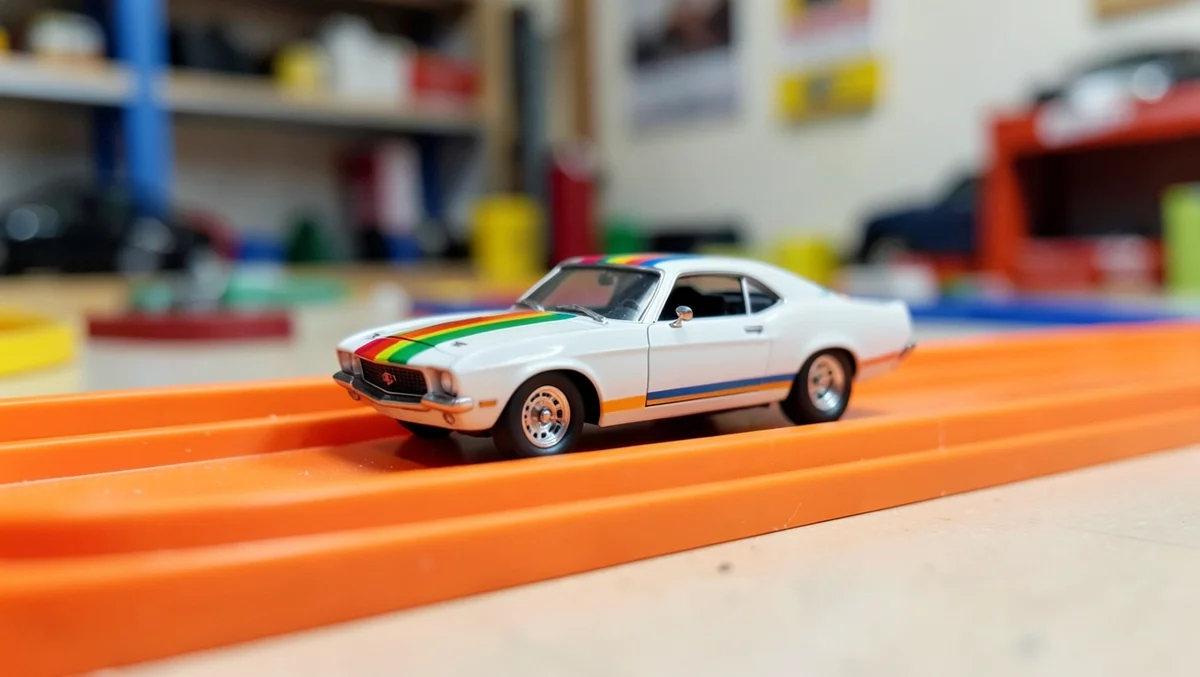
HO Scale Decals for Slot Cars: Types, Application and Real Picks
Choose water-slide decals for hard-shell bodies and restoration-accurate liveries. Use adhesive or vinyl decals when a race-ready Lexan body needs faster handling and a thicker film. Wrong decal type leads to silvering, edge lift, cracked graphics, and a finish that looks off. This guide covers decal types, surface prep, application steps, and named sheet picks by build goal.
What HO decals fit your build?
Start with the finish you want, then match the decal format to the body material. Museum-clean display work usually favors thin water-slide film on a smooth hard shell. Race-ready builds benefit from easier-to-handle peel-and-stick graphics. Restoration work needs the format that best matches the period art, not the quickest sheet to apply.
Which HO decal type fits your build?
| Body type | Skill level | Finish goal | Best decal format | Application difficulty | Common failure mode |
|---|---|---|---|---|---|
| Plastic hard shell | Beginner to advanced | Museum-clean display | Waterslide decals | Moderate | Silvering if the surface is dull or dirty |
| Plastic hard shell | Beginner | Fast race-ready use | Peel-and-stick decals | Easy | Edge lift on tight curves |
| Lexan body | Beginner to advanced | Track durability | Peel-and-stick decals | Easy to moderate | Adhesion loss if the shell is not clean |
| Lexan body | Advanced | Specific livery match | Only a compatible waterslide product | Hard | Cracking, curling, or failure on flex |
| Painted restoration shell | Advanced | Period-correct look | Waterslide decals | Moderate to hard | Tearing during slide-out or too much setting solution |
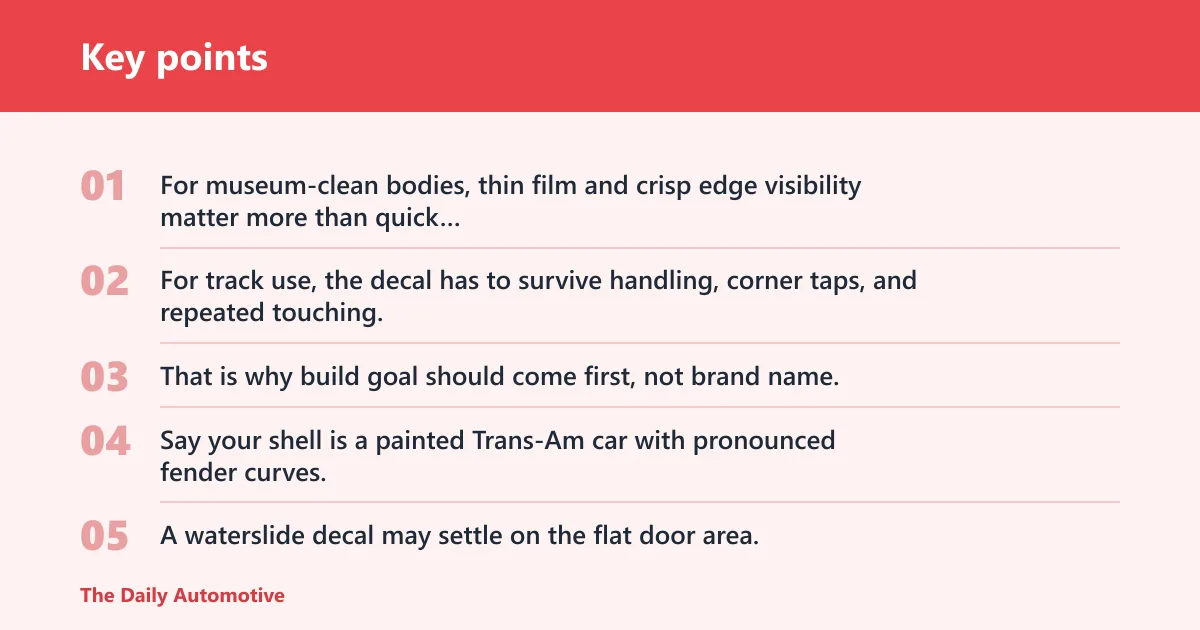
For museum-clean bodies, thin film and crisp edge visibility matter more than quick install. For track use, the decal has to survive handling, corner taps, and repeated touching, so thicker adhesive film can be the better compromise. That is why build goal should come first, not brand name.
Say your shell is a painted Trans-Am car with pronounced fender curves. A waterslide decal may settle on the flat door area, then wrinkle around the wheel arch if you push it too hard. A peel-and-stick sheet can be less fussy there, though the edge needs careful burnishing.
A common first-timer mistake is choosing the thinnest film available for a flexible Lexan body because it looks best on paper. On the wrong backing, a thin waterslide can crack during handling, while a decal with poor adhesive can lift at the spoiler edge after a few laps.
Waterslide versus peel-and-stick
Waterslide decals transfer from a backing paper to the body after soaking, then sliding the graphic into place. Peel-and-stick decals use a self-adhesive face on a thin plastic backing, so you position them dry and press them down. Waterslide is common on plastic hard shells and some compatible Lexan setups; peel-and-stick is usually easier for beginners.
What changes in use
Waterslide film is usually the better choice when you want the graphic to disappear into the paint and clear coat. It also suits vintage and modern liveries where the artwork needs to look printed into the body rather than sitting on top of it. The tradeoff is higher surface sensitivity.
Peel-and-stick decals are simpler to handle because you do not need to soak and slide the graphic. They often suit hard-shell bodies and Lexan bodies when you want quicker installation and stronger handling tolerance. The tradeoff is thicker edge visibility, especially on light-colored paint or under strong lighting.
Compatibility warning: many waterslide decals crack or fail on flexible Lexan if you use them the wrong way. Only use a waterslide sheet on Lexan when the product listing and body type are compatible, or when the decal is specifically intended for that use.
Where each format looks best
- Waterslide: best for close-up display, restoration accuracy, and body panels that are smooth and sealed.
- Peel-and-stick: best for faster builds, frequent handling, and bodies that need a more durable graphic layer.
- Hard shell: both formats work, but waterslide usually gives the cleaner visual finish.
- Lexan: check compatibility first; peel-and-stick is the safer default unless the waterslide product is clearly approved.
What do the major decal families fit?
Match the family to the livery first, then narrow by body material and finish. The best choice for a vintage stock car is not always the best choice for a modern prototype. Some sheets are built around sponsors, others around numbers and roundels, and some are aimed at a very specific era.
Major families by use case
| Use case | Best-fit family | Why it fits |
|---|---|---|
| Vintage stock car | Auto World number and sponsor decals; MicroSport NASCAR sponsor and number sheets | Good match for 1960s and 1970s race numbers, sponsor marks, and period stock-car graphics |
| Modern GT/GTP | MicroSport decal sheet #1; MicroSport GTP Sponsor Stickers Sheet #1 and #2 | Aimed at modern FIA and GT prototypes, with sponsor sets that fit newer endurance themes |
| Trans-Am | Auto World number and sponsor decals; select waterslide sponsor sheets | Works well when you need period numbers, logos, and roundels without over-modern artwork |
| Can-Am | MicroSport Can Am Sponsors; some sponsor-focused waterslide sheets | Useful for vintage Can Am race cars that need era-correct sponsor graphics |
| Generic numbers/roundels | FIA Number Stickers Sheets; Die-Cut Roundel Stickers; Auto World roundels | Best when the build needs basic race markings rather than a full sponsor package |
Where the named products fit
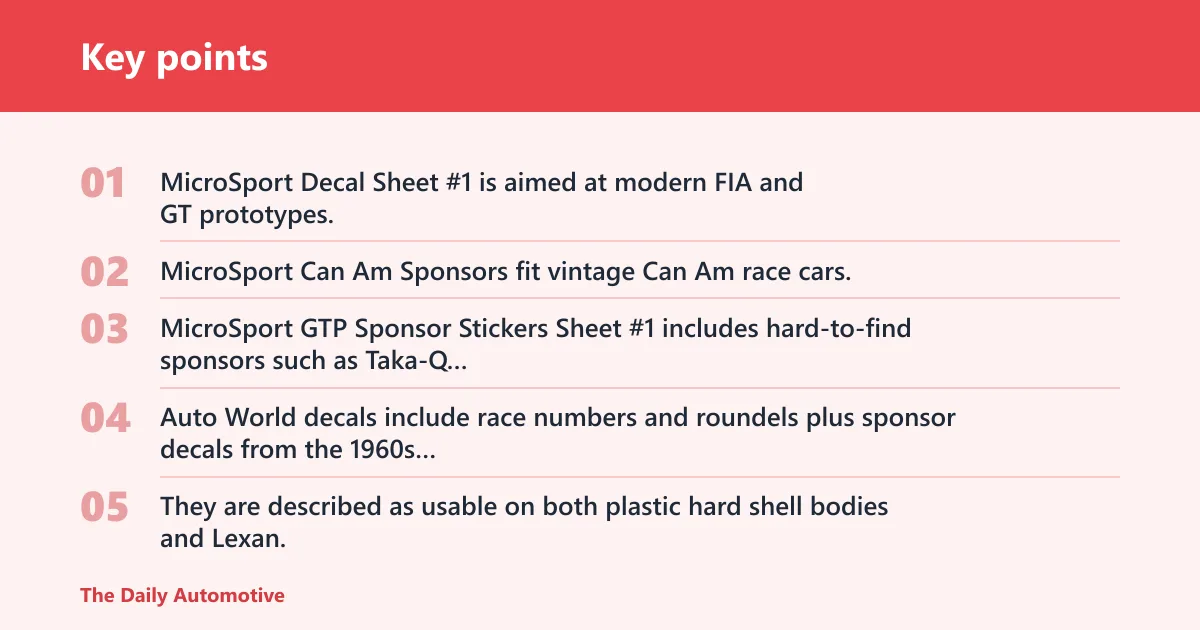
MicroSport Decal Sheet #1 is aimed at modern FIA and GT prototypes. MicroSport Can Am Sponsors fit vintage Can Am race cars. MicroSport GTP Sponsor Stickers Sheet #1 includes hard-to-find sponsors such as Taka-Q and NewMan, while Sheet #2 includes sponsors such as Martini and Camel.
Auto World decals include race numbers and roundels plus sponsor decals from the 1960s and 1970s. They are described as usable on both plastic hard shell bodies and Lexan. That makes them a practical pick when you want one decal family that works across vintage and modern use.
FIA Number Stickers Sheet #2 notes that many Ferrari factory entries used a block-style of race numbers. That matters if you are matching a specific entry rather than using generic roundels. The roundel choice should follow the livery reference, not just the body shape.
Die-Cut Roundel Stickers are pre-cut in circular form. They have no black outer circle, which gives a cleaner look on bodies that already carry the right trim color. They can be used on hard shell or Lexan bodies, but the body surface still needs to suit the adhesive.
UltraCal high-definition decals are a separate peel-and-stick line, not a waterslide sheet. UltraCal states its decals are pre-cut and printed on an ultra-thin film, and that they can be peeled off the backing and easily applied. JAG Hobbies lists 1/64 scale roundel decals through UltraCal, and UltraCal also offers 1/43 scale racing stripe and roundel decals. The line also includes families in roughly 1/87 scale.
How do you apply them cleanly?
Clean application starts before the decal ever leaves the sheet. Wash the body to remove mold release, dust, skin oil, and polishing residue, then let it dry fully. If the surface is rough, lightly sand and prime first; if it is already painted and glossy, check that the clear layer is smooth enough for the film to lay flat.
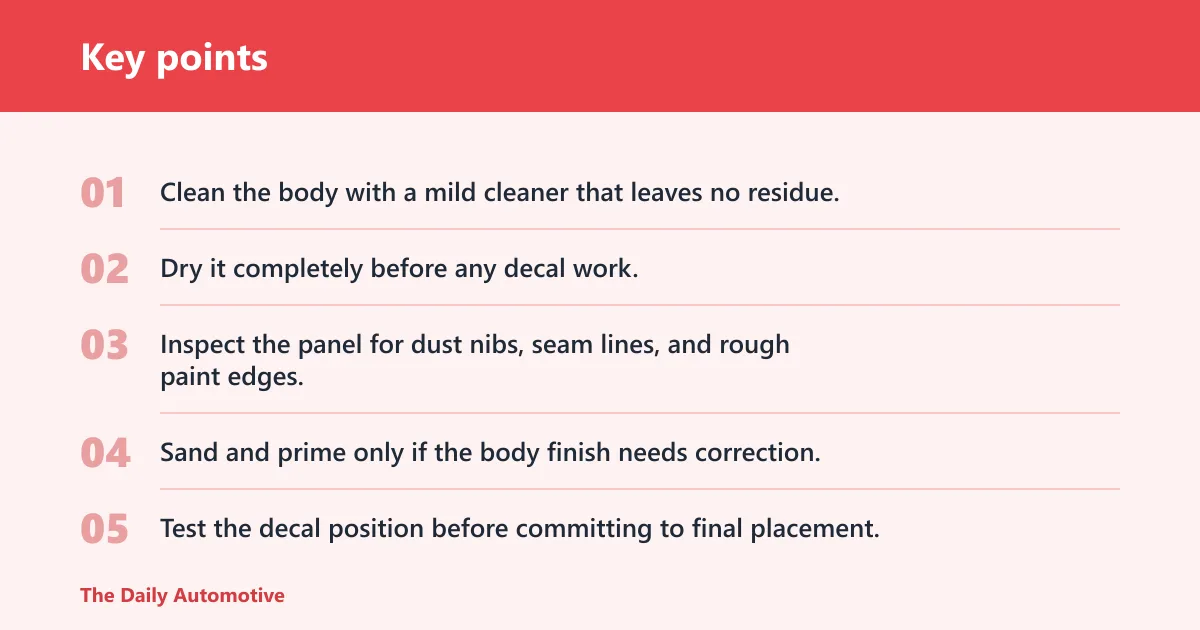
- Clean the body with a mild cleaner that leaves no residue.
- Dry it completely before any decal work.
- Inspect the panel for dust nibs, seam lines, and rough paint edges.
- Sand and prime only if the body finish needs correction.
- Test the decal position before committing to final placement.
Waterslide steps
Cut the decal close to the printed image, then soak it until the film loosens from the backing. Slide it into place with a damp brush or swab, not dry fingers. Once positioned, blot away trapped water and let it dry undisturbed. Use a setting solution only if the product and body finish are compatible.
Do not rush the drying stage. If the decal is moved too early, it can tear or fold. If it sits on a dirty or satin surface, trapped air can leave a cloudy look known as silvering. A glossy base usually gives the cleanest result for waterslides.
Peel-and-stick steps
Peel-and-stick decals are placed dry, so alignment matters more from the start. Set one edge first, then press the rest down with a soft cloth or cotton swab. Work from the center outward to push out air and avoid wrinkles, especially around corners and raised bodywork.
After placement, press the edges again so they stay down at the body line. If the decal is on a hard curve, confirm that the film is not bridging over a gap. That is where edge lift starts. On Lexan, a clean inner or outer surface is the difference between a decal that stays put and one that peels early.
What tools and materials do you need?
Keep the tool list simple. A sharp hobby knife, fine tweezers, a soft cloth, and cotton swabs cover most installs. For waterslides, add a decal-setting solution that matches the sheet and your finish. For peel-and-stick decals, a burnishing tool helps, but a clean swab often does the job.
Basic kit
- Hobby knife for trimming close to the image
- Fine tweezers for placing small numbers and sponsor marks
- Soft cloth for blotting and final pressure
- Cotton swab for curves, edges, and small corrections
- Decal-setting solution when the waterslide sheet calls for it
Do not flood a thin film with setting solution unless the instructions allow it. Clear coats also need caution. Some decal films are happier under a light protective coat after full cure, while others can wrinkle if the solvent is too strong. Follow the product sheet and body paint system instead of forcing one process onto every decal.
Safety note: follow the vehicle/product manual, never work under a vehicle held only by a jack, never exceed the vehicle’s rated roof/hitch/tow limit, keep items out of airbag zones and the driver’s view, and check local laws.
Frequently asked questions
What are the best HO scale decals for slot cars?
The best choice depends on the build outcome. For display and restoration work, waterslide decals usually give the cleanest look. For race-ready durability, peel-and-stick or other adhesive decals are easier to apply and often hold up better to handling. Match the format to the body material and the livery era.
What is the difference between waterslide and peel-and-stick decals?
Waterslides are transferred from a backing sheet with water, then positioned on the body and dried in place. Peel-and-stick decals use a thin plastic backing and a self-adhesive face, so they go on dry. Waterslides can look thinner; peel-and-stick is usually easier and faster for beginners.
How do you apply HO slot car decals without silvering or wrinkles?
Clean the body, let it dry, and apply waterslides to a smooth surface so air cannot get trapped under the film. For peel-and-stick, place one edge first and press outward with a soft cloth or swab. Let waterslides dry fully before handling, and do not force the film around a tight curve.
Which decal type is better for hard shell versus Lexan bodies?
Hard shells usually favor waterslide decals when you want a cleaner, painted-in look. Lexan often favors peel-and-stick decals because they are easier to handle and more durable in use. Waterslides can work on some Lexan bodies only when the product and body are explicitly compatible.
What tools do I need to install slot car decals cleanly?
Use a hobby knife, tweezers, a soft cloth, and cotton swabs as your core kit. Add decal-setting solution for waterslides if the sheet calls for it. A clean, glossy surface matters more than fancy tools, and a steady hand matters more than heavy pressure.
How much do HO slot car decal sheets cost?
Prices vary by brand, subject, and scale, so check the manufacturer or seller listing for the exact sheet you want. As one listed example, JAG Hobbies offers a Late 60’s Stocker decal set priced at $25.00. Value depends on how many usable sponsor marks and numbers the sheet gives you.
Which decals work best for vintage NASCAR, Trans-Am, or GTP builds?
For vintage NASCAR and many Trans-Am builds, Auto World number and sponsor decals are a strong fit because they cover 1960s and 1970s race numbers and roundels. For modern GTP work, MicroSport decal Sheet #1 and the GTP Sponsor Stickers sheets are better matched to current prototype themes.
Can HO decals be used on both modern and vintage slot cars?
Yes, but the sheet has to match the era and body material. Modern FIA and GTP projects often need different sponsor art than vintage Can-Am or stock car builds. Auto World covers both vintage and modern compatibility well, while MicroSport separates its sheets by era and use case.
Products related to this article
Sponsored / affiliate links. As an Amazon Associate I earn from qualifying purchases. I may earn additional commission from eligible campaigns.