How Long Does Auto Tech School Take? Timelines
Auto tech school usually takes from several months to about 2 years, depending on the program type; shorter programs may fit entry-level shop roles, while longer ones may support broader diagnostics and advancement. A poor match can waste tuition, delay wages, and send you into classes that do not fit the work you want. This guide breaks down each timeline, what it qualifies you for, and how to choose a schedule that fits school, work, or both.
Choosing a Tool Set and OBD II Scanner for Your Shop
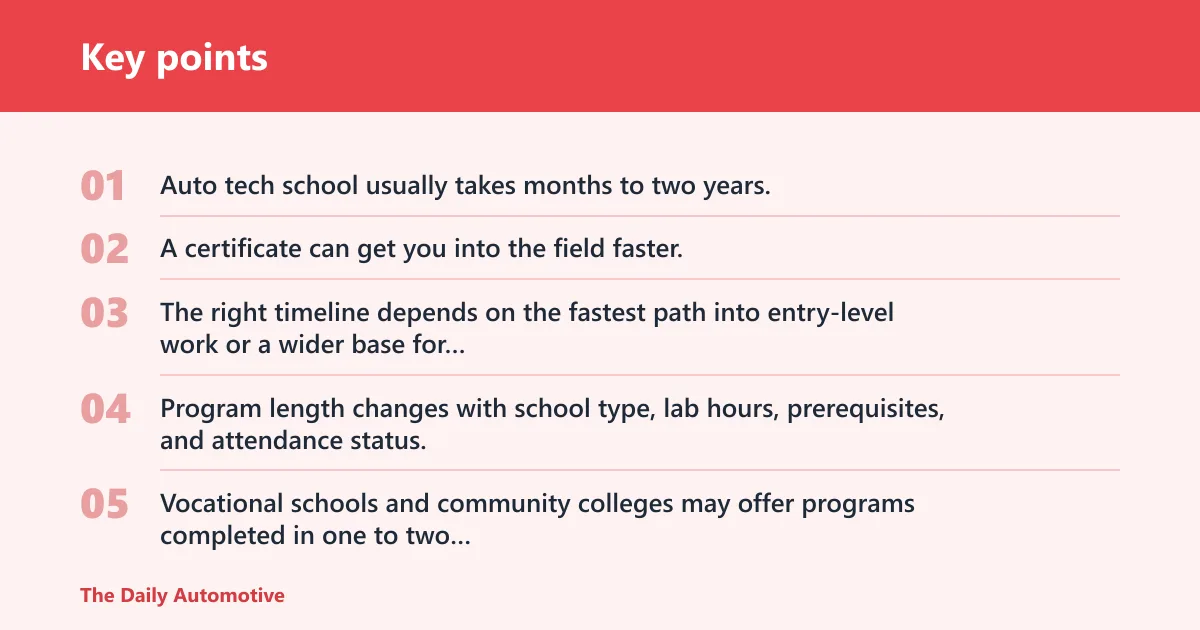


Auto tech school usually takes months to two years. A certificate can get you into the field faster, while an associate degree usually takes about 2 years and adds general education and broader technical coursework. The right timeline depends on the fastest path into entry-level work or a wider base for future advancement.
What changes the timeline
Program length changes with school type, lab hours, prerequisites, and attendance status. Vocational schools and community colleges may offer programs completed in one to two years, while shorter intensive programs may take around nine months. Shop labs and repair bays add required practice time, and more practice can extend the schedule.
Say your goal is a brake and oil-change job at a local independent shop. A shorter certificate may fit that target better than a longer degree program if you want to start earning sooner.
📊 Associate degree programs typically take 2 years to complete. Source: How Long Does Auto Tech School Take?.
Certificate program vs. associate degree: which takes less time?
Certificate programs usually take less time than associate degrees and are built for faster entry to workforce roles. Certificate training often focuses on hands-on shop skills with less general-education load, while an associate degree adds broader coursework and usually takes about 2 years. Your job goal should decide the path.
Certificate program length and job focus
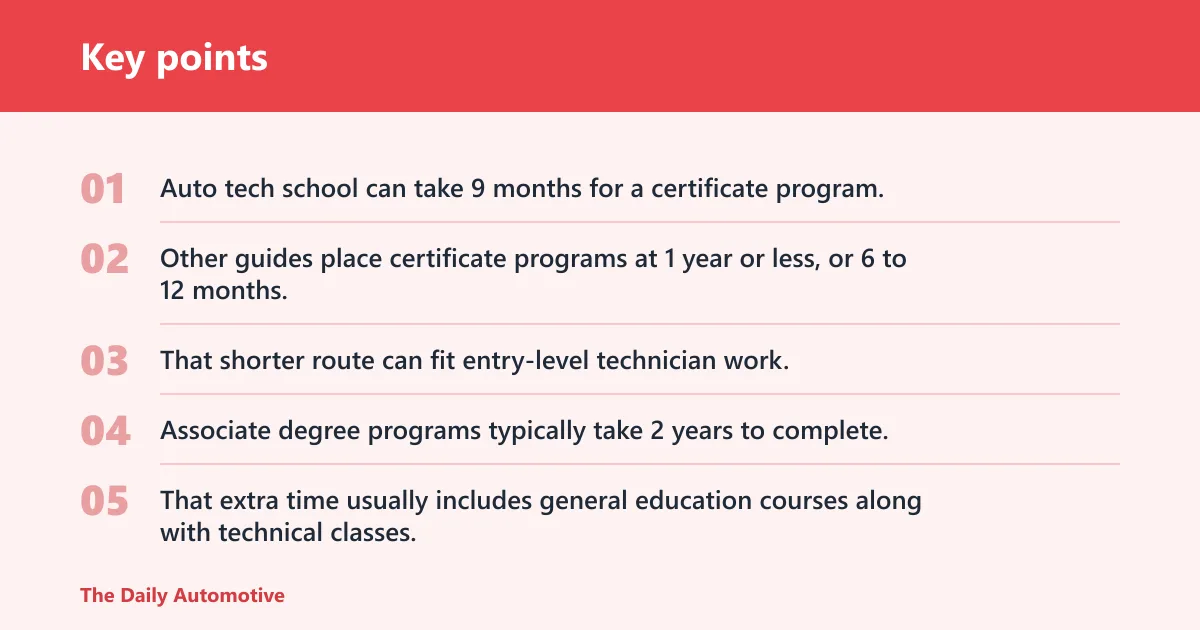
Auto tech school can take 9 months for a certificate program, and some automotive technology certificates can be obtained in as little as 6 months. Other guides place certificate programs at 1 year or less, or 6 to 12 months. That shorter route can fit entry-level technician work, especially when the program emphasizes lab practice and basic diagnostics.
Associate degree length and general-education load
Associate degree programs typically take 2 years to complete. That extra time usually includes general education courses along with technical classes, which broadens the training base. For students who want stronger preparation for diagnostics, service writing, or future supervision, the longer path can be worth the added semester count.
Which path fits your goal
If the goal is the quickest route into entry-level work, a certificate is usually the better fit. If the goal includes broader preparation, more classroom depth, and a credential that may support advancement, an associate degree is the more complete option. Both can lead to auto tech careers; they just get there on different schedules.
| Path | Typical duration | Likely weekly pace | Best-fit student profile |
|---|---|---|---|
| Certificate program | 6 to 12 months | Full-time, several lab blocks each week | Career changer or high school graduate who wants faster entry to the shop |
| Associate degree | 2 years | Full-time academic load with labs and general education | Student who wants broader training and more room for advancement |
| Accelerated program | 6 to 18 months | Heavy, concentrated schedule with frequent lab time | Student who can commit to an intensive pace and wants the shortest route |
| Part-time study | Often longer than full-time; usually stretches completion by several terms | Evenings, fewer credits, or stop-start enrollment | Working adult who needs class around a job or family schedule |
How long does vocational school or community college take?
Vocational schools and community colleges often run auto tech programs in one to two years. Community college usually offers the associate degree option, while vocational school more often centers on career-focused shop and lab training. Full-time enrollment is faster than part-time, and lab requirements can add time because hands-on skill practice cannot be rushed.
Typical full-time program range
Automotive repair and maintenance programs typically range from six months to two years. That range captures short certificate tracks, diploma options, and associate degree paths. Automotive technology is a common trade-school route for entry-level technician preparation, so the exact length depends on how much theory, lab work, and general education the school includes.
Part-time pace at community college
Community college can be the better fit for students who need a lighter schedule, but part-time enrollment usually extends completion. A two-year associate degree can stretch beyond 2 years when classes are taken in the evening or only a few credits at a time. Missed terms and summer skips can add more months.
Where lab hours fit in
Hands-on training matters because you build diagnosis, inspection, and repair skill by doing the work in a shop or lab. More lab hours can mean better preparation for the shop, but they also lengthen the calendar if the program requires sequence-based courses. Some schools will not let you advance until certain labs are finished.
Suppose a student misses the engine lab this fall because of work. That single missed course can push graduation into the next term, which is why schedule planning matters as much as the catalog length.
What is the shortest time to become a mechanic?
The shortest route is usually an accelerated auto tech program, which typically ranges from 6 to 18 months. Some intensive programs may take around nine months, and a few automotive technology certificates can be obtained in as little as 6 months. The tradeoff is less time for broader theory and deeper practice.
The tradeoff between speed and depth
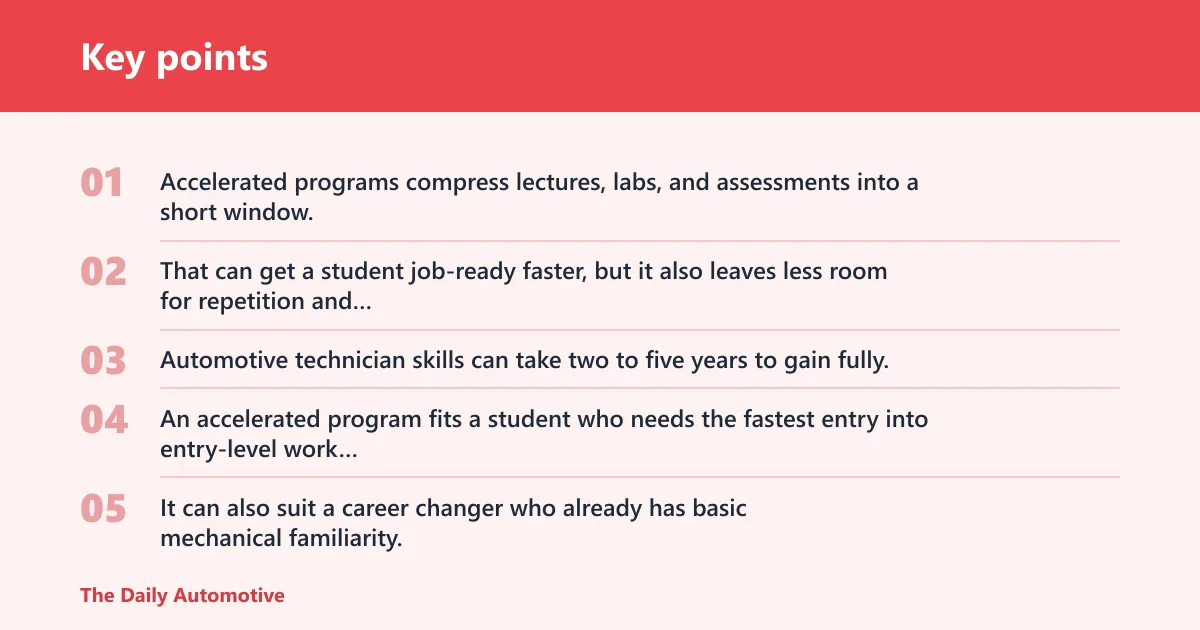
Accelerated programs compress lectures, labs, and assessments into a short window. That can get a student job-ready faster, but it also leaves less room for repetition and extra troubleshooting practice. Automotive technician skills can take two to five years to gain fully, so fast school completion is only the start of the learning curve.
Who should choose this path
An accelerated program fits a student who needs the fastest entry into entry-level work and can handle a dense schedule. It can also suit a career changer who already has basic mechanical familiarity. If the target is immediate hiring rather than a broad credential, speed may matter more than degree depth.
How much longer does part-time study take?
Part-time study usually takes longer because fewer credits are earned each term and lab sequences move more slowly. Working adults, parents, and students with fixed shifts often choose this route. Prerequisites and remediation can add even more time if math, reading, or shop fundamentals need to be completed first.
Working-adult schedules
Evening and weekend classes reduce conflict with a job, but they often stretch a certificate or associate degree by several terms. A program advertised as 12 months full-time may take 18 months or longer part-time, depending on course rotation. Community college schedules are especially likely to vary by term.
Prerequisites and remediation
Some students must finish placement-based math or English courses before entering technical classes. That adds calendar time without adding automotive credit hours. If a school requires remediation before brakes, electrical, or engine performance courses, the first semester may not count toward the core auto tech timeline.
Missed terms and stop-start enrollment
Stop-start enrollment can turn a short program into a much longer one. If a student takes a term off, waits for a required lab, or misses a course with limited seats, graduation shifts. The result is often delayed entry-level employment and a slower payback period on tuition.
How long does diesel mechanic school take?
Diesel mechanic school often takes a different amount of time than general auto tech because the specialization changes the curriculum. Diesel training can be similar in length, but it may also require more engine, drivetrain, and heavy-equipment shop time. That makes timeline comparisons useful, but not interchangeable.
Why diesel training can differ from general auto tech
Diesel systems are larger and more specialized than many passenger-car systems, so schools often adjust lab content accordingly. The added focus can lengthen training if the program includes heavy-duty components, air systems, or fleet equipment. Diesel mechanic training is not just a longer version of auto tech; it is a separate track.
Specialization and added shop time
Specialization can change the calendar because the student may need more focused practice on engines, fuel systems, and inspections used in trucks or buses. That extra shop time is useful, but it is still time spent before graduation. If the goal is fleet work or trucking support, the added months can pay off.
When diesel is the better fit
Choose diesel training when the target job is heavy-duty repair rather than passenger-car service. The route can make sense for students who want fleet maintenance, trucking, or equipment service. If the job market goal is general auto repair, a standard automotive technology program may be the faster and more direct path.
How long does it take to learn auto mechanics?
Learning auto mechanics takes longer than finishing school. A formal program may last months to 2 years, but automotive technician skills can take two to five years to gain through school, practice, and job experience. School gets you started; repetition in real repairs builds speed and confidence.
- Finish a certificate, diploma, or degree path that matches your job goal.
- Complete as many lab hours as your school allows.
- Start in an entry-level role to build diagnosis and repair speed.
- Keep learning on newer systems, scan tools, and repair procedures.
how long does auto tech school take
Auto tech school usually takes 6 months to 2 years, depending on the program type and schedule. Certificate programs are shorter than associate degrees, accelerated programs are the fastest option, and part-time enrollment stretches the timeline. The best choice depends on quick entry or broader preparation.
how long does auto mechanic school take
Auto mechanic school commonly takes from 6 months to 2 years. A certificate path is usually the shortest, while an associate degree adds general education and more technical depth. The length also changes if the school is a vocational school, community college, or accelerated program with a heavy lab schedule.
Frequently asked questions
How long does automotive mechanic school take?
Automotive mechanic school usually takes 6 months to 2 years, depending on the credential and school format. Certificate tracks are shorter and built for entry-level work, while associate degree programs usually take 2 years. Hands-on lab hours and part-time attendance can stretch the calendar beyond the published minimum.
How long does automotive tech school last?
Automotive tech school can last anywhere from 6 months to 2 years. A certificate or diploma is often the shorter route, and an associate degree is the longer one. Vocational schools and community colleges may both offer these paths, but their schedules and lab requirements are not always the same.
Does part-time enrollment make auto tech school take longer?
Yes. Part-time enrollment almost always makes auto tech school take longer because fewer credits are completed each term. Evening classes, work conflicts, prerequisites, and missed lab courses can add several months or more. A program that is 12 months full-time may take much longer part-time.
Do certificate programs take less time than associate degrees?
Yes. Certificate programs usually take less time than associate degrees because they focus on career training and include fewer general-education courses. Many certificate programs can be finished in 1 year or less, while associate degrees typically take 2 years. That makes certificates the faster entry option.
Products related to this article
Sponsored / affiliate links. As an Amazon Associate I earn from qualifying purchases. I may earn additional commission from eligible campaigns.