Cheap Auto Tech Options on a Budget: Buy First Guide
Start with the cheapest tech that fixes the biggest pain point: an inexpensive phone mount for commuting, a modestly priced fast charger for daily use, and a dash cam if safety is the priority. Buy the wrong item first and you can waste money on gadgets you barely use while the real problem stays unsolved. This guide ranks cheap auto tech by use case, with typical prices and the first buy for commute, safety, and cabin convenience.
Essential Budget Gear And Utility Upgrades


Cheap auto tech is low-cost gear that improves convenience, safety, or daily usability without turning the car into a project. The best buys solve a real annoyance: dead phones, messy cables, dark cabins, poor emergency readiness, or worn-out handling parts. Cosmetic add-ons belong in a separate bucket.
Utility upgrades versus cosmetic accessories
Utility upgrades do a job. They charge devices, cut clutter, improve visibility, prepare the car for a breakdown, or restore grip and braking. Cosmetic accessories can still be fun, but they should not outrank items that affect how the car is used every day.
That difference matters because cheap accessories often look like bargains until they fail. A dead charger, weak adhesive, or light kit that causes glare is not a value buy. A simple part that prevents a tow, a flat phone battery, or a cluttered cabin usually pays for itself faster.
Price bands that make shopping easier
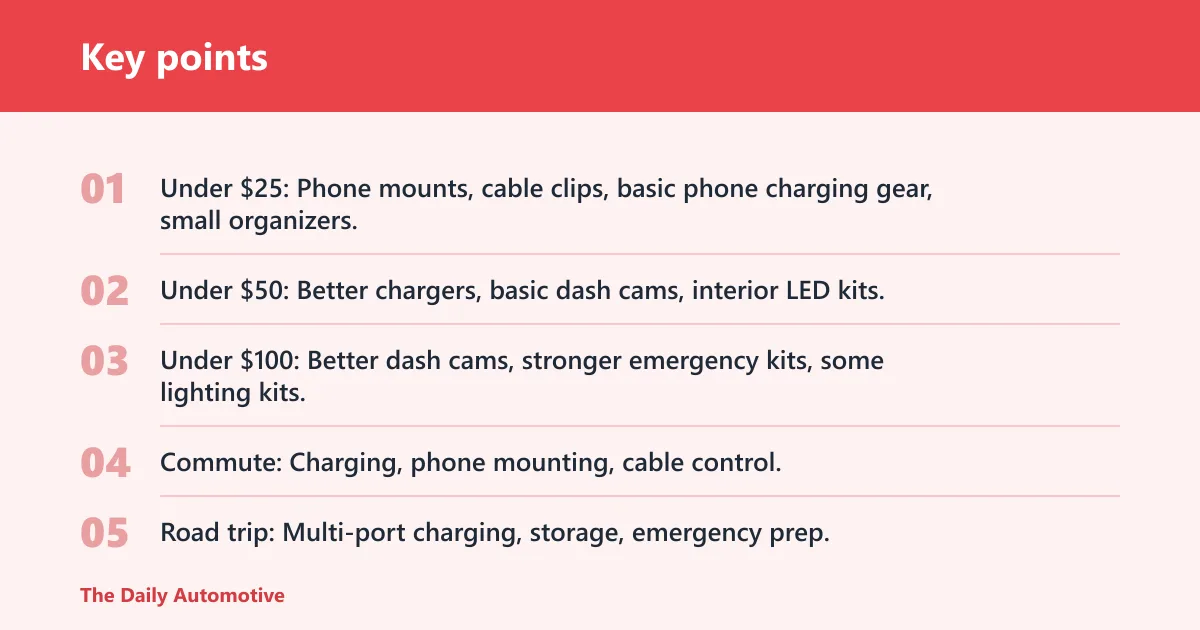
- Under $25: Phone mounts, cable clips, basic phone charging gear, small organizers, and compact emergency add-ons.
- Under $50: Better chargers, basic dash cams, interior LED kits, and more durable storage or comfort accessories.
- Under $100: Better dash cams, stronger emergency kits, some lighting kits, and a few higher-quality convenience items.
Those bands matter because compatibility and durability rise with price, but so do hidden costs if the item is wrong for the car. A bargain charger that does not sit well in the 12V socket is still a bad buy.
Best use cases by driver type
- Commute: Charging, phone mounting, cable control.
- Road trip: Multi-port charging, storage, emergency prep.
- Teen driver: Safety gear, simple charging, clear cabin organization.
- Older vehicle: Emergency kit, cabin lighting, basic maintenance refreshes.
If a daily commuter keeps missing calls because the phone sits on a seat and slides into the footwell, a cheap mount and charger fix that fast. A cabin light kit would not.
Which cheap auto tech options should you buy first?
Buy the gear that removes the most friction first: charging, emergency readiness, then comfort. A cheap auto tech purchase should either keep the car usable or make it safer, not just look newer. If the car already works well, start with the weak link in the cabin.
Top picks for charging and cable control
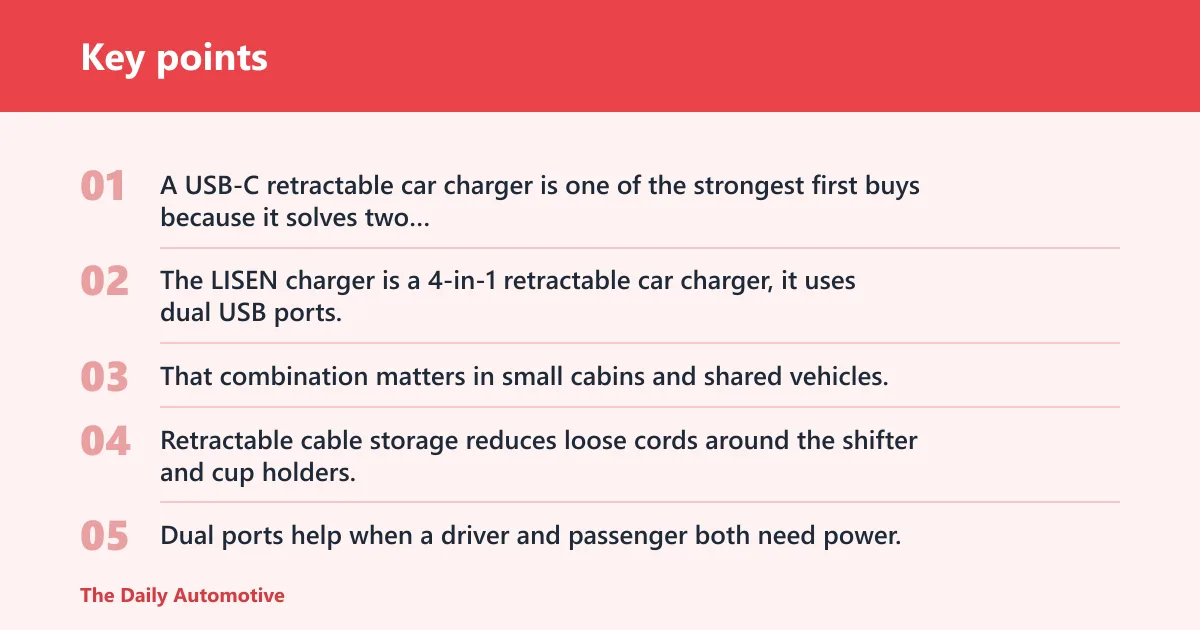
A USB-C retractable car charger is one of the strongest first buys because it solves two problems at once: power and clutter. The LISEN charger is a 4-in-1 retractable car charger, it uses dual USB ports, its retractable cord extends up to about 31.5 inches, and it is designed for standard 12V vehicle sockets.
That combination matters in small cabins and shared vehicles. Retractable cable storage reduces loose cords around the shifter and cup holders. Dual ports help when a driver and passenger both need power.
Top picks for safety and emergency prep
An emergency car kit belongs ahead of style items. The emergency kit includes a window breaker and a seatbelt cutter, which makes it a safety-first buy instead of a novelty accessory. Compact storage also matters, because a kit that rolls around under a seat is not ready when needed.
Top picks for comfort and daily convenience
Interior lighting can be useful when it improves cabin visibility, but it should stay legal and controlled. The KITUREK light uses approximately 200 LED beads and peel-and-stick installation, so it fits the low-effort category. Keep brightness moderate and check local rules before adding any colored or flashing interior light.
For a budget-minded driver, the best order is usually charger first, emergency kit second, then interior convenience. A cabin that stays powered and organized is more useful than one that only looks customized.
Budget buying matrix: 10 cheap auto tech options ranked
| Option | Typical price band | Install difficulty | Compatibility risk | Best use case | Buy first or skip for now |
|---|---|---|---|---|---|
| USB-C retractable car charger | $15–$35 | Easy | Medium: 12V socket shape and cable clearance | Commute, rideshare, shared cars | Buy first |
| Phone mount | $10–$25 | Easy | Medium: vent style and dashboard texture | Navigation, commuting, teen driver | Buy first |
| Emergency car kit | $25–$60 | Easy | Low | Road trip, older vehicle, teen driver | Buy first |
| Interior LED light kit | $20–$150 | Easy to moderate | High: legality, glare, adhesive, wiring | Cabin convenience, personal styling | Skip until basics are covered |
| Basic dash cam | $40–$100 | Moderate | Medium: power routing, windshield fit | Safety evidence, parking incidents | Buy first if safety matters most |
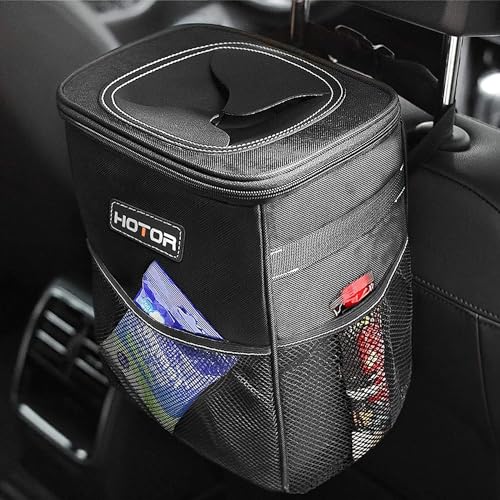
| Seat organizer | $15–$35 | Easy | Low | Family hauling, rideshare, commute | Buy if clutter is the problem |
| Performance air filter | $20–$70 | Easy | High: exact fit and engine code matter | Cheap first mod, mild maintenance refresh | Buy later, after fitment check |
| Brake pads and rotors | Mid-range budget pricing | Moderate to difficult | High: exact vehicle match required | Stopping confidence, daily safety | Buy first if wear is present |
| Tire upgrade | $400–$1,000+ | Professional install | High: size, load rating, speed rating | Grip, handling, braking, safety | Buy first when tires are worn |
| Wireless charging pad | $20–$60 | Easy | Medium: phone case and alignment | Desk-like cabin convenience | Skip if a cable charger is faster |
What cheap charging and cable-management gear is worth it?
Charging gear is usually the best budget buy because it solves a daily problem the moment the key turns. A good low-cost charger should fit the socket, charge fast enough for your devices, and avoid turning the cabin into a cord nest. Retractable or short-cable designs usually age better in small interiors.
Why a USB-C retractable car charger ranks so high
The LISEN charger is the right kind of cheap tech because it is built for use, not decoration. A 4-in-1 retractable layout, dual USB ports, and a cord that reaches up to about 31.5 inches give enough flexibility for front-seat passengers without leaving long wires dangling.
12V socket fit is the hidden detail to check first. Some vehicles place the socket deep in the console or under a cover that blocks bulky plugs. A charger can look universal online and still sit poorly in the car.
When wireless charging is not the best budget pick
Wireless pads sound convenient, but they are often slower, bulkier, and more sensitive to phone placement. For a budget shopper, a wired charger usually wins on speed and price. If the phone is used for navigation, a cable also holds the battery up more reliably on long drives.
- Check whether the car has a standard 12V socket in a reachable spot.
- Measure the cable path from socket to phone mount or cup holder.
- Choose USB-C first if the phone supports it.
- Avoid overbuying ports you will never use.
A common first-timer mistake is buying a charger with too many dangling leads for a small car. The result is cable clutter, not convenience.
Which safety and emergency upgrades belong in the car?
Emergency gear belongs in the car before decorative add-ons because it reduces risk when the car is disabled or the cabin needs fast exit tools. A compact kit with a window breaker and seatbelt cutter is more useful than nearly any style accessory, especially for daily drivers and older vehicles.
Why an emergency car kit beats novelty accessories
The Cofsodi emergency kit includes a window breaker and a seatbelt cutter, two tools aimed at escape rather than comfort. Compact storage also matters because emergency tools should stay in the car without getting in the way. That makes the kit a sensible buy for new drivers, long commuters, and family cars.
Roadside basics belong here too: gloves, a flashlight, a tire inflator if the budget allows, and simple first-aid items. These are not flashy, but they matter more when a flat tire or dead battery turns into a long wait.
Visibility and roadside basics
Interior lighting can help with cabin visibility, but it is not a replacement for actual safety gear. If a budget is tight, safety money should go to items that help during a stop, breakdown, or collision. Light strips and color themes can wait.
Are cheap performance and maintenance upgrades worth it?
Yes, but only when the item is tied to a real need. Cheap performance parts rarely transform a car, and claims about big gains should be treated carefully. The best low-cost maintenance upgrades restore function first, then add modest improvement. Tires beat everything else on actual road feel.
Performance air filter as a first DIY mod
The upgraded air filter is described as a relatively quick driveway job and is priced in the lower-to-mid range. That makes it one of the cheapest first mods for people who want a simple improvement with a low labor bill. The likely gains are modest airflow improvement, with only modest fuel-efficiency and horsepower potential.
Fitment matters more here than on a phone charger. The filter must match the engine and airbox exactly. A wrong part wastes money and may create intake issues instead of solving them.
Brake pads and rotors as a safety spend
Brake pads and rotors are not fun buys, but they matter more than most cheap add-ons once wear shows up. Better pads and rotors can improve stopping power and reduce brake fade, yet the exact result depends on the vehicle, compound, and condition of the rest of the brake system.
This is a mid-range budget item, and the hidden cost is labor if the job is not a simple driveway task. If the brakes squeal, pulse, or feel weak, budget should move here before cosmetic gear.
Tires deliver the biggest real-world change
Tires give the largest real-world improvement because they connect the car to the road. Better grip and handling improve braking, cornering, and wet-weather confidence. They are also more expensive than many cosmetic mods, with tire upgrades listed at $400–$1,000+.
That higher price is still easier to justify than repeated replacement of cheap accessories. Tires wear by use, not by style preference, so the best budget plan often puts tires ahead of cabin lighting and decor.
Here is the quick priority rule: if the car needs safety, buy tires or brakes first. If the car needs daily convenience, buy charging gear first. If the car only needs a cleaner cabin, then move to organizers or lighting after the fundamentals are covered.
What should I avoid when buying low-cost car tech?
Avoid cheap auto tech that creates hidden costs through poor fit, weak build quality, or legal trouble. A low sticker price can hide replacement costs, clutter, or a part that does not work in your vehicle. The best budget purchases stay simple, legal, and easy to return if they do not fit.
Compatibility risks to check before buying
- Socket fit for chargers and adapters.
- Exact vehicle fit for filters, pads, and rotors.
- Adhesive strength for interior lights and clips.
- Windshield or vent layout for dash cams and mounts.
- Phone size and case thickness for mounts and wireless pads.
Failure cases that waste money
Poor adhesive can make a light strip fall within days. Dead ports make a charger useless. Glare from bright interior lights can irritate the driver and break local rules. A wrong filter or brake part can force a second purchase before the first one is even installed.
Suppose a sedan owner buys an interior light kit before checking cabin trim. The tape peels on a hot afternoon, the wires hang near the shifter, and the “upgrade” becomes a cleanup task. That is a common budget mistake.
What are the best budget automatic cars?
Budget automatic cars are the ones that stay inexpensive to own, not just cheap to buy. The best choices usually pair easy-to-find parts, simple maintenance, and strong reliability records. Automatic transmission matters less than the total cost of ownership, so used-market condition should come first.
What to look for in a cheap automatic
Look for common parts availability, a clean service record, and an automatic that shifts smoothly without slipping or harsh engagement. Budget auto tech can make a cheap car easier to live with, but it cannot fix a neglected transmission. Budget car rentals can be filtered by automatic transmission, which is a reminder that transmission choice is often about convenience first.
If the goal is low ownership cost, the smartest upgrade path is still maintenance before gadgets. A clean cabin charger or organizer is useful. A worn transmission is expensive.
How can I upgrade my car with cheap tech accessories?
Start with a short list tied to one daily pain point. Cheap tech accessories work best when they are installed in minutes, fit the car cleanly, and solve a repeated annoyance. A cluttered cabin, dead phone, or dark back seat points to the right upgrade faster than a long accessory catalog does.
A simple upgrade order
- Buy charging gear if the phone is always low.
- Buy a phone mount if navigation is awkward.
- Buy an emergency kit if the car lacks one.
- Buy cabin lighting only after checking legal limits.
- Move to maintenance parts only when wear appears.
That order keeps spending aligned with use, not hype. It also limits replacement costs because each item serves a clear purpose.
What are the cheapest auto tech upgrades worth buying?
The cheapest upgrades worth buying are the ones that solve daily friction for under $50 and do not require special tools. Phone mounts, quality chargers, cable clips, and a compact emergency kit usually beat cosmetic accessories because they affect every drive. Safety and visibility gear belongs near the top too.
Best value picks by budget
Under $25, start with a phone mount or cable organizer. Under $50, move to a better charger or emergency kit. Under $100, consider a dash cam or a stronger cabin convenience upgrade. Once the car’s basics are covered, then look at lights or performance parts.
How much do affordable car gadgets usually cost?
Affordable car gadgets usually land between $10 and $100, with the most practical items sitting in the $15–$50 range. Charging gear, mounts, organizers, and compact emergency tools tend to be the easiest buys. Larger safety or performance items cost more because they have more material, labor, or fitment demands.
What auto tech features give the most value on a budget?
Charging speed, cable control, easy installation, and compatibility give the most value on a budget. After that, emergency readiness and safety gear matter more than appearance. If the item saves time every day or reduces risk in a breakdown, it belongs ahead of decorative tech.
Are automatic cars more expensive to repair?
Automatic cars can be more expensive to repair when transmission work is needed, because automatic transmissions are complex and labor-heavy. That does not mean every automatic is costly, but transmission problems often raise the bill fast. Routine maintenance and clean service history matter a lot on used purchases.
What is auto tech in a car?

Auto tech in a car means the electronic and accessory equipment that helps the car charge devices, warn the driver, simplify use, or improve comfort. That can include chargers, dash cams, lighting, sensors, infotainment, and emergency tools. On a budget, it should be practical first and stylish second.
How much do auto techs make?
Auto tech pay varies widely by region, experience, certification, and shop type. Entry-level pay, dealership pay, and specialist pay can differ a lot, so there is no single number that fits every market. For a job search, local listings are more useful than national averages alone.
Are vehicles getting cheaper?
Some used vehicles do get cheaper at certain points in the market cycle, but new-car pricing, financing, and trim mix can move in different directions. The better question is whether the total cost of ownership fits the budget. A cheaper purchase price does not always mean a cheaper car to keep.
Products related to this article
Sponsored / affiliate links. As an Amazon Associate I earn from qualifying purchases. I may earn additional commission from eligible campaigns.