
How Long Do You Have to Register a Car After Buying It?
Usually, you have about 10 to 30 days to register a car after buying it, but your state sets the deadline, and it starts at the sale date or delivery date, not when you have time to handle it. Miss the deadline, and you can face late fees, ticket risk, and delays with plates or proof of ownership. This guide explains when the clock starts, which papers to file first, and what to do if the deadline is only days away.
What starts the registration clock?
The clock usually starts on the sale or delivery date, but some states tie the process to title transfer, and others treat title and registration as one step. In a private sale, the buyer usually has the filing burden. In a dealer sale, the dealer often handles part of the paperwork, but you should still confirm what remains in your name.
Title transfer date vs. registration date
Title transfer and registration are related, but they do not always share the same deadline. Title transfer is the legal change in ownership. Registration is the step that lets the vehicle be legally driven on public roads and often brings plates, tabs, or a sticker.
Some states want both done together. Others let you transfer title first and finish registration after inspection, insurance, or tax payment. If you are near the deadline, treat the earliest required filing date as the controlling one.
Private sale, dealer sale, and out-of-state purchase
A private-party purchase usually puts the burden on the buyer. You typically need the signed title, a bill of sale, and any lien release before the state will issue a clean title and registration. Dealers may file more of the paperwork, but you still need insurance, tax payment, and any inspection items the state requires.
Out-of-state purchases can add VIN verification, emissions testing, or a different tax calculation. If the vehicle came from another state, check whether the DMV wants a physical inspection, a verification form, or both before it will finish the registration.
What paperwork do you need to register it?
Most states want a signed title, proof of identity, proof of insurance, and payment for title and registration fees. If the car had a lender, you may also need a lien release. If the car came from out of state, a VIN verification or inspection form may be required before the office will complete the transaction.
Signed title, bill of sale, and lien release
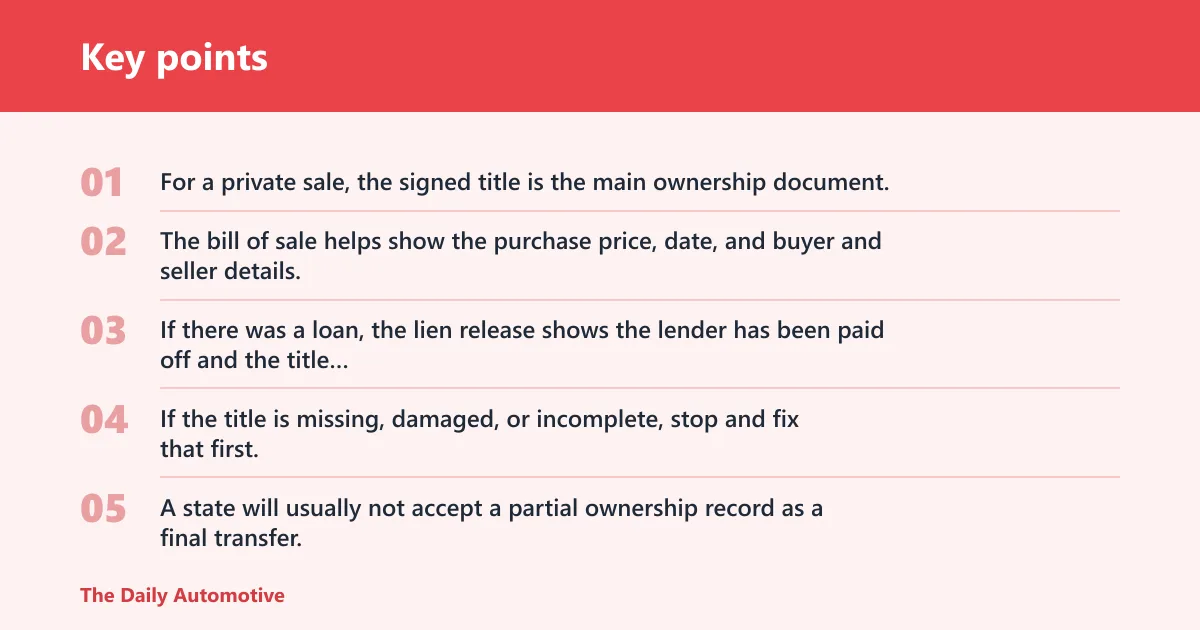
For a private sale, the signed title is the main ownership document. The bill of sale helps show the purchase price, date, and buyer and seller details. If there was a loan, the lien release shows the lender has been paid off and the title can move cleanly to the new owner.
If the title is missing, damaged, or incomplete, stop and fix that first. A state will usually not accept a partial ownership record as a final transfer. If the seller still has the physical title, make sure every required signature and odometer field is complete before you leave.
Insurance, ID, and VIN verification
Proof of insurance is often required at the counter before registration can be finished. Bring a driver license or other accepted ID as well. Many states also want the VIN on the title to match the VIN on the car, including the dashboard plate and the door-frame sticker.
That match matters because a single digit error can stop the filing. If the vehicle is coming from another state, some offices require a physical VIN check. That step can be done by DMV staff, law enforcement, or another authorized inspector, depending on the state.
Temporary plates and inspection forms
Temporary permits or plates can bridge the gap while you wait for permanent registration. Rules vary by state, and plate transfer rules also vary. Some states let you move plates from one vehicle to another under narrow conditions, while others require fresh plates for the new purchase.
If the car needs an emissions or safety inspection, the inspection form may be part of the packet you submit. A temporary plate does not replace that form. It only covers limited driving while the permanent records are being processed.
Car registration deadline table
The table below gives a practical deadline map for the states readers search most often. Some of these states treat title transfer and registration together. Others separate them. The first consequence column shows the earliest common result, not every possible penalty.
| State | Typical filing window | Title transfer and registration together? | Documents to bring | First consequence of missing the deadline |
|---|---|---|---|---|
| California | Usually 10 days for title transfer and related filing | Often handled together at the same office visit | Signed title, bill of sale, proof of insurance, ID, and any smog or VIN paperwork | Late penalties and possible registration delay |
| Texas | 30 days is the common filing window | Usually combined with title application and registration steps | Signed title, bill of sale, insurance, ID, and tax forms | Penalty exposure and tax assessment issues |
| Virginia | Usually 30 days | Often processed together for a new owner | Signed title, bill of sale, proof of insurance, ID, and any inspection documents | Late fees or a denied registration transaction |
| Alabama | Usually 20 days | Often tied closely to titling and registration filing | Signed title, bill of sale, insurance, ID, and lien release if needed | Late filing penalties and delays in plate issuance |
| Wisconsin | Usually 10 days | Registration and title work may be handled in the same filing process | Signed title, bill of sale, insurance, ID, and VIN verification if required | Late fees and possible citation exposure |
| Illinois | Usually 20 days | Often completed in one new-owner transaction | Signed title, bill of sale, insurance, ID, and tax payment records | Late penalties and delayed plates or stickers |
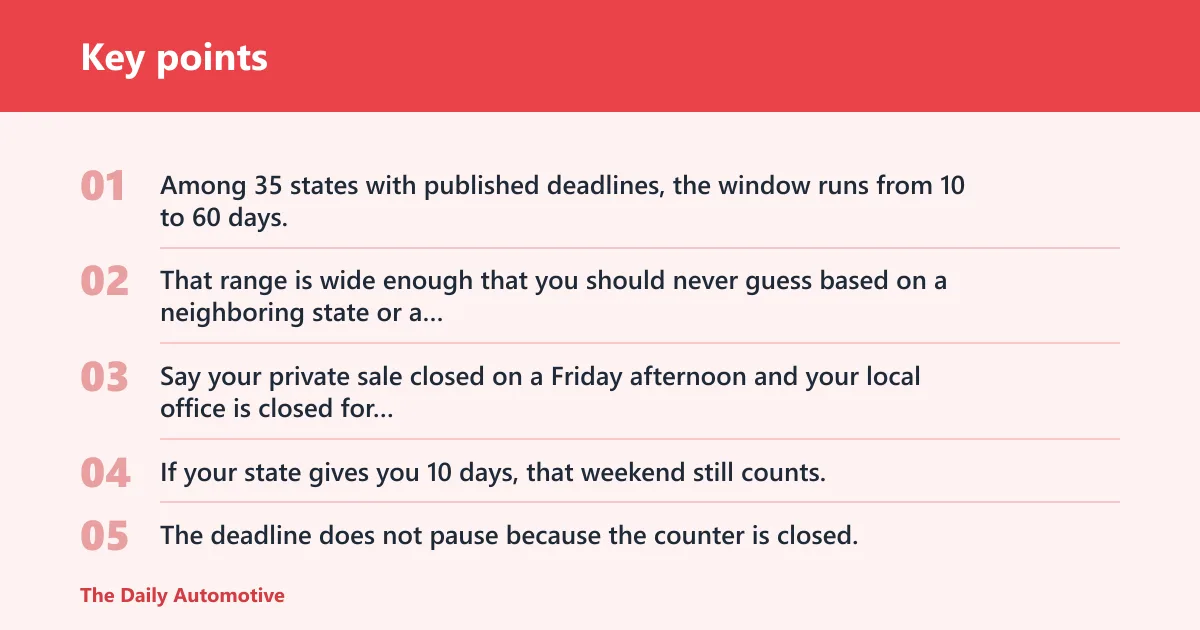
Among 35 states with published deadlines, the window runs from 10 to 60 days. The most common filing window is 30 days. That range is wide enough that you should never guess based on a neighboring state or a friend’s purchase.
Say your private sale closed on a Friday afternoon and your local office is closed for the weekend. If your state gives you 10 days, that weekend still counts. The deadline does not pause because the counter is closed.
How long do you have after a private sale?
After a private sale, you usually have the same state deadline for title transfer and registration, but the buyer carries the paperwork burden. The seller usually does not collect tax. You do. If the seller keeps the plates, you may also need a temporary permit before driving the car home.
When the seller keeps the plates
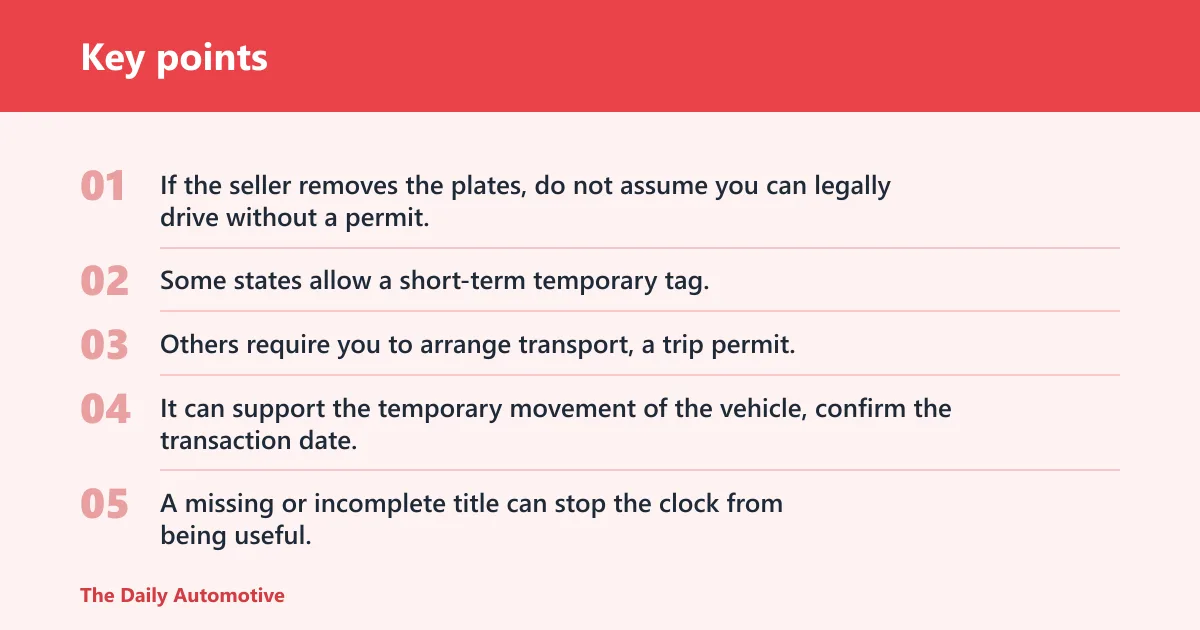
If the seller removes the plates, do not assume you can legally drive without a permit. Some states allow a short-term temporary tag. Others require you to arrange transport, a trip permit, or immediate registration before use on the road.
That is one reason the bill of sale matters. It can support the temporary movement of the vehicle, confirm the transaction date, and help the DMV match the purchase to the deadline clock.
When the title is missing or incomplete
A missing or incomplete title can stop the clock from being useful, because you may not have the document needed to file at all. Check that the seller name, buyer name, odometer statement, signatures, and lien release are all present when needed.
A common first-timer mistake is buying on a Saturday and finding on Monday that the title still lists an old lender. Without the lien release, the office may not issue the clean title or final registration.
When tax and title are filed together
Many states collect sales or use tax when you title or register the car. In most states, that tax is based on the purchase price. Some states use book value or another override if the sale price looks too low. Texas may tax a private sale using Standard Presumptive Value. Massachusetts may tax on clean trade-in value if it is higher than the sale price.
Montana and New Hampshire charge no sales tax on cars. Delaware charges a 5.25% document fee when you title the car. These tax rules can affect the total due at filing, so budget for them before you reach the counter.
What happens if you miss the deadline?
Missing the deadline can lead to late fees, penalties, citation risk, or registration denial, depending on the state. In some places, the DMV may still let you file late and charge extra. In others, you may face trouble driving legally until the paperwork is complete.
Late fees and penalties
Missed deadlines can trigger penalties in many states. The amount and type vary. Some states assess a flat late fee. Others add tax-related penalties, interest, or a registration surcharge that rises the longer you wait.
If the car already has a title brand such as salvage, rebuilt, or flood, the process may take longer and the office may ask for more documents before it will register the vehicle.
Ticket or impound risk in some states
Some states can treat expired temporary tags, unregistered operation, or missing plates as a traffic issue. That can mean a ticket, a warning, or, in some cases, a tow if the vehicle is not legally allowed on the road. Do not assume a grace period exists unless the state says so.
What to do if you are already late
- Stop driving the car if you cannot prove it is legally registered.
- Gather the signed title, bill of sale, lien release, ID, and insurance proof.
- Check whether the state wants a VIN verification, inspection, or emissions test.
- Call the DMV or county office to confirm whether an appointment is needed.
- Bring payment for tax, title fees, and any late charges.
Special cases that can change the timeline
Some transfers do not follow the standard private-sale path. Gifts, inherited vehicles, dealer sales, and out-of-state purchases can all change the document list and the filing order. The deadline may still exist, but the paperwork sequence can shift.
Salvage, rebuilt, or flood brands
A title brand can change registration eligibility or add inspection steps. Salvage, rebuilt, and flood brands may affect value, insurance access, and whether the car needs a special inspection before plates are issued. Check the brand before you pay, not after.
Gift and inherited vehicles
Gift transfers often still need a signed title and a state form showing no sale price or a nominal transfer amount. Inherited vehicles may require probate papers, an affidavit, or a death certificate before the title can move. The deadline may start when the estate paperwork allows transfer, not at a normal sale date.
Dealer paperwork and temporary tags
Dealer sales often arrive with temporary tags and a filing package, but that does not mean the process is finished. You should verify that the title application, tax records, and registration filing are actually underway. Temporary tags usually do not replace the final title transfer.
Out-of-state purchases
Out-of-state purchases often require extra checks. The VIN must still match. Some states also want an inspection form or a verification performed by an authorized inspector. If the title brand or tax treatment differs from your home state, expect extra questions at the counter.
What to do this week if your deadline is close
If the deadline is close, start with the items that can block the filing completely. A late visit is better than a wrong one. Missing one document can turn a same-day filing into a second trip, and the deadline clock does not wait for convenience.
How long have register checklist
- Confirm the exact deadline date in your state.
- Check the title for signatures, VIN, odometer entry, and lien release.
- Buy or confirm insurance before you go to the office.
- Find out whether you need a VIN check, emissions test, or inspection.
- Check office hours, holiday closures, and whether appointments are required.
Fastest order to complete the steps
Start with the documents that are hardest to replace: the signed title and lien release. Then handle insurance, inspection, and tax payment. Last, finish plates or registration pickup. If the state allows online pre-filing, use it before you visit the office.
When to call the DMV or county office
Call if the title is lost, the seller’s name is wrong, the lien release is missing, or the purchase happened near a holiday. Also call if you bought the car from another state or if the title brand is salvage, rebuilt, or flood. Those are the cases most likely to slow a normal filing.
Frequently asked questions
How long do you have to register a car after buying it?
Usually, you have 10 to 30 days, but the exact deadline depends on your state. Among 35 states with published deadlines, the window runs from 10 to 60 days, and 30 days is the most common filing window. The clock usually starts on the sale or delivery date.
How long do you have to register a car after buying it from a private seller?
After a private sale, the buyer usually has the same state deadline for title transfer and registration, and the buyer is usually the one handling the filing. Most states want a signed title and bill of sale, and many also require insurance, tax payment, and sometimes a lien release.
How long do you have to register a car after buying it in California?
California is generally treated as a 10-day state for title and related filing after a private purchase. The registration and title work are often handled together, and you should be ready with the signed title, bill of sale, proof of insurance, ID, and any smog or VIN paperwork.
How long do you have to register a car after buying it in Texas?
Texas is commonly treated as a 30-day filing state. Texas may also tax a private sale using Standard Presumptive Value, so the amount due can be based on more than the price on the bill of sale. Bring the signed title, proof of insurance, ID, and tax documents.
How long do you have to register a car after buying it in Virginia?
Virginia is commonly treated as a 30-day filing state. The office may ask for the signed title, bill of sale, proof of insurance, ID, and any inspection documents. If the title is incomplete or the vehicle needs extra verification, the process can take longer.
How long do you have to register a car after buying it in Alabama?
Alabama is commonly treated as a 20-day filing state. You should bring the signed title, bill of sale, proof of insurance, ID, and a lien release if the vehicle had a lender. If you miss the deadline, expect possible late filing penalties and delays in plate issuance.
What happens if you miss the registration deadline after buying a car?
Missed deadlines can trigger penalties in many states. The result may be a late fee, tax penalty, delayed plates, or citation risk if you drive without valid registration. If you are already late, stop driving until you know whether the car can still be legally operated and filed.
Products related to this article
Sponsored / affiliate links. As an Amazon Associate I earn from qualifying purchases. I may earn additional commission from eligible campaigns.