Should You Buy Out Your Car Lease?
Buy it only if your all-in buyout cost is below the car’s current market value and the payment fits your budget; otherwise, return it. If you ignore the numbers, you can overpay for worn-out transportation or miss a cheap path to owning a car you already know. This guide shows how to calculate your true buyout cost and judge it against current market value, wear-and-tear charges, and financing terms.
This guide is part of our Car Dealer Money Guide: Negotiating, Financing, Leasing, Trading In and Selling series.
What a lease buyout
A lease buyout means you buy the leased car instead of returning it. Leases usually allow returning the car, trading it in, or buying it, and the contract usually sets the buyout price in advance through the residual value. The decision comes down to the total number, the car’s current market value, and your next transportation plan.
Lease-end buyout versus early buyout
A lease-end buyout happens when the lease term is over, so the paperwork is often simpler. An early lease buyout can happen before the lease ends, but it may include remaining lease payments and can trigger early termination fees. Lease-end buyouts are often the cleaner path if you already know you want the car long term.
What the contract already sets
The residual value is the expected worth of the car at lease end. It is the base buyout price component, and captive lenders almost never negotiate the purchase price. That makes the contract the starting point, not the whole answer. (Caranddriver)
Why drivers consider a buyout
Drivers usually consider a buyout for one of three reasons: the car is worth more than the payoff, return-side charges look ugly, or the financing still works. High-mileage drivers often run the numbers differently because most leases cap mileage at about 10,000 to 15,000 miles per year, and excess mileage charges can run 10 to 30 cents per mile. (Consumerreports)
What is your all-in buyout cost?
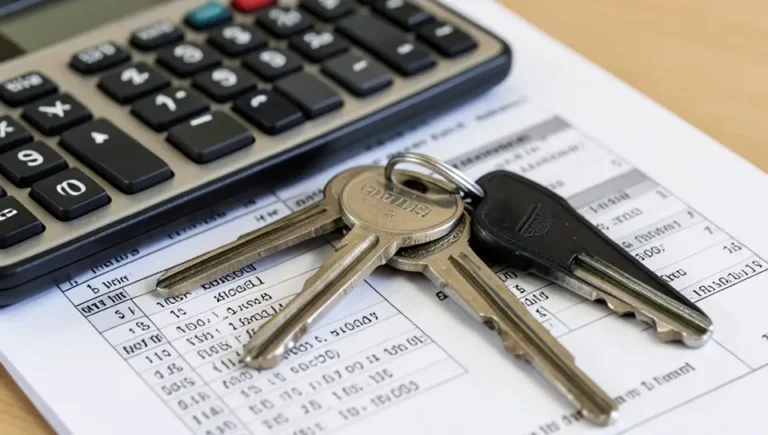
Your all-in buyout cost is the residual value plus every charge that gets added before title transfer. That can include sales tax required by your state, registration fees, a purchase option fee, and, in an early buyout, remaining payments or early termination charges. Do not compare the car’s market value to residual value alone.
Residual value and payoff amount
The payoff amount is the number you need to own the car free and clear. For a lease-end buyout, that often means residual value plus taxes and fees. For an early buyout, the payoff may also include remaining payments and any early-exit charge in the lease contract.
Taxes, registration, and purchase option fee
Lease buyouts can include sales tax required by your state. Registration fees also vary by state. Some contracts list a separate purchase option fee, so check the lease carefully rather than assuming the quoted residual value is the final price.
Remaining payments and early termination charges
An early buyout may include the remaining lease payments. That is why some early buyouts look cheap at first and expensive after the full quote arrives. Consumer Reports says it can be hard to get out of a lease early, and voluntary return can trigger a giant termination fee.
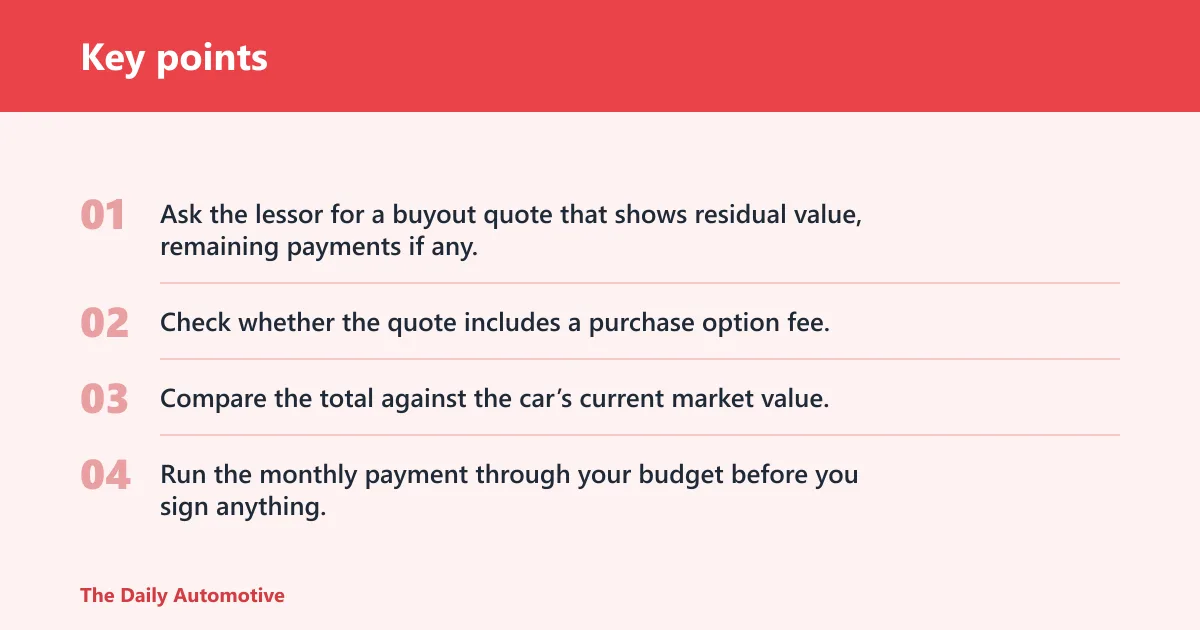
- Ask the lessor for a buyout quote that shows residual value, remaining payments if any, tax, fees, and any early-exit charge.
- Check whether the quote includes a purchase option fee.
- Compare the total against the car’s current market value.
- Run the monthly payment through your budget before you sign anything.
How to request the quote
Start with the lender named on the contract, especially if it is a captive lender. Third-party lessors may handle payoff quotes differently, so request the exact all-in figure in writing and ask when the quote expires. That avoids surprises at signing.
What is the car worth today?
Current market value is the number that tells you whether buying makes sense. If the car’s market value is above the all-in payoff, you may have some equity. If it is below the payoff, you are looking at negative equity, and a buyout can be a bad move even if you like the car.
Current market value versus payoff
Compare the payoff amount to what the same car sells for in your area with similar mileage, trim, and condition. If a compact SUV is worth $24,000 and the all-in payoff is $21,500, the buyout has room. If the payoff is $25,800, you are paying more than the car is currently worth.
When equity makes a buyout attractive
Equity can make the buyout worth considering because you are buying below market and can keep the car or trade it later with a cushion. This is where lease-end buyouts were especially popular during early COVID-era shortages, when used-car values jumped and some drivers could buy below market.
When negative equity makes it a bad deal
A loved car can still be a bad buy if the all-in number does not work. Taxes, fees, and loan interest can erase a small pricing gap fast. If the market value is lower than the payoff and you still need to finance the balance at a higher rate, the deal can turn sour quickly.
Say your sedan’s residual value is close to market price, but the state tax and purchase option fee add enough to push the payoff above what dealers are listing similar cars for. In that case, the emotional value of keeping the car does not fix the math.
What return-side costs are you avoiding?
Return-side costs can make a buyout cheaper than turning the car in. Mileage overage fees, wear-and-tear charges, disposition fees, and reconditioning charges all matter. If the car is clean and under mileage, those avoided costs may be small. If it is over mileage or has cosmetic damage, they can move the decision a lot.
Mileage overage fees
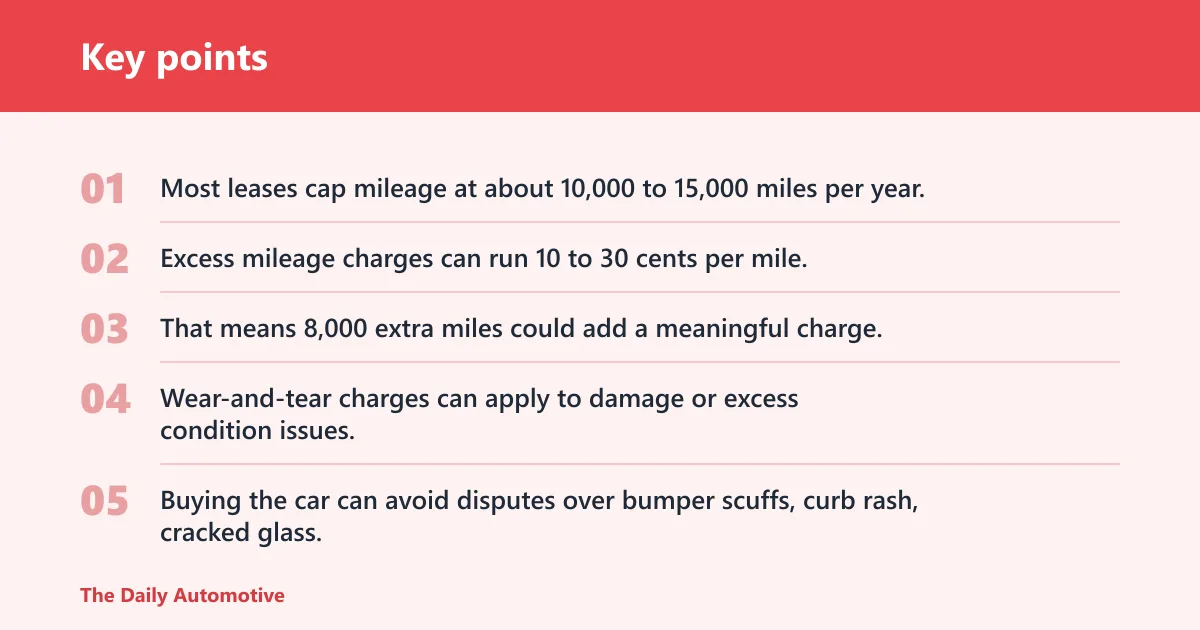
Most leases cap mileage at about 10,000 to 15,000 miles per year. Excess mileage charges can run 10 to 30 cents per mile. That means 8,000 extra miles could add a meaningful charge, and a buyout may be cheaper than paying that penalty at return.
Wear-and-tear charges and reconditioning
Wear-and-tear charges can apply to damage or excess condition issues, and the lessor may bill reconditioning costs after inspection. Buying the car can avoid disputes over bumper scuffs, curb rash, cracked glass, stained upholstery, or tire wear that sits outside the normal range in the contract.
Disposition fees and return friction
Some leases add a disposition fee at turn-in, and return timing can bring inspection friction. If the lease-end process looks messy, buyout becomes more attractive because you avoid the final inspection and the chance of itemized return charges. That is separate from whether the car is actually a good financial deal.
Picture a small crossover with 18,500 miles on a 12,000-mile annual allowance and a clean interior. The extra miles alone may be enough to justify a closer look at buyout, even before you count any tire or windshield charges.
Can you finance the buyout?
Yes, you can finance a lease buyout through a lender or the dealer. Lease buyout loans can carry higher interest rates than standard auto loans, so the payment matters as much as the purchase price. If the monthly cost does not fit your budget, the buyout is not a good fit even when the car looks like a bargain.
Lease buyout loan basics
A lease buyout loan covers the payoff amount after taxes and fees. The lender will usually look at the car’s value, your credit, and the term length. Compare the payment to a conventional auto loan before you sign, because a higher rate can turn a decent buyout into an expensive one.
When dealer financing helps
Dealer financing can help when the paperwork is simple and the rate is competitive. It may also be convenient if you want to finish the transaction quickly. Even then, ask for the total cost of borrowing, not just the monthly payment.
When to shop banks and credit unions
Shop banks and credit unions if the dealer quote looks high or if you want a cleaner rate comparison. If the buyout price is already tight against market value, a lower APR can be the difference between keeping equity and losing it to interest.
Lease buyout decision matrix
Start with the all-in buyout cost, then test it against the market value and the charges you avoid by not returning the car. The matrix below keeps the decision simple: if the payoff is below market and the avoided costs are meaningful, buy may win. If the payoff is above market and financing is weak, return usually wins.
| Scenario | Buyout price | Estimated return-side costs avoided | Current market value | Net decision |
|---|---|---|---|---|
| Low-mileage clean car | $19,400 all-in | $400 estimated disposition and minor wear charges avoided | $21,000 | Buy |
| High-mileage car | $18,800 all-in | $1,500 mileage and wear charges avoided | $18,600 | Buy |
| Early buyout with remaining payments | $24,700 all-in | $900 avoided return charges | $23,200 | Shop financing |
Low-mileage clean car
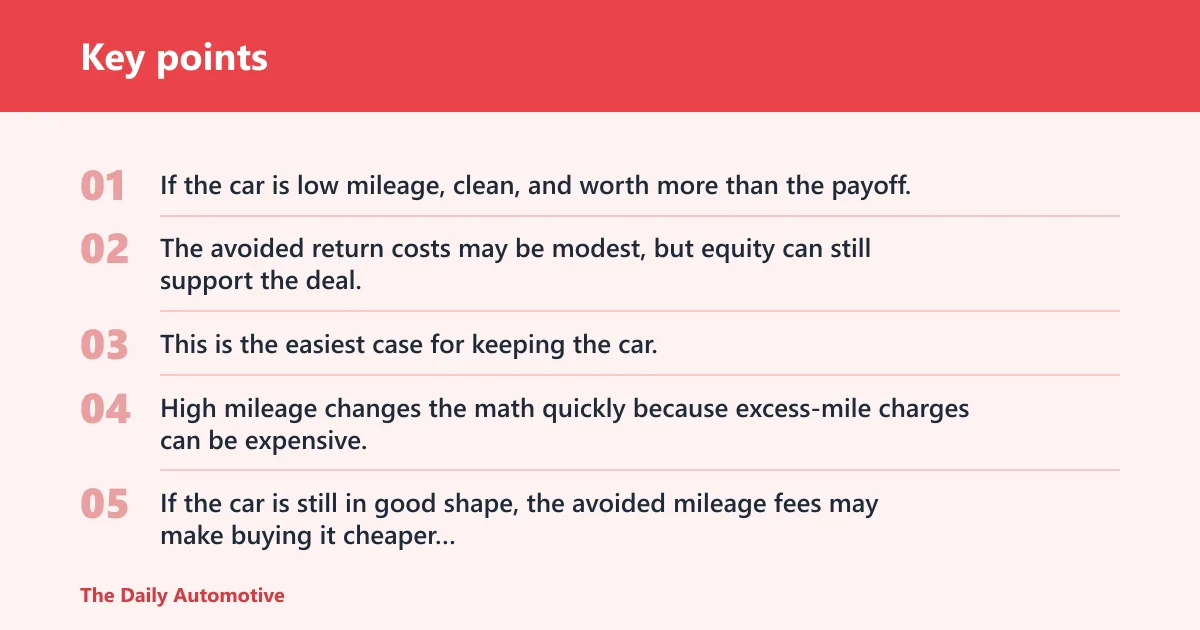
If the car is low mileage, clean, and worth more than the payoff, the buyout often makes sense. The avoided return costs may be modest, but equity can still support the deal. This is the easiest case for keeping the car.
High-mileage car
High mileage changes the math quickly because excess-mile charges can be expensive. If the car is still in good shape, the avoided mileage fees may make buying it cheaper than turning it in. That is especially true when the car’s market value is close to the payoff.
Early buyout with remaining payments
An early buyout is the hardest case. You may be adding remaining payments and an early-exit charge to a payoff that already includes tax and fees. If the total is above market value, the better move is usually to keep your options open and shop financing before signing anything.
When should you buy the lease and when should you walk away?
Buy if the all-in payoff is below current market value, the payment fits your budget, and the avoided return charges are real. Return if the car is overpriced after taxes, fees, and interest. If the equity is thin, shop financing before you decide, because a better rate can change the answer.
Buy if the math favors you
Buy when the buyout amount is clearly below what the car would cost to replace, and the loan payment is manageable. This is also a strong option if you want to keep the car for several more years and avoid the friction of shopping again soon.
Return if the car is overpriced
Return when the payoff is higher than the car’s market value and the avoided fees do not close the gap. A clean emotional attachment does not erase negative equity. If the lease car would cost more to own than to replace, walk away.
Shop financing if equity is thin
Shop financing when the numbers are close and the difference could go either way. A better loan rate may make a lease buyout workable. If the financing quote is weak, the same car can go from affordable to overpriced very quickly.
Frequently asked questions
Should you buy out your car lease?
Buy out your car lease only if the all-in cost is below the car’s current market value and the payment fits your budget. If the payoff is above market, or the loan terms are weak, returning the car is usually the cleaner move. Love for the car is not enough by itself.
Can you buy out a car lease early?
Yes, a lease buyout can happen before the lease ends. An early buyout may include the remaining lease payments and can trigger early termination fees, so ask for the full quote before you decide. Early buyouts are more attractive when you expect to drive more miles than the lease allows.
How do you calculate a lease buyout?
Start with the residual value, then add taxes, registration, any purchase option fee, and any early-exit charge or remaining payment balance if you are buying early. Compare that total to the car’s current market value. If the all-in number is lower, the buyout may make sense.
What fees are included in a lease buyout?
A lease buyout can include sales tax required by your state, registration fees, and a purchase option fee if the contract lists one. A dealership or lessor may also charge administrative fees. If you are buying early, remaining payments or early termination charges may also be part of the total.
Can you finance a lease buyout?
Yes, you can finance a lease buyout through a lender or the dealer. Lease buyout loans can have higher interest rates than standard auto loans, so compare offers before signing. A lower rate can be the difference between a sensible buy and a payment that strains your budget.
When is a lease buyout cheaper than turning the car in?
A buyout is cheaper when the payoff is below market value and the charges you avoid at turn-in are substantial. Mileage overage fees, wear-and-tear charges, and disposition fees can tip the scale. If those return-side costs are low, turning the car in may still be the better call.
Products related to this article
Sponsored / affiliate links. As an Amazon Associate I earn from qualifying purchases. I may earn additional commission from eligible campaigns.