Can You Trade in a Leased Car? Key Rules
Yes, often, but only if your lease payoff is lower than the car’s trade-in value and your lender allows an early buyout or dealer payoff. Skip that check and you can lose equity or pay taxes twice. This guide explains the payoff math, dealer rules, and state tax treatment behind a lease trade-in.
Lease payoff vs. trade value worksheet
This worksheet separates the three numbers that matter: the lease payoff, the dealer’s trade value, and the state tax effect. Use all three before you agree to a swap, because a strong appraisal can still be a poor deal if the payoff is high or your state gives no tax credit.
| Decision path | Lease payoff | Dealer trade value | State tax effect | Yes/no branch |
|---|---|---|---|---|
| Trade to same-brand dealer | Use the lessor’s payoff quote, not the remaining payments total | Compare the dealer’s appraisal against that payoff | Check whether your state allows a trade-in tax credit on a leased car | Yes if trade value exceeds payoff and tax credit helps; no if policy blocks the payoff or tax treatment removes the gain |
| Trade to another dealer | Ask whether that dealer can access the lessor’s buyout terms | Get a separate appraisal from the new dealer | Confirm the trade-in is treated as a taxable credit in your state | Yes only if the lessor permits the channel and the tax result still favors the swap |
| Buy out then trade | Use the purchase amount needed to end the lease | Get a fresh retail-style offer after the buyout, if allowed | See whether the buyout creates a cleaner title path and a better tax result | Yes when the buyout price is lower than the dealer’s net offer or when turn-in charges would be higher |
| Return at lease end | Check the final payoff or return settlement and any inspection-based charges | No trade value needed unless you decide to buy the car instead | Usually no trade-in credit to apply | Yes if the lease-end bill is lower than the value you would give up by trading |
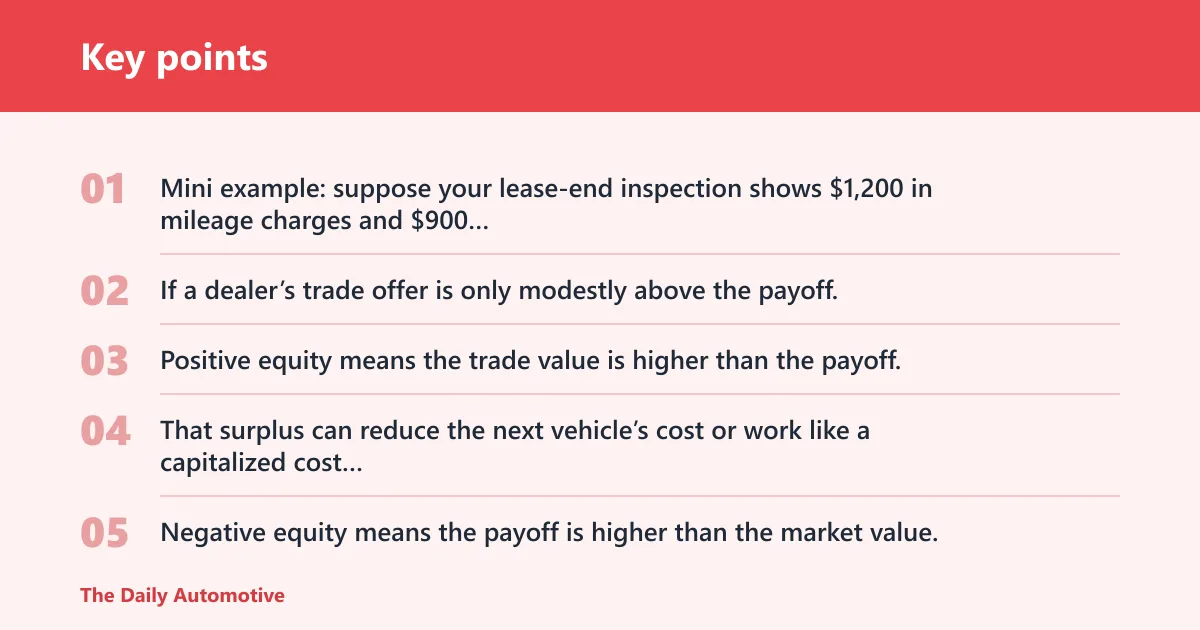
Mini example: suppose your lease-end inspection shows $1,200 in mileage charges and $900 in damage charges. If a dealer’s trade offer is only modestly above the payoff, buying out the car may cost less than returning it, because you avoid the lease-end bill and keep control of the vehicle’s next step.
Positive equity means the trade value is higher than the payoff. That surplus can reduce the next vehicle’s cost or work like a capitalized cost reduction on a new lease. Negative equity means the payoff is higher than the market value. In many deals, that shortfall can be rolled into the next loan or lease, which can raise the payment and total interest.
How lease trade-ins work
A lease trade is usually a payoff transaction, not a normal owner trade. Lease Solutions says the dealer is effectively buying the car from the lessor at the payoff amount, and the dealership typically works with the leasing company to obtain that payoff amount. That is why the lessor’s quote matters more than a casual estimate.
Closed-end leases are the standard consumer lease structure. They make the end-of-term path more predictable than an owned-car sale, but they do not erase return obligations. Mileage and wear charges can still apply at lease end if the contract and inspection support them.
Say your sedan has a clean body, about 32,000 miles on a 36,000-mile allowance, and a payoff quote that sits below the dealer’s offer. In that case, the positive equity may help cover the next car’s down payment or lease cost. The same deal can look very different if the quote is stale or the inspection reveals excess wear.
- Ask the lessor for a current payoff quote and note the good-through date.
- Get a dealer appraisal that is separate from new-car pricing.
- Compare payoff, trade value, and likely state tax treatment.
- Check for channel restrictions before you accept a third-party offer.
- Decide whether to trade, buy out, or return the car at lease end.
Can you trade in a leased car before it ends?
Yes, a leased car trade can happen before or at the end of the lease term. Early trade makes sense when the payoff is favorable, the car has positive equity, or the current vehicle no longer fits your needs. It is less attractive when negative equity is large and the next deal cannot absorb it cleanly.
Do not assume the math starts with remaining payments. The payoff amount is the official amount needed to end the lease, and it can include the contractual purchase formula, any required fees, and a date limit for the quote. That figure is what the dealer must beat, not the monthly payment alone.
Picture a compact SUV with a strong appraisal and a lease contract that still has several months left. If the trade value exceeds the payoff, you may be able to exit early without a loss. If the payoff is higher, the dealer may roll the negative equity into the next deal, which can change both the payment and the total cost.
When the numbers are close, a return at lease end can be the cleaner move. That is especially true if the dealer offer is weak, the payoff quote is stale, or your state gives no tax credit on the trade.
Can you trade in a leased car at any dealership?
No, not always. Some captive lessors limit who may buy a leased car, and brand-dealer-only rules exist. That means the answer depends on the lessor’s policy, the dealer’s channel access, and whether the dealer can obtain the payoff directly from the leasing company.
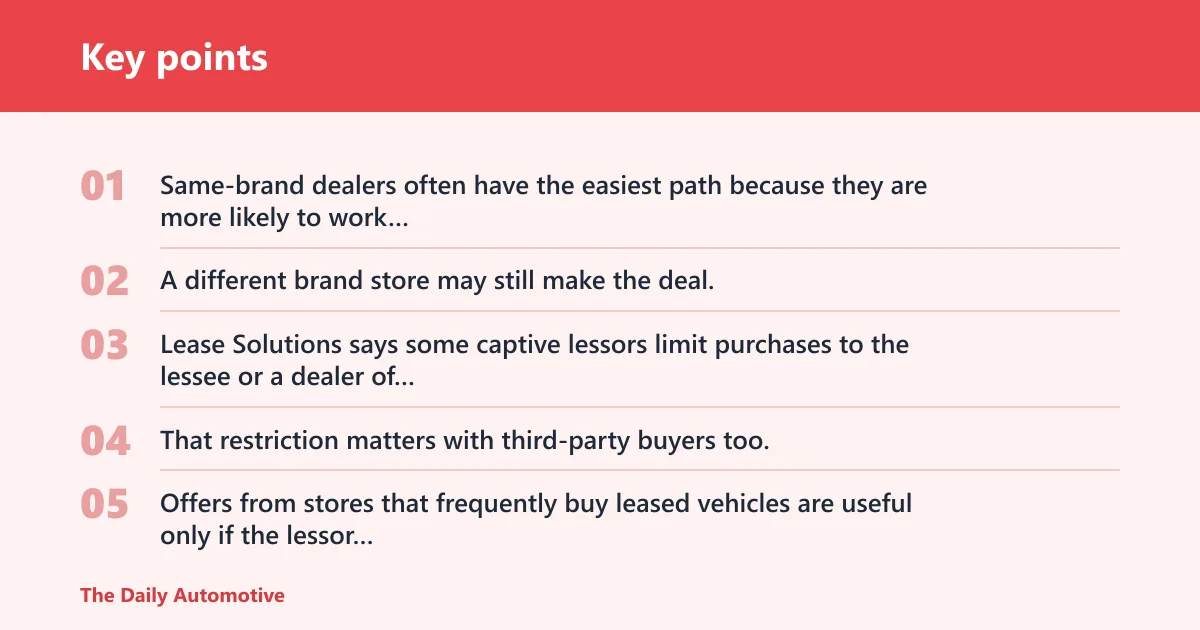
Same-brand dealers often have the easiest path because they are more likely to work within the captive lender’s system. A different brand store may still make the deal, but only if the lessor allows that buyer or that channel. The same source says some captive lessors limit purchases to the lessee or a dealer of their own brand.
That restriction matters with third-party buyers too. Offers from stores that frequently buy leased vehicles are useful only if the lessor permits that sale path. If the buyout channel is blocked, the highest offer on paper may not be usable.
Same-brand dealers and captive lease rules
A same-brand dealer is often the smoothest route because the dealer may already know the lessor’s process. Even so, you still need the payoff quote from the lease account. The dealer may use a different number if its quote is older or based on a different access path.
Third-party buyout restrictions to check first
Before you accept a non-brand offer, ask whether the lessor allows a third-party buyout. Some captive lenders restrict the buyer list, and that can stop the sale even when the offer looks strong. That is the failure case many guides skip.
CarMax or Carvana offers can be useful starting points, but their usefulness depends on the lessor’s policy. If the captive lender allows only the lessee or a brand dealer to buy the car, those offers may not close the deal. Check the policy before you spend time on paperwork.
Trade-in taxes and lease-end charges
State tax treatment can change the value of a lease trade. The same source says some states, including Florida and New Jersey, give no trade-in tax credit on a leased car. In those states, the tax savings you expected from the swap may be smaller or may not exist at all.
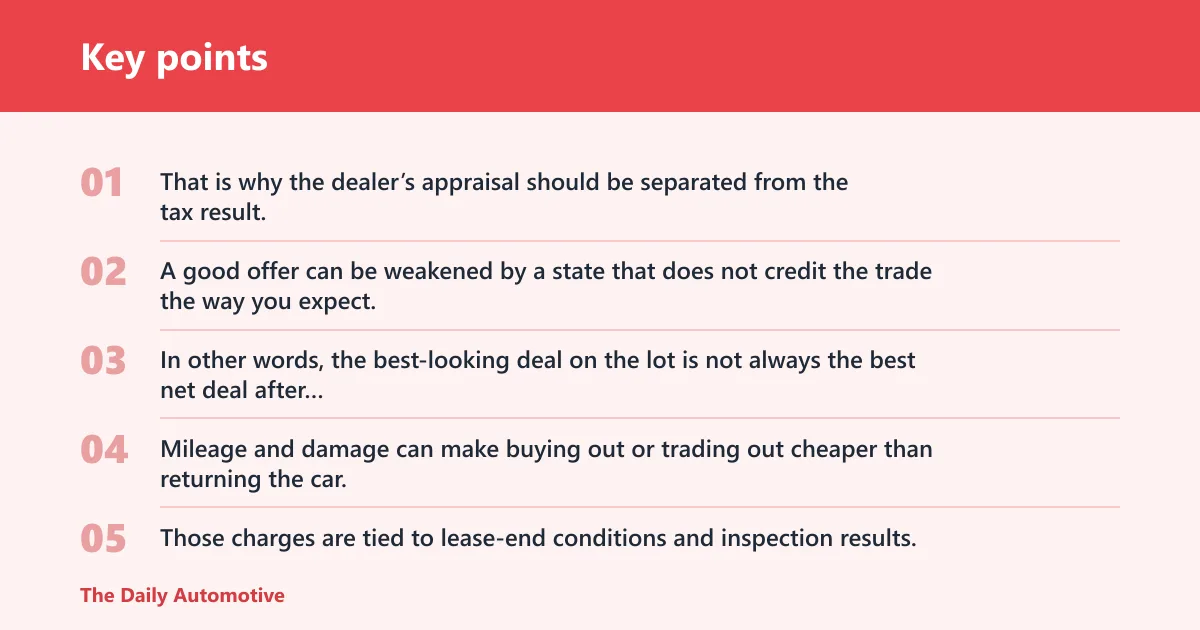
That is why the dealer’s appraisal should be separated from the tax result. A good offer can be weakened by a state that does not credit the trade the way you expect. In other words, the best-looking deal on the lot is not always the best net deal after tax.
Lease-end charges also matter. Mileage and damage can make buying out or trading out cheaper than returning the car, especially if the turn-in bill is large. Those charges are tied to lease-end conditions and inspection results, not to every early trade in the same way.
Lease End says its dataset covered 19,287 completed lease buyouts. It reports all 10 of its most popular buyout vehicles carried positive equity, with average captured equity of about $5,500, and drivers also avoided about $3,800 in overage fees. Its data also cites an average buyout payment of $563 per month, compared with about $659 per month for a new lease, and a May 2026 average APR of 9.05%.
Those figures do not decide your deal for you. They do show why a buyout deserves a close look when the car has value left in it and the lease-end bill is growing. A buyout can be a better exit path than a return if it keeps the turn-in charges off the table and the payment still fits your budget.
Can you trade a leased car for another loan or lease?
Yes. Trading into a financed car and trading into another lease are both possible, but they handle negative equity differently. If you finance the next car, the negative equity may be folded into the loan balance. If you lease the next car, the shortfall may still be rolled in, but it can affect the payment structure in a different way.
Negative equity may be rolled into a new financing agreement. That helps close the deal, but it usually increases the monthly payment and the total interest you pay. The more shortfall you carry forward, the less room you have to negotiate the next vehicle on its own merits.
Trading into another lease can be useful when you want a lower monthly target and the dealer can structure the negative equity within the lease. Trading into a financed car can make more sense if you want to own the next vehicle and keep the lease discussion separate from long-term ownership costs.
Buyout vs. trade: if your payoff is favorable and the car is in demand, buying out first can sometimes give you more control over the final numbers. If the dealer’s trade offer is strong enough and the lessor permits the channel, an immediate trade may be simpler. Compare both paths before you sign anything.
Can you trade in a leased vehicle?
Yes, a leased vehicle can usually be traded in, but the payoff controls the outcome. The dealer pays the lessor first, then applies any positive equity or negative equity to the next deal. That is why the lease payoff, dealer offer, and state tax effect should be checked together, not one at a time.
A common mistake is to assume the dealer will roll your remaining lease balance into a trade-in without checking for early termination fees or equity first. That number is not the trade number. The quote that matters is the payoff amount the lessor will accept, on the date that quote remains valid.
Frequently asked questions
Can you trade in a leased car early?
Yes, often. Early trade works when the payoff is lower than the trade value and the lessor allows the dealer or buyer to close the lease. If the car is underwater, the shortfall may be rolled into the next loan or lease, which can raise the next payment.
Can you trade in a leased car before the lease is up?
Yes. Before-term trading is common when the car has equity, the current vehicle no longer fits your needs, or the lease-end bill would be high. The key is the payoff quote, not the number of remaining months on the contract.
Can you trade in a leased car for a financed car?
Yes. A dealer can apply the lease payoff and then structure the next purchase as a loan. If there is negative equity, it may be added to the financing agreement. That can make the payment higher and increase total interest, so compare the full numbers first.
Can you trade in a leased car for another leased car?
Yes. The dealer can often move positive equity into the next lease or roll negative equity into the new deal. That can be convenient, but the lease payment and capitalized cost may rise if the old shortfall is large.
Can you trade in a leased car to CarMax?
Sometimes. The offer depends on the lessor’s buyout policy and whether CarMax can legally purchase the vehicle from the lease account. If the captive lender limits the sale to you or a brand dealer, a CarMax offer may not be usable even if the price is strong.
Products related to this article
Sponsored / affiliate links. As an Amazon Associate I earn from qualifying purchases. I may earn additional commission from eligible campaigns.