Can You Return a Car to the Dealership? Rules and Deadlines
Usually, no: once you sign and take delivery, a dealership can refuse a return unless you have a written return policy, a financing rescission right, a lemon-law defect, or a fraud claim. Miss the deadline or handle it badly, and you can still owe the loan, lose fees, or damage your credit. Start with the contract, the policy, the financing papers, and the repair records.
Can you return a car after buying it?
Usually, no. Most dealership sales become final when the written sales contract is signed and the car is delivered. The few paths that can still change the outcome are a written dealer return policy, a financing unwind or spot-delivery problem, a lemon-law defect claim, or fraud or misrepresentation.
Why most dealership sales are final once the contract is signed
The written sales contract controls whether the sale is final. If the paperwork does not give you a return right, the dealer does not owe you one by default. That is why the first question is not whether you regret the purchase, but what the contract says.
The four paths that can still change the outcome
Think in four buckets. First, a voluntary dealer return policy. Second, a financing problem after spot delivery. Third, a lemon-law defect on a new vehicle. Fourth, fraud or misrepresentation. Buyer’s remorse alone usually fits none of them.
How the written sales contract sets the rules
Read the buyer’s order, retail installment contract, and any separate return promise together. If a condition matters, it should be written clearly. If the dealer says you can return the car only within a narrow window, the contract needs to say so.
Return path decision table

How to read the table fast: match your situation to the closest row, then gather the evidence listed before you call the dealer. The deadline or risk column tells you how quickly the problem can turn into a payment, credit, or litigation issue.
| Scenario | Evidence you need | Likely remedy | Deadline/risk |
|---|---|---|---|
| Buyer’s remorse | Written dealer return policy, contract terms, delivery paperwork | Usually none unless the dealer promised a return or exchange | No general right; act only inside any written policy window |
| Dealer return policy | Signed policy, mileage log, condition photos, all receipts | Refund, exchange, or both only as the policy allows | Often three to seven days; may include mileage caps and fees |
| Spot delivery, then financing falls through | Spot-delivery form, finance approval texts, dealer calls or emails | New terms, rescission, or dealer unwind request | High risk if you ignore the dealer or keep driving without clarity |
| Lemon-law defect | Repair orders, dates in service, complaint history, warranty papers | Refund or replacement if the defect qualifies | Usually after multiple failed repairs or 30 or more days out of service |
| Fraud or misrepresentation | Ads, text messages, disclosures, inspection reports, odometer photo | Rescission, damages, or claim under warranty or fraud law | Act fast; odometer-fraud claims have a two-year filing window from discovery |
What each deadline means in practice
A dealer policy may last roughly three to seven days, but only if the written policy says so. A lemon-law claim can take longer to build, yet repair orders should start on day one. An odometer-fraud claim can still be viable later, but the two-year clock starts from discovery.
Why documentation matters more than memory
People remember promises differently once money is at stake. Keep the contract, buyer’s order, financing paperwork, ads, texts, emails, delivery sheet, repair orders, and an odometer photo if you have one. If the dealer later changes its story, those records matter more than a phone call summary.
Return car dealership checklist
Gather these before the file goes cold.
| Document | Why it matters |
|---|---|
| Written sales contract | Shows whether the sale is final and whether any condition was made part of the deal |
| Buyer’s order | Lists price, trade-in, dealer fees, and any added conditions |
| Financing paperwork | Shows whether funding was approved, pending, or conditional |
| Ads and window sticker photos | Can support a misrepresentation claim if the vehicle was described falsely |
| Texts and emails | Preserve promises about returns, financing, repairs, or condition |
| Repair orders | Support lemon-law and warranty claims |
| Delivery sheet | Shows the exact date the car was handed over |
| Odometer photo | Useful if mileage later becomes disputed |
Is there a 3-day right to return a car?

No general three-day right exists for a car bought from a dealer with a permanent location. The FTC Cooling-Off Rule gives a three-business-day cancellation period for certain off-premises sales, but motor vehicles sold by dealers with permanent business locations are exempt. A dealer policy can still create a short return window.
What the FTC Cooling-Off Rule actually covers
The FTC Cooling-Off Rule allows consumers to cancel certain purchases within three business days. It applies to sales made away from the seller’s permanent place of business. That means the rule can cover some door-to-door or temporary-location sales, but not ordinary dealership car sales.
Why dealer car sales are excluded
Motor vehicles sold by dealers with permanent business locations are exempt from the Cooling-Off Rule. So the common “three-day rule” people talk about does not apply to the typical showroom sale. If a salesperson says otherwise, ask for the promise in writing.
When a dealer’s own written policy is the only window
If the dealer offers a return or exchange, the policy is contractual, not a legal default right. Some policies run three to seven days. Some limit miles. Some charge a restocking or reconditioning fee. Some allow exchange only, not a cash refund.
Suppose you buy a compact SUV on Friday and the dealer’s signed policy gives you five days with a 300-mile cap. If you drive 500 miles and return it on day four, the dealer can point to the written limit. The policy, not your regret, controls the result.
What to verify before you sign
- Whether the policy is actually in writing.
- Whether it allows refund, exchange, or both.
- Whether mileage is capped.
- Whether fees apply for return or reconditioning.
- Whether the deadline is calendar days or business days.
What if financing fell through?
If the dealer let you take the car before financing was final, you may be in a spot delivery situation. A dealership can later unwind the deal if financing falls through after you drive home, or it can ask you to accept worse terms. Do not ignore the dealer’s calls or letters.
Spot delivery and the risks of driving home before funding is final
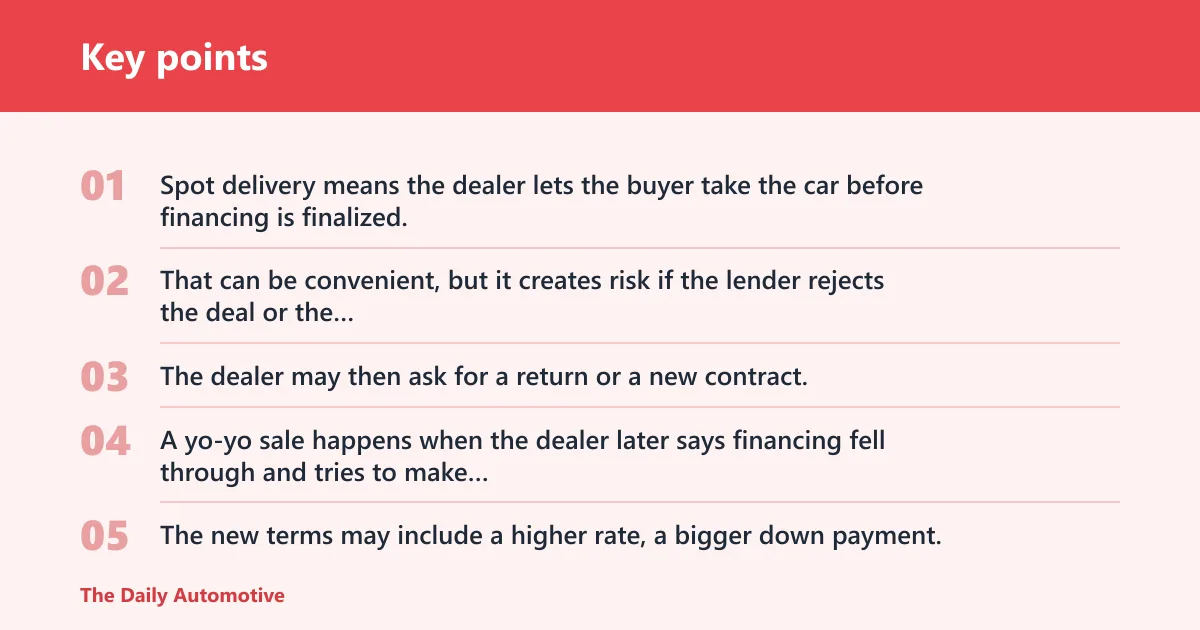
Spot delivery means the dealer lets the buyer take the car before financing is finalized. That can be convenient, but it creates risk if the lender rejects the deal or the approved terms change. The dealer may then ask for a return or a new contract.
How a yo-yo sale can change the deal later
A yo-yo sale happens when the dealer later says financing fell through and tries to make the buyer sign a worse deal. The new terms may include a higher rate, a bigger down payment, or a request to bring the car back. Read every revised paper before signing anything.
What the dealer can and cannot demand from you
The dealer cannot rewrite history, but it can follow the conditions in the contract. If the written sales contract made financing approval a condition, that clause matters. If the dealer promised final financing or an unconditional sale, save that proof and insist on a written explanation before surrendering the car.
A common first-timer mistake is returning the vehicle after a phone call without asking for a written payoff, refund, or status letter. If you also traded in your old car, ask whether the trade has already been sold, because that changes how hard it can be to unwind the deal.
Can a defect trigger a return?
Yes, but only in a narrow set of cases. Lemon laws generally cover new vehicles with serious, unrepairable defects, not ordinary wear or buyer regret. If the problem is covered and persistent, the remedy can be a refund or replacement. A written warranty can also support a Magnuson-Moss claim.
When lemon law protections may apply
Lemon-law defects are substantial problems affecting safety, value, or usability. A common threshold is three or four failed repairs for the same problem. Another common threshold is 30 or more cumulative days out of service. Those numbers are not universal, so check your state rules.
Why multiple repair attempts and days out of service matter
One repair visit rarely ends the story. Keep every repair order, including the date the car went in and the date it came out. If the same issue keeps returning, the pattern can matter more than any single failed fix.
How Magnuson-Moss may help if a written warranty exists
If the vehicle is covered by a written warranty, the Magnuson-Moss Warranty Act may support damages claims. It can also allow attorney’s fees in the right case. That does not mean every defect becomes a return, but it can strengthen a claim tied to warranty performance.
Used-car edge cases to watch
Used cars are harder to fit into lemon-law rules, and as-is language matters. An as-is sale does not erase a written warranty, but it can limit what defects support a return claim. If the problem existed before sale and was concealed, fraud may be the better path.
Fraud and misrepresentation
Fraud or misrepresentation can support unwinding a car sale if the dealer lied or hid a material fact. That can include false damage disclosures, fake history statements, or odometer tampering. The key is proof that the statement was false and mattered to the deal.
Examples of hidden damage, false disclosures, and odometer fraud
Examples include a dealer saying a car has no prior frame damage when repair records show otherwise, or promising “one-owner, clean history” when the paperwork tells a different story. Odometer fraud is illegal mileage tampering and can support civil damages.
How civil damages claims can fit the case
A fraud-based return right requires a false statement about a material fact. If the issue fits federal odometer law, damages can be treble damages or $10,000, whichever is greater. That claim can exist alongside state-law fraud or warranty claims.
Why the two-year discovery window matters for odometer fraud
An odometer-fraud claim must be filed within two years of discovery. That clock starts when the tampering is discovered, not when the car was bought. Save the odometer photo, service records, and any history report that first made the mismatch visible.
What should I do if the dealership refuses to take the car back?
Start with a written demand that identifies the path you are using: policy, financing unwind, lemon law, or fraud. If the dealer still refuses, escalate with the state attorney general, a consumer agency, or a lawyer. The more precise your paper trail, the better your position.
Steps to take right away
- Stop relying on phone conversations.
- Put your request in writing and keep a copy.
- Point to the exact contract clause, policy, defect record, or false statement.
- Ask for the dealer’s response in writing.
- Keep making payments unless a lawyer tells you otherwise.
Why the first written response matters
The first response can reveal whether the dealer is treating the matter as a policy return, a financing problem, or a disputed claim. If the dealer changes its explanation, save each version. That shift can matter later if the case turns into a complaint or lawsuit.
Frequently asked questions
Can you return a car to the dealership after buying it?
Usually not unless the dealer gave you a written return policy, financing later failed under a spot-delivery deal, the car qualifies under lemon-law rules, or the sale involved fraud or misrepresentation. Most dealership sales are final once the contract is signed and delivered.
Can you return a new car after buying it?
A new car can sometimes be returned, but not because it is new. The path still has to be in the paperwork or in the law: a written dealer policy, a financing unwind, a lemon-law defect, or a fraud claim. Newness alone creates no general return right.
Can I return a car I bought from a dealership?
Only if one of the recognized paths applies. Check the contract first, then any separate return promise, then the financing paperwork, then repair records or evidence of false statements. If none of those exist, the dealership can usually refuse the return.
Is there a 3-day right to return a car you just bought?
No general three-day right applies to a car bought from a dealer with a permanent location. The FTC Cooling-Off Rule covers certain off-premises sales and gives a three-business-day cancellation period, but dealer car sales are excluded. A written dealer policy may still offer a short window.
What if the dealer says financing fell through after I drove home?
That is a spot-delivery or yo-yo-sale problem. Demand the reason in writing, review the financing clause in your contract, and ask whether the dealer wants a new deal or a return. Do not surrender the car or sign revised terms without a clear paper trail.
Products related to this article
Sponsored / affiliate links. As an Amazon Associate I earn from qualifying purchases. I may earn additional commission from eligible campaigns.