Is There a 3-Day Right to Return a Car You Just Bought?
There is no automatic 3-day right to return a car you just bought; your exit depends on a signed return policy, a state cooling-off rule, a lemon-law or fraud claim, or the dealer’s willingness to unwind the deal. This guide shows how to sort the three paths in the first 24 hours: contract return, defect claim, or no-return fallback.
Quick answer
Usually, no. If you changed your mind after signing, the default rule is that the purchase stands unless the contract gives you a return right, state law gives you a remedy, or the dealer agrees to take the car back. The signed paperwork matters more than wishful thinking.
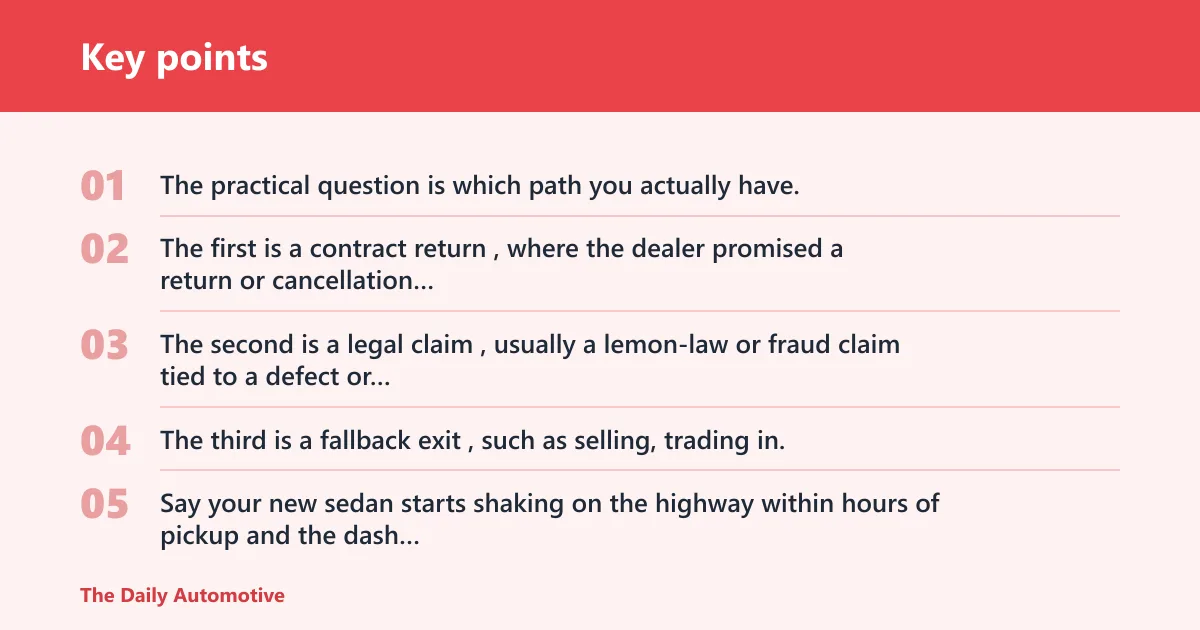
The practical question is which path you actually have. The first is a contract return, where the dealer promised a return or cancellation window in writing. The second is a legal claim, usually a lemon-law or fraud claim tied to a defect or false statement. The third is a fallback exit, such as selling, trading in, or refinancing after the deal is already binding.
Say your new sedan starts shaking on the highway within hours of pickup and the dash lights stay on. That is not buyer’s remorse; that is a defect problem, and the paper trail starts immediately. A clean return is still not automatic, but the complaint route is different from a simple change of mind.
Does the FTC cooling-off rule apply?
No, not to ordinary dealership sales. The FTC cooling-off rule lasts 3 business days, but it does not apply to car dealerships. That is the most common point of confusion, and it is where many buyers assume they have a federal return right when they do not.
The rule can apply to certain door-to-door and off-premises sales instead. That means the place and manner of the sale matter. A standard vehicle purchase signed at a dealer lot is generally outside the rule, so you cannot rely on it to cancel a regular dealership deal.
If someone sold a vehicle at your home or in another off-premises setting, review the transaction documents closely. Even then, the contract terms and the exact sale context control the outcome. Do not assume the same rule covers every car sale just because the paperwork was signed quickly.
Check the purchase contract first
Your signed purchase contract is the first document to read. If it includes a written return or cancellation clause, that clause controls the window, the conditions, and the documents you need. If it does not, you usually need another legal basis or the dealer’s voluntary cooperation.
Look for deadlines, mileage caps, required inspection forms, and who must approve the return. Some policies require the car to be in the same condition as when delivered. Others require the original finance paperwork and all keys. If the contract says nothing about returns, do not assume one exists.
Keep every page of the deal jacket together. That includes the buyer’s order, retail installment contract, arbitration notice if present, warranty booklet, and any addendum about returns. If the car was financed, the lender paperwork matters too, because a return and a loan payoff are separate steps.
Do dealer return policies exist?
Yes, but they are voluntary and dealer-specific. Some dealers offer a written return window on used cars, while others do not offer any return policy at all. The terms vary by time limit, mileage limit, and paperwork requirements, so you need the written version, not a verbal promise.
Some sellers make it easier, but the terms are dealer-specific and must be checked in writing.
What should written terms say before you rely on them? The return deadline, maximum mileage, any fee, the condition standard, and whether financing must be unwound through the dealer. If the dealer’s policy is silent on any of those points, ask for clarification in writing before you drive more miles.
Can lemon law help with a new car?
Sometimes. Lemon laws are state-specific, and they typically apply to new cars. They usually cover defects that affect use, value, or safety. If the problem is serious enough and the repair history meets the state threshold, the remedy can be a refund or a replacement car.
The repair-attempt count matters. States set their own standards, so a claim may turn on whether the dealer or manufacturer got a fair number of tries to fix the defect. A small cosmetic issue is not the same as a brake failure, a stalling engine, or repeated electrical faults that leave the car unsafe or unusable.
Some states also apply lemon laws to used cars, but that is not the default. Do not assume a used-car purchase has the same protection as a new-car purchase. If the car is new and the defect is serious, preserve repair orders, dates, and mileage from every visit.
What if the dealer hid a defect?
That can shift the issue from buyer’s remorse to fraud or misrepresentation. A concealed defect, false statement about accident history, or altered paperwork may support a consumer-protection complaint or other legal remedy. The key is evidence: what was said, what was shown, and what was left out.
Start with the listing, window sticker, inspection sheet, text messages, emails, and any finance documents. Photograph the defect, the odometer, and any fresh warning lights. If the dealer said the car had never been wrecked, for example, keep the ad and the exact wording that conflicts with the condition you found.
Complaint options can include the state attorney general, the state consumer protection office, and the dealership’s licensing authority. If the dealer refuses to unwind the deal, those records help show that the issue is more than a simple preference change. Fraud claims tend to rise or fall on detail.
Car return decision table
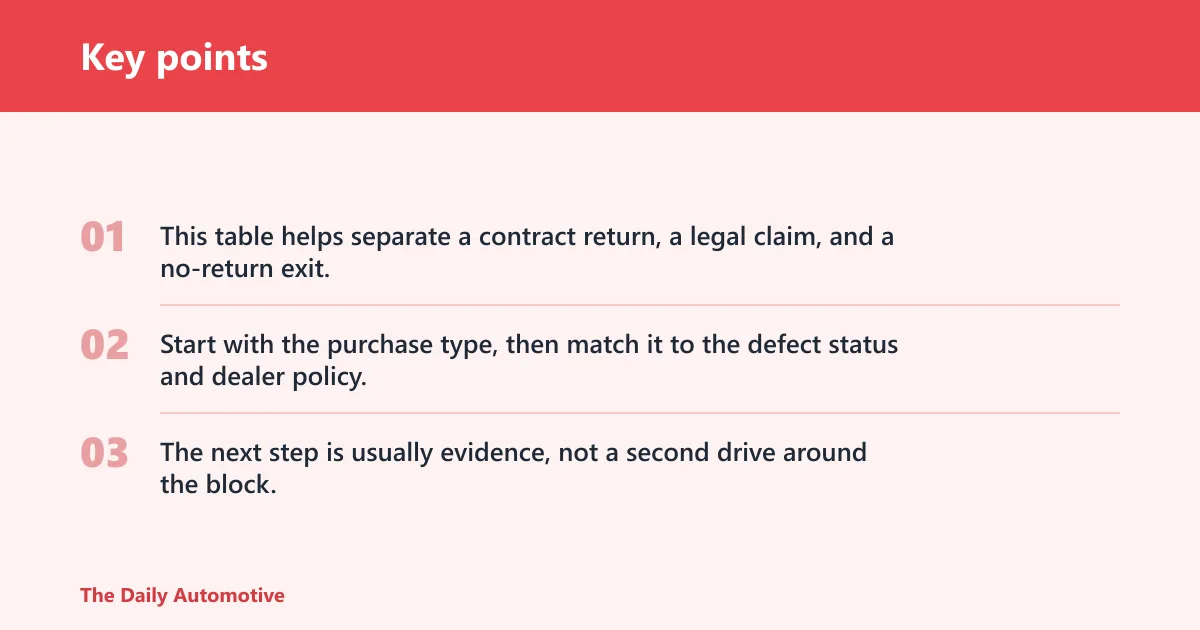
This table helps separate a contract return, a legal claim, and a no-return exit. Start with the purchase type, then match it to the defect status and dealer policy. The next step is usually evidence, not a second drive around the block.
| Purchase type | Defect status | Dealer policy present or absent | Likely legal path | What evidence to gather next |
|---|---|---|---|---|
| New car from dealer | Serious defect affecting use, value, or safety | Absent | Lemon-law claim | Repair orders, dates, mileage, warning lights, service notes |
| New car from dealer | No defect; buyer changed mind | Written return policy present | Contract return | Return clause, deadline, mileage reading, finance documents |
| Used car from dealer | Undisclosed damage or false statement | Absent | Fraud or misrepresentation claim | Listing, messages, photos, inspection sheet, repair estimate |
| Used car from dealer | No defect; buyer changed mind | Dealer-specific voluntary window present | Dealer goodwill return | Written policy, mileage cap, deadline, signed return steps |
| Private sale | Any condition unless fraud can be shown | Private party sales have no return rights | Market-based resale or fraud complaint | Bill of sale, ad, messages, title paperwork, defect proof |
What should you do in the first 24 hours?
Do five things right away: check the contract clause, photograph the odometer and any damage, save the repair order if the car has a problem, keep the financing paperwork, and call the dealer first. If there is a lender, call that lender next so you can confirm the financing side of the deal.
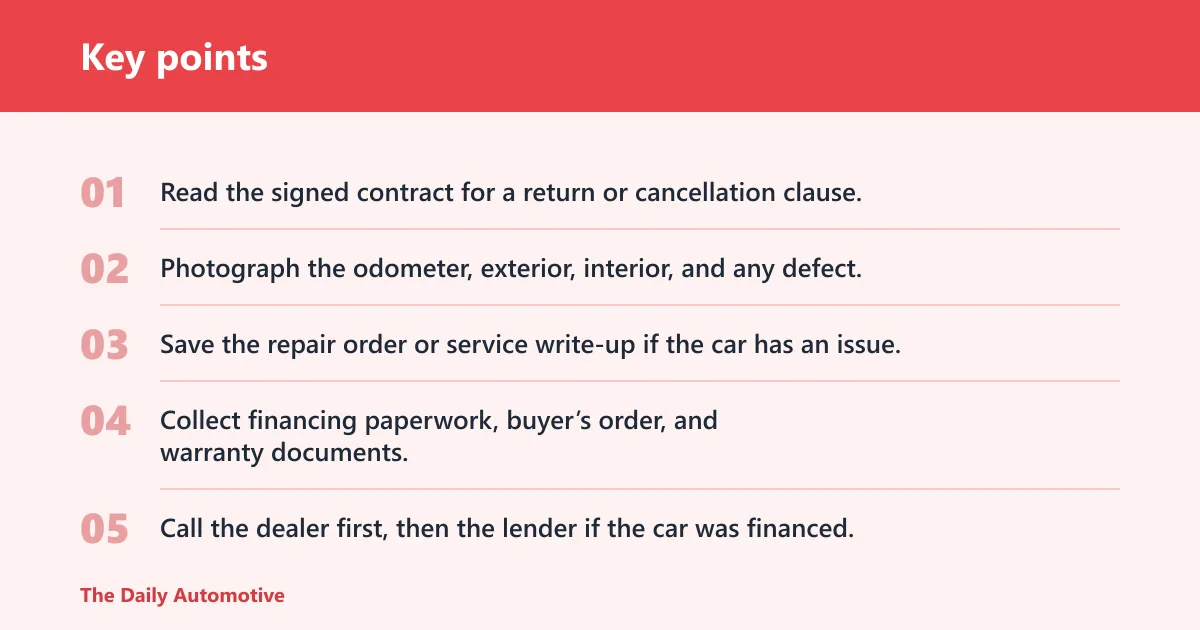
Use an order. First, read the contract for any return or cancellation clause. Second, document the car’s condition with photos and video, including the odometer, tires, warning lights, and any fresh dents. Third, gather the finance contract, buyer’s order, and any warranty or addendum pages. Fourth, contact the dealer in writing.
Fifth, if the vehicle has a defect, ask for a repair order that names the complaint. That document matters more than a vague service note. Keep every text and email. If the dealer gives a return window, ask how many miles are allowed and whether you need to bring back all accessories, keys, and documents.
- Read the signed contract for a return or cancellation clause.
- Photograph the odometer, exterior, interior, and any defect.
- Save the repair order or service write-up if the car has an issue.
- Collect financing paperwork, buyer’s order, and warranty documents.
- Call the dealer first, then the lender if the car was financed.
Picture a used SUV with 212 miles on it and a written 7-day return policy. The buyer notices a transmission shudder the next morning. The policy may still control the return path, but the repair order and mileage log become important immediately because they separate a voluntary return from a defect complaint.
What if you can’t return the car and still owe on a loan?
Then the loan does not disappear with the car. A financed purchase may require payoff or lender coordination before you can make a clean sale, trade, or title transfer. If the sale proceeds are lower than the payoff amount, you may have negative equity that still needs to be covered.
That is why a no-return exit is often a financial decision, not just a legal one. If you sell the car privately, the lender usually must be paid before title can transfer cleanly. If you trade it in, the dealer may roll the remaining balance into the next loan. That can solve the immediate problem and raise the long-term cost.
Auto loan refinance is another option if the payment is the issue rather than the vehicle itself. A lower monthly payment can create breathing room, but a longer term may increase total interest. It helps with cash flow, not with the fact that the original deal is still binding.
Can you sell or trade in a car you no longer want?
Yes. Selling or trading in is often the fastest exit when there is no legal return right. The trade-off is value: a dealer trade-in is usually the easiest route, but it can bring less than a private sale. Private party sales have no return rights, but fraud, title defects, or specific state laws can still create remedies.
If the car is financed, check the payoff figure before you list it or visit a dealer. The title may not be free and clear until the lender is paid. If the payoff is higher than the car’s market value, the gap is the part you need to plan for.
A trade-in can offset the replacement purchase, and that can be useful if you need another car immediately. It is a fast exit, not a legal one. If the original deal involved fraud or a qualifying defect, keep that claim alive even while you explore resale or trade options.
Frequently asked questions
Can you return a car you just bought if you changed your mind?
Usually no. A change of mind alone does not create a return right at a dealership. Your best chance is a written dealer policy, a contract cancellation clause, or a separate legal claim tied to a defect or misrepresentation.
Does the FTC 3-day cooling-off rule apply to car dealerships?
No. The FTC cooling-off rule lasts 3 business days, but it does not apply to car dealerships. It can apply to certain door-to-door and off-premises sales instead, so the sale setting matters.
What exceptions let you return a car after purchase?
The main exceptions are a written dealer return policy, a state law remedy such as a lemon-law claim, or a fraud or misrepresentation claim. Each one depends on documents, deadlines, and the car’s condition, not on a general right to cancel.
Do lemon laws cover used cars or only new cars?
Lemon laws typically apply to new cars, and the defect must affect use, value, or safety. Some states also apply lemon laws to used cars, but that is state-specific. Check the repair attempt rules and the vehicle type before relying on this path.
What should you do first if the car has a problem after buying it?
Document it immediately. Photograph the defect and the odometer, save every message, and get a repair order that names the complaint. Then contact the dealer in writing and keep the lender informed if the purchase was financed.
Products related to this article
Sponsored / affiliate links. As an Amazon Associate I earn from qualifying purchases. I may earn additional commission from eligible campaigns.