Lane Keep Assist vs Adaptive Cruise Control: Which To Pick
Adaptive Cruise Control usually cuts daily highway stress sooner than Lane Keep Assist. It handles speed and following distance; pick Lane Keep Assist first only if your routes stay straight, your lane drift bugs you more than traffic gaps, and you want steering help more than pedal relief. Miss the match, and you keep working both pedals, stay more tense, and quit using the feature. This guide compares both by driving task so you can pick the one that helps most on your commute.
This guide is part of our Car safety features: types, functions and legal basics series.
Lane Keep Assist vs Adaptive Cruise Control: which problem each one solves
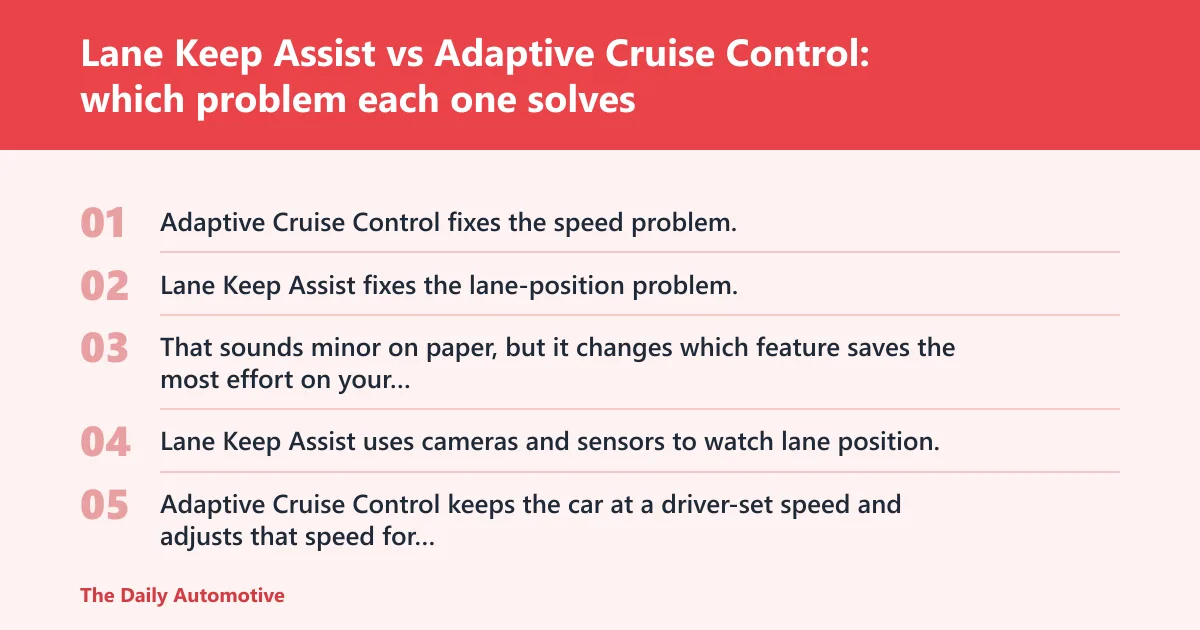
Adaptive Cruise Control fixes the speed problem. Lane Keep Assist fixes the lane-position problem. That sounds minor on paper, but it changes which feature saves the most effort on your roads, in your traffic, and in the part of the drive that wears you down.
| Decision factor | Lane Keep Assist | Adaptive Cruise Control | Winner |
|---|---|---|---|
| Main job | Helps keep the vehicle from drifting out of its lane | Maintains a driver-set speed and adjusts to traffic ahead | Depends on the job |
| Best relief | Steering fatigue on marked highways | Pedal fatigue in changing traffic gaps | Adaptive Cruise Control |
| What it needs | Visible lane markings and a camera view of the lane | Radar sensors and/or forward-looking cameras with a clear view ahead | Tie |
| Common weak point | Faded paint, construction lines, sharp merges, or odd lane shapes | Cut-ins, debris, weather interference, and stop-and-go edge cases | Tie |
| Best use case | Clear-lane commutes and gentle highway cruising | Long highway runs, traffic, and speed changes | Adaptive Cruise Control |
Main job
Lane Keep Assist uses cameras and sensors to watch lane position, then gives nudges or alerts when the car drifts. Adaptive Cruise Control keeps the car at a driver-set speed and adjusts that speed for the vehicle ahead. Different tasks, different payoff. The right pick depends on whether your problem is steering, braking, or both.
Best relief
ACC usually pays off faster on real commutes because traffic rarely stays constant. When the car ahead keeps opening and closing the gap, ACC cuts repeated pedal work and makes highway traffic less tiring. LKA helps too, but its gain can feel small if the lane lines are clean and the car already tracks straight.
What it needs
Lane Keep Assist generally relies on lane markings being visible. ACC typically uses radar sensors and, in some setups, forward-looking cameras to gauge traffic ahead and respond to speed changes. Both can be limited by weather or debris, but they fail in different ways.
Common weak point
LKA loses confidence when paint is faded, snow-covered, or broken up by work zones. ACC can feel late or hesitant when a vehicle cuts in close or when dirt, slush, or heavy weather interferes with the sensors. Neither feature replaces driver supervision, steering judgment, or braking in a sudden hazard.
Best use case
For a straight suburban or freeway commute, ACC usually removes more repetition. For a route with solid lane paint but steady lane drift from fatigue, LKA may be the help you notice most. If both problems show up often, the car that offers both features usually earns its keep fastest.
📊 ACC with lane centering rises to Level 2. Source: What Is Adaptive Cruise Control? Is It Worth Paying For?.
How adaptive cruise control works
Adaptive Cruise Control holds a driver-set speed, then automatically adjusts speed relative to the vehicle ahead. Most systems let the driver set following distance, and some advanced versions integrate navigation and forward-looking cameras to plan speed changes more smoothly. ACC alone does not make a car self-driving.
Stop-and-go and traffic jam assist
Some ACC systems include stop-and-go functionality, sometimes called traffic jam assist. In those systems, the car can usually slow to a stop in congestion, though it may require the driver to resume after stopping. That detail matters, because plenty of shoppers assume “adaptive” means the car will handle every crawl without input.
On SAE’s scale, ACC is Level 1. That means the driver still supervises, still steers with ACC-only systems, and still remains responsible for braking and evasive action. The system helps, but it does not take over. (motortrend.com)
How lane keep assist works
Lane Keep Assist uses cameras and sensors to monitor lane position. When the car starts to drift, it can provide corrective steering inputs or alerts, including visual, audible, or haptic warnings. It is meant to reduce lane departure accidents caused by distraction or fatigue.
Why lane keep assist feels different by brand
Some systems nudge the wheel gently. Others feel more pushy, or they wait until the car is farther over the line before acting. That is why one driver calls LKA calming and another calls it annoying. The feature’s behavior depends heavily on manufacturer tuning.
LKA also depends on visible lane markings. If the road paint is thin, patched, or missing, the system may weaken or shut down. On some cars it will simply warn; on others it will tug at the wheel and then give up when the lane picture gets uncertain.
Is lane keep assist the same as lane centering?
No. Lane Keep Assist reacts when the car drifts toward a lane edge. Lane centering actively keeps the vehicle centered within the lane. That difference matters on long highway drives, where centering can cut small steering corrections for minutes at a time.
Why lane centering usually pairs with ACC
Lane centering usually works with ACC on more advanced systems, because one system handles speed and gap control while the other handles steering position. Together, they move the car closer to SAE Level 2. That is still not full self-driving, but it is a bigger step than ACC or LKA alone.
When each system helps most on real roads
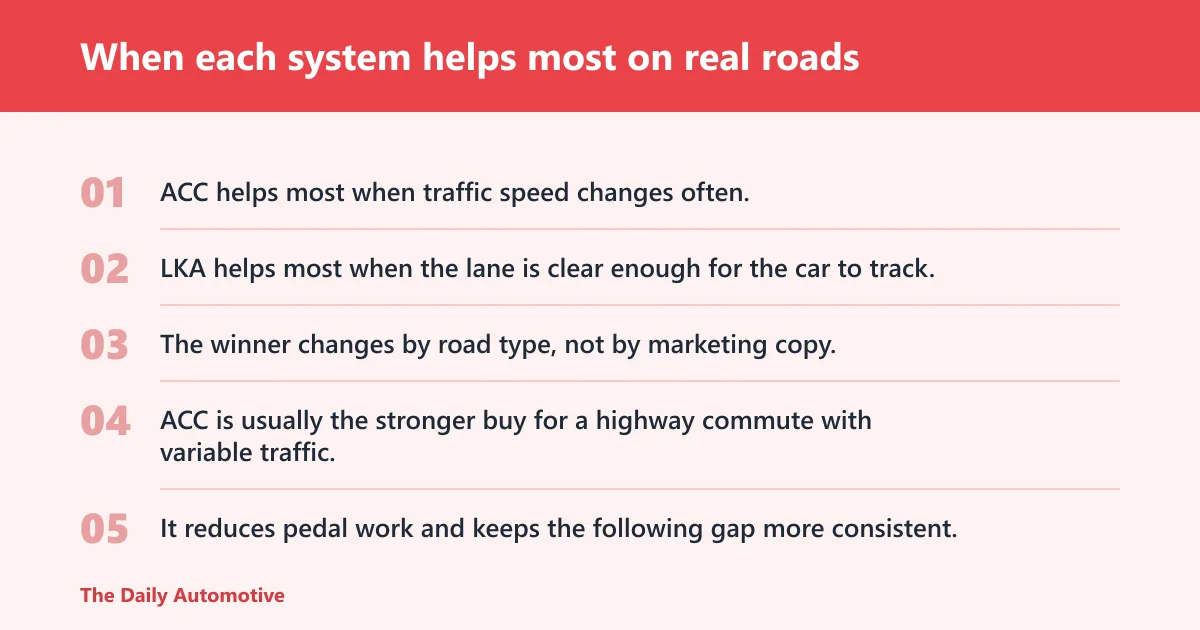
ACC helps most when traffic speed changes often. LKA helps most when the lane is clear enough for the car to track, but the driver wants fewer small steering corrections. The winner changes by road type, not by marketing copy.
Highway commute
ACC is usually the stronger buy for a highway commute with variable traffic. It reduces pedal work and keeps the following gap more consistent, which matters when the car ahead keeps speeding up and slowing down.
Stop-and-go traffic
ACC with stop-and-go or traffic jam assist is the feature to look for here. LKA can help a little, but it does little for the repeated braking that makes congestion tiring. If the system cannot resume by itself, check how much input it needs after a stop.
Road trips
On long trips, ACC tends to be the feature people use longest. It takes the edge off passing traffic, speed swings, and long stretches of steady cruising. Lane centering can matter more than basic LKA on these trips, because it reduces constant steering cleanup.
Rural roads and faded lane markings
LKA loses value quickly when markings are worn, patched, or absent. ACC may still work if forward traffic is present, but it also depends on clear sensor input and can be limited by debris or weather. If your roads are narrow or poorly marked, neither feature should be treated as a sure thing.
Construction zones and merge-heavy sections
Both systems can struggle here. LKA may chase temporary lines or lose the lane entirely, while ACC can react awkwardly to merging traffic, cut-ins, and changing gaps. These are the sections where driver attention matters more than any assist feature.
Decision matrix for common driving conditions
| Driving condition | Lane Keep Assist | Adaptive Cruise Control | Why it fails | Best fit |
|---|---|---|---|---|
| Highway commute | Yes | Yes | LKA can feel weak if the lane paint is poor; ACC cannot help with lane position | Adaptive Cruise Control |
| Stop-and-go traffic | No | Yes | LKA does little for braking; ACC may need manual resume after a full stop | Adaptive Cruise Control |
| Rural roads | No | Sometimes | LKA struggles with weak markings; ACC needs traffic ahead to matter much | Adaptive Cruise Control |
| Faded lane markings | No | No | LKA loses lane detection; ACC can still work, but it does not solve lane placement | Neither |
| Construction zones | No | Sometimes | LKA may follow temporary paint badly; ACC can be thrown off by cut-ins and odd lane flow | Adaptive Cruise Control |
| Road trips | Yes | Yes | LKA reduces lane drift only; ACC reduces speed changes only | Adaptive Cruise Control |
Choose Lane Keep Assist if… / Choose Adaptive Cruise Control if…
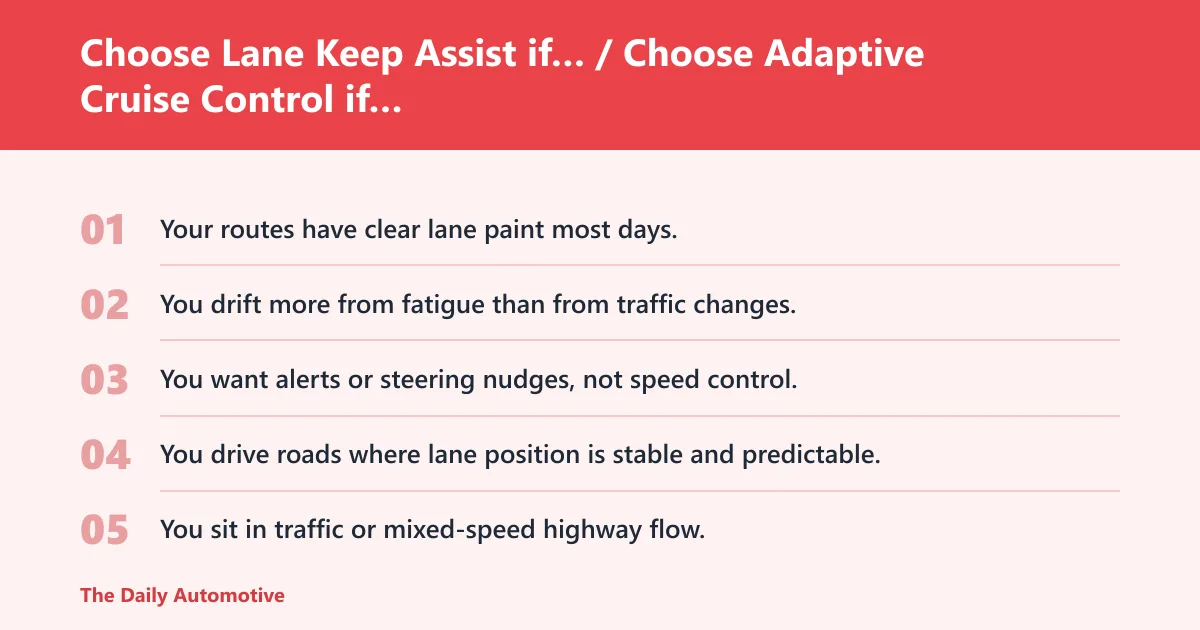
Choose Lane Keep Assist if your driving is mostly on clearly marked roads, you get tired from small steering corrections, and your commute is steady enough that traffic gaps are not the main stress. Choose Adaptive Cruise Control if you spend more time adjusting speed than adjusting direction, especially on highways and in congestion.
Choose Lane Keep Assist if…
- Your routes have clear lane paint most days.
- You drift more from fatigue than from traffic changes.
- You want alerts or steering nudges, not speed control.
- You drive roads where lane position is stable and predictable.
Choose Adaptive Cruise Control if…
- You sit in traffic or mixed-speed highway flow.
- You want less pedal work on long commutes.
- You do frequent road trips or freeway miles.
- You want the best payoff from stop-and-go or traffic jam assist.
Choose both if…
If your commute mixes steady highway cruising, traffic jams, and long miles, both features usually make sense together. ACC handles the speed, LKA handles the lane, and lane centering on some trims can cut more fatigue still. That is the setup most likely to feel worth paying for.
What to verify on a trim sheet before you buy
Do not assume the brochure’s “driver assist” label means the car has the version you want. Some trims get only basic ACC, some get LKA without lane centering, and some bundle stop-and-go into a higher package. Read the spec sheet line by line.
- Confirm whether the car has Adaptive Cruise Control or only fixed-speed cruise.
- Check whether ACC includes stop-and-go or traffic jam assist.
- Look for Lane Keep Assist versus lane centering; they are not the same.
- Verify whether lane features are standard, optional, or tied to a package.
- See whether following distance is adjustable.
- Check if the system uses radar sensors, forward-looking cameras, or both.
Frequently asked questions
adaptive cruise control vs lane keep assist
Adaptive Cruise Control handles speed and gap control. Lane Keep Assist handles lane position. If your commute is tiring because of traffic flow, ACC usually matters more. If your fatigue comes from holding the car in lane on long, steady roads, LKA can be the more useful feature.
lane keeping assist adaptive vs standard
“Standard” Lane Keep Assist usually means lane-drift help: warnings or steering nudges when the car moves toward a line. More advanced systems may add lane centering, which actively holds the car near the middle of the lane. That extra steering help is a different feature, not a stronger version of the same one.
is lane keep assist worth it
It is worth it when your roads have clear lane paint and you get tired from small steering corrections or late-day lane drift. It is less useful on worn rural roads, in work zones, or anywhere markings disappear often. In those cases, the system can stay quiet or act inconsistently.
what cars have lane keep assist
Many mainstream cars now offer Lane Keep Assist, but usually by trim and package rather than across every version. Shoppers should check the exact trim sheet, because the same name can mean different behavior from one brand to the next. Basic availability is common; the tuning is not.
Can adaptive cruise control work in stop-and-go traffic?
Yes, if the system includes stop-and-go or traffic jam assist. Some ACC setups can brake to a complete stop, then ask for a manual resume before moving again. If your commute has heavy congestion, that detail matters as much as the badge on the spec sheet.
Is lane keep assist the same as lane centering?
No. Lane Keep Assist reacts when the car starts to drift, while lane centering holds the vehicle more continuously in the lane. Lane centering is usually the more advanced system and often pairs with ACC, which is why it is tied to Level 2 operation on SAE’s scale.
Which system is more useful for highway driving?
Adaptive Cruise Control is usually the more useful highway feature because it reduces speed changes and following-gap work, which are constant on real freeway drives. Lane Keep Assist helps too, but it does less if the road is straight and the lane paint is clear. The bigger win depends on whether traffic or steering is the bigger drain.
Products related to this article
Sponsored / affiliate links. As an Amazon Associate I earn from qualifying purchases. I may earn additional commission from eligible campaigns.