Car Guys Super Cleaner for Leather Review
CAR GUYS Super Cleaner is a good one-bottle cleaner for finished leather if you want convenience, but it does not replace leather conditioner or protection. Skip the follow-up care, and leather can dry out, lose feel, and show wear sooner. This review explains what it cleans, where a dedicated leather cleaner still makes more sense, and what to use after cleaning.
Multi-surface interior cleaning performance and limits
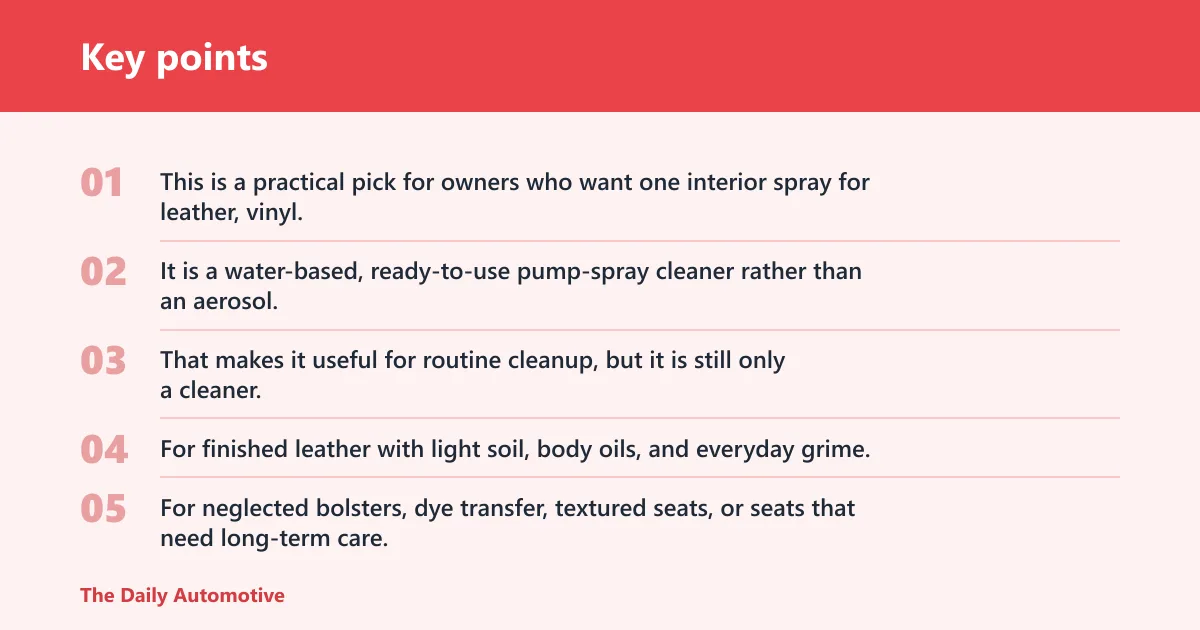

This is a practical pick for owners who want one interior spray for leather, vinyl, fabric, carpet, and plastic. It is a water-based, ready-to-use pump-spray cleaner rather than an aerosol, and it is not meant to add protection. That makes it useful for routine cleanup, but it is still only a cleaner.
For finished leather with light soil, body oils, and everyday grime, that is enough for many cabins. For neglected bolsters, dye transfer, textured seats, or seats that need long-term care, you still need a leather routine after the wipe-down.
Best use case for leather owners
The best fit is a driver who wants one bottle for mixed interior materials and does not need a leather-only system. It can clean finished automotive leather, and the same bottle can also handle vinyl, fabric, carpet, and plastic inside the cabin.
Main limitation for real leather care
The limit is simple: cleaning is not conditioning, and cleaning is not protection. If your goal is softness, suppleness, or a finish that is better prepared for sun and wear, you still need separate follow-up products.
Pros and cons
Pros
- Ready to use with no mixing.
- Works on leather, vinyl, fabric, carpet, and plastic.
- Pump-spray trigger bottle gives controlled application.
- Cleaner-only formula keeps the job simple for quick interior care.
Cons
- Does not add protection.
- Not for glass or instrument-panel screens.
- Set-in stains can need a second pass and agitation.
- No public SDS on file limits ingredient and hazard transparency.
Is CAR GUYS Super Cleaner good for leather?
Yes, for finished leather that needs a basic clean. It is listed for leather and also for vinyl, fabric, carpet, and plastic, so it fits a convenience-first interior routine. It is less compelling when the seat needs deeper leather care, because it does not condition or protect.
Finished leather versus porous or coated surfaces
On finished automotive leather, a cleaner like this can remove routine grime and body oils. On porous or heavily textured surfaces, the same stain may sit deeper and need more agitation. That is where a dedicated leather cleaner can be the better tool, especially if the seat is already showing wear.
What light soil and body oils should wipe off
Light dust, fresh transfer, and normal skin oils are the best match for a spray cleaner of this type. Use a microfiber towel for the wipe-off so you control how much liquid reaches seams and stitching. Light soil is where a one-bottle cleaner earns its keep.
When set-in grime needs a dedicated leather cleaner
Set-in stains, dyed transfer, and neglected high-wear bolsters often need a dedicated leather cleaner with more focused agitation. A common first-timer mistake is to keep adding spray to the same spot. That can over-wet the panel without lifting the embedded soil.
Leather cleaner matrix
This decision matrix separates seat condition from cleaning method. It is meant to help you decide whether CAR GUYS Super Cleaner is enough, whether you should follow with conditioner, or whether you should skip straight to a dedicated leather cleaner.
| Leather condition | Seat type | Risk level | Recommended application method | Follow with conditioner? | Skip to dedicated leather cleaner? |
|---|---|---|---|---|---|
| Light dust, fresh fingerprints, routine body oils | Finished leather | Low | Spray onto a microfiber towel, wipe, then buff dry | Optional, if you want a conditioning step | No |
| Moderate grime on high-touch areas | Finished leather with smooth grain | Medium | Apply to towel first; add light agitation with an interior scrub brush if needed | Yes, if softness or routine maintenance is the goal | Only if staining remains after a second pass |
| Set-in soil or dyed transfer | Seat bolsters and armrests | Higher | Use a controlled towel application, then brush lightly and wipe again | Yes, after cleaning | Yes, often a better choice |
| Perforated leather with visible dirt in the surface | Perforated seat panels | Higher | Do not spray into the holes; spray the towel and wipe gently | Yes, but only after the panel is dry enough to assess finish | Yes, if grime is trapped in perforations |
| Cream leather or other light-color seats with transfer marks | Finished leather | Medium to higher | Start with a spot test, then work in short passes with a towel | Usually yes | Yes, if color transfer is stubborn |
| Heavily neglected surfaces with embedded grime | Textured leather or fabric inserts | High | Cleaner plus interior scrub brush, then towel wipe-off | Yes, after full drying | Yes |
How do you use it on leather?
Use it with control, not volume. The practical method is to spot-test first, keep overspray off trim and screens, apply to a microfiber towel rather than flooding the seat, and wipe dry after cleaning. If dirt is embedded, add gentle agitation and then remove residue fully.
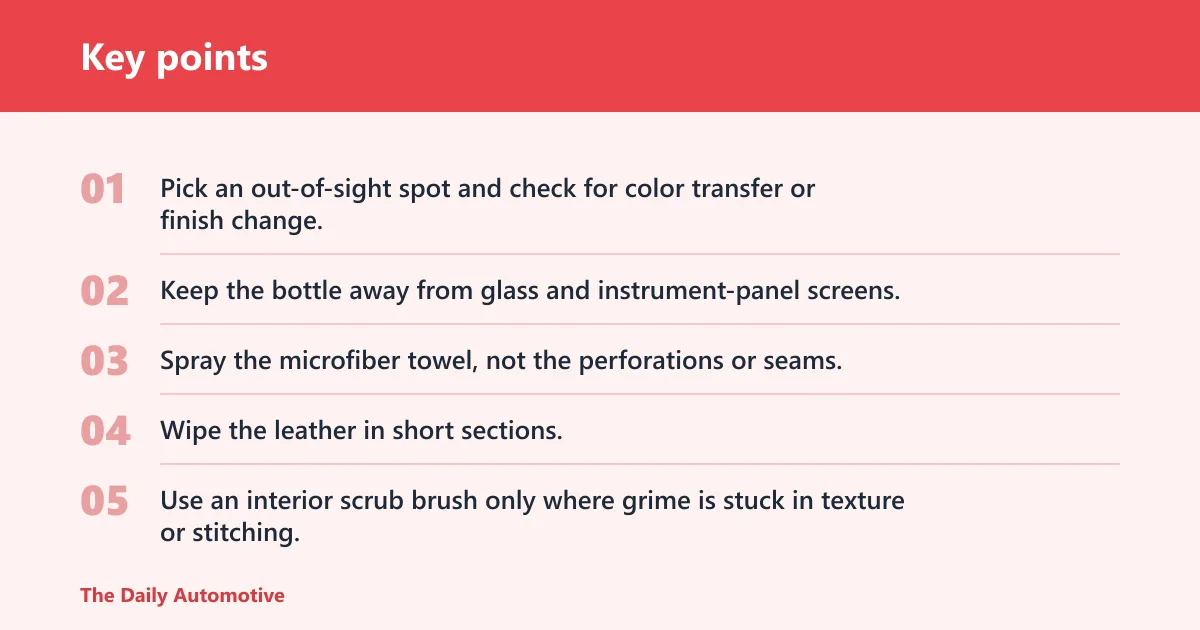
- Pick an out-of-sight spot and check for color transfer or finish change.
- Keep the bottle away from glass and instrument-panel screens.
- Spray the microfiber towel, not the perforations or seams.
- Wipe the leather in short sections.
- Use an interior scrub brush only where grime is stuck in texture or stitching.
- Buff dry with a clean microfiber towel.
- After the panel is clean and dry, decide whether conditioner is needed.
Spot-test and control overspray
Spot-testing matters because leather finishes can vary. A small hidden section tells you whether the surface reacts badly or transfers dye. Controlled application also matters because the product is water-based and ready to use, so the real risk is usually too much liquid in the wrong place.
Use a microfiber towel for application and wipe-off
A microfiber towel is the right tool for controlled application and dry wipe-off. It helps you apply less cleaner to seams, perforations, and stitching, then remove the loosened soil without soaking the panel. That matters more on delicate or lighter-colored leather.
Add agitation with an interior scrub brush when needed
If the dirt sits in the grain, use an interior scrub brush with light pressure. That is especially useful on fabric inserts, textured leather, and stubborn seat bolsters. The brush should loosen the soil, while the towel removes it.
Handle perforated leather with extra care
Perforated leather needs extra care because liquid can pool in the holes. Do not spray directly into the perforations. Spray the towel instead, then wipe the panel. That reduces over-saturation risk and helps keep moisture out of the seat backing.
Say your driver seat has a dark smear on the outer bolster and a row of perforations across the center panel. A direct spray can push cleaner into the holes. A towel-first approach keeps the cleaner on the surface, where it can lift the mark without flooding the panel.
Suppose a cream leather rear bench has light transfer from denim but still feels dry after cleaning. That is a case where a conditioner may still make sense after the seat is fully dry. Cleaning removed the soil; conditioning addresses the leather’s feel, not the stain.
Who should buy it?
This suits convenience-first buyers with mixed interiors, especially if they want one spray for leather and adjacent cabin materials. It also fits drivers who mostly fight routine dirt, quick spills, and light body oils. It is less appealing if you want a dedicated leather routine, strong ingredient transparency, or a product that adds protection.
Convenience-first buyers with mixed interiors
If your cabin has leather seats, vinyl trim, carpet mats, and plastic panels, one bottle is easier to store and easier to grab. That is the main appeal here. You get a cleaner that covers more than one surface without mixing or decanting.
Drivers with routine dirt and quick cleanup needs
If your main problem is light soil, this kind of product is enough for regular maintenance. It is best when you want a quick wipe-down after everyday use, not a complete leather preservation plan. For that job, it is a cleaner, not a finish system.
Who should skip it for a dedicated leather routine?
Skip it if the seats have heavy dye transfer, deep grime, or visible neglect. Also skip it if you want a true leather-only routine with a dedicated cleaner, conditioner, and protectant chosen separately. That workflow takes more steps, but it gives you more control over the finish.
What it does not replace
CAR GUYS Super Cleaner is a cleaner only. It does not replace a dedicated leather cleaner when the seat needs more focused stain removal, and it does not replace conditioner or protection. Those are separate decisions, and they matter for maintenance.
Dedicated leather cleaner
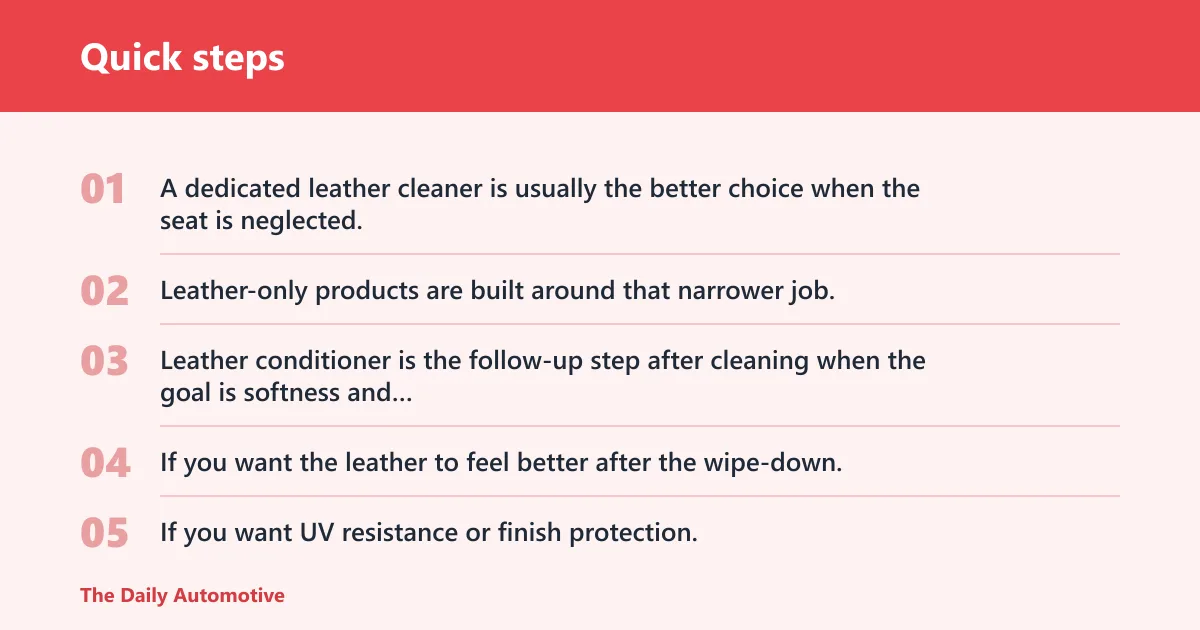
A dedicated leather cleaner is usually the better choice when the seat is neglected, stained, or showing transfer that a general interior spray cannot remove cleanly. Leather-only products are built around that narrower job, so they can be a better match for problem seats.
Leather conditioner
Leather conditioner is the follow-up step after cleaning when the goal is softness and conditioning rather than stain removal. It does not clean the seat by itself. If you want the leather to feel better after the wipe-down, conditioner is the next product to use.
Leather protection
Protection is separate from cleaning. If you want UV resistance or finish protection, you need a product that specifically claims that function. This cleaner does not add that layer, so do not count on it for long-term protection.
Safety and ingredient transparency
The safety discussion is not just about surface compatibility. CarCareTruth says the product has no public SDS on file, which limits how much ingredient and hazard detail is available to a shopper. For buyers, that means more caution with ventilation, gloves if desired, and careful overspray control.
That missing SDS does not mean the cleaner is unsafe to use on listed interior surfaces. It does mean you have less public documentation for hazard classification and PPE decisions. If that matters to you, a dedicated product with fuller safety disclosure may be easier to evaluate.
What the missing SDS means in practice
Without a public SDS, you have less formal ingredient transparency than you would like for a chemical product. The practical response is straightforward: work in a ventilated area, keep the spray off screens and glass, and avoid saturating seams, switches, and perforations.
Comparison with a dedicated leather cleaner
The difference is in scope. CAR GUYS Super Cleaner is a multi-surface interior spray that works on leather, vinyl, fabric, carpet, and plastic. A dedicated leather cleaner is narrower by design and is often paired with conditioner in a two-step routine.
Use the multi-surface bottle if convenience matters more than specialization. Use a leather-only cleaner if you want a more focused leather workflow, especially for deeper grime or seats that need repeated maintenance. The right choice depends on whether you need one bottle or the right sequence of products.
Its value is better when you want one cleaner for the whole cabin. If you only care about leather, the cost-per-clean logic gets less favorable because you are paying for versatility you may not use. In that case, a leather-only product can be the cleaner fit.
Frequently asked questions
Is chemical guys leather cleaner good?
For finished leather with light to moderate soil, yes, a cleaner in this category can be a good choice. The better question is whether you need a leather-only product or a multi-surface cleaner. If the seat needs conditioning or protection afterward, you still need separate products.
Does CAR GUYS Super Cleaner clean leather without conditioning it?
Yes, it can clean leather without conditioning it. That is the point of a cleaner-only product. The limitation is that cleaning alone does not soften or maintain the leather long term, so many owners still add conditioner after the seat is clean and dry.
Is CAR GUYS Super Cleaner safe on perforated leather?
It can be used carefully on perforated leather, but direct spray into the holes is the wrong move. Spray the towel instead and wipe gently. The concern is over-saturation, since liquid can travel through the perforations and linger where you cannot easily remove it.
Can CAR GUYS Super Cleaner be used on glass?
No. It is explicitly not for glass or instrument-panel screens. That is an exclusion, not a supported use. Keep it on the interior surfaces it lists, and use a glass-specific cleaner for windows and reflective screen-safe care.
What is the difference between CAR GUYS Super Cleaner and a dedicated leather cleaner?
CAR GUYS Super Cleaner is a multi-surface interior spray that also works on leather. A dedicated leather cleaner is focused on leather care, and it is often paired with conditioner in a two-step routine. If the seat is neglected or stained, the leather-only route is usually the better fit.
Products related to this article
Sponsored / affiliate links. As an Amazon Associate I earn from qualifying purchases. I may earn additional commission from eligible campaigns.