How Much Is A Toyota Corolla Car Battery? 2025 Price Guide
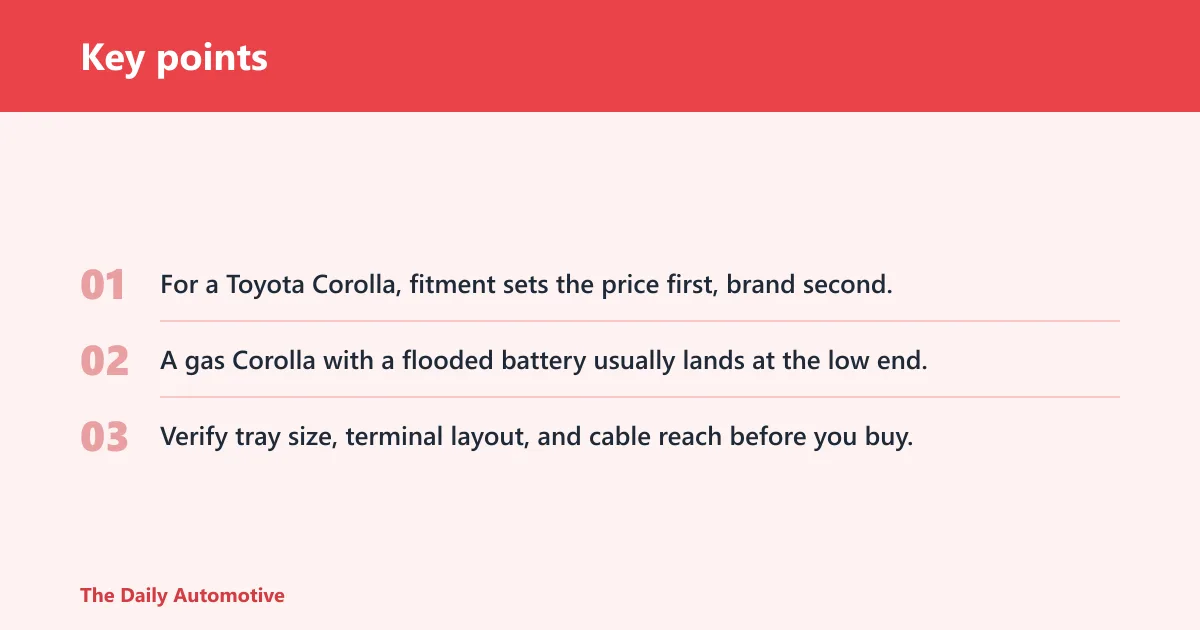
For a Toyota Corolla, fitment sets the price first, brand second. A gas Corolla with a flooded battery usually lands at the low end, while start-stop trims and Corolla Hybrid auxiliary batteries cost more because AGM or EFB chemistry and extra fitment checks raise the total. Verify tray size, terminal layout, and cable reach before you buy.
Corolla battery price matrix

| Model family | Likely battery group | Technology | Battery-only price range | Installed price range | Fitment check required before purchase |
|---|---|---|---|---|---|
| Gas Corolla, many 2003–2018 trims | Group 35 | Flooded | $120–$220 | $180–$320 | Confirm Group 35 tray size, hold-down, and terminal layout. |
| Gas Corolla with reversed terminals | 51R | Flooded or AGM, depending on trim | $120–$260 | $190–$360 | Verify reversed polarity and cable reach before purchase. |
| Newer Corolla gas models | H4/46 | Flooded, EFB, or AGM | $120–$360 | $190–$430 | Check DIN case size, clamp style, and whether the car needs stop-start compatible chemistry. |
| Newer Corolla gas models | H5/47 | Flooded, EFB, or AGM | $120–$360 | $210–$450 | Match case height, terminal orientation, and cable reach to the exact trim. |
| Corolla Hybrid 12V auxiliary battery | Model-specific auxiliary fitment | AGM, with case and venting verified | $200–$360 | $280–$500 | Confirm auxiliary battery type, venting, and that this is not the traction battery. |
How much does a Corolla battery cost?
A Corolla battery usually costs about $120 to $360 for the battery alone, and installed totals are often higher once labor, shop supply charges, and fitment time are added. Toyota battery guidance also points shoppers toward a 36+ months free replacement warranty, but the correct battery still depends on model year, trim, and system type.
Battery-only vs installed pricing
Battery-only price is the sticker on the box. Installed price includes the battery plus labor, and that spread grows when the shop has to verify terminal orientation, reset settings, or source a less common DIN case. Dealer pricing can make sense when the Corolla uses a model-specific fitment or the hybrid auxiliary battery needs exact matching.
Say your gas Corolla needs a Group 35 flooded battery and the tray, hold-down, and cable reach all match. That is usually the simplest and least expensive replacement path. If the same car turns out to need a 51R, the battery itself may still be affordable, but reversed polarity makes the wrong choice expensive fast.
Why labor changes the total
Labor is removal, installation, and the checks around them. A technician may need to confirm the hold-down style, inspect the terminals, and check whether the charging system or venting layout fits the new battery. Those extra checks matter more on newer Corollas and hybrids than on older gas-only cars.
What battery size does a Toyota Corolla take?
There is no single Corolla battery size. Many 2003–2018 gas trims use Group 35, some fitments use 51R with reversed polarity, and 2019-plus Corollas often move to H4/46 or H5/47 DIN cases. The correct size depends on the exact model year, region, and whether the car has a standard, start-stop, or hybrid setup.
Group 35 fitment
It is usually the simplest match for a conventional gas Corolla, but you still need to verify the tray and clamp before purchase. Size alone is not enough if the terminal orientation or case shape does not match the original battery.
51R fitment and reversed polarity
Some Corolla fitments use 51R, which has reversed polarity. That matters because the cables must reach the correct posts without strain. A battery that fits the tray can still be wrong if the terminals land on the wrong side or the lead length is too short.
H4/46 and H5/47 DIN cases
Corolla models from 2019 onward often use H4/46 or H5/47 DIN sizes. These cases are not interchangeable by guesswork. Confirm the case height, terminal position, and clamp style before buying, especially if the car has start-stop equipment or market-specific hardware.
Tray, clamp, and cable checks
Some Corolla fitments require verifying tray, clamp, and cable reach. That check matters as much as chemistry. A battery that is correct on paper can still sit loose, stress the cables, or block the hold-down if the case profile does not match the car.
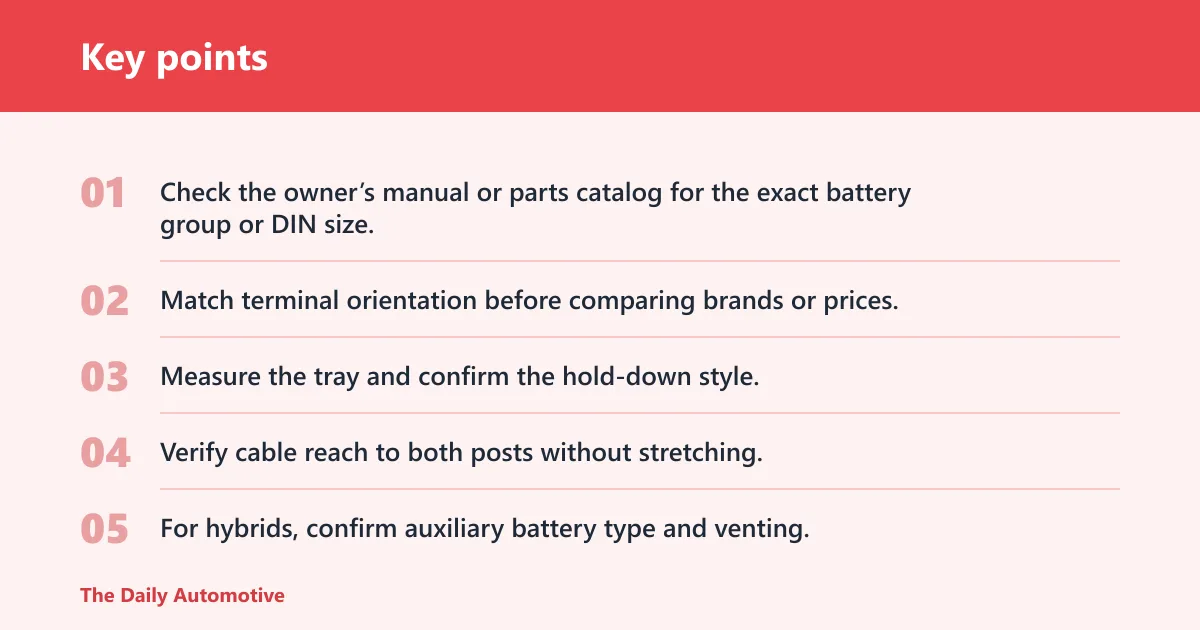
- Check the owner’s manual or parts catalog for the exact battery group or DIN size.
- Match terminal orientation before comparing brands or prices.
- Measure the tray and confirm the hold-down style.
- Verify cable reach to both posts without stretching.
- For hybrids, confirm auxiliary battery type and venting, then buy only after the fitment listing matches.
AGM, EFB, or flooded?
Flooded batteries are the lowest-cost option when the Corolla uses a standard starting battery and there is no start-stop requirement. EFB fits many start-stop applications and gives better cycle life than flooded. AGM is the safer pick for hybrids, start-stop trims, cold climates, and cars that sit through short-trip duty with frequent electrical loads.
When AGM is the safer pick
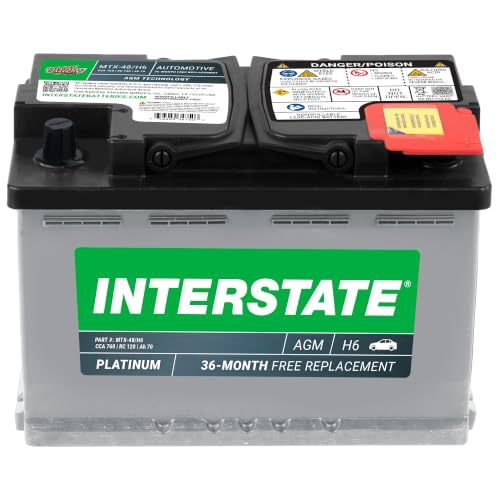
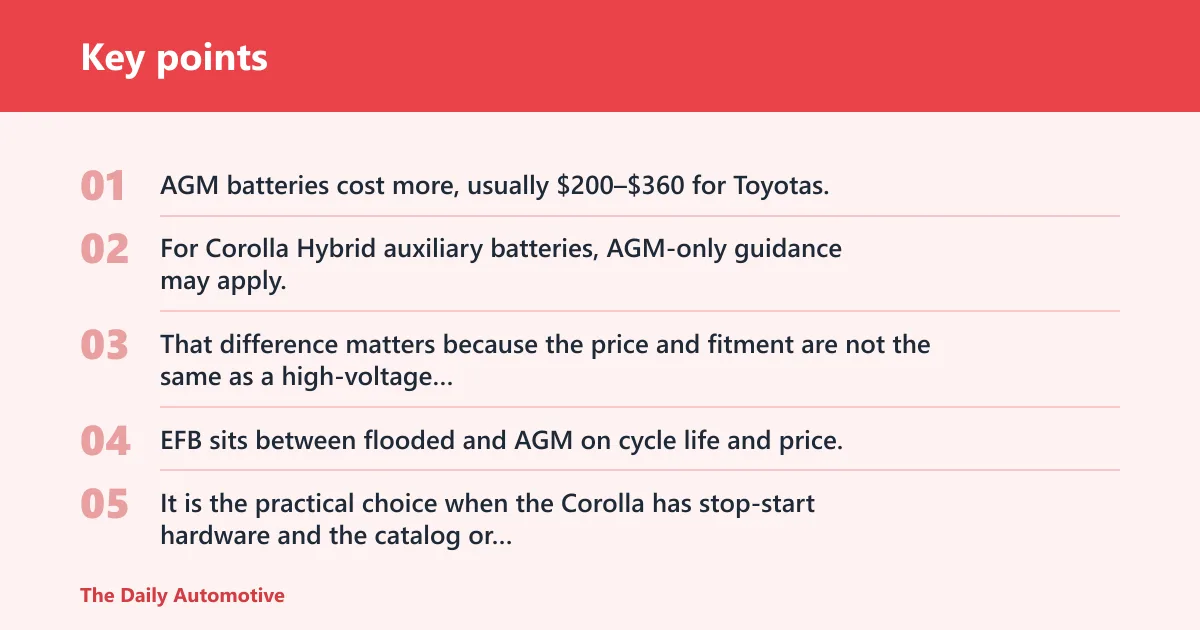
AGM batteries cost more, usually $200–$360 for Toyotas, but they handle repeated cycling better and are less sensitive to vibration. For Corolla Hybrid auxiliary batteries, AGM-only guidance may apply, and the auxiliary battery is not the traction battery. That difference matters because the price and fitment are not the same as a high-voltage hybrid pack.
Where EFB fits
EFB sits between flooded and AGM on cycle life and price, with Toyota EFB batteries typically priced at $160–$280. It is the practical choice when the Corolla has stop-start hardware and the catalog or manual calls for that type. Do not assume EFB and flooded are interchangeable just because the case fits.
When flooded is acceptable
Flooded batteries remain acceptable for many conventional gas Corollas when the OE setup calls for that chemistry. Toyota flooded batteries are typically priced at $120–$220. If the original battery was flooded, a like-for-like replacement is usually the simplest path, provided the group size and polarity match.
Why hybrids need extra verification
Hybrid Corollas need extra attention because the 12V auxiliary battery is separate from the traction battery. The updated hybrid model uses a redesigned, lighter lithium-ion unit, so fitment can change by market and trim. Check the listing carefully before ordering, especially for venting and case style.
Corolla battery specs that matter
For a Corolla, the most useful shopping filters are CCA, reserve capacity, warranty length, terminal orientation, and venting. CCA should meet or exceed OE spec, RC helps with short trips and electrical loads, and a 36+ months free replacement warranty is a strong target when you are comparing replacements.
CCA target
CCA matters most in cold starts. Choose a battery that meets or exceeds the OE rating for your exact Corolla. Higher headroom helps in cold climates, but do not buy a larger battery if it causes fitment problems or forces the wrong terminal layout.
Reserve capacity
Reserve capacity supports lights, HVAC, and audio during short trips and idle-heavy city use. If the Corolla is used for frequent stop-and-go driving, RC becomes more important than a flashy brand name. Compare the listing against the manual or exact OE replacement guidance.
Warranty length
Toyota battery guidance recommends 36+ months free replacement warranty. That is a useful buying target, not a universal rule. A shorter warranty can still be acceptable if the battery is the correct fit and the price reflects the warranty term.
Terminal orientation and venting
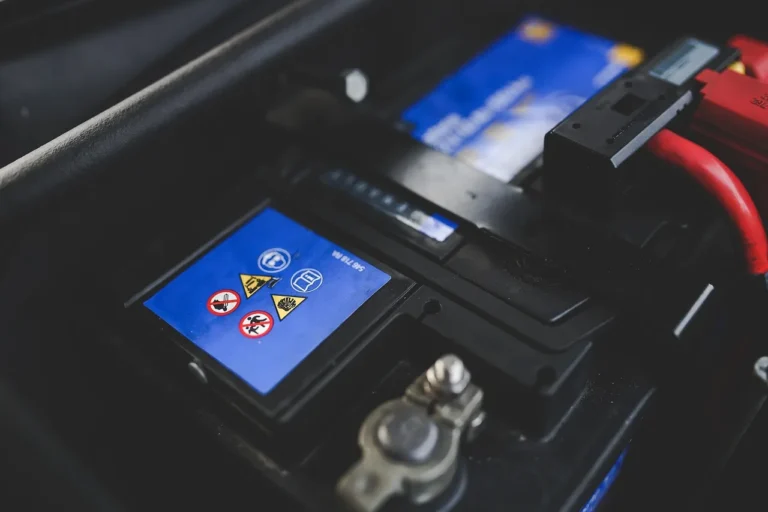
Terminal orientation decides whether the cables reach cleanly and safely. Venting matters on batteries that require a vent tube, especially in model-specific or hybrid applications. If the listing does not clearly state polarity and vent provision, keep looking.
Common fitment mistakes
Cheap batteries become expensive when the fitment is wrong. The biggest mistakes are reversed polarity, the wrong case height, skipping vent-tube checks, and choosing the wrong chemistry for a start-stop or hybrid system. Each one can create warning lights, poor starts, or a return trip to the parts counter.
Wrong polarity
Buying a standard-polarity battery for a 51R Corolla fitment is a common error. The battery may sit in the tray, but the cables will not land correctly. That can force unsafe routing or an immediate return.
Wrong case or hold-down
A battery can be the right chemistry and still fail the fitment test if the case height or hold-down does not match. That is one reason tray and clamp checks matter before purchase. A loose battery can move, stress cables, and shorten service life.
Skipping vent-tube checks
Some batteries and some Corolla fitments require venting. If the original battery used a vent tube and the replacement does not support it, the installation is not complete. Confirm the listing before leaving the counter.
Choosing the wrong chemistry
Do not downgrade from AGM or EFB to flooded if the OE battery was the higher-spec type. Toyota battery guidance advises not to downgrade if the OE battery was EFB or AGM. That warning matters most on start-stop Corollas and hybrids.
A common first-timer mistake is buying a cheaper flooded battery for a start-stop Corolla because the case size looks correct. The car may still start, but cycle life and warranty coverage can suffer if the OE system expected EFB or AGM.
How long should a Toyota Corolla battery last?
A Corolla battery often lasts several years, but short trips, cold weather, heat, and heavy accessory use can shorten that span. If starts are slower, the idle stop system becomes unreliable, or the battery warning light appears, replacement planning should start. Charging-system checks matter before you blame the battery alone.
Short-trip and climate effects
Frequent short trips leave less time for the alternator to refill the battery. Cold weather makes cranking harder. Heat can age the battery faster. That is why RC and chemistry choice matter as much as the price tag on the box.
Signs replacement is due
Slow cranking, dim lights at idle, repeated jump-starts, and stop-start complaints are all reason to inspect the battery. A battery that still fits can still be near the end of its useful life if voltage recovery is poor or the warranty window is almost over.
When charging-system checks matter
If the battery keeps failing early, the charging system may be part of the problem. A weak alternator, poor cable connection, or incorrect battery match can make a new battery seem defective. Follow the vehicle and product manual, and do not work under a vehicle supported only by a jack.
Frequently asked questions
How much does a Toyota Corolla car battery cost in 2025?
Most Corolla battery buyers should expect about $120–$360 for the battery alone, depending on the fitment and chemistry. Installed totals are higher because labor, testing, and model-specific checks add cost. Hybrid auxiliary batteries and newer DIN sizes tend to sit near the top of the range.
Is a Corolla battery AGM, EFB, or flooded?
It depends on the model. Many conventional gas Corollas use flooded batteries, while start-stop trims often call for EFB or AGM, and some Corolla Hybrid auxiliary batteries use AGM. If the OE battery was EFB or AGM, do not downgrade without confirming compatibility first.
How much should I pay installed vs just the battery?
Battery-only pricing is lower because it excludes labor. Installed pricing adds the shop’s time to verify fitment, connect the battery correctly, and check the charging system if needed. The gap is usually wider on hybrids, stop-start cars, and less common DIN-size Corollas.
Do Corolla hybrid models use a different 12V battery?
Yes. The hybrid’s 12V auxiliary battery is separate from the traction battery, and fitment can differ by market and trim. Some hybrids need AGM-only guidance, and the case, venting, and terminal layout must be verified before purchase.
What are common Corolla battery fitment mistakes?
The most common errors are buying the wrong polarity, using the wrong case size, ignoring tray and hold-down differences, and skipping venting checks. Another costly mistake is installing flooded where the OE system expected EFB or AGM. Those shortcuts can make a cheap battery expensive fast.
Products related to this article
Sponsored / affiliate links. As an Amazon Associate I earn from qualifying purchases. I may earn additional commission from eligible campaigns.