Crankshaft Position Sensor Cost
Crankshaft position sensor replacement usually costs about $150 to $400, but the bill can rise when the sensor sits behind intake parts or transmission bellhousing covers, or when the fault is actually in the wiring. If you ignore it, a bad signal can cause stalling, no-starts, and parts swaps that solve nothing. This guide breaks down part price, labor, access, and how to tell sensor failure from connector or wiring trouble.
Why total repair costs swing from $100 to $1,150


The biggest price split is access, not the sensor itself. A simple top-of-engine swap may stay near the low end, while a sensor buried at the bellhousing or behind intake parts can turn a modest part into a four-figure repair once diagnostic time and labor are added.
| Scenario | Parts range | Labor range | Total replacement range | Diagnostic step before replacement |
|---|---|---|---|---|
| Easy-access sensor | $25 to $120 | $75 to $180 | $100 to $300 | Read OBD-II codes and confirm signal loss with live data or cranking RPM |
| Moderate-access sensor | $40 to $180 | $150 to $300 | $200 to $500 | Inspect the connector, wiring, and sensor air gap before ordering parts |
| Difficult-access sensor | $60 to $250 | $300 to $900 | $400 to $1,150 | Verify power, ground, wiring continuity, and tone-wheel signal path before removal |
Those totals assume the fault really is the sensor. If the connector is corroded, the wiring is broken, or the reluctor path is damaged, the correct repair may be cheaper or more expensive than a sensor swap. That is why you start with diagnosis.
What does a crankshaft position sensor do?
The crankshaft position sensor tells the engine control module, often called the ECM or PCM, where the crankshaft is and roughly how fast it is turning. The module uses that signal to time spark and fuel delivery. If the signal drops out, the engine may stall, refuse to start, or run badly.
How the ECM or PCM uses the signal
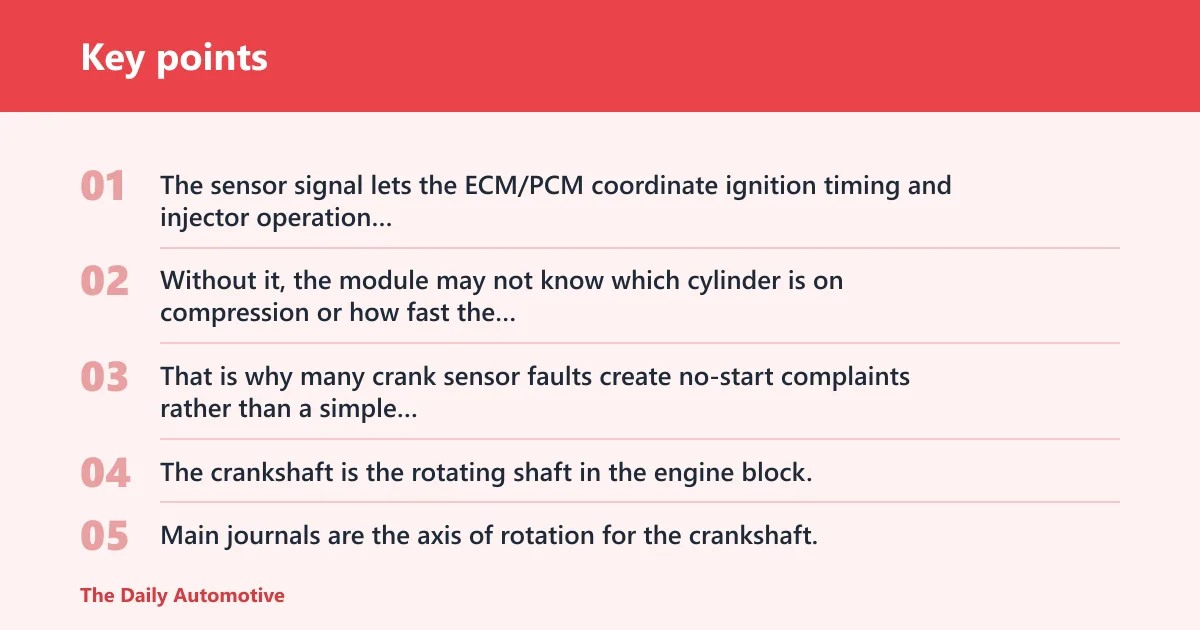
The sensor signal lets the ECM/PCM coordinate ignition timing and injector operation with crankshaft rotation. Without it, the module may not know which cylinder is on compression or how fast the engine is spinning. That is why many crank sensor faults create no-start complaints rather than a simple warning light.
The crankshaft is the rotating shaft in the engine block. Main journals are the axis of rotation for the crankshaft, and connecting rod journals are also called crank pins. Oil passageways run inside the crankshaft to lubricate rod journals, and the rear end of the crankshaft ends with a flywheel flange. The crankshaft nose drives the valve train and accessories.
Why signal loss can cause no-start or stalling
If the ECM/PCM loses a believable crank signal, it may shut down spark and injector control. That can show up as a hard no-start, an engine that starts and then dies, or an intermittent cutout while driving. A weak or missing signal can also mimic a misfire or fuel problem.
When clearances are too low, metal-to-metal contact can follow, but sensor complaints are more often electrical than mechanical. That is why the wiring path matters as much as the sensor body itself.
Hall-effect versus magnetic pickup designs
Many sensors are either Hall-effect or magnetic pickup designs. Hall-effect sensors usually need a power feed and ground, then send a digital signal back to the ECM/PCM. Magnetic pickup sensors generate their own AC signal and are often used with a different connector style and testing method.
That design difference affects cost. A vehicle-specific Hall-effect sensor may cost more from the OEM because its connector and wiring match are tighter. An aftermarket magnetic pickup may be cheaper, but fitment and signal quality can vary by brand.
What changes the replacement price?
Three things move crankshaft position sensor cost the most: where the sensor sits, which part number the engine needs, and how much shop time the job takes. Regional labor rates matter too. A low parts price does not help if access requires intake removal or transmission-side work.
Sensor location and access time
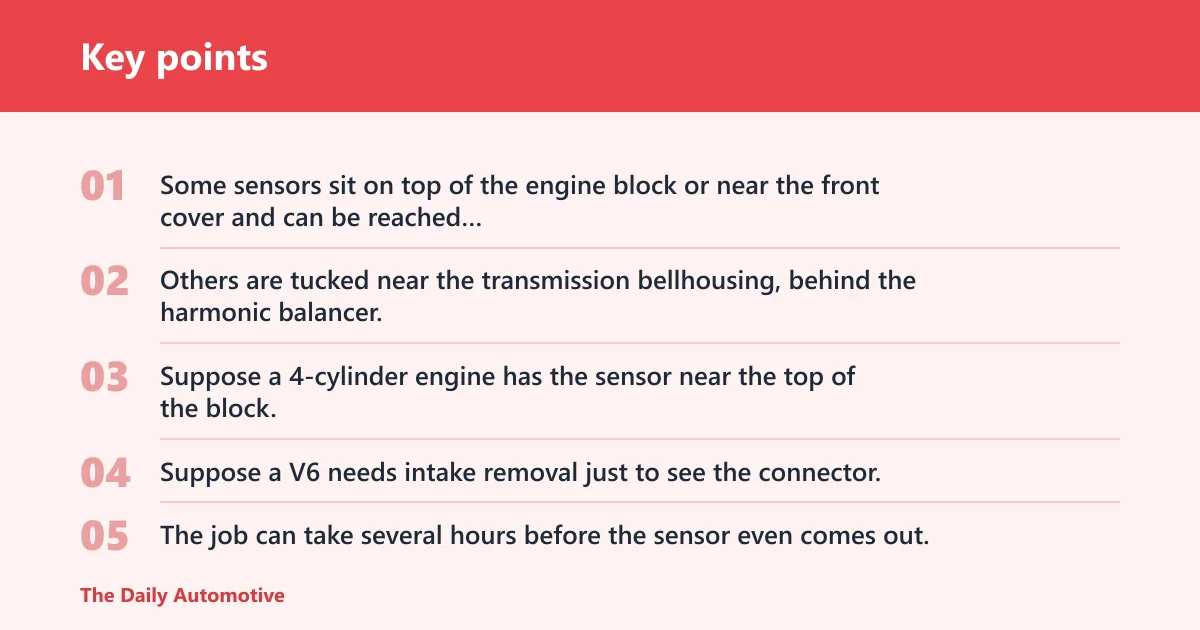
Some sensors sit on top of the engine block or near the front cover and can be reached in minutes. Others are tucked near the transmission bellhousing, behind the harmonic balancer, or deep on the block. Those layouts raise labor hours fast.
Suppose a 4-cylinder engine has the sensor near the top of the block. The labor may be close to an hour. Suppose a V6 needs intake removal just to see the connector. The job can take several hours before the sensor even comes out.
OEM versus aftermarket part pricing
An OEM part usually costs more, but it is more likely to match the connector, wiring length, and sensor shape the vehicle was built with. Aftermarket parts are often cheaper. Fitment and quality vary, and brand reputation matters because a poor signal can leave the same fault code in place.
For cost shoppers, the real question is not only price. It is whether the part matches the model-year-engine combination and any engine code requirements. A sensor listed for the right model year can still be wrong for a specific engine family.
Vehicle-specific fitment and engine code matching
Crankshaft position sensor fitment can change with model year, engine code, and even transmission choice. Some engines require removal of the intake, cover, or other nearby parts to reach the sensor. Others use different connector keys or wire lengths between trims.
That is where quote comparisons go wrong. Two vehicles with the same badge can need different labor times and different sensors. The parts counter should match the exact engine, not just the model name.
Shop-rate and regional pricing
Labor rate varies by region and shop type. Dealer labor, independent shop labor, and urban versus rural pricing can move the bill by a large margin. A lower part price does not offset a high labor rate on a difficult access job.
That is why a single national average can mislead. A fair estimate should separate part price, diagnostic time, and labor time. Ask for each line item.
How do you know the sensor is bad?
Start with the scan tool. An OBD-II scan tool can read diagnostic trouble codes, often help confirm crank sensor-related faults, and show whether the ECM/PCM sees engine speed during cranking. If the code and live data do not line up, the wiring or tone wheel may be the real problem.
OBD-II codes tied to crank sensor faults
Codes related to crankshaft sensor performance, circuit faults, or signal loss point in the right direction, but they do not prove the sensor has failed. A code may set because the connector loosened, the wiring rubbed through, or the sensor gap changed.
That is why live data matters. If the engine cranks and the scan tool shows zero RPM, the ECM/PCM is not receiving a usable crank signal. If RPM appears erratic, the sensor, wiring, or reluctor path may be intermittent.
Symptoms that often appear first
Common symptoms include no-start, stalling, rough running, misfire-like behavior, and intermittent cutout. Some vehicles crank normally but never fire. Others start cold, then stall once vibration or heat affects the circuit.
A common first-timer mistake is replacing the sensor after one stall and a code readout, then finding the connector full of oil and corrosion. The sensor was only the last part in the chain to fail.
Wiring, connector, and gap problems that mimic failure
Connector damage and wiring faults can look exactly like a dead sensor. So can mounting gap issues and a damaged tone wheel or reluctor path, which is the signal target the ECM reads. If the gap is wrong, the signal can weaken enough to set the same fault code.
Check for chafed insulation, loose terminals, broken locks, oil intrusion, and heat damage. Then verify the sensor is seated correctly and that the tone wheel or reluctor path is intact.
Crankshaft sensor replacement factors
Replacement cost is mostly a labor story. Easy access keeps the job cheap. Tight packaging adds time, and removal steps can pull in other seals, covers, or intake parts. That is why the same sensor can cost far more on one engine than another.
Top-of-engine versus bellhousing access
A sensor mounted at the top of the engine or on an exposed block area is usually faster to replace. A sensor near the bellhousing often means reaching from underneath, working near heat shields, or moving other components out of the way. Labor time rises with every extra obstruction.
Harness and connector condition
Before replacement, inspect the connector style and wiring. Loose pins, oil inside the plug, corrosion, and brittle wiring can create an intermittent no-start or stall. If the wiring is damaged, the total bill may include repair connectors or pigtails, not only the sensor.
Related parts that may be removed for access
Some engines need intake ducting, air boxes, covers, or even the intake manifold removed to reach the sensor. Others require shields near the harmonic balancer or lower splash panels. Every extra step adds labor and adds the chance of broken clips or tired fasteners.
One more thing matters: the crankshaft itself. It carries the rotating load through the main journals and connecting rod journals, and the signal target may sit near the flywheel flange or tone wheel path. If that target is damaged, a new sensor will not fix the fault.
Can you drive with a bad sensor?
Sometimes, briefly. Often, no. If the crankshaft position sensor signal is failing, the engine may stall without warning or refuse to restart. Short-distance driving may be possible only when the fault is intermittent, but that still carries a real risk of being stranded.
When the engine may stall or refuse to start
If the signal fails completely, the ECM/PCM may cut spark and fuel control. That can leave the vehicle dead in a driveway or in traffic. A repeat no-start after heat soak is a strong sign to stop driving until the fault is diagnosed.
When short-distance driving is possible but risky
If the fault is intermittent, the vehicle might move for a short trip and then quit. That is a bad trade if you need to merge, cross traffic, or reach work on time. Towing is safer when the engine has already stalled more than once.
Picture a sedan that starts in the morning, then dies at the first stoplight after warming up. That pattern points to a signal problem that can worsen with heat. In that case, short trips only increase the chance of a roadside stall.
Why diagnosis should come before parts ordering
Do not order a sensor blindly. A scan tool should confirm the fault code, verify RPM during cranking, and help distinguish sensor failure from wiring or connector trouble. That avoids paying for a part that leaves the original fault untouched.
Frequently asked questions
How much is crankshaft position sensor cost?
Most crankshaft position sensor repairs often fall around $150 to $400, though easy-access engines can be lower and difficult-access engines can be higher. The part itself may be inexpensive. Labor and diagnostic time usually decide where the bill ends up.
How much does crankshaft sensor cost?
A crankshaft sensor part can run from roughly $25 to $250, depending on OEM versus aftermarket choice and vehicle-specific fitment. Vehicles with tighter connector matching or unique engine codes often cost more. The final parts price is only part of the repair total.
How much should it cost to replace a crankshaft position sensor?
A fair replacement quote depends on access. Easy jobs often stay near $100 to $300, moderate jobs around $200 to $500, and difficult jobs can reach $400 to $1,150. Ask the shop to separate parts, labor, and diagnostic time on the estimate.
How do you know if you have a bad crankshaft position sensor?
Start with an OBD-II scan tool and live data. Crank sensor-related codes, zero RPM while cranking, no-start, stalling, and intermittent cutout all point toward the circuit. Still, wiring damage, connector corrosion, and bad sensor gap can create the same symptoms.
What affects crankshaft position sensor cost
Location, access time, part type, and fitment drive the cost. A sensor near the bellhousing is usually more expensive to replace than one on top of the engine block. OEM parts, engine-code matching, and local labor rates also change the final bill.
Is the crankshaft position sensor expensive to replace?
Not always. On easy-access engines, it can be a modest repair. It becomes expensive when the sensor is buried behind intake parts, lower covers, or the transmission bellhousing, or when diagnosis reveals wiring damage instead of a failed sensor.
Can you drive with a bad crankshaft position sensor?
Only with caution, and often not for long. A failing sensor can cause sudden stalling or a no-start condition, which makes driving risky. If the engine has already cut out once, or the fault keeps returning, plan on diagnosis before more driving.
Does labor make up most of the total replacement cost?
Usually, yes. The part is often a small piece of the bill, while labor climbs quickly with difficult access. Bellhousing-mounted sensors, intake removal, and hidden connectors can turn a low-cost sensor into a much larger repair because of the time involved.
Products related to this article
Sponsored / affiliate links. As an Amazon Associate I earn from qualifying purchases. I may earn additional commission from eligible campaigns.