How to Get Better EV Range in Winter
Start by cutting cabin heat demand, preconditioning the battery before departure, and charging while the pack is warm; those three steps recover the most winter range. Skipping them can cut usable driving range by roughly 20% to 40%, and can mean more time spent at chargers. This guide covers the biggest winter losses in order, with practical fixes for daily driving, charging, and road-trip planning.
Why EV range drops in winter

Cold weather cuts EV range for three main reasons: lithium-ion chemistry slows, the cabin heater can pull several kilowatts on its own, and cold tires plus reduced regenerative braking add more drag and waste. The result is usually temporary range loss, not permanent battery damage.
Cold slows the battery
Lithium-ion cells move ions more slowly in low temperatures, and internal resistance rises below freezing. That means the pack delivers less usable energy for the same trip. The range hit is temporary, and it usually improves once the battery warms during driving or charging.
Cabin heat is often the biggest drain
A resistive cabin heater can draw 3-7 kW, which is a large load on a small battery during short trips. That draw competes directly with driving range. On a 10-mile errand, the heater can matter more than the motor.
Heat pumps handle the same job differently. They move heat rather than generating it, and in moderate cold they can deliver two to three units of heat per unit of electricity. That advantage shrinks in very low temperatures, so the gap versus resistive heat narrows when the thermometer plunges.
Regeneration and tires change too
Regenerative braking is reduced when the battery is cold, then returns toward normal after warmup. That is why one-pedal driving can feel weaker on a cold morning. Winter tires also add rolling resistance versus summer or all-season tires, although they improve grip on snow and ice.
How much range do you really lose?
Most EVs lose about 20-30% of range in freezing weather, and extreme cold can push losses to 35-40%. A 300-mile EV may realistically deliver 200-240 miles in a hard winter. The exact hit depends on trip length, temperature, speed, wind, heat use, and whether the battery starts warm.
Short trips usually hurt more
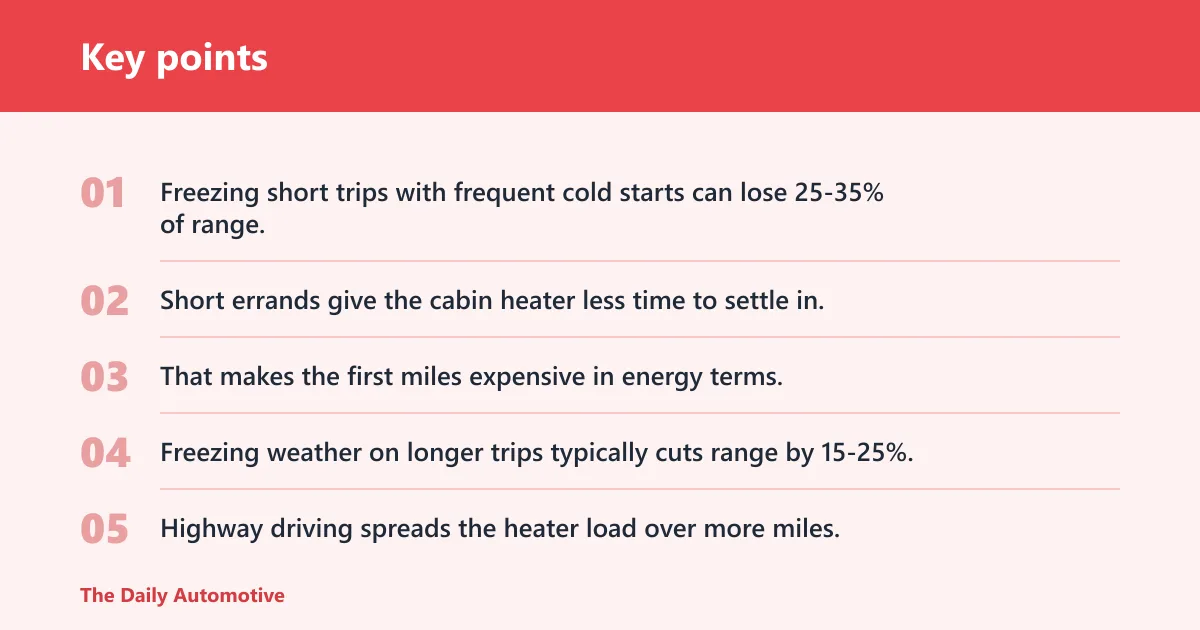
Freezing short trips with frequent cold starts can lose 25-35% of range. Short errands give the cabin heater less time to settle in, and the battery stays cold for longer. That makes the first miles expensive in energy terms.
Freezing weather on longer trips typically cuts range by 15-25%. Highway driving spreads the heater load over more miles, so the penalty is often smaller than on stop-and-go errands. Cool weather around 40-50°F can still cut range by 5-12%.
Extreme cold changes the picture
At 0°F and below, range losses can exceed 30-40%. Heater use and cold chemistry stack together, and the battery may also limit power more aggressively. That is why winter range planning has to be based on conditions, not a single average number.
Suppose a commuter normally uses 25% of a 300-mile EV’s battery for a 75-mile round trip. In a freezing week with a cold start and heavy cabin heat, the same drive can push much closer to one-third of the pack, especially if traffic is slow and the car never fully warms.
Temporary loss is not battery degradation
Winter range loss is usually temporary. It is different from long-term battery degradation, which reduces total capacity over months and years. If range comes back as temperatures rise, the issue was cold-soaked chemistry and energy use, not a permanently damaged pack.
Heat, range, and preconditioning
Preconditioning works best while plugged in, and it is usually scheduled 15-30 minutes before departure. That lets the car warm the cabin and battery using wall power instead of battery energy. It also helps prepare the pack for faster DC fast charging.
Use seat heat before blasting cabin heat
Seat heaters are far cheaper electrically than heating the whole cabin. Steering wheel heaters help too. If you only need to keep occupants comfortable, those localized heaters can trim the need for a 3-7 kW cabin load and preserve more range.
When a heat pump helps most
Heat pumps make the biggest difference in moderate cold, where they can narrow winter range loss by about 10 percentage points. In milder winter weather, they are often the most efficient way to heat the cabin. In extreme cold, their advantage shrinks, so the savings are smaller than many shoppers expect.
Why preconditioning matters most before departure and charging
Preconditioning before departure gets the battery and cabin to a better starting point, so the first miles do not spend so much energy on warmup. Preconditioning before DC fast charging matters for a different reason: a warmer pack accepts power faster and avoids the sluggish cold-battery phase.
Winter range recovery checklist
This checklist puts the biggest winter fixes in the order that usually matters most. Use it to decide what to do before a commute, before a road trip, or before a fast charge.
| Condition | Likely range penalty | Best fix | Works before departure | Works while driving | Works before a fast charge |
|---|---|---|---|---|---|
| Short trips | 25-35% | Precondition while plugged in; use seat and wheel heaters instead of full cabin heat | Yes | Yes | Sometimes |
| Highway trips | 15-25% | Precondition, keep speeds steady, and limit high cabin setpoints | Yes | Yes | Yes |
| Extreme cold | 35-40% | Preheat the battery, expect slower regen, and plan a larger charging buffer | Yes | Partly | Yes |
| No heat pump | Higher cabin-heating penalty | Lean harder on seat heaters and preconditioning | Yes | Yes | Sometimes |
| Heat pump | Smaller penalty in moderate cold | Use the heat pump, but do not expect full efficiency in deep cold | Yes | Yes | Sometimes |
| DC fast charging | Longer charging time when the pack is cold | Navigate to the charger so the car can precondition the battery | No | No | Yes |
Can you drive farther by changing habits?
Yes. Speed, heat use, tire setup, and braking feel all matter more in winter than many drivers expect. The easiest gains come from reducing cabin heat demand, keeping speeds sensible, and using the car’s winter systems the right way.
Speed matters more than people think
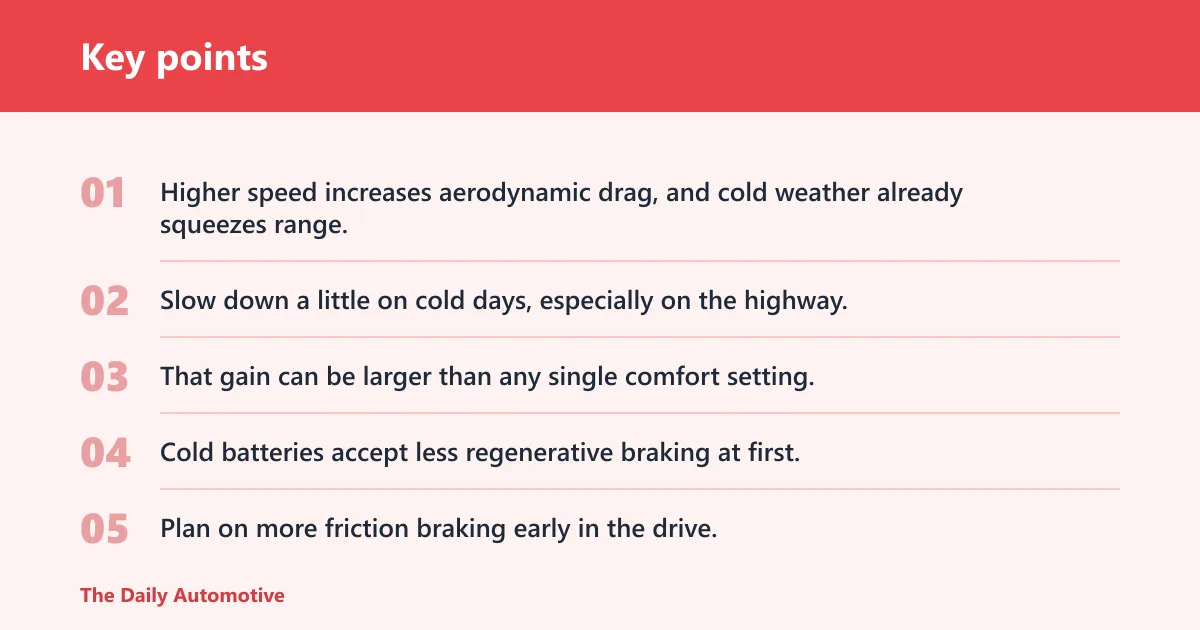
Higher speed increases aerodynamic drag, and cold weather already squeezes range. Slow down a little on cold days, especially on the highway, and the battery will often last much farther than a same-speed summer drive. That gain can be larger than any single comfort setting.
Use regen carefully
Cold batteries accept less regenerative braking at first, so the pedal feel may change until the pack warms. Plan on more friction braking early in the drive. Once the battery reaches a better temperature, one-pedal driving usually feels normal again.
Check tire type and pressure
Winter tires are the right choice for snow and ice, but they do add rolling resistance compared with summer or all-season tires. Cold air also lowers tire pressure, which can raise rolling resistance further. Check pressure when the tires are cold and set it to the vehicle placard.
A common first-timer mistake is thinking a winter tire set caused a sudden range failure. In many cases, the real change is a mix of colder air, colder pavement, lower tire pressure, and heavier cabin heat use.
Why cold batteries charge slower
Cold batteries accept charge more slowly, so DC fast charging can take longer in winter even when the charger itself is working normally. Navigation-based preconditioning helps by warming the pack before arrival. In the coldest conditions, 20% to 80% charging can roughly double in time.
What happens at the charger
If the battery is cold, the car may limit charging power to protect the cells and bring them up to temperature gradually. That is why a winter stop can start slowly and then improve as the pack warms. The charger is not necessarily the bottleneck.
Why the route planner matters
Many EVs can precondition the battery automatically when you set a fast charger as the destination. Use that feature whenever the battery starts cold. A warm pack is the difference between a short stop and a frustratingly long one.
How much extra buffer should you plan?
Plan buffer around the specific trip, not a fixed percentage. Daily commutes usually need a smaller cushion than road trips, but both should account for temperature, wind, speed, heater use, and charging access. Cold-weather planning is about margin, not guessing.
Daily commuting buffer
For a commute, leave enough battery for the coldest part of the drive plus any side trips. If the route is short and the car starts unplugged, assume the first miles will be the least efficient. A buffer that feels unnecessary in summer can disappear quickly in freezing weather.
Road-trip buffer
For winter road trips, add more margin than usual and plan charging stops sooner than you would in mild weather. If a route normally fits with one fast charge, winter may make two shorter stops the smarter choice. That is especially true when chargers are sparse.
When to charge more often
Charge more often when the weather is near or below freezing, when the route includes strong headwinds, or when your car lacks a heat pump. The goal is simple: avoid arriving at a charger with a cold, low battery and too little reserve for detours or delays.
Frequently asked questions
Why do electric cars have less range in winter?
Cold weather slows lithium-ion battery chemistry, raises internal resistance, and forces the car to spend more energy on cabin heating. Regenerative braking is also weaker at first. Those losses are usually temporary, and they ease as the battery and cabin warm up.
How does cold weather affect EV range?
Cold weather can trim range by roughly 20-30% in freezing conditions, with deeper losses in extreme cold. Short trips usually suffer more than highway trips because the cabin heater and cold battery dominate the energy budget before the car has time to warm.
How much range does an electric car lose in cold weather?
Many EVs lose about 20-30% of range in freezing weather, and extreme cold can push losses to 35-40%.
Does preconditioning really help EV range in winter?
Yes. Preconditioning before departure and before DC fast charging can recover useful winter range by warming the cabin and battery with wall power or by getting the pack ready to accept charge faster. It is most effective when the car starts plugged in.
Should I use seat heaters instead of cabin heat to save range?
Often, yes. Seat heaters and steering wheel heaters use far less electricity than heating the whole cabin, so they are a smart first choice when you want comfort without a large range penalty. That said, they do not replace full cabin heat on long, cold drives.
Why does my EV charge more slowly when it’s cold?
Cold batteries limit charging power until they warm up, so DC fast charging can slow down significantly in winter. Navigation-based preconditioning helps by heating the pack before arrival. In very cold conditions, 20% to 80% charging can roughly double in time.
How much extra buffer should I plan for on winter road trips?
Plan a larger buffer than you would in mild weather, especially if temperatures are near or below freezing. The right margin depends on distance, wind, speed, charging access, and whether the car can precondition. Shorter legs and earlier stops are usually safer in winter.
Products related to this article
Sponsored / affiliate links. As an Amazon Associate I earn from qualifying purchases. I may earn additional commission from eligible campaigns.