How to Transfer a Car Title Step by Step
Transfer a car title by matching the title record to the vehicle and the buyer’s identification, completing the required transfer sections, getting any lien release, paying fees and taxes, and filing with the DMV within your state’s deadline, often about 10 to 30 days. Miss a step and you can face rejected registration, delayed plates, or seller liability for tickets and crashes. This guide lays out the sequence for buying, selling, gifting, or inheriting a vehicle, plus the lien and odometer traps to avoid.
How car title transfer works
A title transfer changes the legal record of who owns the vehicle. The title usually shows the current owner, VIN, sale date, odometer reading, and signatures. Some states also want a separate transfer form, a bill of sale, or a release of liability filed the same day.
The DMV is the state filing office for most U.S. transfers. Paper and electronic titles follow different paths, so verify the process before anyone signs.
Timing matters because delays can block registration and leave the seller on the hook for tolls, tickets, or crash notices tied to the old record. Finish the paperwork right after payment or delivery.
What you’ll need

- The vehicle title
- Buyer and seller full legal names
- Government ID for both parties
- The VIN from the vehicle and title
- Sale date and sale price
- Odometer reading at transfer time
- Bill of sale, if your state uses one
- Lien release, if a lender still has an interest
- Notary acknowledgment, if required in your state
- DMV transfer form, if separate from the title
- Proof of submission or confirmation number
Title transfer decision table
| Scenario | Documents needed | Who signs | Where to file | Common rejection reason |
|---|---|---|---|---|
| Private sale | Title, bill of sale, odometer disclosure, ID | Seller and buyer; any co-owner as required | DMV or state equivalent; in the UK, DVLA | Name mismatch or missing signature |
| Financed car | Title or lender paperwork, lien release, payoff confirmation | Lender and seller, then buyer | DMV after lien release is issued | Unsigned or missing lien release |
| Gift or family transfer | Title, transfer form, gift affidavit if required | Donor and recipient | DMV or DVLA, depending on jurisdiction | Wrong tax form or missing relationship proof |
| Inheritance | Title, death certificate, probate or estate papers | Executor, administrator, or heir as required | DMV or court-directed filing point | Estate paperwork not completed |
| Dealer trade-in | Title and any state transfer form | Seller and dealer representative | Dealer files with DMV in many states | Trade-in title not endorsed correctly |
| Electronic title | 11-digit reference number, ID, transfer request | Current owner and buyer where required | Online or DMV system | Wrong reference number or no access to e-title |
| Missing title | Duplicate title application, ID, possible bill of sale | Current owner | DMV or state equivalent | Duplicate request not accepted before transfer |
How do I transfer title to a car?
Start by checking that the title matches the deal, then complete the transfer section, collect any lien release, and file the paperwork with the DMV. If your state requires a separate form, use that form instead of trying to substitute the bill of sale.
Say your buyer is paying cash for a 2018 sedan. If the title shows the wrong middle initial or a missing lien release, the clerk can reject the packet even when the sale price and odometer are correct. Fix identity errors before mailing anything.
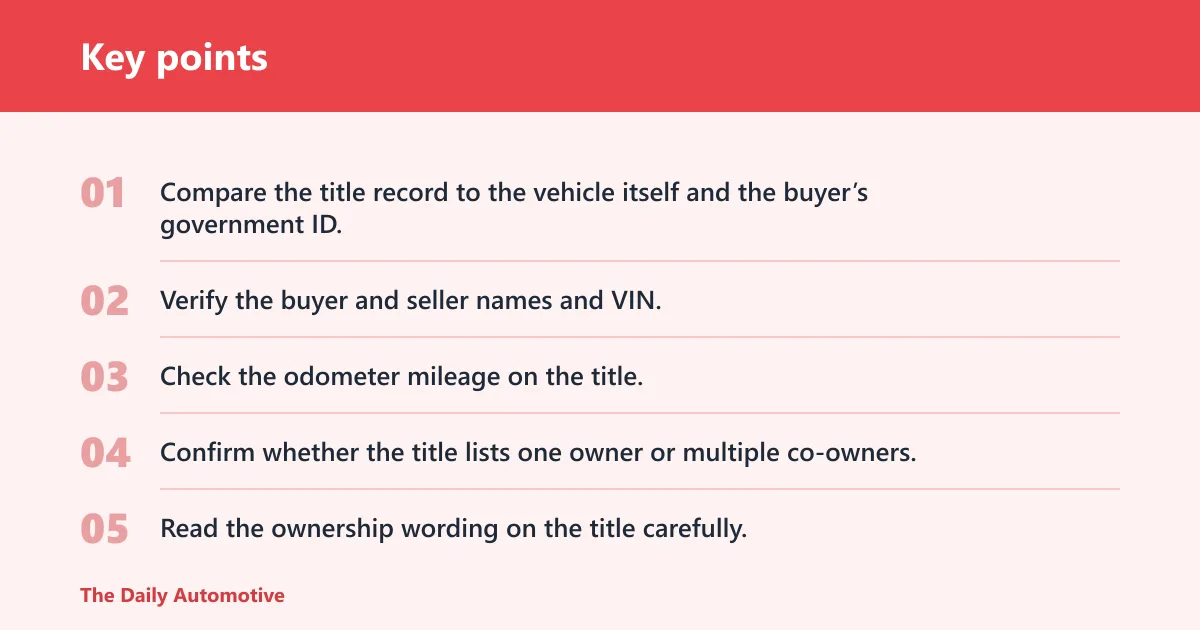
Step 1: Do a title check
- Compare the title record to the vehicle itself and the buyer’s government ID.
- Verify the buyer and seller names and VIN.
- Check the odometer mileage on the title.
- Confirm whether the title lists one owner or multiple co-owners.
Step 2: Handle co-owners correctly
- Read the ownership wording on the title carefully.
- If the names are joined by and, both owners should sign unless your state’s DMV says otherwise.
- If the names are joined by or, one owner may be able to sign in some states.
- Use your state DMV’s instructions when the wording is unclear.
Is there a lien on the car?
If a lender still holds an interest in the vehicle, you usually need a lien release before the title transfer can close. Many transfers stall here because the seller has the payoff amount but not the release that proves the loan is paid off.
The lender may mail the title to the owner or directly to the buyer, depending on the state and payoff timing. Do not assume a payoff receipt is enough. Many DMVs want a formal lien release or a title cleared by the lender.
Step 3: Clear the lien
- Contact the lender and request the exact payoff amount for the account.
- Pay that amount using the method the lender requires.
- Obtain the lien release or the endorsed title from the lender.
- Check that the release names the correct vehicle and VIN.
Complete the transfer form
Fill in the buyer and seller information exactly as it appears on ID. Add the sale date, price, and odometer reading. If your state requires a notary acknowledgment, sign in front of the notary, because some states will reject an otherwise complete title without that verification.
A bill of sale records the sale price, sale date, and both parties’ identities. It supports the transfer record, but it does not replace the title or any state transfer form.
Step 4: Sign in the right place
- Use the signature blocks designated by your state.
- Enter the odometer reading where required.
- Write the sale date and sale price where required.
- Complete notarization if your state demands it.
File it and keep proof
Submit the transfer to the DMV by the deadline your jurisdiction sets. Keep the confirmation, receipt, or posted copy after submission.
Step 5: Save your proof the same day
- Photograph or scan every signed page before mailing.
- File any release of liability the same day if your state allows it.
- Keep the submission receipt, tracking number, or online confirmation.
- Store the bill of sale with your copy of the title record.
Common mistakes

- Unsigned or mismatched names: Use the exact legal names from the title and ID. A one-letter mismatch can stop processing.
- Wrong odometer or sale date: Enter the reading and date once, then recheck before signing. Odometer errors can trigger rejection.
- Skipping state rules: Some states require a notary signature, a transfer form, or same-day release of liability filing.
- Missing lien release: A payoff receipt is not always enough. Get the lender’s release before filing.
- Waiting too long: Delayed filing can leave the seller exposed to tolls, tickets, or registration problems.
A common first-timer mistake is mailing the title before confirming who must sign. Suppose the title lists two owners joined by and. If only one signs, the DMV may send the packet back and the buyer cannot register the car until the form is corrected.
Prevention: Make copies before anyone hands over the keys. Keep one copy of the signed title, one bill of sale, and one filing confirmation for each side.
Frequently asked questions
How do I transfer title to a vehicle?
Use the title, not just a bill of sale, and complete every required transfer box before filing with the DMV. Match the names and VIN, record the odometer where required, and include any lien release. If your state asks for notarization, do that before submission.
What documents do I need to transfer a car title?
At minimum, you usually need the title, buyer and seller IDs, sale date, sale price, and odometer reading. Many states also want a bill of sale, transfer form, lien release if financed, and notary acknowledgment if required. Check DMV instructions before you start.
What if the title has a lien on it?
Get the payoff amount from the lender, then wait for the lien release or cleared title before filing. A payoff receipt alone may not satisfy the DMV. If the lender mails the title, confirm whether it goes to you or directly to the buyer.
How long does a car title transfer take?
The filing step can be same day, but the full process depends on your state and whether the title is paper, electronic, or liened.
How do I properly transfer a car title?
Do it in this order: confirm ownership, fix any lien issue, enter the odometer and sale details, sign in the right place, then file and keep proof. Do not hand over the vehicle until the paperwork is complete or you risk liability and registration delays.
Products related to this article
Sponsored / affiliate links. As an Amazon Associate I earn from qualifying purchases. I may earn additional commission from eligible campaigns.