Best Selling 5 Is Ethanol Fuel Good for Your Car
E10 is safe for most gasoline cars, but only use E15 if your owner’s manual says yes, and use E85 only in flex-fuel vehicles. Skip that rule and you can lose fuel economy, pay more per mile, or damage fuel-system parts in incompatible cars. This guide explains which ethanol blends fit which vehicles, when mpg loss makes ethanol a poor buy, and how to check your own car.
Quick answer by vehicle type
Modern gasoline cars and E10
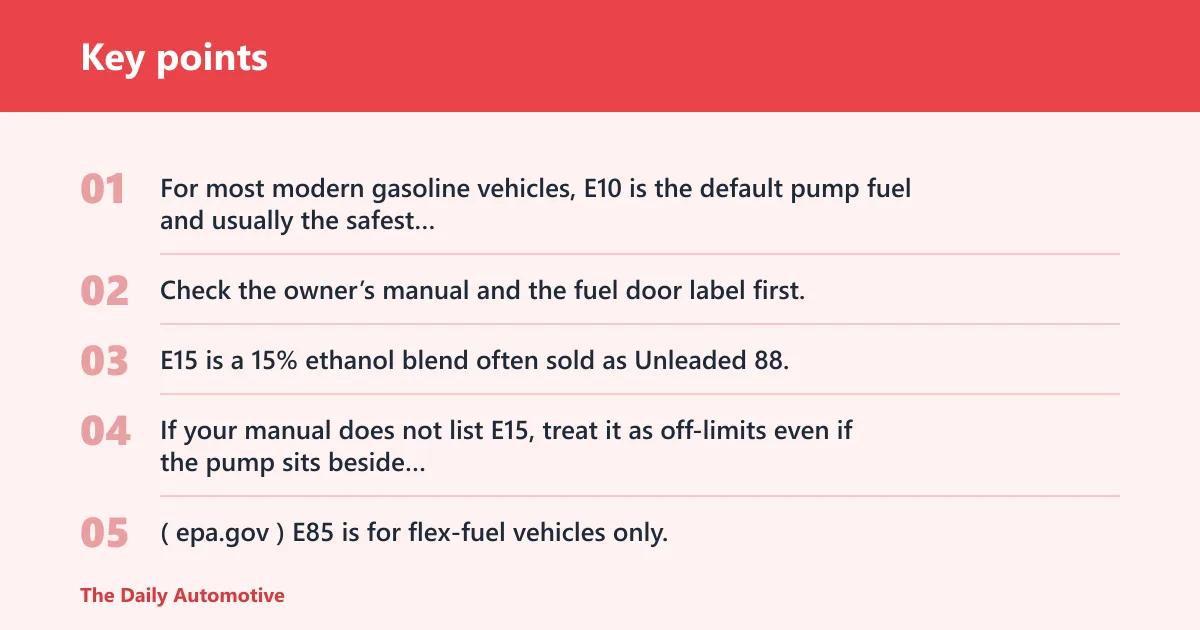
For most modern gasoline vehicles, E10 is the default pump fuel and usually the safest pick. Check the owner’s manual and the fuel door label first, because those labels beat assumptions at the pump. If both approve E10, use it.
2001+ vehicles and E15
E15 is a 15% ethanol blend often sold as Unleaded 88, and it is approved for many 2001 and newer light-duty vehicles. That approval does not cover every vehicle. If your manual does not list E15, treat it as off-limits even if the pump sits beside regular unleaded. (EPA)
Flex-fuel vehicles and E85
E85 is for flex-fuel vehicles only. FFVs are built to handle a wide ethanol range, from pure gasoline to E85, and the car may show a yellow gas cap, an FFV badge, or explicit manual approval. If your vehicle is not marked or listed as flex-fuel, skip E85.
Ethanol fuel decision table
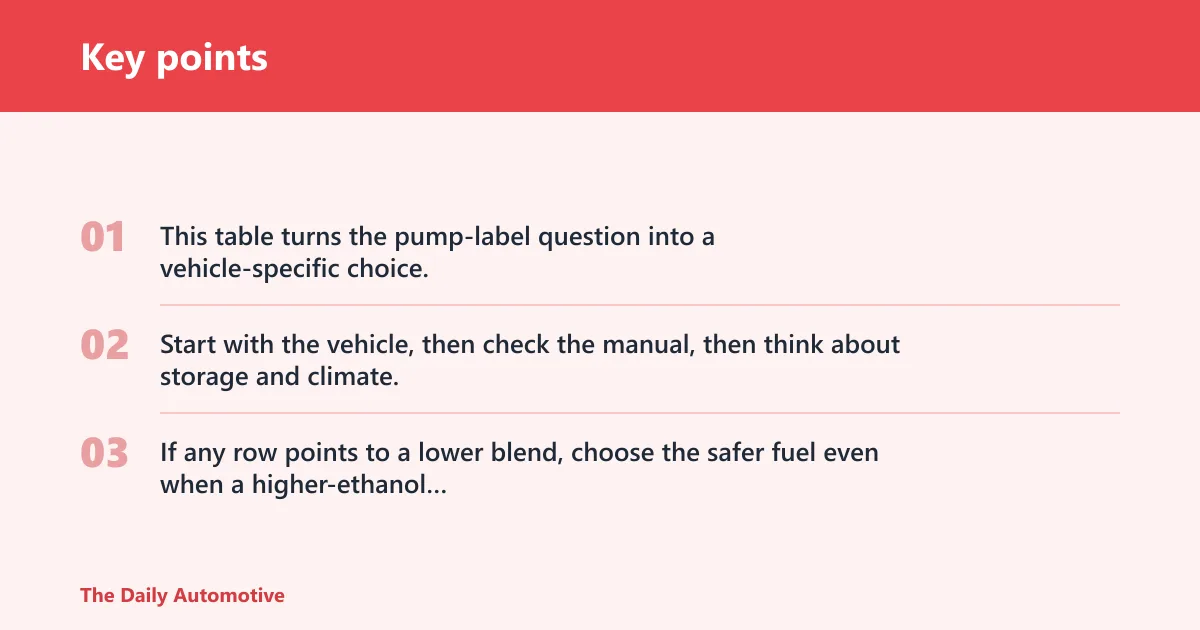
This table turns the pump-label question into a vehicle-specific choice. Start with the vehicle, then check the manual, then think about storage and climate. If any row points to a lower blend, choose the safer fuel even when a higher-ethanol option looks cheaper on the sign.
| Vehicle type | Model year and fuel-system type | Storage pattern and climate | Safest blend to choose |
|---|---|---|---|
| Typical gasoline sedan, crossover, or pickup | 2001 or newer, no flex-fuel label, manual lists E10 only or is silent on E15 | Daily driven, mixed weather, no long storage | E10 |
| Approved light-duty vehicle | 2001 or newer, manual approves E15 | Daily driven, normal humidity | E15 if the manual allows it; otherwise E10 |
| Flex-fuel vehicle | Manual or label confirms FFV approval | Daily driven, no unusual storage | E85 is allowed, but only if the pump price still makes sense per mile |
| Older gasoline car, truck, or motorcycle-style fuel system | Pre-modern seals, carburetors, rubber hoses, or a manual that does not mention ethanol blends beyond E10 | Seasonal use, humid climate, or long sits between drives | E10 or ethanol-free gasoline if the manual and local rules allow it |
| Collector, weekend car, or small engine with long storage | Any age, but stored for weeks or months at a time | Humid climate or frequent short starts | E10 only if approved; ethanol-free fuel is often the safer storage choice where available |
Can your car use E10, E15, or E85?
Start with the owner’s manual. Then check the fuel door label. If they conflict, the manual wins. E10 is the broad default for U.S. pump gasoline, E15 needs vehicle approval, and E85 belongs only in flex-fuel vehicles.
How to read the owner’s manual
Go to the fuel section, not the octane section alone. Many manuals list approved ethanol blends in plain language, and that list matters more than the fuel grade on the sign. If the manual says regular unleaded or E10 only, do not assume E15 is acceptable.
What the fuel door label tells you
The fuel door label is meant for quick decisions at the station. If it lists E15 or E85, that approval is part of the vehicle’s design. If it only shows regular unleaded or E10, stay with the lower blend unless the manual says otherwise.
What a flex-fuel badge means
A flex-fuel badge means the engine and fuel system were calibrated for a broad ethanol range. Appearance alone is not enough. Many non-FFVs share body styles with FFVs, so the badge or manual matters more than the model name.
Why ethanol changes fuel economy
Ethanol changes fuel economy because it contains about 33% less energy per gallon than gasoline. Ethanol also has a higher octane rating than many gasoline blends, but octane and fuel economy are separate questions. Higher octane does not cancel the energy loss that shows up at the pump.
Lower energy per gallon
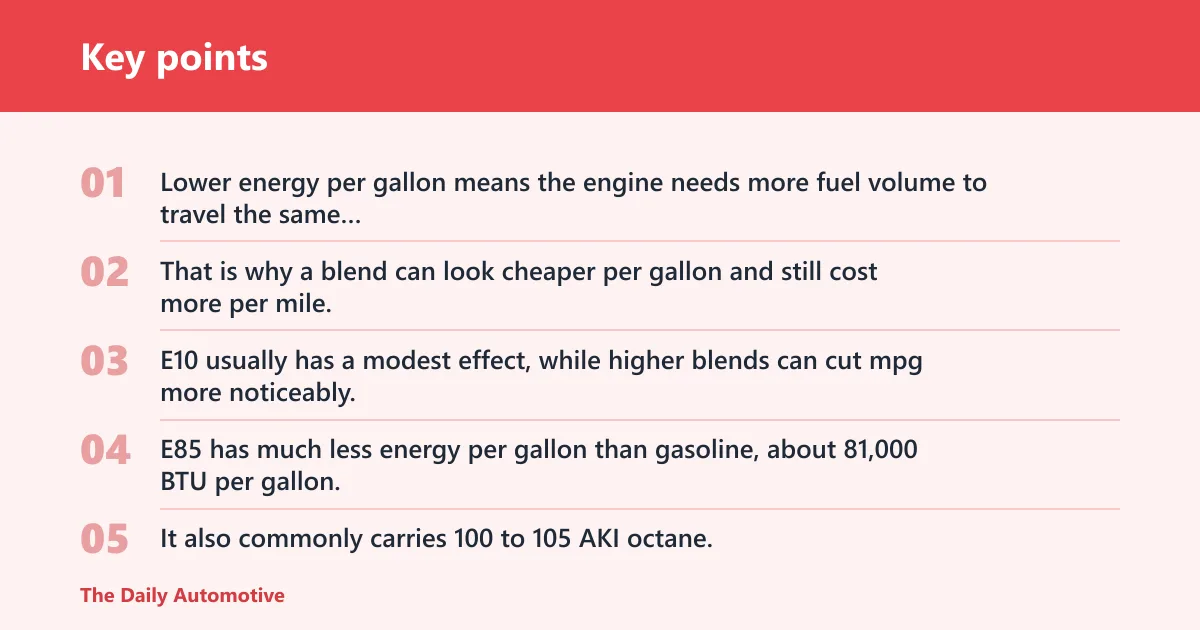
Lower energy per gallon means the engine needs more fuel volume to travel the same distance. That is why a blend can look cheaper per gallon and still cost more per mile. E10 usually has a modest effect, while higher blends can cut mpg more noticeably.
Why E85 usually cuts MPG more
E85 has much less energy per gallon than gasoline, about 81,000 BTU per gallon, and it typically contains 51% to 83% ethanol depending on season and location. It also commonly carries 100 to 105 AKI octane. The octane is high, but the mpg penalty is usually large.
Say your sedan gets 30 mpg on E10. If E85 drops that to 22 mpg, a lower pump price can still lose on cost per mile. At $3.00 per gallon for E10, the fuel costs 10 cents per mile. At $2.20 per gallon for E85, the cost is still about 10 cents per mile, and it can be worse if mpg falls farther.
When a lower pump price still loses
The price sign matters less than the per-mile math. A fuel that is $0.30 to $1.00 less per gallon can still cost more to drive if mpg falls enough. That is why E85 is worth checking only after you compare your vehicle’s actual blend tolerance and the likely mpg drop.
| Blend | Example pump price per gallon | Example mpg | Cost per mile | What the math says |
|---|---|---|---|---|
| E10 | $3.00 | 30 | $0.10 | Baseline for comparison |
| E15 | $2.85 | 29 | About $0.098 | Slightly cheaper per mile in this example |
| E85 | $2.20 | 22 | About $0.10 | The lower gallon price can disappear after mpg loss |
Is ethanol fuel risky for older cars?
Older cars need extra caution. The main concerns are compatibility and aging parts, especially carburetors, rubber hoses, seals, and gaskets. E10 is often tolerated better than higher blends, but storage habits and component condition matter more as the fuel system gets older.
Carburetors and older seals
Carburetors and older soft parts were not always built with modern ethanol exposure in mind. Ethanol can be more corrosive to components not designed for high ethanol content, and it attracts water. That does not mean every older vehicle fails quickly, but it does mean the risk is higher.
Rubber hoses, gaskets, and soft parts
Rubber hoses and seals can harden, swell, or degrade over time if the fuel system was not designed for ethanol-rich fuel. A vehicle that already has aging parts is a bad place to try a higher blend. If the manual does not approve E15 or E85, do not use them as a substitute for maintenance.
Short-trip use and long storage
A common first-time mistake is using a fuel that looks cheap for a car that sits more than it drives. Short trips do not burn off moisture the same way sustained use can, and long storage gives ethanol more time to absorb water. For a weekend classic in a humid garage, that combination raises risk fast.
Storage, moisture, and phase separation
Ethanol attracts water, and that matters most when fuel sits in the tank. Moisture can build during long storage, especially in humid climates, and that raises the chance of fuel quality problems. Phase separation becomes more likely when water content climbs beyond what the blend can handle.
Why humid climates matter
Humidity raises the amount of water a fuel system can absorb over time. A car parked through damp weather, repeated temperature swings, or months of sitting has more exposure than a daily driver. That is why storage risk matters as much as the blend on the pump.
Where fuel stabilizer fits
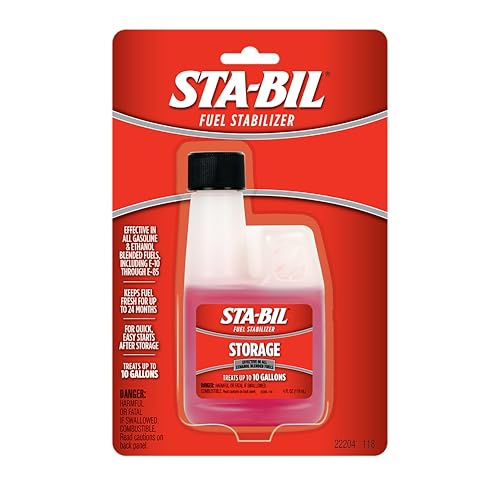
Fuel stabilizer is a storage tool, not a cure-all. It helps when a vehicle sits unused, especially if the tank will hold fuel for weeks or months. Follow the product label and the vehicle manual, but do not use stabilizer to justify ignoring a fuel blend the manual does not approve.
What to do after a wrong-fuel fill-up
If you catch a wrong-fuel fill-up early, stop and do not start the engine if possible. If the vehicle already ran, switch it off as soon as it is safe and follow the owner’s manual, roadside help, or a repair shop’s guidance. The less the wrong fuel circulates, the better.
- Stop fueling as soon as you notice the error.
- Do not start the engine if it has not been started yet.
- Check the owner’s manual for the exact next step.
- If the engine ran, shut it down safely and call roadside help or a repair shop.
- Do not guess at “burning it off” with driving.
Suppose a driver puts E85 into a non-flex-fuel compact car and notices the error before turning the key. Leave the car parked and get help draining or correcting the tank, rather than circulating the wrong blend through the fuel system.
If the mistake happened after a full start and the engine is running roughly, the manual should still guide the next step. Some vehicles may need towing, while others may need fuel removal and a system check. Either way, do not assume it will clear itself.
Frequently asked questions
Is ethanol fuel bad for your car?
Not by itself. E10 is safe for most gasoline cars, E15 is limited to approved vehicles, and E85 belongs only in flex-fuel vehicles. The real question is whether your vehicle, fuel system, and storage habits match the blend. If they do not, ethanol can become a bad fit.
Can my car run on E10 gas?
Most modern gasoline cars can run on E10 because it is the common U.S. pump blend. Still, the owner’s manual and fuel door label should decide the issue, not habit or guesswork. If both list E10 as acceptable, you are on safe ground.
Is E15 safe for my 2001 or newer car?
It may be, but only if the manual approves it. E15 is often sold as Unleaded 88 and is approved for many 2001 and newer light-duty vehicles, not every gasoline vehicle from that era. If the manual does not list it, use E10 instead.
What happens if I put E85 in a regular car?
In a non-flex-fuel car, E85 can cause driveability problems and may strain fuel-system parts that were not built for it. If you catch the mistake before starting, do not start the engine. If it already ran, stop and follow the manual or get roadside help.
Does ethanol reduce gas mileage?
Yes, higher ethanol blends usually reduce mpg because ethanol contains about 33% less energy per gallon than gasoline. The effect is small with E10 and larger with E15 or E85. That is why a cheaper pump price is not proof of lower driving cost.
How do I know if my car is flex-fuel?
Check the owner’s manual, the fuel door label, and any FFV badge or yellow gas cap. A flex-fuel vehicle is designed to handle blends from pure gasoline to E85, but visual cues alone can mislead you. The manual or label is the final check.
Why does ethanol gas go bad in storage?
Ethanol absorbs water, so fuel that sits unused can pick up moisture over time. That matters more in humid climates and in vehicles that are parked for long stretches. The result can be fuel quality problems, especially in tanks and systems that were not meant for high ethanol content.
Will ethanol damage fuel lines or seals?
It can in older or incompatible fuel systems. Rubber hoses, seals, gaskets, and carburetor parts are more vulnerable when they were not designed for higher ethanol content. Modern vehicles built for E10 usually handle it well, but higher blends need explicit approval from the manual.
Products related to this article
Sponsored / affiliate links. As an Amazon Associate I earn from qualifying purchases. I may earn additional commission from eligible campaigns.